
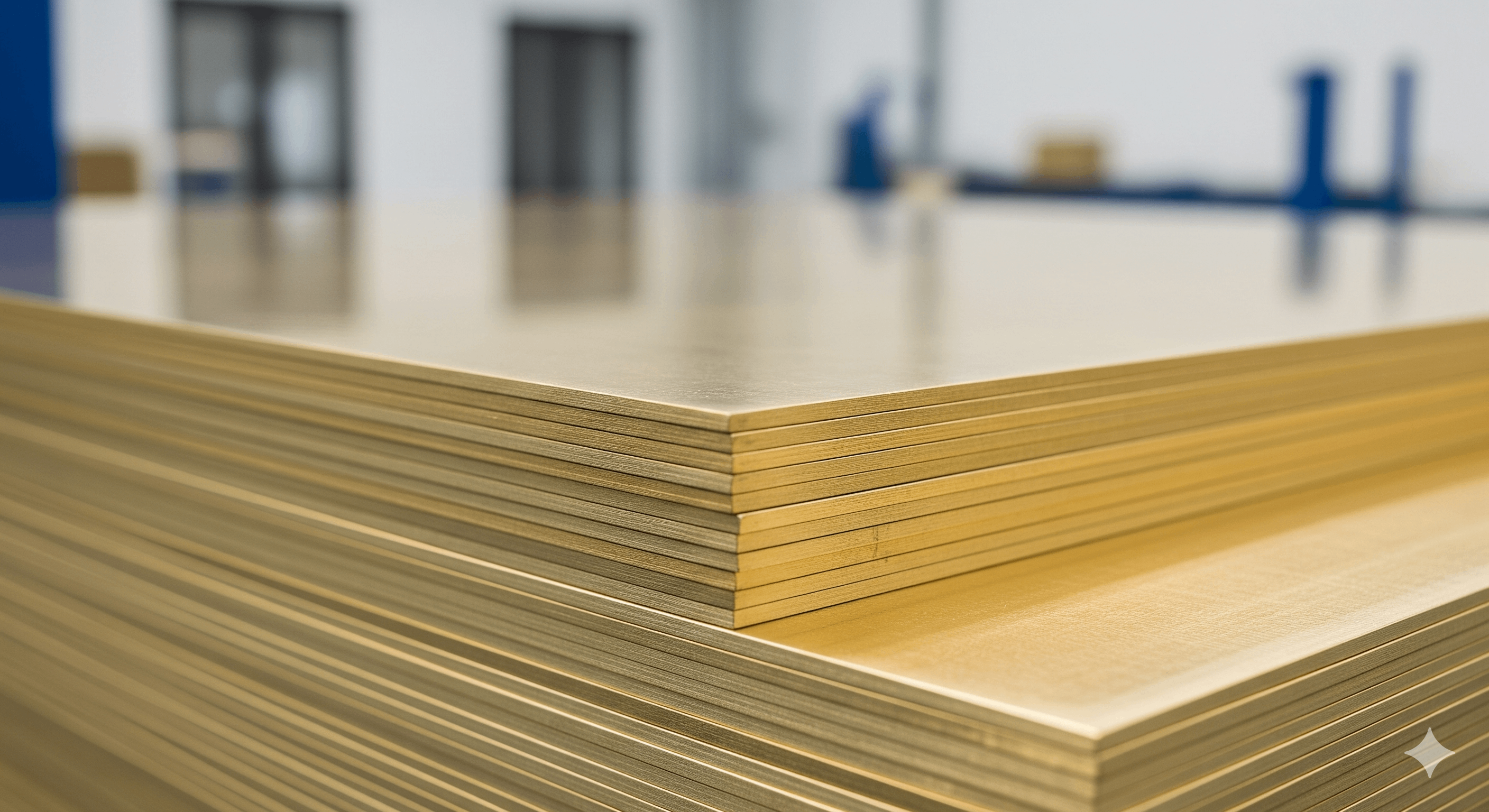
In the landscape of global precision engineering, selecting a brass sheet manufacturer has transcended simple commodity purchasing. For procurement heads managing multi-ton inventories in automotive or energy storage, material integrity is the primary determinant of downstream operational uptime.
Brass is a highly sought-after alloy due to its corrosion resistance, malleability, and superior conductivity, making it suitable for critical infrastructure. However, professional buyers understand that the difference between a successful production run and a costly batch failure lies in variables invisible to the naked eye.
At YISHANG, we move beyond the superficial “price-per-kilogram” metrics to address the root causes of production inefficiency. This audit examines the engineering logic required for industrial excellence, providing wholesale buyers with a roadmap to mitigate risk through 26 years of technical manufacturing expertise.
I. The Metallurgy of Reliability: Beyond Basic Material Knowledge
The foundational quality of any brass sheet is dictated by its metallurgical purity and chemical consistency. While many suppliers claim compliance, the zinc-to-copper ratio often fluctuates in secondary-market alloys, affecting the material’s behavior during complex processes like deep drawing.
For instance, while C26000 (Cartridge Brass) is the standard for precision hardware, C46400 Naval Brass is essential for maritime environments due to its tin content. This specific alloy provides enhanced resistance to dezincification in salt-water, a critical factor when designing offshore junction box NEMA rated systems.
When sourcing electrical enclosure raw material, procurement teams must verify the material inspection certification to ensure low iron (Fe) impurity levels. Excess iron acts as a resistive barrier, compromising the thermal efficiency of an enclosure electrical meter system or a solar battery enclosure.
YISHANG utilizes advanced spectrometer testing to ensure all brass sheets for industrial use meet exact PPM (parts-per-million) thresholds. This rigor ensures RoHS and REACH compliance, which is non-negotiable when exporting high-precision components to European and North American markets.
To assist global sourcing, the following table provides a cross-reference for common industrial brass grades under different international standards such as ASTM B36:
| Grade Name | ASTM (US) | JIS (Japan) | EN (Europe) | Key Characteristic |
|---|---|---|---|---|
| Cartridge Brass | C26000 | C2600 | CuZn30 | Best for deep drawing |
| Naval Brass | C46400 | C4641 | CuZn38Sn1 | Corrosion resistant (Marine) |
| Muntz Metal | C28000 | C2800 | CuZn40 | High strength, hot working |
II. Mechanical Integrity: The Hidden Physics of Thickness Tolerance
In wholesale metal procurement, the “Negative Tolerance Trap” is a significant industry risk. Some suppliers roll the brass sheet to the absolute bottom edge of the allowed thickness to reduce material weight, which compromises the durability of an electrical meter box or a control station enclosure.
If a sheet is consistently 0.05mm thinner than the technical drawing material specifications, it leads to loose tolerances in terminal connectors or structural failure in a galvanized steel enclosure frame. YISHANG adheres to strict micron-level control, ensuring every square meter performs identically.
Precision manufacturing requires a data-driven approach to “Springback”—the tendency of metal to return to its original shape after deformation. If the thickness or hardness temper varies across the batch, the springback rate becomes unpredictable, causing high rejection rates during the assembly of control station enclosures.
The selection of the “Hardness Temper”—ranging from Annealed to Full Hard—must be optimized for the specific bend brass sheet requirements. Selecting a temper that is too hard for the required bend radius leads to “orange peel” textures or tensile fractures on the outer radius of the component.
The mechanical benchmarks YISHANG maintains ensure fabrication success for our global wholesale partners:
| Temper Grade | Tensile Strength (MPa) | Yield Strength (MPa) | Elongation (%) | Hardness (HV) | Primary Industrial Use |
|---|---|---|---|---|---|
| Annealed (O) | 300 – 340 | 100 – 150 | 45% – 60% | 60 – 90 | Deep drawing, heat exchangers |
| 1/4 Hard (H01) | 340 – 410 | 200 – 280 | 30% – 40% | 90 – 110 | Progressive die stamping |
| Half Hard (H02) | 380 – 460 | 280 – 370 | 20% – 30% | 110 – 150 | Connectors, switch components |
| Full Hard (H04) | 500 – 580 | 430 – 520 | 3% – 8% | 150 – 190 | Springs, structural plates |
III. Fabrication Dynamics: From 3D Design to Fiber Laser Precision
The interaction between raw material and fabrication equipment is where the grain structure of the brass sheet becomes paramount. Every cold-rolled sheet has a rolling texture that dictates how to bend brass sheet components without causing structural fractures or mechanical failure.
In the construction of high-performance enclosures, such as a solar battery enclosure, the grain direction must be perpendicular to the bend line. This engineering nuance ensures that the enclosure push button interface and structural walls maintain integrity under internal pressure.
Advanced 3D design electrical enclosure workflows allow YISHANG to optimize the nesting of parts, significantly reducing scrap rates. By utilizing precision fiber laser technology to cut brass sheet profiles, we maintain tolerances as tight as ±0.05mm, even for complex geometry.
When operators align the laser along the marked line, they must manage the “Heat Affected Zone” (HAZ). Brass is highly reflective; without proper reflectivity management, back-reflection can damage equipment or leave burrs on the brass surface, requiring expensive secondary deburring.
Proper fiber laser settings ensure a clean edge, vital for a push button enclosure where human interaction is frequent. Eliminating secondary polishing through primary cutting precision directly reduces the overall labor-intensive finishing costs for the wholesale buyer.
To support the procurement audit, YISHANG offers clients the ability to download technical drawing files for their custom orders. This transparency ensures that the material inspection certification aligns perfectly with the initial 3D design and fabrication specifications.
Whether you are sourcing a stainless steel enclosure or a carbon steel enclosure, the logic remains: precision at the start prevents failure at the end. Our ISO 9001 facility ensures that every enclosure aluminum enclosure or brass component is ready for immediate industrial deployment.
IV. Strategic Sourcing: Optimizing Total Cost of Ownership (TCO)
For professional wholesalers, the initial quote is often the least important metric. The true cost is found in the material utilization rate. By offering custom dimensions, such as 500mm 1000mm x 2000 mm sheets, we help clients reduce scrap rates by up to 15% compared to standard stock.
Beyond the physical sheet, the logistics of global shipping to 50+ countries demand specialized surface engineering. Brass sheets find various applications including brewing and distilling, where they are exposed to moisture. Without anti-tarnish passivation, the material arrives oxidized.
YISHANG applies a microscopic chemical barrier that prevents oxidation during maritime transit. This ensures that when the sheet reaches your facility, it maintains its acoustic properties and aesthetic appeal, eliminating the need for costly post-delivery chemical cleaning or rework.
Compliance and traceability have also evolved into critical business imperatives. Global supply chains now demand full transparency through Mill Test Reports (MTRs) and material inspection certification. This protects the buyer against legal risks and recall liabilities in the medical and automotive sectors.
Our raw material knowledge center is always available to help you navigate the complexities of material selection. Whether it is a carbon steel enclosure carbon or a high-purity brass junction box, YISHANG provides the expertise needed to streamline your procurement supply chain.
Ultimately, the goal of this audit is to shift the conversation from “Price per Piece” to “Performance per Batch.” High-quality brass sheets include specific mechanical properties that ensure longevity in the construction of critical electrical enclosure infrastructure.
V. Technical FAQ: Solving Critical Procurement Challenges
Q: Why is the grain size important for deep drawing applications?
If the grain size on the brass sheet is too large, it creates a rough “orange peel” texture during forming. If it is too small, the material becomes brittle. YISHANG controls the annealing process to ensure the grain is optimized for your specific stamping needs.
Q: How does C46400 naval brass differ from standard architectural brass?
Naval brass contains tin, which specifically prevents dezincification in salt-water environments. It is utilized in the manufacturing of marine hardware and offshore electrical enclosures where standard alloys would fail prematurely due to corrosion and stress.
Q: Can YISHANG provide 3D design support for custom enclosure projects?
Yes, our engineering team specializes in 3D design electrical enclosure development. We provide technical drawings and prototypes to ensure that the assembly of your push button enclosure or electrical meter box is flawless before mass production begins.
Q: What surface finishes are available for architectural brass sheets?
We offer a range of finishes from No.8 Mirror Polish to Satin Brushed. All aesthetic sheets can be treated with PVD coatings or clear lacquers to maintain their visual appeal and detailing in high-traffic commercial environments.
If you are ready to optimize your supply chain with precision-engineered brass components, YISHANG is here to support your next project. Our team is ready to provide the technical drawings and certifications you need for a successful industrial audit.
Send Inquiry Now to receive a customized technical proposal and material data sheet for your wholesale requirements.