
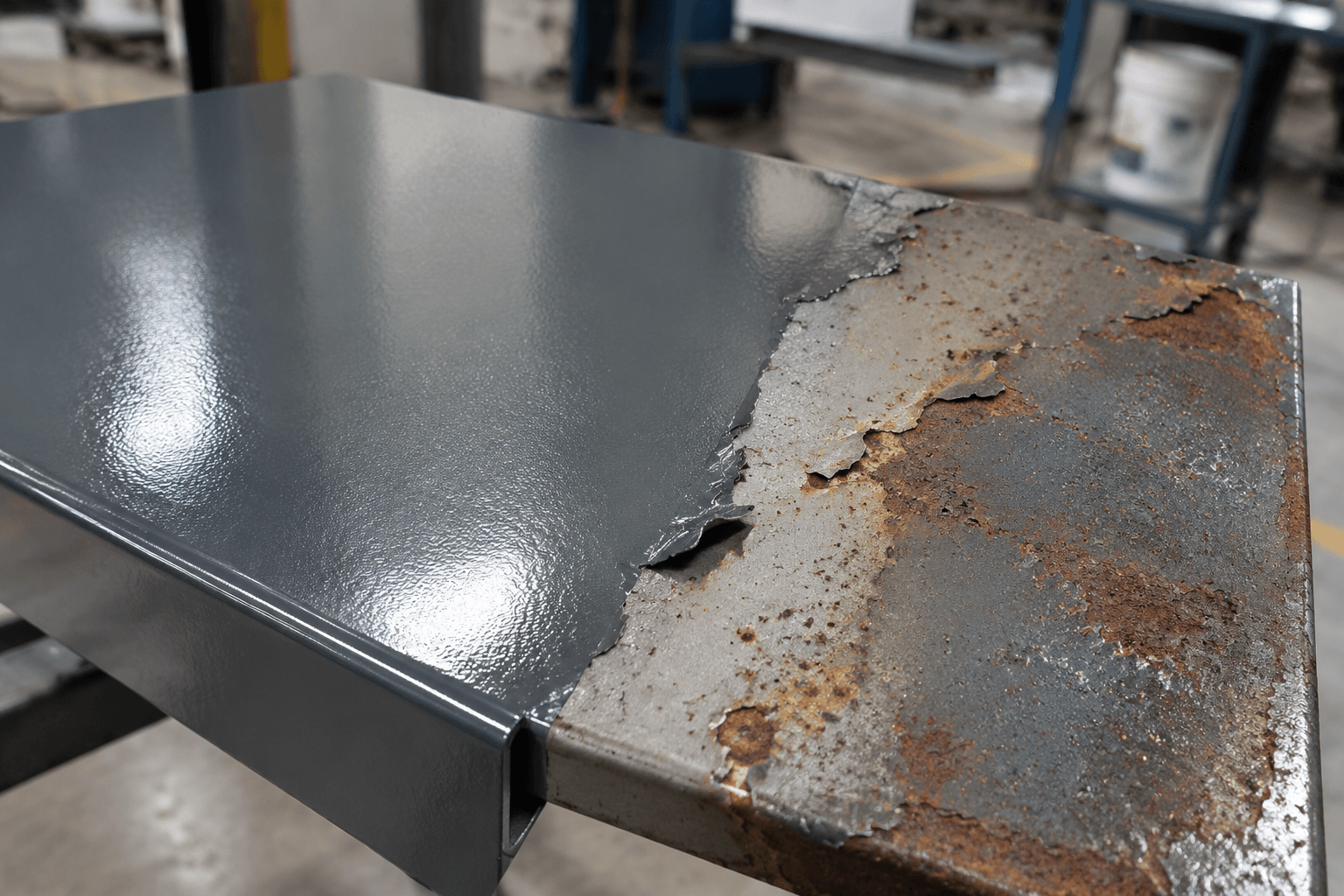
Yes, spray paint can stick to powder-coated metal if the existing coating is sound, clean, uniformly abraded, and compatible with the new paint system. It should not be applied directly over peeling powder coat, active corrosion, oily contamination, or an unknown finish without first preparing and testing a small area.
Successful repainting depends on more than choosing an aerosol labeled for metal. The existing powder chemistry, substrate, surface condition, primer, spray-paint formulation, curing conditions, and final service environment all affect adhesion and durability.
Is the Existing Powder Coat Suitable for Repainting?
Begin by inspecting the entire part, including edges, weld areas, fastener holes, corners, seams, and locations that collect water or cleaning chemicals. A coating can look acceptable across a broad flat surface while already separating around damaged edges.
A sound powder coat is generally firmly attached, free from active corrosion, and stable when cleaned or lightly rubbed. Small scratches or isolated exposed-metal areas may be repairable. Widespread peeling, bubbling, cracking, or corrosion indicates that the old coating is no longer a reliable base.
| Observed condition | Likely decision | Reason |
|---|---|---|
| Intact but glossy coating | Clean, abrade, and test | The low-profile surface may need controlled abrasion before another coating can bond. |
| Grease, wax, silicone, or cleaning residue | Remove contamination before abrasion | Sanding a contaminated surface can spread or embed residue. |
| Light chalking | Clean thoroughly and assess again | Loose oxidation or degraded surface material must not remain beneath the new paint. |
| Isolated scratch with exposed metal | Treat the damaged area using a substrate-compatible system | Bare steel, aluminum, and other substrates may require different preparation or primer. |
| Peeling, bubbling, or broad corrosion | Remove the failed coating and investigate the cause | New paint cannot restore adhesion between an unstable powder layer and the metal. |
Do not assume rust staining is only cosmetic. Determine whether corrosion is coming through a scratch, spreading beneath the coating, or emerging from a seam. Painting over active corrosion can hide the problem temporarily while allowing the underlying failure to continue.
Can You Spray Paint Over Powder Coat? Inspect, Prepare, Test, Then Apply
The preparation sequence should be adjusted to the selected coating manufacturer’s instructions and the condition of the part. The following decision path is suitable for evaluating a small repair or color change, but it does not replace product-specific technical data.
- Confirm that the old coating is stable. Remove loose material and inspect the edges of damaged areas. If the powder coat continues to lift, or corrosion extends underneath it, stop and consider stripping rather than spot painting.
- Remove dirt and grease. Use a cleaner that is compatible with the existing finish and substrate. Test an inconspicuous location if the cleaner could soften, discolor, or stain the surface.
- Eliminate cleaner residue and dry the part. Rinse or wipe as directed for the cleaning product. Pay attention to seams and cavities where water or solvent can remain. The surface must be fully dry before abrasion, priming, or painting.
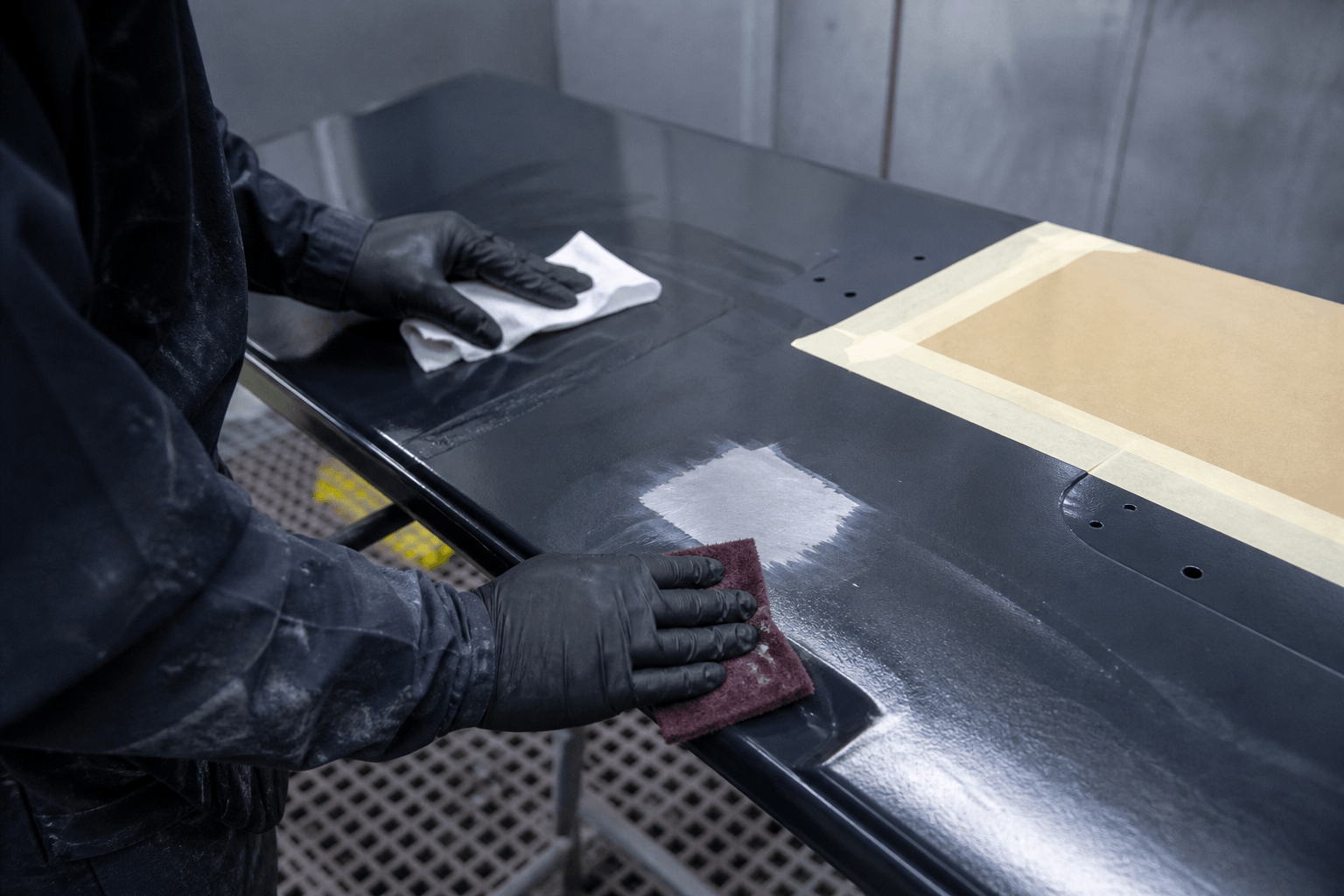
- Abrade the powder coat uniformly. Reduce excessive gloss and create a consistent surface profile without unnecessarily cutting through a sound coating. Abrasive type and grade should suit the paint supplier’s instructions, part geometry, and desired appearance.
- Remove all sanding dust. Use a suitable clean method that does not introduce oil, lint, or incompatible residue. Recheck the surface under good lighting for glossy areas that were missed.
- Address exposed substrate correctly. Feather stable coating edges where appropriate and treat bare metal according to the substrate and paint system. A product intended for steel may not be the correct choice for aluminum, galvanized material, or another metallic surface.
- Mask adjoining surfaces. Protect threads, electrical contacts, labels, grounding points, precision interfaces, seals, and areas where coating thickness could interfere with assembly.
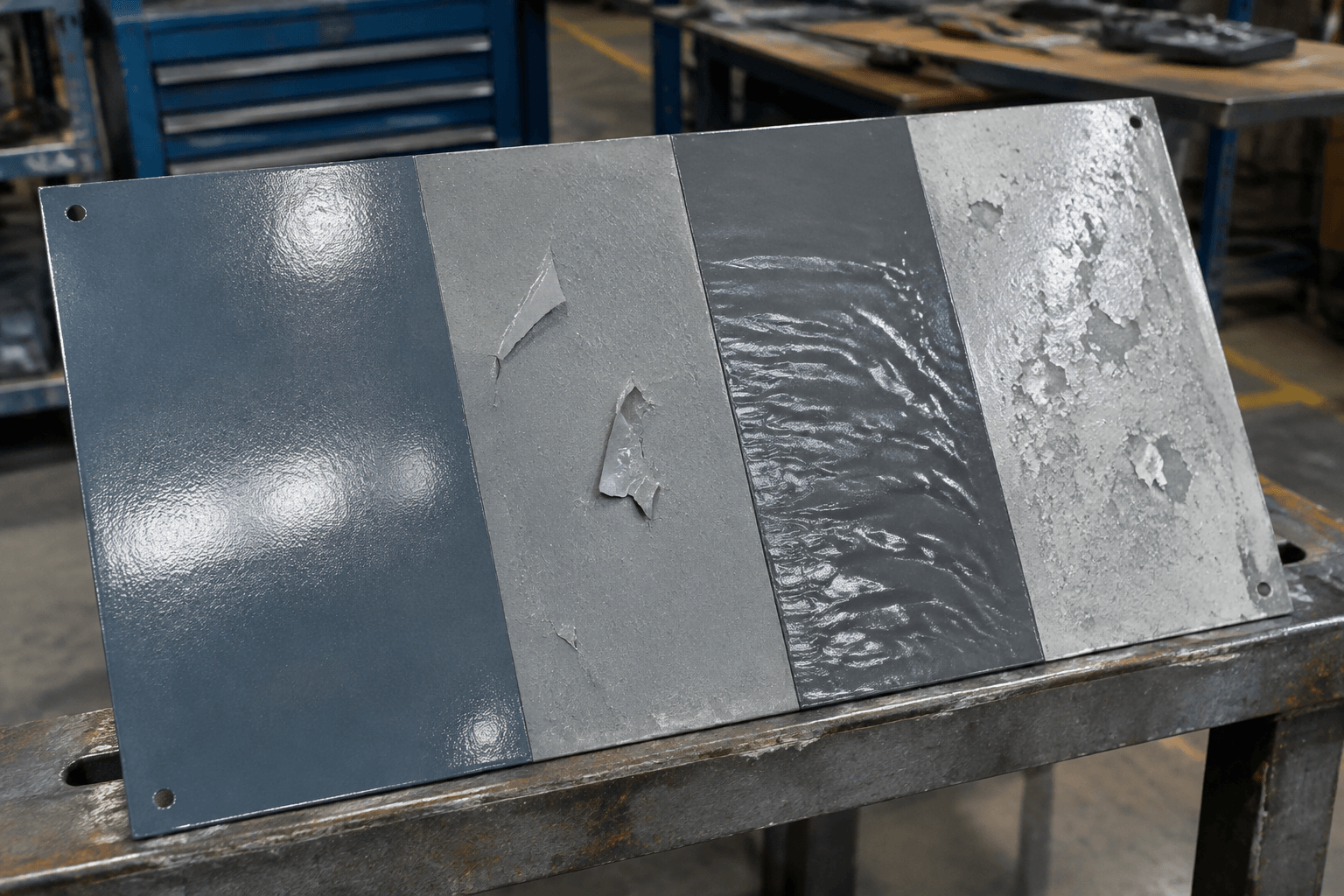
- Test the complete system, then apply under the specified conditions. First use the planned cleaner, abrasion method, primer if required, and paint on a concealed area or representative sample. Allow the test area to cure as directed and check for adverse reactions and poor adhesion before coating the whole part. During full application, follow the selected primer and paint instructions for ventilation, personal protection, temperature, humidity, spray distance, film build, flash time, recoat window, and cure period. Several controlled coats are usually easier to manage than one heavy coat, but the product instructions take priority.
Abrasion dust, solvent vapor, and aerosol overspray require suitable controls. Work in an appropriately ventilated area and follow the safety data, labeling, and local requirements for every cleaner, primer, and topcoat used.
Choosing a Compatible Spray Paint and Primer
There is no universal best spray paint over powder-coated metal. A suitable product must be evaluated against the existing coating, underlying metal, intended exposure, and required finish. If the powder chemistry is unknown, compatibility testing becomes especially important because a new solvent-containing coating may soften, wrinkle, or lift the old surface.
Review the paint manufacturer’s technical data sheet rather than relying only on a general metal-use statement on the front label. Check whether the system is intended for previously coated surfaces and whether it addresses the relevant substrate, indoor or outdoor use, moisture, sunlight, temperature changes, handling, impact, flexibility, and contact with cleaners, fuels, oils, or other chemicals.
Primer is a compatibility decision, not an automatic step. A compatible paint may be approved for a properly abraded, intact coating without a separate primer. Bare substrate may require a specific primer, while an adhesion-promoting or barrier primer may be recommended for another situation. Adding an unverified primer creates another interface that can fail; it does not guarantee adhesion or service life.
Color and gloss should also be judged on the test area. Differences in application angle, film thickness, surface texture, and underlying color can make a spot repair visible even when adhesion is acceptable. An aerosol repair should not be assumed to match the original powder-coated appearance.
When Spray Painting Is Practical—and When It Is Not
Spray painting over a prepared powder coat can be practical for a small cosmetic update, a lightly used indoor item, a prototype, or a localized repair where an exact production finish is not required. Its suitability decreases as appearance and performance demands increase.
- Widespread coating failure: Peeling, broad corrosion, bubbling, and unstable edges normally call for removal of the failed material and correction of the underlying cause.
- Repeated impact or abrasion: Racks, guards, handles, transport equipment, and frequently handled parts can expose a weak bond between coating layers.
- Heat and temperature cycling: Use only a complete coating system specifically rated for the actual operating conditions and substrate. Generic metal spray paint should not be assumed to tolerate heat.
- Moisture, weather, or chemicals: Outdoor exposure, condensation, salt, cleaners, fuels, and solvents can shorten the life of an inadequately specified repair.
- High appearance consistency: Large panels, textured finishes, metallic colors, and high-gloss surfaces can reveal overlap, dry spray, texture changes, and color variation.
For production quantities or demanding service, controlled stripping and refinishing—or manufacturing the new part with a specified coating system—may provide more repeatable preparation, coverage, curing, color, and inspection. This is particularly relevant to automotive parts and transportation equipment with demanding finish exposure.
Food-related use needs separate caution. A generic aerosol must not be treated as suitable for food contact merely because it adheres to metal. Coating location, cleaning chemicals, operating temperature, and product-specific compliance require review when specifying finishes for food and beverage equipment.
For a new OEM part, compare spray painting and powder coating as complete manufacturing finish specifications rather than assuming a field repaint is equivalent to the original finish. Repainting may be easier for a minor change, but it may not reproduce the coverage, texture, durability, or appearance consistency expected from a controlled production process.
Need an application and finish review for a custom metal product? Yishang supports B2B OEM and ODM manufacturing projects and has more than 26 years of custom sheet metal and metal-product manufacturing experience. Share part photos or drawings, the existing coating condition, substrate, intended use, indoor or outdoor exposure, heat, chemical, impact and handling requirements, and the desired color, gloss, and finish consistency. These details help determine whether recoating is reasonable or whether a more controlled manufacturing and finishing route should be specified.
Frequently Asked Questions
What paint sticks to powder-coated metal?
A paint specified as compatible with properly prepared, previously coated metal may work, but no chemistry is universally suitable. Selection should account for the existing powder coat, substrate, abrasion method, primer if required, curing conditions, and exposure. Confirm the choice through the technical data sheet and a test patch.
Can you paint directly over powder coating without primer?
Sometimes, if the powder coat is sound and the paint manufacturer approves application over a cleaned and abraded coating. Primer may instead be necessary for exposed substrate, corrosion protection, or compatibility. It should not be added automatically because an unsuitable primer can introduce another weak interface.
Can consumer aerosol paint such as Rust-Oleum be used over powder coating?
A consumer aerosol may be suitable only if the specific product supports the substrate, prepared existing finish, and intended environment. Brand name alone does not establish compatibility. Follow that product’s current instructions and test for lifting, softening, cure, adhesion, color, and gloss before full application.
What should be done with peeling, chalking, rusty, or scratched powder-coated metal?
Remove loose material and contamination first. Light chalking may be cleanable, while an isolated scratch may allow localized substrate treatment. Peeling, underfilm corrosion, bubbling, or widespread rust usually requires more extensive coating removal and investigation. Do not seal active corrosion or unstable powder beneath new paint.