
There is no universal ranking of the largest metal fabrication companies. Results change with the size metric, geography, business boundary, and reporting year. Group revenue may make a steel producer look larger, while fabricated tonnage may favor a structural steel specialist and fabrication revenue may favor a contract manufacturer.
Quick answer: Publicly documented companies with substantial fabrication-related operations include diversified groups such as Commercial Metals Company, BlueScope Steel, Valmont Industries, and JFE Engineering. More specialized examples include Severfield in structural steel and Mayville Engineering Company in contract manufacturing. These companies do not form a defensible universal ranking because their disclosed figures cover different activities. The comparison below uses fiscal 2024 disclosures and the 2024 or 2025 editions of named US industry sources. It reports original currencies rather than converting unlike figures into a league table.
The figures are a source-qualified market snapshot, not a complete top-10 list. Steel mills, service centers, EPC contractors, structural fabricators, and drawing-based custom manufacturers are separated wherever the available reporting permits.
What Does “Largest” Mean in Metal Fabrication?
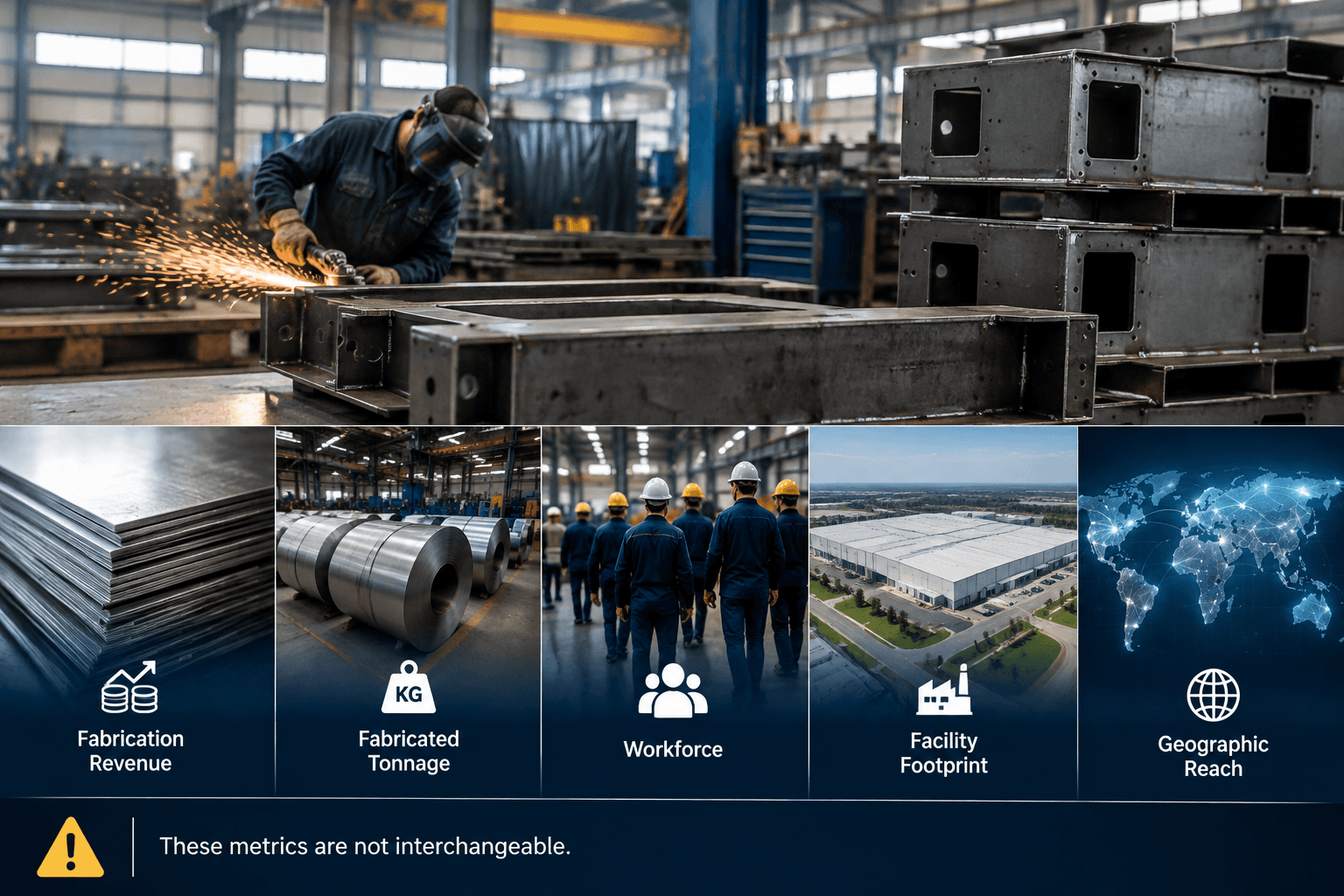
Metal fabrication is not reported as one consistent industry category. Structural steel companies may disclose fabricated tonnage, contract manufacturers commonly report sales, and diversified industrial groups may combine fabrication with steel production, coating, installation, engineering, or construction.
| Size metric | What it indicates | Comparison limit |
|---|---|---|
| Fabrication or segment revenue | Commercial scale of defined operations during a stated fiscal year | The segment may still include engineering, material sales, erection, installation, or services. |
| Group revenue | Total financial scale of a corporation | It can include mills, distribution, construction, agriculture, energy, or other businesses. It is not fabrication revenue unless separately disclosed. |
| Fabricated tonnage | Output scale for a defined structural, plate, or reinforcing-steel category | Heavy structural tonnage is not equivalent to precision sheet metal output or value added per component. |
| Workforce | Organizational scale and operating breadth | Headcount may include mill personnel, engineers, sales teams, construction crews, and employees outside fabrication. |
| Facility footprint | Physical manufacturing presence | Floor area does not establish utilization, automation, throughput, or suitable equipment. |
| Geographic reach | Markets or regions served | International offices do not necessarily represent owned fabrication capacity in every location. |
Public companies generally provide traceable financial statements, but fabrication may sit inside a larger segment. Private businesses often disclose selected capacities without publishing comparable revenue or tonnage. Absence from a public-data table therefore does not establish that a private company is smaller.
Inclusion method for this overview
A company is included in the quantitative tables only when a fiscal 2024 figure can be traced to a company annual report or regulated filing and the company documents substantial fabrication-related operations. The tables label each figure as group-wide or segment-level. US industry sources are included separately when they state their reporting year and measurement basis.
This method intentionally excludes arbitrary ordering. It also prevents total steel-production revenue, distribution sales, and unrelated conglomerate operations from being presented as pure fabrication revenue.
Global Diversified Groups with Fabrication-Related Operations
These organizations have substantial metal-product, downstream, building-system, or engineering operations, but their reported scale extends beyond fabrication. Values remain in the disclosed currencies and are rounded to the precision shown.
| Company | Disclosed metric | Period and source | Business-scope qualification |
|---|---|---|---|
| Commercial Metals Company | Approximately US$7.93 billion in group net sales | Fiscal year ended August 31, 2024; Commercial Metals Company 2024 Form 10-K, Item 8, Consolidated Statements of Earnings | Group-wide figure covering steel production, recycling, downstream products, and fabrication in the United States and Europe. It is not fabrication-only revenue. |
| BlueScope Steel | Approximately A$17.6 billion in group sales revenue | Fiscal year ended June 30, 2024; BlueScope Annual Report 2023/24, consolidated income statement and financial summary | Group-wide figure covering steelmaking, coated products, building products, and building solutions. Only part of the reported revenue relates to fabricated building systems. |
| Valmont Industries | Approximately US$4.08 billion in group net sales | Fiscal year ended December 28, 2024; Valmont Industries 2024 Form 10-K, Item 8, Consolidated Statements of Earnings | Group-wide figure for infrastructure and agriculture operations, including engineered metal products and associated services. |
| JFE Engineering | Approximately ¥539.9 billion in engineering-segment revenue | Fiscal year ended March 31, 2024; JFE Holdings Integrated Report 2024, business-segment data | Segment-level figure and therefore narrower than total JFE group revenue, but the engineering segment still includes project and system activities beyond shop fabrication. |
The table shows why revenue alone cannot identify a universal winner. BlueScope and Commercial Metals Company report large corporate totals, but those totals include primary steel and other operations. JFE’s engineering-segment figure has a narrower boundary, yet it is still not directly comparable with the sales of a fabrication specialist.
Structural and Contract-Manufacturing Specialists
Specialists provide a closer view of fabrication-related scale, although structural steel and contract manufacturing remain different markets.
| Company | Category | Disclosed metric | Period, source, and qualification |
|---|---|---|---|
| Severfield | Structural steel specialist | £463.5 million in revenue | 52 weeks ended March 30, 2024; Severfield Annual Report 2024, consolidated income statement. The business is more closely aligned with structural steel than the diversified groups, but its geographic and project scope remains distinct. |
| Mayville Engineering Company | Contract manufacturing and metal fabrication | Approximately US$588.4 million in net sales | Fiscal year ended December 31, 2024; Mayville Engineering Company 2024 Form 10-K, Item 8, Consolidated Statements of Operations. This figure is more relevant to contract manufacturing than to structural-frame fabrication. |
These figures should not be used to conclude that Mayville Engineering is larger than Severfield in an operational sense. The companies use different currencies and production models. Structural projects, recurring manufactured products, component complexity, erection content, and material throughput create fundamentally different revenue profiles.
A Separate View of Large US Fabricators
Searches for the largest metal fabrication companies in the USA often combine custom contract fabricators with structural steel businesses. US datasets answer different questions, so they should remain separate.
| US comparison group | Metric and data year | Relevant source | Interpretation |
|---|---|---|---|
| Custom contract fabricators | Participating companies’ reported 2024 revenue | The Fabricator FAB 40, 2025 edition | The FAB 40 ranks eligible survey participants under the publication’s rules. It is useful within custom fabrication but is not a census of every US fabricator and does not represent a structural-steel tonnage ranking. |
| Publicly reporting contract manufacturer | Mayville Engineering Company: approximately US$588.4 million in fiscal 2024 net sales | Mayville Engineering Company 2024 Form 10-K | Provides a traceable public-company reference point for contract manufacturing. It should not be compared directly with private-company capacity claims or structural tonnage. |
| Structural steel contractors | 2023 specialty-contracting revenue in the 2024 edition | Engineering News-Record Top 600 Specialty Contractors, 2024 edition | Revenue may include erection, construction, and field services. It is not necessarily shop-fabrication revenue. |
| Structural steel facilities | Certification status and facility information; directory accessed September 11, 2026 | AISC certified fabricator directory | The directory can confirm facilities listed within defined certification programs, but it does not rank companies by revenue, tonnage, workforce, or plant area. |
| Diversified downstream steel organizations | Group or segment financial results for fiscal 2024 | Company annual reports and regulated filings | Companies such as Commercial Metals Company participate in downstream fabrication, but consolidated revenue includes substantially more than fabrication. |
Names encountered in US structural steel research include Schuff Steel, W&W|AFCO Steel, Banker Steel, and SME Steel. Their presence in industry directories or project markets should not be converted into a current top-ten order without a common-year dataset showing comparable structural tonnage or fabrication revenue.
Nucor presents another boundary issue. It is primarily a steel producer with downstream operations that include fabricated steel products. Total Nucor revenue or steel output would describe the scale of the broader corporation, not fabrication alone.
How the Company Categories Differ
A diversified metal group may operate mills, coating lines, distribution centers, product factories, and construction divisions. Its corporate scale may support extensive supply networks, but consolidated revenue does not disclose the capacity available for a particular fabricated assembly.
A structural steel specialist primarily produces members and connection assemblies for buildings or infrastructure. Tonnage can be informative when companies report the same product category, year, and operating boundary. Comparisons still need to state whether the figure covers one plant, an entire network, or production completed through partnerships.
A custom product manufacturer converts drawings and bills of materials into components or finished products such as enclosures, frames, cabinets, panels, guards, and vehicle parts. Its output may combine sheet metal fabrication, welding, purchased hardware, finishing, and assembly. CNC machining and CNC turning can supply parts for these assemblies, but they remain distinct manufacturing categories.
Steel mills produce primary or semi-finished forms such as coil, plate, bar, and structural sections. Service centers commonly stock, slit, level, saw, process, or distribute those materials. Some mills and service centers own value-added operations, but steel output and distribution revenue cannot automatically be counted as fabricated-product capacity.
Company Scale Does Not Equal Project Fit
For an airport, stadium, or infrastructure project involving substantial structural members and field erection, a structural steel organization with suitable engineering coordination, heavy handling, and site resources may be relevant. A precision sheet metal contract manufacturer belongs to a different production category.
For an OEM requiring recurring batches of formed covers, welded frames, finished cabinets, and assembled hardware, drawing-based contract manufacturing is the more relevant model. Group revenue and structural tonnage reveal little about compatibility with the component mix, batch pattern, finishing route, assembly content, or supply geography.
The practical next step is therefore to move from market size to the applicable manufacturing category. To continue that research, explore application-specific fabrication for automotive and transportation equipment or see custom metal manufacturing considerations for material handling and logistics equipment. These application pages address defined product categories without implying that corporate size alone determines fit.
Where RFQ Assumptions Create Cost and Production Risk
Many sheet metal fabrication problems begin before production starts. If drawings, tolerances, finish expectations, material grades, or assembly requirements are unclear, suppliers may quote based on different assumptions. That can make prices difficult to compare and may lead to rework, cosmetic rejection, assembly misalignment, or production delays later.
For OEM buyers, the goal is not simply to request the lowest price. The goal is to make sure each supplier is quoting the same manufacturing reality. Before confirming an order, clarify which dimensions are fit-critical, which surfaces are cosmetic, whether prototypes must match batch-production conditions, and how finished parts will be inspected.
Frequently Asked Questions
What largest metal fabrication companies details should buyers define before requesting a quote?
Buyers should define the functional requirement, drawing notes, critical dimensions, material or process expectations, and any inspection points related to largest metal fabrication companies. This helps suppliers quote the same manufacturing scope instead of making different assumptions.
How can RFQ details affect cost, fit, or lead time?
RFQ details can change tooling, forming, welding, finishing, inspection, or rework requirements. If buyers do not clarify it early, two supplier quotes may look comparable while covering different production risks.
Why should drawing requirements be reviewed before prototype approval?
drawing requirements may look acceptable on a single sample but become harder to control during batch production. Buyers should confirm whether the prototype reflects the same process, finish, and inspection conditions expected for production.
What inspection points matter most for largest metal fabrication companies projects?
Important inspection points usually include fit-critical dimensions, holes or mating areas, cosmetic surfaces, finish build-up, welded or formed features, and any dimensions that affect downstream assembly. These points should appear in the RFQ or drawing notes.
How can buyers reduce prototype approval risk before batch production?
Buyers can reduce risk by clarifying drawings, locking key material and finish assumptions, defining inspection timing, approving a representative sample, and confirming which dimensions or surfaces require tighter process control.
How can Yishang help review largest metal fabrication companies requirements?
Yishang can review drawings, RFQ notes, material requirements, tolerance expectations, finish details, samples, and assembly needs to identify unclear assumptions before quoting or batch production.