
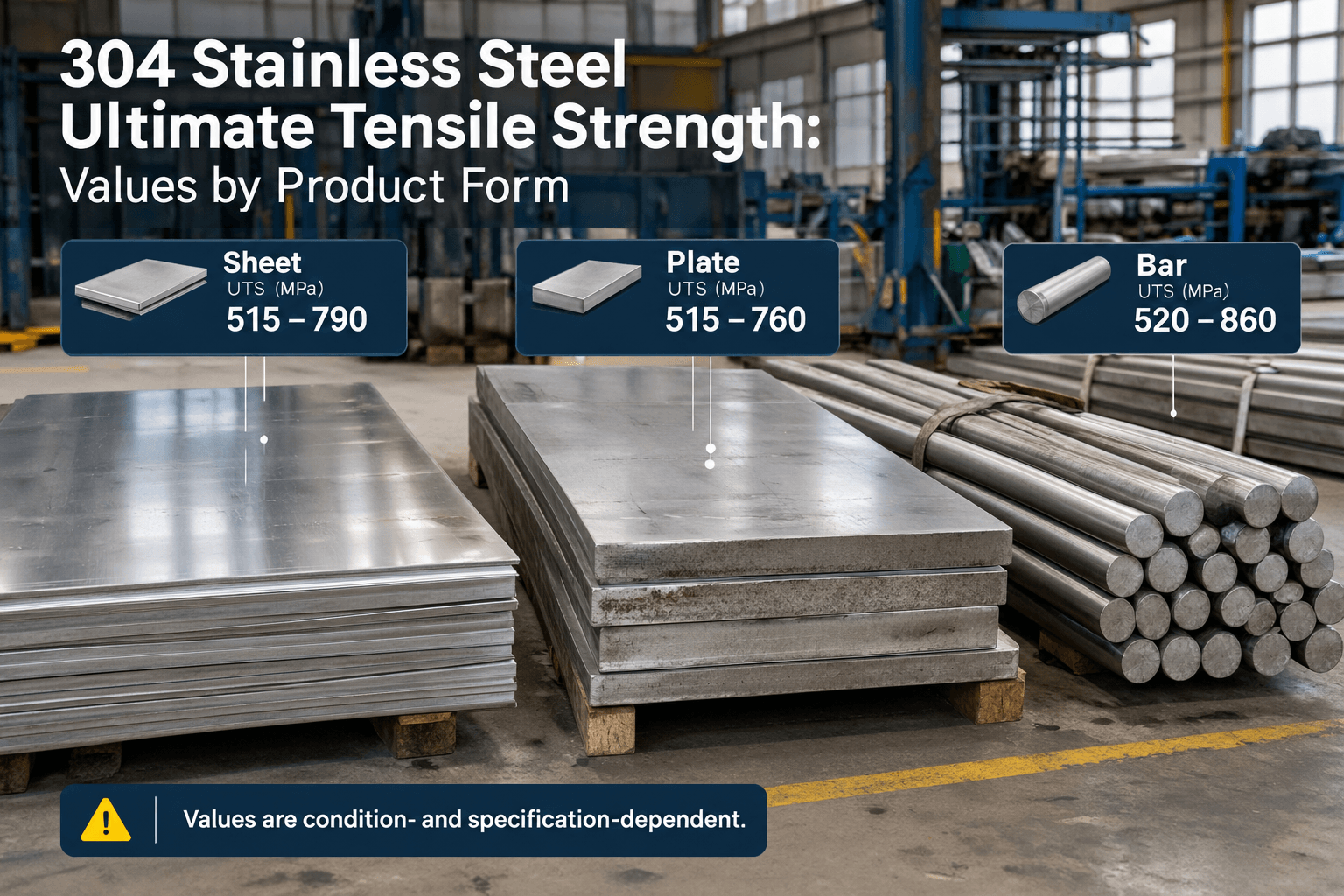
304 stainless steel ultimate tensile strength is typically approximately 500–750 MPa, but that range is not a universal value for every 304 product. The applicable figure depends on the product form, thickness or diameter, material condition, manufacturing history, grade variant, governing material or product specification, and tensile-test basis. The range below should therefore be treated as typical reference data, not automatically as a guaranteed minimum.
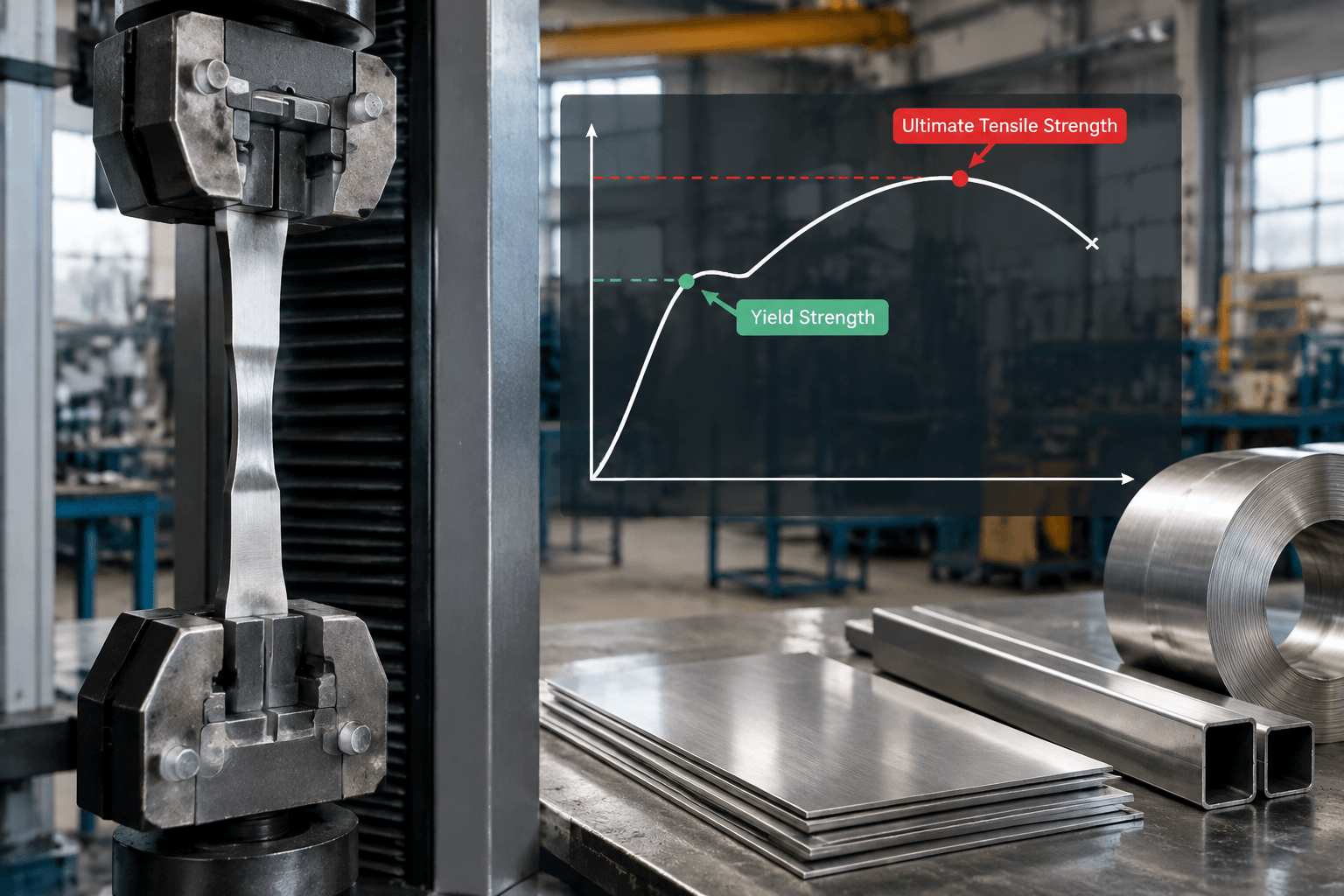
For material selection, ultimate tensile strength (UTS) is the highest engineering stress reached during a tensile test before the specimen fractures. It is different from yield strength, which describes the stress at which the material begins to undergo defined permanent deformation. A material can have a useful UTS while still requiring a separate yield-strength value for design and specification review.
304 Tensile Strength by Product Form
The following supplied ranges separate 304 stainless steel by product form and thickness. The thickness boundaries are contextual ranges for interpreting the supplied data; they should not be treated as universal classification rules for every supplier or specification.
| Product form | Contextual thickness or size range | Typical UTS reference | Yield-strength reference |
|---|---|---|---|
| Sheet | Up to 8 mm | Approximately 540–750 MPa | Verify against the applicable specification; no single supplied range applies universally |
| Plate | Approximately 8–75 mm | Approximately 520–720 MPa | Verify against the applicable specification; no single supplied range applies universally |
| Bars or sections | Product dimensions and section type vary | Approximately 500–700 MPa | Verify against the applicable specification; no single supplied range applies universally |
These ranges overlap because 304 stainless steel is not supplied as one identical material condition. A published sheet value should not be transferred automatically to a plate, bar, or machined component. Likewise, a value near the top of a typical range should not be presented as a required minimum unless the governing specification explicitly requires it.
How to read the comparison
Suppose a data sheet reports 620 MPa for a 304 sheet product. That number may be useful as a typical observed value if the product form, thickness, condition, and test basis match the intended material. It does not establish the minimum UTS for every 304 sheet, and it does not establish the applicable value for a 304 bar or plate.
A second source might report a lower or higher value without either source being incorrect. The sources may be describing different forms, thicknesses, conditions, or acceptance requirements. Before comparing figures, record whether each number is typical data, a specified minimum, or a result from a particular tested lot.
Why Published 304 Values Differ
Product form and thickness: Sheet, plate, bars, and sections can have different processing histories and different property requirements. Thickness also affects how the material is processed and which product requirements apply. This is why the supplied sheet, plate, and bar ranges should remain separate during technical review.
Annealed or cold-worked condition: A material supplied in an annealed condition may have different tensile properties from material that has undergone cold work. Rolling, drawing, forming, straightening, or other deformation can change the reported strength. The amount and direction of deformation matter, so a generic statement that cold work produces one fixed UTS is not appropriate.
Manufacturing history and grain structure: Prior processing can influence the material structure and the measured result. Product route, reductions, forming history, and grain structure may contribute to differences between otherwise similar-looking 304 products. These factors are reasons to review product-specific documentation rather than select a value from a broad alloy description alone.
Test condition and reporting basis: Tensile results depend on how the test was conducted and reported. The governing material or product specification and the applicable test method should accompany any quoted value. Without that information, two numerical values may not be directly comparable even when both are labeled 304 stainless steel.
304, 304L, 304H, and Other Grade Comparisons
304 versus 304L and 304H
304L and 304H should receive a separate property-data review rather than being assumed to have exactly the same tensile-strength requirements as standard 304. The grade variant, product form, condition, thickness, and governing specification all need to match before the values can be compared. A material certificate or product document may identify the variant and its applicable requirements, but the required documentation should be confirmed for the purchase.
304 versus 316
Comparing 304 with 316 requires more than asking which grade has the higher UTS. The relevant comparison should match product form, thickness, condition, specification, and test basis. Grade selection may also depend on corrosion environment and other service requirements, so tensile strength alone does not determine whether 304 or 316 is appropriate.
304 versus grade 8
“Grade 8” normally identifies a fastener-grade classification, while 304 identifies an austenitic stainless-steel grade. They are not equivalent labels for the same type of material product. A meaningful comparison would require the specific fastener classification, product form, property requirements, and intended application. An unsupported numerical comparison between generic 304 stainless steel and grade 8 fasteners should be avoided.
Machining and magnetic response
For a machined 304 component, the material property review still begins with the supplied bar, plate, or other stock form. Custom CNC machining from first sample to repeat production is a downstream manufacturing consideration and does not change the definition of UTS. Cold work can also affect magnetic response, but that response should not be used as a substitute for material identification or tensile documentation.
Specification Inputs Before Relying on a 304 Value
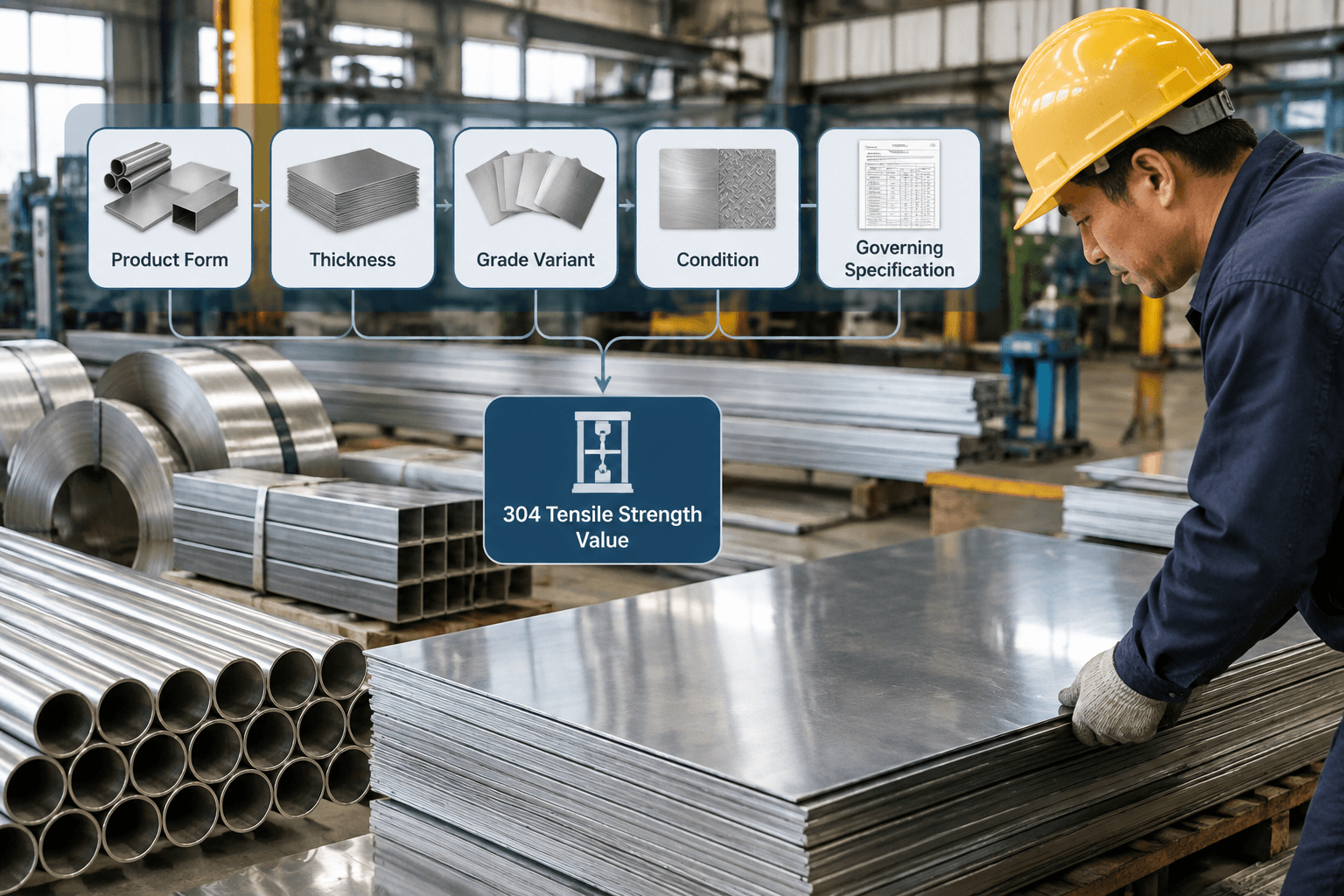
An engineer or purchasing team should provide enough information to identify which tensile-strength value applies. A compact material request should include the following:
| Input | Why it matters |
|---|---|
| Product form | Separates sheet, plate, bar, section, and other product-specific data. |
| Thickness, diameter, or section dimensions | Helps identify the relevant dimensional category and property requirements. |
| Grade or variant | Confirms whether the material is 304, 304L, 304H, or another designation requiring separate review. |
| Material condition | Indicates whether annealed, cold-worked, or another documented condition applies. |
| Required UTS and yield strength | Distinguishes the project requirement from a general typical reference value. |
| Governing specification, test basis, and documentation | Provides the acceptance criteria and evidence needed to interpret the reported result. |
UTS is one input to material selection, not a complete design calculation. It does not by itself establish allowable loads, fatigue life, forming limits, weld performance, or service-temperature suitability. Those questions require the applicable drawing, design calculation, material specification, and service conditions. Fabrication, CNC machining, welding, finishing, assembly, and inspection should remain separate downstream considerations.
Practical Summary for Material Review
Use approximately 500–750 MPa as the supplied overall typical range for 304 stainless steel only when it is clearly labeled as non-universal reference data. For the supplied product-form ranges, use approximately 540–750 MPa for sheet up to 8 mm, 520–720 MPa for plate from approximately 8–75 mm, and 500–700 MPa for bars or sections. Then verify the exact requirement against the product form, dimensions, grade variant, condition, governing specification, and test basis.
For an OEM or ODM inquiry, provide the product form and dimensions, required tensile and yield-strength values, grade or variant, material condition, documentation requirements, and drawing or specification details for the custom part. This allows the applicable 304 data to be reviewed without assuming that a generic value fits every supplied form.
Where RFQ Assumptions Create Cost and Production Risk
Many sheet metal fabrication problems begin before production starts. If drawings, tolerances, finish expectations, material grades, or assembly requirements are unclear, suppliers may quote based on different assumptions. That can make prices difficult to compare and may lead to rework, cosmetic rejection, assembly misalignment, or production delays later.
For OEM buyers, the goal is not simply to request the lowest price. The goal is to make sure each supplier is quoting the same manufacturing reality. Before confirming an order, clarify which dimensions are fit-critical, which surfaces are cosmetic, whether prototypes must match batch-production conditions, and how finished parts will be inspected.
Frequently Asked Questions
What 304 stainless steel ultimate tensile strength details should buyers define before requesting a quote?
Buyers should define the functional requirement, drawing notes, critical dimensions, material or process expectations, and any inspection points related to 304 stainless steel ultimate tensile strength. This helps suppliers quote the same manufacturing scope instead of making different assumptions.
How can RFQ details affect cost, fit, or lead time?
RFQ details can change tooling, forming, welding, finishing, inspection, or rework requirements. If buyers do not clarify it early, two supplier quotes may look comparable while covering different production risks.
Why should drawing requirements be reviewed before prototype approval?
drawing requirements may look acceptable on a single sample but become harder to control during batch production. Buyers should confirm whether the prototype reflects the same process, finish, and inspection conditions expected for production.
What inspection points matter most for 304 stainless steel ultimate tensile strength projects?
Important inspection points usually include fit-critical dimensions, holes or mating areas, cosmetic surfaces, finish build-up, welded or formed features, and any dimensions that affect downstream assembly. These points should appear in the RFQ or drawing notes.
How can buyers reduce prototype approval risk before batch production?
Buyers can reduce risk by clarifying drawings, locking key material and finish assumptions, defining inspection timing, approving a representative sample, and confirming which dimensions or surfaces require tighter process control.
How can Yishang help review 304 stainless steel ultimate tensile strength requirements?
Yishang can review drawings, RFQ notes, material requirements, tolerance expectations, finish details, samples, and assembly needs to identify unclear assumptions before quoting or batch production.