
In today’s fast-paced global industrial market, wholesale procurement engineers and supply chain managers share a very specific set of priorities. Specifically, you are tasked with sourcing high-quality custom OEM metal parts while strictly controlling the total cost of ownership (TCO). Balancing increasingly complex geometrical designs with uncompromising batch precision and compressed international lead times is a daily logistical challenge that requires more than just standard manufacturing solutions.
Traditional manufacturing supply chains often force volume buyers into difficult compromises. Frequently, procurement teams feel they must sacrifice lead times for lower initial piece prices, or accept higher defect rates in exchange for rapid delivery. However, the continuous evolution of precision manufacturing offers a highly effective commercial solution to bypass these compromises entirely. Therefore, understanding the true benefits of 5-axis machining has become a strategic procurement imperative for any business ordering metal parts in bulk to maintain a competitive edge.
This guide explores how advanced multi-axis CNC technology optimizes the production of large-scale orders, helping wholesale buyers secure a fundamentally more resilient, predictable, and highly profitable supply chain. Furthermore, we will move beyond the technical surface to examine how this investment directly impacts your bottom line and supply chain stability.
The Mechanics: 3-Axis vs. 5-Axis Strategic Decision Matrix
To clearly evaluate the commercial return on investment (ROI) of advanced manufacturing, procurement teams must first understand the physical constraints of traditional milling. In conventional CNC milling, for instance, the cutting tool moves linearly across the basic X, Y, and Z axes. While this setup is perfectly adequate for simple, flat components, processing a multi-sided or complex part creates immediate hidden costs that are often overlooked during the initial quoting phase.
Using traditional 3-axis machines requires the spindle to be stopped repeatedly during the production cycle. For every new face or angle that needs machining, an operator must manually unclamp, rotate, and precisely re-fixture the workpiece. In a high-volume wholesale run, this constant manual intervention inevitably creates severe production bottlenecks. Furthermore, every manual adjustment introduces a slight but compounding risk of human error, which directly inflates scrap rates and disrupts your final delivery schedules.
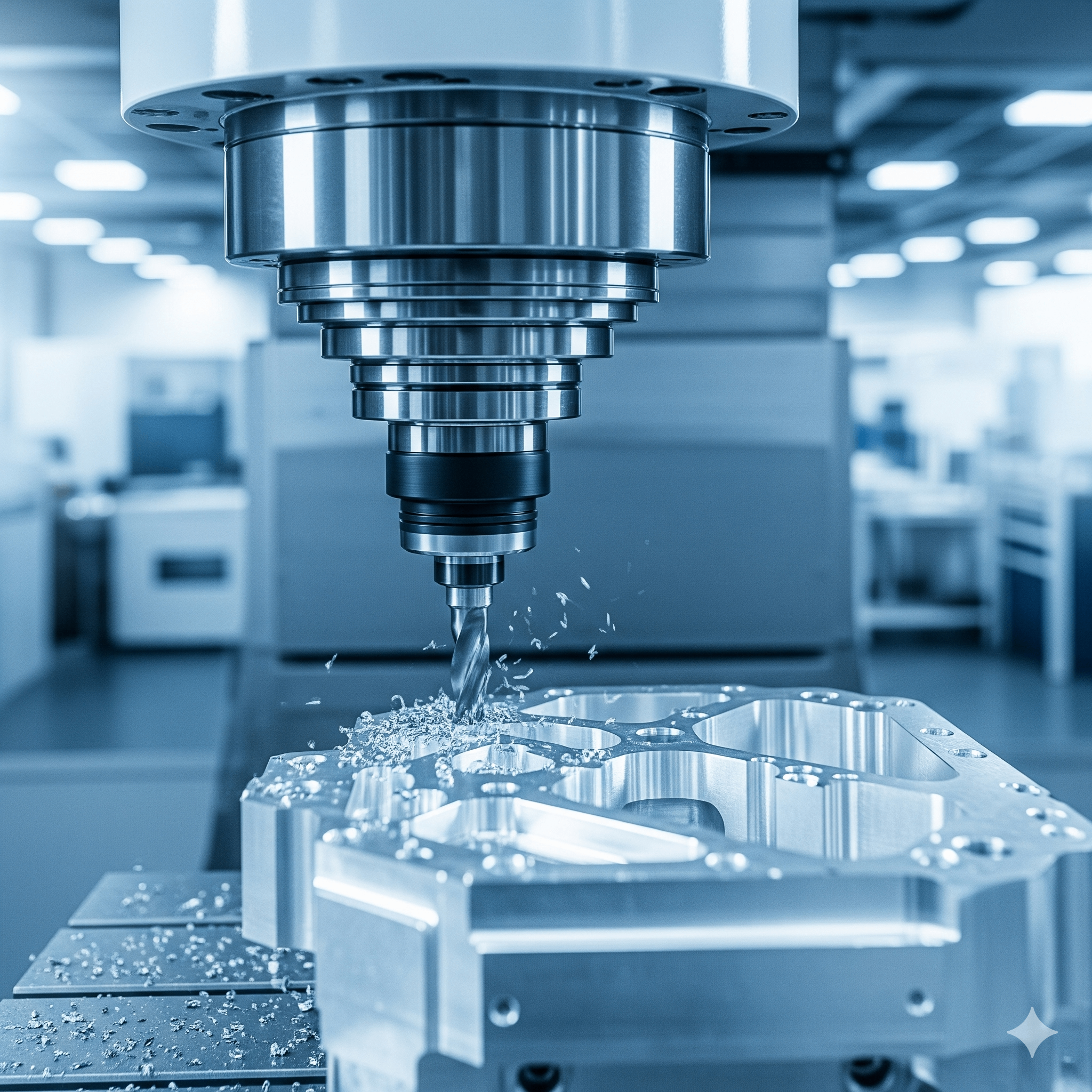
Conversely, continuous 5-axis machining introduces two additional rotary axes, typically designated as the A and B axes. This allows the spindle or worktable to rotate simultaneously alongside the linear movements. As a result, this fluid, uninterrupted kinematics allows the cutting tool to maintain an optimal engagement angle at all times. The tool gracefully navigates around complex contours without requiring a single manual intervention or repositioning stop.
For wholesale buyers, this mechanical superiority means highly predictable production schedules. By eliminating the manual repositioning stop, you secure a 100% reduction in setup-related dimensional drift. Consequently, this ensures that every part in a large batch is referenced from a single origin point, maintaining absolute geometric integrity from the first part to the last.
| Feature Comparison | Traditional 3-Axis Milling | Continuous 5-Axis Machining | Wholesale Commercial Impact |
|---|---|---|---|
| Setups Required | 3 to 6 Separate setups | Just one setup (Done-in-One) | 70% Faster production throughput |
| Design Complexity | Limited to flat planes | Complex 3D contours | Unlimited engineering design freedom |
| Dimensional Drift | High (Cumulative error) | Near Zero (Single datum) | Guaranteed batch consistency |
| Surface Finish | Manual polishing often needed | Superior (Ra < 0.8um) | 20% Lower post-processing cost |
Core Commercial Benefits for High-Volume Procurement
The strategic shift to multi-axis technology fundamentally transforms the cost structure of mass-produced metal components. For procurement professionals, the benefits of 5-axis machining directly support the reduction of sunk costs and the acceleration of time-to-market.
1. Achieving One-Piece Flow and Reducing Sunk Capital
The most financially impactful advantage for global sourcing teams is the dramatic reduction in custom tooling and fixture investments. Traditional machining demands bespoke, expensive fixturing for each separate operational stage. For an order of 10,000 units, maintaining multiple distinct fixtures ties up vast amounts of capital and leaves massive work-in-progress inventory sitting idle on the factory floor, waiting for the next station.
Advanced 5-axis machining is celebrated for its “done-in-one” capability. By accessing five sides in a single operation, we effectively enable one-piece flow even in demanding high-volume environments. Moreover, when manual handling is removed, cycle times plummet. Industry data shows that reducing setups can decrease total lead times by up to 30%, drastically accelerating your inventory turnover and freeing up critical cash flow that would otherwise be locked in stagnant inventory.
2. Empowering Engineering Product Design and Tighter Tolerances
Modern engineering product design often requires lightweight, consolidated designs to meet energy efficiency and performance standards. For decades, designers were forced to break down components into sub-assemblies for manufacturability, increasing assembly labor, complicating the bill of materials (BOM), and creating more potential failure points.
In contrast, 5-axis machining for complex geometries removes these barriers. The articulating spindle effortlessly machines deep pockets and intricate undercuts without tool interference. Crucially, this allows for the use of shorter, highly rigid cutting tools. This physical advantage drastically minimizes tool deflection and chatter—the primary culprits behind out-of-tolerance parts and poor surface finishes. As a result, for the wholesale buyer, this guarantees that the 10,000th part is identical to the first approved prototype, protecting your brand reputation in the global market.
3. Material-Specific Optimization for B2B Durability
A cost-effective supply chain requires matching advanced machinery with high-performance raw materials. Specifically, 5-axis technology is particularly effective for hard metals where tool wear and surface integrity are major concerns during bulk production.
- Stainless Steel (304/316): These are tough alloys that tend to work-harden under heat. Nevertheless, 5-axis feeds maintain a constant chip load, preventing tool dwelling and rubbing. This extends tool life and ensures a sterile-ready, smooth surface essential for medical or food-grade equipment.
- Aluminum Alloys (6061/7075): Ideal for high-speed continuous cutting of lightweight, complex heat sinks or automotive components. The efficiency of 5-axis movement allows for rapid material removal while maintaining structural integrity.
- Brass and Copper: These materials require absolute precision for electronic hardware. In addition, 5-axis machining prevents deformation during complex contouring, ensuring perfect connectivity in high-volume electrical orders.
Integrating Precision CNC Within the YISHANG Ecosystem
A precision 5-axis machined component rarely functions in isolation; instead, it usually serves as the critical core of a larger mechanism, requiring seamless integration with structural housings or frames. Managing multiple separate vendors for machining, welding, and coating is a significant logistical risk that increases freight costs, delays final delivery, and obscures quality accountability.
At YISHANG, we understand that all metals fabricating is a comprehensive journey. Therefore, we provide a single-source solution to reduce supply chain fragmentation and ensure that your precision parts are handled with expert care from start to finish.
Precision Forming and Integrated Cutting
Specifically, we integrate laser cutting CNC, tube laser cutting, and CNC punching to form the foundational enclosures and frames for your machined parts. This ensures a perfect fit during final assembly. By consolidating these processes, we eliminate the communication gaps that often occur between separate vendors.
Automated Robotic Joining
In addition, our robotic welding hardware guarantees uniform weld penetration and absolute structural integrity across thousands of units. This automated approach eliminates the inconsistency of manual welding in large wholesale batches. Consequently, the quality of the structural assembly matches the precision of the 5-axis machined core.
Complete Assembly and Finishing Services
Finally, from professional powder coating silk screening to full electromechanical assembly, we deliver retail-ready components directly to your distribution center. By keeping the entire process under one roof, we eliminate the 15-20% overhead typically lost to multi-vendor logistics and administrative management. Furthermore, this provides a single point of accountability for your entire procurement project.
Securing Your Supply Chain and Lowering TCO
Evaluating manufacturing partners solely on the quoted hourly rate paints a dangerously incomplete picture of your true procurement costs. Instead, the transition to advanced 5-axis CNC technology is a long-term strategy that solves the persistent trade-offs between speed, cost, and complexity that plague traditional, fragmented supply chains.
By embracing single-setup efficiency, unparalleled batch consistency, and integrated secondary operations like robotic welding and electromechanical assembly, wholesale buyers secure a vastly more agile and profitable supply chain. Therefore, consolidating your vendor list and removing the hidden costs of outdated manufacturing methods directly protects your bottom line. Moreover, it improves your market responsiveness by implementing advanced Design for Manufacturability (DFM) strategies.
If your current custom metal parts require multiple vendor transfers, suffer from high fixturing costs, or struggle with inconsistent quality in bulk runs, we are here to streamline your operations. Reach out and request a quote today to discover how YISHANG can optimize and secure your next high-volume manufacturing project.