
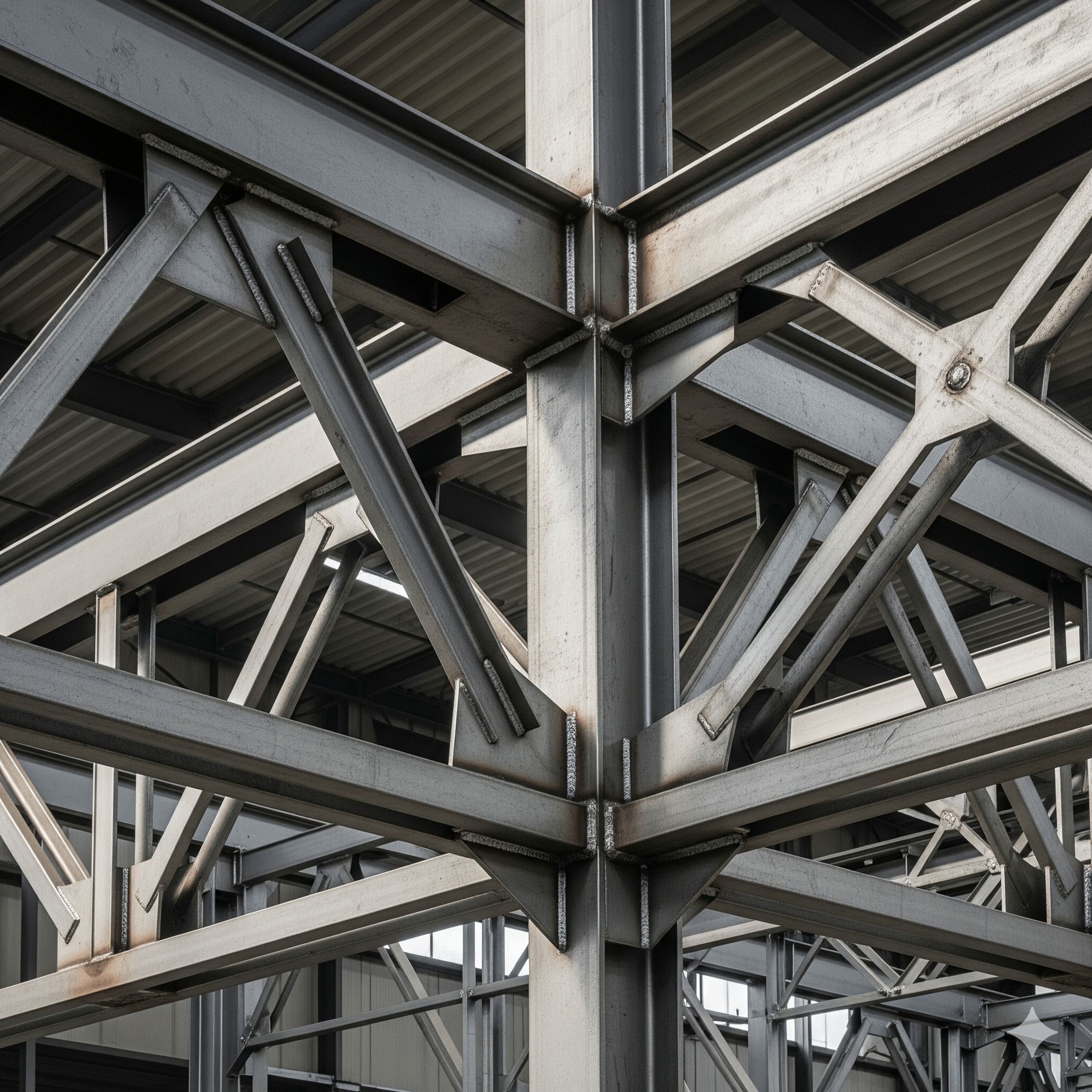
Wholesalers rarely find choosing a structural framework simple. It involves a calculated engineering gamble where reputation and profit are at stake. For overseas businesses, identifying a partner who balances high-precision output with scalability is the real challenge.
As 2026 approaches, the industry is shifting rapidly. Consequently, modular and sustainable solutions have become competitive necessities. At YISHANG, we understand the interplay between steel structure types and fabrication precision. This understanding often separates a successful project from a logistical nightmare. Therefore, we emphasize transparency to help B2B buyers navigate international procurement with confidence.
We base this guide on our 26 years of technical expertise. Throughout this article, we explore how geometric configurations meet real-world industrial demands. For instance, whether you deploy solar battery enclosures or power grids, your choice defines project longevity. We focus on solving the hurdles procurement officers face daily.
I. Foundational Components: The Metallurgy and Geometry of Industrial Sections
Understanding Section Geometry
Starting at the beginning is essential. If we think of a steel structure as a living entity, the sections represent its DNA. In our experience, choosing a specific profile is a strategic pivot point. This choice dictates the strength-to-weight ratio. Seasoned importers know that this variable directly impacts sea freight costs and assembly speed.
Industry relies on H-sections as reliable workhorses for load-bearing columns. Their wider flanges offer the resistance to buckling required under heavy axial loads. In contrast, engineers design I-beams for efficiency. These beams excel at horizontal spans where keeping a tight grip on the material budget is a priority.
Furthermore, precision matters most in high-stakes applications. Cold-formed C-channels and L-angles have become the industry standard for custom junction boxes and push-button enclosures. These shapes allow for high-speed CNC machining and precise bending. At YISHANG, we use these profiles to build control station enclosures. Consequently, these units exceed NEMA 4X or IP66 standards and keep your electronics protected in harsh conditions.
Material Selection and Metallurgy
Metallurgy also plays a critical role as a balancing act. For chemical plants, a stainless steel enclosure (typically 304 or 316L) offers “set it and forget it” corrosion resistance. Meanwhile, carbon steel enclosures provide raw tensile strength for inland use at a more manageable price. Similarly, for outdoor projects, a galvanized steel enclosure serves as a perfect middle ground. These units use a sacrificial zinc layer to halt oxidation.
In specific niches, the focus shifts toward weight and heat management. For example, aluminum enclosures shine in electrical meter units. Their superior thermal conductivity extends the lifespan of electronics by dissipating heat better than steel. By choosing the right material, you invest in a 20-year insurance policy for your hardware.
Finally, the future of steel continues to evolve. New protective coatings now fight oxidation in brutal C4 or C5 environments. By adopting these advancements, YISHANG delivers frameworks that maintain structural integrity and aesthetic finish far longer than the competition.
II. The Geometry of Strength: Core Classifications for Scalability and ROI
Rigid Frames and Seismic Resilience
Structural performance is rooted in geometric logic. For a wholesaler, scalability is the name of the game. A design must be mechanically sound and repeatable. It must scale to thousands of units without increasing defects or losing accuracy. Therefore, manufacturers must treat design as a science.
Wholesalers often use rigid frame structures for industrial housing. By using moment-resisting joints, these systems stay stable without external bracing. This opens up internal volume, which benefits solar battery enclosures. Consequently, users get more space for airflow and component density.
From a procurement standpoint, this rigidity helps during shipping. International transit is rough, as products often vibrate and shift. However, a rigid frame keeps everything aligned during the journey. In seismic zones, ductility keeps high-value electronics from being crushed. We build these protective shells to absorb energy and keep standing.
Efficiency Through Truss Systems
Furthermore, moment-resisting designs translate to fewer headaches for B2B buyers. YISHANG builds frames to survive deployment in over 50 countries. We focus heavily on the “Landed Cost” to ensure prices are not inflated by post-delivery failures. Consequently, we deliver consistency year after year.
Engineers consider truss structures the professional go-to for spanning massive distances. By relying on the triangle’s natural stability, they turn complex forces into simple tension and compression. This represents an elegant solution for agricultural infrastructure. Similarly, green energy projects use these lean designs to make financial numbers work.
Moreover, the truss impacts your logistics positively. By cutting down mass, we have seen sea freight costs drop by 15-20% per unit. This allows procurement officers to allocate more budget toward internal hardware. Therefore, you stop paying for “dead weight” and start paying for performance.
Similarly, lattice designs offer a hidden advantage. Because they are “wind-transparent,” wind passes through them instead of pushing against them. This allows for smaller, cheaper foundations. Consequently, these technical wins help you stay competitive in your local market.
III. Fabrication Reality: Achieving 0.5mm Precision for Specialized Enclosures
Precision Tolerance Standards
The “precision gap” creates significant challenges in industrial manufacturing. While general construction might tolerate a centimeter of deviation, industrial applications demand 0.5mm tolerances. For instance, junction box frameworks require perfect alignment. If a mounting plate is off, the assembly line stops.
Advanced Fabrication Technologies
Consequently, manufacturers must treat the structural framework as a high-precision chassis. At YISHANG, we have replaced manual labor with robotic welding and fiber laser cutting. This minimizes the Heat Affected Zone (HAZ). Consequently, it prevents the localized failure or corrosion common in cheaper products.
For a wholesaler, this precision saves labor. Whether you order a push button enclosure or a control station, parts fit the first time. Therefore, there is no need for on-site grinding. This ensures that IP or NEMA ratings hold up for the long haul.
Similarly, specialized housing requires a deep understanding of thermal dynamics. In solar battery designs, steel must manage thermal expansion while staying rigid. It is a delicate balance. Therefore, our engineers use FEA (Finite Element Analysis) to simulate these stresses. We solve problems on a screen rather than at a customer’s site.
Furthermore, steel structures have shifted toward modularity. Many modern galvanized units now use “knock-down” (KD) kits. Consequently, these units are easier to store and move. They deploy in a fraction of the time required for traditional pre-assembled units.
Ultimately, high-precision metalwork prevents the “hidden costs” of procurement. Flawless execution ensures that design meets market demands. To us, steel structure design represents a technical commitment to your supply chain.
IV. Sustainability, Logistics, and the Future of Procurement
A steel structure’s life continues long after it leaves our factory. As an ISO 9001-certified outfit, YISHANG understands the importance of a “Logistics-First” mindset. Furthermore, sustainability has evolved from a “nice-to-have” into a core part of green building practices.
Steel structures represent a huge selling point because they are 100% recyclable. By using steel, you hit your ESG goals. Furthermore, modular disassembly cuts down waste. Consequently, these structures appeal to today’s international market.
Similarly, KD (Knock-Down) optimization cuts costs effectively. By flat-packing our products, we often fit 40% more units into a container. This directly improves your “Landed Cost.” Therefore, you gain a serious edge in local price wars.
Looking forward, automation and new materials will define the next decade. YISHANG is already integrating smart manufacturing to ensure a high-tech and low-impact future. We are excited to push the envelope of steel fabrication.
Whether you need a stainless steel enclosure or a galvanized farm unit, the choice of partner is everything.
If you are ready to optimize your supply chain, our engineering team is currently accepting custom OEM/ODM consultations for late 2026 deployments. Contact us today to receive a technical breakdown and a prototype timeline tailored to your specific industrial needs.
V. Strategic FAQ: Navigating the Complexities of Steel Structures
What role do steel structures play in sustainable construction? To put it simply, steel allows for modularity. You can reduce on-site waste by up to 90% compared to pouring concrete. It is a cornerstone of how we think about green building practices how—focusing on a circular economy that actually works for industrial applications.
How is the effect of corrosion on steel structures prevented in coastal zones? We usually go with a double-defense strategy: start with a high-grade base metal like by material stainless steel (316L), and then add a C5-rated powder coating. Corrosion can be prevented; you just have to know the environment and pick the right steel structures and how they are treated.
What are the advantages and disadvantages of installing steel structures in residential versus industrial sites? In industrial zones, that strength and design flexibility are your best friends for housing heavy gear. In residential areas, the speed of assembly is the big winner. The only real “downside” is that you need to be a bit more thoughtful about acoustic insulation, which is not usually an issue in a factory setting.
How do you ensure the strength of steel in high-volume batches? Consistency is the goal. We do not leave it to chance. Every batch of carbon steel enclosure units goes through strict material testing and automated quality checks. At YISHANG, we rely on robotic production lines to cut out the variability you get with manual labor.