
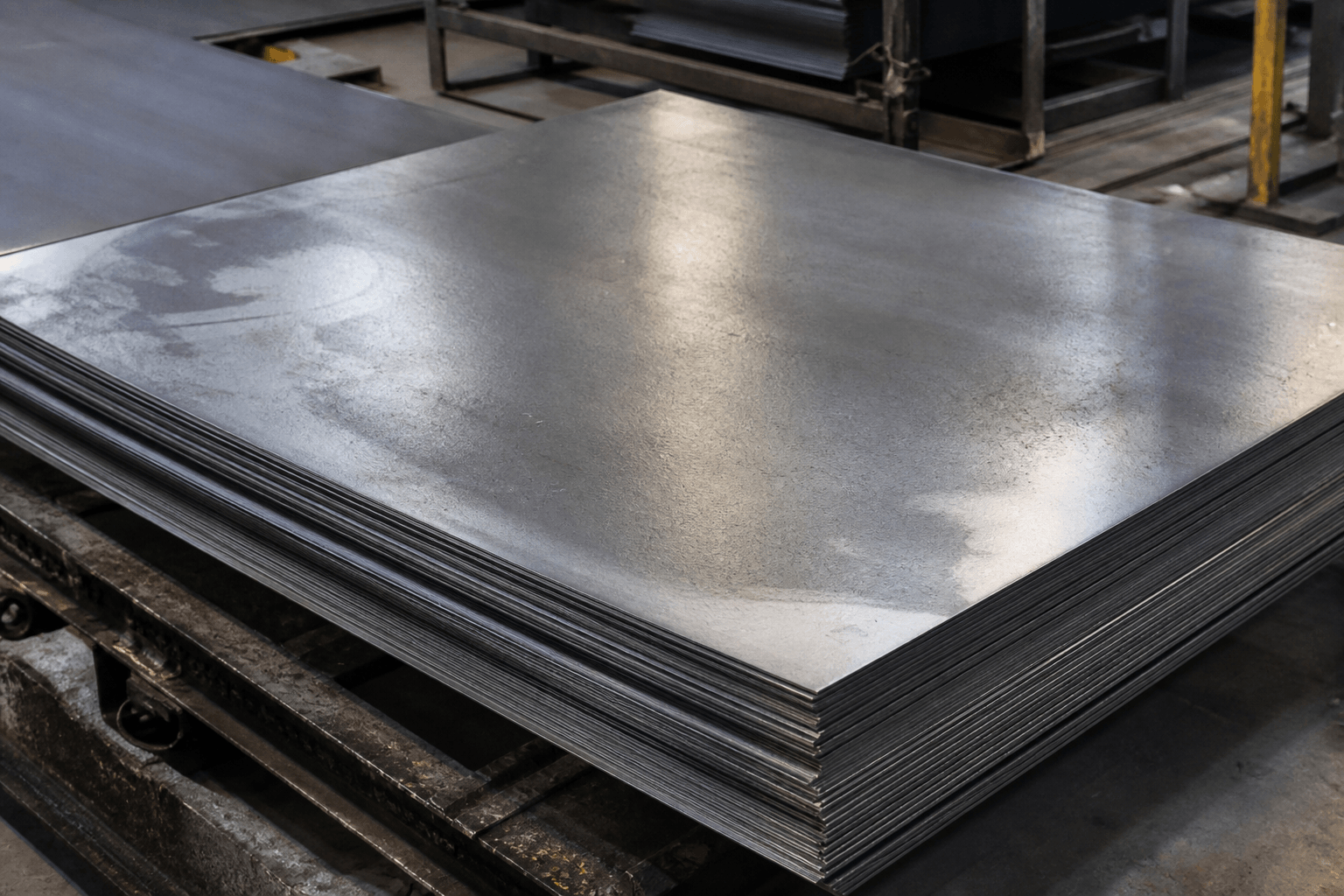
When someone asks for the thickness of 16 gauge sheet metal, the material must be identified before giving a precise conversion. Gauge is not a universal linear measurement: 16 gauge stainless steel, mild steel, and aluminum have different nominal thicknesses.
Under commonly used US sheet metal gauge conventions, 16 gauge stainless steel is 0.0625 inches, or approximately 1.587 millimeters. By comparison, 16 gauge mild steel is commonly listed as 0.0598 inches, or 1.519 millimeters, while 16 gauge aluminum is approximately 0.0508 inches, or 1.290 millimeters. These are nominal conversion values rather than guaranteed measurements for every supplied sheet.
How Thick Is 16 Gauge Sheet Metal?
The following table compares typical nominal values used in common gauge charts. Because gauge conventions can vary by material, region, and supplier, a purchase specification should identify both the material and the required decimal thickness.
| Material | 16 gauge in inches | 16 gauge in millimeters |
|---|---|---|
| Stainless steel | 0.0625 in | 1.587 mm |
| Mild steel | 0.0598 in | 1.519 mm |
| Aluminum | 0.0508 in | 1.290 mm |
This difference explains why an instruction such as “use 16 gauge sheet” is incomplete. A fabricator cannot reliably determine the intended thickness unless the drawing, bill of materials, or purchase order also states the material.
For example, replacing 16 gauge stainless steel with 16 gauge aluminum does not preserve the same thickness. It also changes material strength, stiffness, weight, corrosion behavior, forming response, and joining requirements. Even when two sheets have similar dimensions, their performance cannot be assumed to be equivalent.
Gauge numbers also work in the opposite direction from many ordinary numbering systems: within the same material convention, a lower gauge number normally indicates a thicker sheet. This relationship should not be used to compare different materials without checking their decimal values.
Nominal Thickness Is Not the Same as Measured Thickness
A gauge conversion provides a nominal thickness. Actual sheet can vary because of the applicable material specification, mill production tolerance, alloy or grade, surface condition, and supplier practice. The acceptable variation is therefore not determined by the gauge number alone.
Stainless steel grade selection illustrates this distinction. Different stainless grades may use the same nominal gauge conversion, but they can have different mechanical properties, corrosion resistance, availability, and forming behavior. The grade and thickness should be treated as separate drawing requirements.
Surface finishes and coatings require similar care. A painted, powder-coated, plated, or film-protected component may measure slightly thicker after finishing, but the base-metal thickness has not changed. If an enclosure must fit into a narrow slot or a formed panel must match another component, clarify whether a dimensional requirement applies before or after finishing.
For routine purchasing, three descriptions are useful together:
- Material and grade: identifies the metal needed for performance and processing.
- Nominal decimal thickness: removes uncertainty caused by gauge conversions.
- Applicable thickness tolerance: defines how much variation the design can accept.
A clear specification might therefore state “stainless steel, 1.587 mm nominal thickness” rather than relying only on “16 gauge stainless.” The final grade and tolerance should match the project requirements and the material specification agreed with the supplier.
Choosing Between 14, 16, and 18 Gauge
Adjacent gauges are often considered during enclosure, cabinet, cover, housing, and bracket design. For stainless steel, commonly listed nominal values are:
| Stainless steel gauge | Nominal inches | Nominal millimeters | General design implication |
|---|---|---|---|
| 14 gauge | 0.07812 in | 1.984 mm | Thicker and generally more resistant to deflection, but heavier and harder to form |
| 16 gauge | 0.06250 in | 1.587 mm | Intermediate thickness for designs balancing rigidity, weight, and fabrication |
| 18 gauge | 0.05000 in | 1.270 mm | Thinner and lighter, with greater sensitivity to deflection and heat distortion |
Thickness alone does not establish whether a part is light-, medium-, or heavy-duty. A shallow cover with return flanges may be sufficiently rigid at a thickness that would allow a large flat panel to flex. Material grade, unsupported span, bend geometry, ribs, hems, fastener spacing, applied load, impact exposure, and mounting arrangement can matter as much as the gauge.
Moving from 16 to 14 gauge can increase rigidity, but it also increases material use, component weight, bending force, and the difficulty of forming tight features. Moving from 16 to 18 gauge can reduce weight and forming load, but may make flatness, welding distortion, dent resistance, and thread engagement more challenging.
A useful selection sequence is to define the load and allowable deflection, review the geometry, confirm the material grade, and then choose a thickness. Gauge should record that decision rather than replace the engineering review behind it.
How 16 Gauge Affects Fabrication
Once the material is known, 16 gauge thickness influences cutting, bending, welding, hardware installation, and inspection. The exact processing conditions still depend on alloy, grade, part geometry, equipment, and quality requirements.
Cutting: Laser cutting, punching, and other profile-cutting methods may be considered for sheet in this thickness range. Feature size, edge condition, hole diameter, part nesting, and heat sensitivity affect the suitable process. A hole that will receive a fastener or locating pin should be dimensioned according to its function rather than described only by appearance.
Bending: Material thickness is an input for bend allowance, bend deduction, inside radius, tooling selection, and required forming force. Stainless steel, mild steel, and aluminum of nominally the same gauge do not necessarily bend in the same way. Grain direction, temper, grade, bend radius, and springback must also be considered. Substituting one alloy or thickness after the flat pattern is developed may alter the finished dimensions.
Welding: Heat input and joint design affect distortion, penetration, and appearance. Large flat panels can be especially sensitive to distortion around continuous welds. Depending on structural and sealing requirements, a designer may evaluate intermittent welds, tabs and slots, mechanical fastening, or a revised joint layout. These alternatives are application-dependent and should not be treated as automatic replacements.
Fastening: A sheet approximately 1.3 to 1.6 mm thick offers limited depth for threads formed directly in the sheet. Where stronger or reusable threads are needed, inserted hardware, weld nuts, captive nuts, or formed features may be considered. The selected fastener must suit the base material, sheet thickness, access direction, load, and assembly sequence.
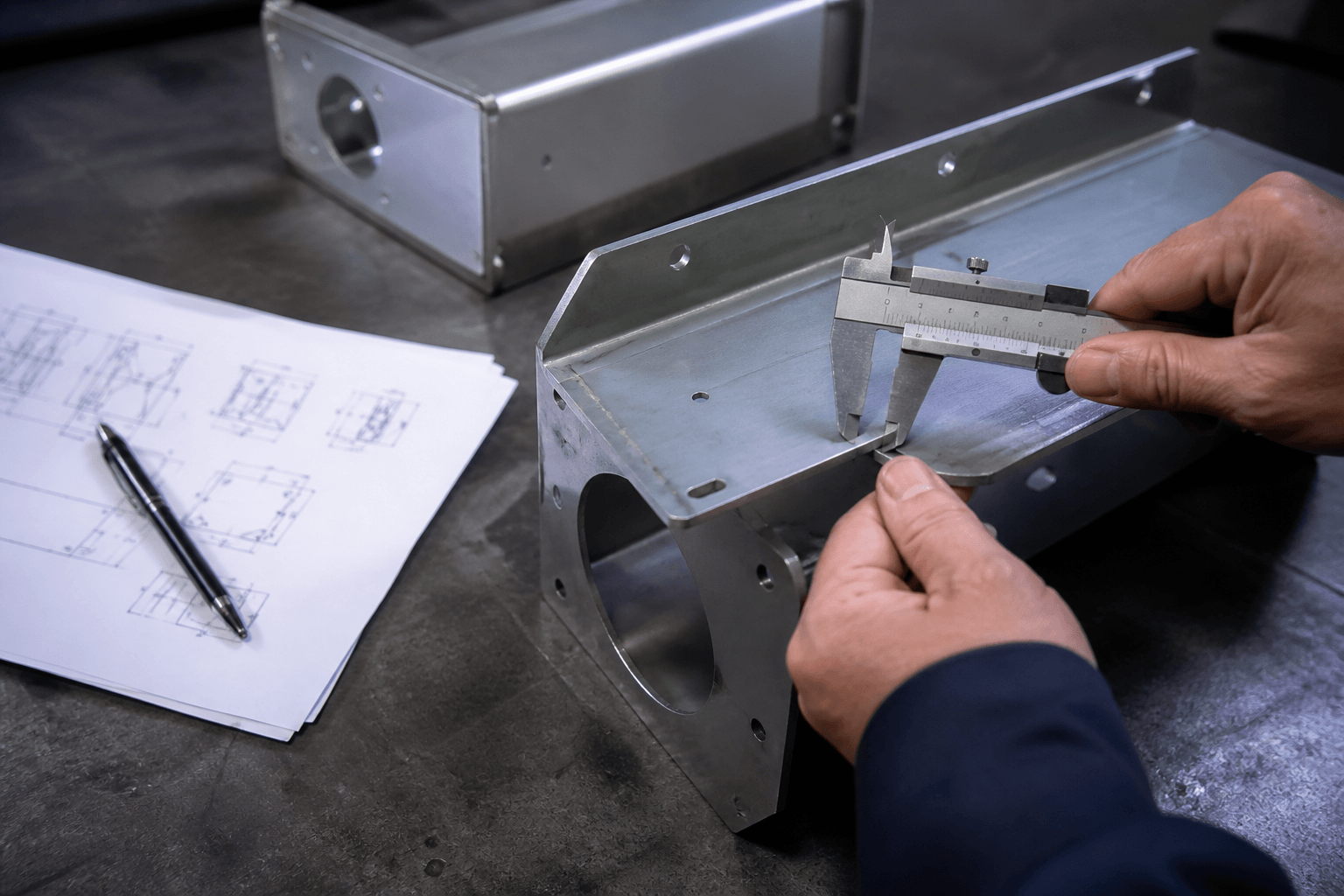
Inspection: Material thickness can be checked separately from finished dimensions. Bend angle, flange length, hole position, flatness, and overall assembly fit are controlled by the drawing rather than by the gauge designation. Critical dimensions should therefore have explicit tolerances.
How to Specify 16 Gauge for a Custom Part
For an initial manufacturing review, provide the drawing, material, quantity, tolerance requirements, and finish. The drawing should preferably show the decimal thickness in millimeters or inches. Gauge may be included as a reference, but it should not conflict with the stated decimal value.
Also indicate the material grade where it is important. “16 gauge stainless steel” still leaves open questions about corrosion resistance, forming characteristics, surface appearance, and availability. Likewise, “16 gauge aluminum” does not identify the alloy or temper.
Finish requirements should state which surfaces are cosmetic, whether grain direction matters, and whether dimensions apply before or after coating. For assemblies, identify mating components, hardware, and any interfaces that control fit. These details help distinguish a simple nominal-thickness question from the actual manufacturing requirements.
For B2B OEM and ODM projects, Yishang can review a drawing together with the specified material, quantity, tolerance, and finish to clarify manufacturability and project requirements. Yishang has more than 26 years of custom sheet metal manufacturing experience and supplies custom metal products to customers in more than 50 countries.
Frequently Asked Questions
What is 16 gauge sheet metal thickness in mm?
It depends on the material. Typical nominal values are 1.587 mm for stainless steel, 1.519 mm for mild steel, and 1.290 mm for aluminum. Confirm the material and supplier convention before using a gauge conversion for production.
Which is thicker, 20 gauge or 16 gauge steel?
Within the same steel gauge convention, 16 gauge is thicker than 20 gauge. Do not compare gauge numbers across different materials without converting both to inches or millimeters.
Is 10 mm the same as 16 gauge?
No. A 10 mm plate is much thicker than common 16 gauge sheet. Depending on the material, 16 gauge sheet is typically around 1.3 to 1.6 mm thick. A drawing stating 10 mm should not be converted to 16 gauge.
Can I specify a fabricated part using only 16 gauge?
It is better to specify the material, grade, and nominal decimal thickness. Add the required tolerance and finish where relevant. This avoids ambiguity and gives the fabricator a measurable requirement for purchasing, production, and inspection.