
For any overseas procurement manager, picking the right grade of austenitic stainless steel is rarely as simple as looking at a price tag. It is, quite often, a delicate balancing act between immediate budgets and the long-term integrity of the asset. While 308 stainless steel is frequently pigeonholed as just another welding consumable, those of us in high-end metal fabrication view it as something more—a critical piece of engineering insurance. At YISHANG, we’ve seen firsthand how a slight shift in material choice can be the difference between a decade of service and an early, costly warranty claim.
This guide moves past the dry, textbook descriptions you might find elsewhere. Instead, we’ll dig into the metallurgical logic that makes 308 a true workhorse for industrial infrastructure. We want to show you how its specific chemical “recipe” directly impacts the life of your products, helping your supply chain stay resilient even when the environment gets aggressive. By the time you finish reading, it should be clear why this grade has become the professional benchmark for hardware that simply cannot afford to fail.
I. Strategic Procurement: The “Insurance Policy” of 308 Stainless Steel
In the world of industrial metal, the move from 304 to 308 is often a tactical one, designed to combat the inevitable “element burn-off” that happens during high-heat fabrication. When a metal products manufacturer joins components, extreme temperatures tend to deplete chromium levels in the weld zone—a recipe for premature decay. By specifying 308, with its robust 20 chromium and 10 nickel profile, you’re essentially “over-alloying” the joint. It’s an intentional buffer that maintains a superior resistance to corrosion where it’s needed most.
For B2B wholesalers, choosing 308 stainless steel is, at its heart, about risk mitigation. Imagine a mount electrical enclosure installed in a humid, coastal setting; a single failure in the weld can lead to massive liability and, frankly, a tarnished reputation. Using 308 ensures the “heat-affected zone” doesn’t become the weak link in the chain. This kind of foresight is what separates premium engineering from the “good enough” commodity production we see so often today.
From a procurement standpoint, the slightly higher cost of 308 is best viewed as an investment in a lower total cost of ownership (TCO). When you factor in extended service life and the headaches of on-site maintenance you’ll avoid, the return on investment (ROI) becomes quite obvious. Our team at YISHANG focuses on this “Life-Cycle Value.” We want to ensure that every junction box nema rated product we deliver stands up to years of environmental stress, long after the initial purchase order is forgotten.
Consistency is another factor that can’t be overlooked. In a reliable B2B partnership, you need the mechanical properties of the ten-thousandth unit to be identical to the first. By sticking to strict ASTM standards and sourcing high-purity 308 ss raw materials, we remove the variables that usually lead to project delays. This ensures that your enclosure electrical meter projects move smoothly from design to global distribution without any nasty metallurgical surprises along the way.
II. Technical Specifications: Global Standards and Composition
To keep global procurement seamless, you have to recognize 308 SS across various international frameworks. Whether your drawings call for ASTM A240 or a Japanese standard, the core performance remains remarkably consistent.
| Standard / Region | Designation | Primary Application |
|---|---|---|
| UNS (Global) | S30800 | General purpose industrial components |
| ASTM (USA) | A240 / A479 | Specific plate, sheet, and bar stock |
| JIS (Japan) | SUS308 | High-precision metal parts |
| EN (Europe) | 1.4303 | Mechanical and architectural frames |
What really makes the material tick is that well-balanced composition—the roughly 20 chromium and 10 nickel ratio that stabilizes its austenitic phase. Chromium, sitting at that 19-21% level, is the engine behind the passive oxide film. It’s what allows the material to heal itself, surviving intermittent temperatures as high as 870°C (1600°F) without the heavy scaling that would plague lesser steels.
The chemical analysis of 308 SS also highlights the roles of Manganese and Silicon, elements that are too often ignored. At YISHANG, we keep a close eye on silicon levels (up to 1.0%) because they act as deoxidizers. This makes the material is much easier to work with during laser cutting or welding, filling microscopic gaps with a precision that matters. This focus on the nickel in the composition reduces the risk of internal porosity—arguably the biggest culprit behind structural fatigue in high-vibration environments.
III. Application Intelligence: From NEMA Enclosures to Solar Energy
The range of applications for 308 stainless steel has grown as industries push into tougher, more remote environments. A junction box nema enclosure made from 308, for example, will typically outlast standard grades in salty, coastal air by a significant margin. At YISHANG, we lean on the many superior properties of this alloy to build the kind of control station enclosures and push button enclosure units that actually meet their IP and NEMA ratings in the real world, not just on paper.
Look at the renewable energy sector: the solar battery enclosure is now a high-demand item. These enclosures solar battery setups are often left to face extreme UV and corrosive outgassing from the batteries themselves. Using 308 allows the material to provide a fire-resistant, corrosion-proof shell that protects a very expensive investment. It’s the kind of protection a galvanized steel enclosure or a standard carbon steel enclosure simply can’t promise over a 20-year lifecycle.
Wholesalers often come to us with specific aesthetic and functional needs for their finishes. At YISHANG, we’ve mastered several for 308 ss products:
- 2B Finish: A smooth, moderately reflective look—perfect for industrial enclosure electrical meter boxes where utility is king.
- No. 4 Finish: That classic brushed texture. It’s excellent for hiding the fingerprints and scuffs that inevitably happen on push button enclosure panels.
- BA (Bright Annealed): A mirror-like reflection often chosen for high-end architectural mount electrical enclosure hardware.
When you weigh a stainless steel enclosure against a galvanized steel enclosure, the logic usually comes down to maintenance cycles. Galvanized options are cheaper upfront, certainly, but that zinc coating is sacrificial—it will eventually fail. The material stainless steel we use in our 308 products offers protection that goes all the way through. In the long run, this makes it making it highly cost-effective for outdoor utility infrastructure like enclosure electrical meter housings.
IV. Fabrication and Risk Mitigation: Ensuring Batch Consistency
From a manufacturing perspective, machining 308 stainless steel is a different beast entirely compared to working with a carbon steel enclosure. 308 is notoriously prone to work hardening. If the feed rates are off, the surface can become almost impenetrable in an instant, ruining tools and causing the kind of dimensional drift that can wreck a mount electrical enclosure order.
At YISHANG, we’ve found that using “positive rake” tooling and keeping feed rates constant and aggressive is the best way to stay ahead of that hardened layer. This technical discipline ensures every enclosure enclosure by our team hits the exact tolerances your engineers expect. During the bending 308 process, the material’s ductility is great, but its spring-back is much higher than standard steel, requiring precise CAD compensation to get the fitment right every single time.
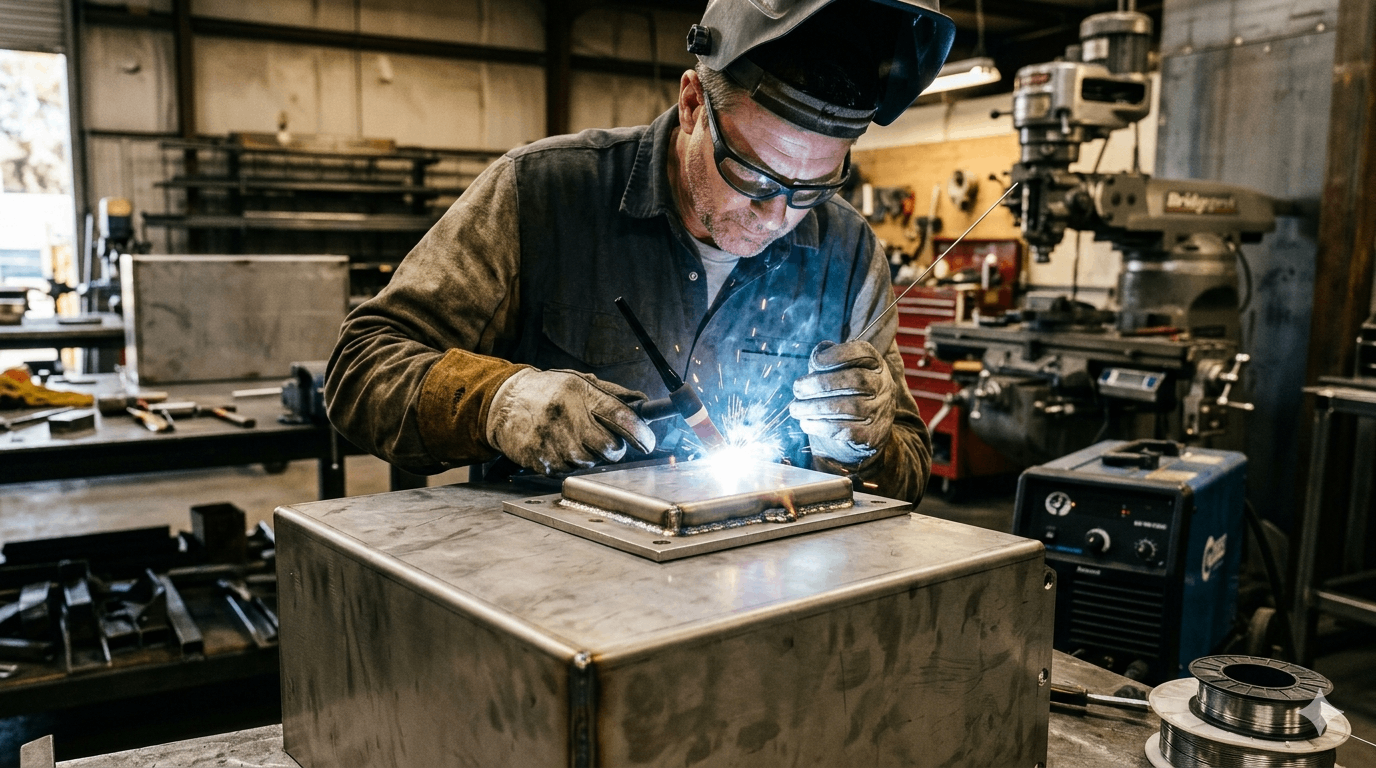
There’s also the often-overlooked factor of shielding gas during welding. If a fabricator gets lazy with the gas mix—using too much CO2, for instance—carbon can migrate into the weld pool. This can turn a “Low Carbon” 308L part into a sensitized 308 part without anyone noticing until it’s too late. We stick to High-Argon mixes to protect the purity of the austenitic stainless steel. It’s these “hidden” details that ensure the YISHANG supply chain remains a reliable one.
Finally, we consider surface passivation a mandatory step for every stainless steel the product we ship. This chemical bath strips away any free iron particles that might have been picked up during CNC work, making sure the 20 chromium and 10 nickel content can form its protective shield properly. This level of attention is why distributors around the globe trust us for zero-defect metal solutions.
V. FAQ: Technical Insights for B2B Buyers
Q: Is 308 stainless steel magnetic? Typically, in its annealed state, 308 is non-magnetic. However, like most austenitic stainless steel, it can pick up a slight magnetic pull after cold working—think deep drawing or sharp bending. This is just a natural result of the austenite partially transforming into martensite.
Q: How is 308 actually better than 304 for welding? It’s that additional 2% chromium and 2% nickel. It acts as a buffer for the elements lost during the high heat of the weld, ensuring the bead stays as corrosion-resistant as the base metal, if not more so.
Q: Can I use 308 in marine environments? 308 is excellent for general oxidation, but if you’re looking at direct saltwater immersion, 316 is usually the better bet. That said, for “coastal-adjacent” mount electrical enclosure applications, 308 often offers a much better TCO than 304.
As you weigh the options for your next project, remember that your choice of material is the foundation of everything that follows. Whether you’re after a simple push button enclosure or a complex hybrid setup, understanding the nuances of 308 SS will give you a real edge. At YISHANG, we’re ready to bring our fabrication experience and metallurgical expertise to your next technical challenge.
Send your inquiry today, and let’s get a customized quote started for your 308 SS project.