
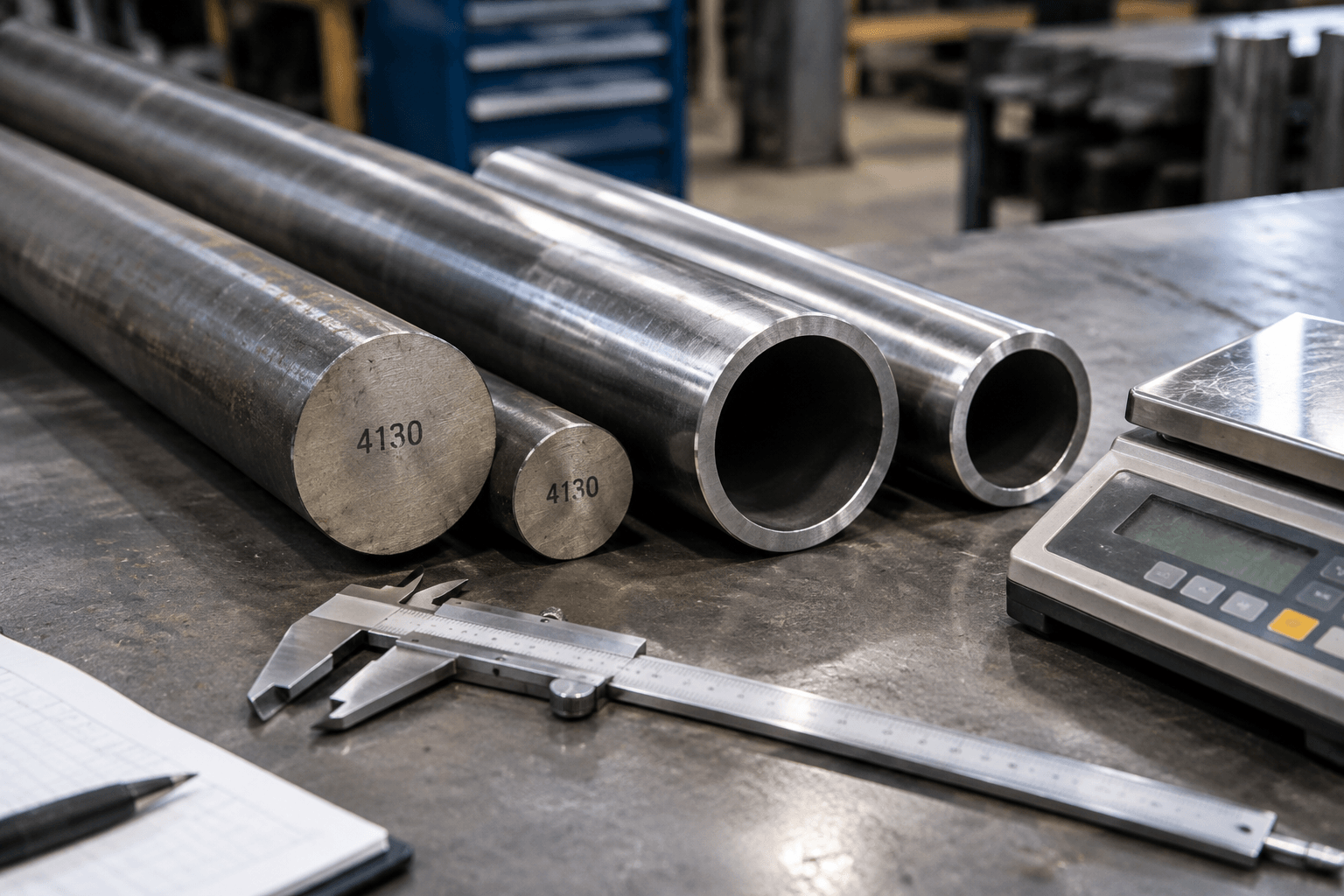
The nominal room-temperature density of AISI 4130 chromoly steel is approximately 7.85 g/cm3, or 7,850 kg/m3. The same reference value is approximately 0.2836 lb/in3 and 490 lb/ft3. These values are suitable for estimating the theoretical mass of 4130 solid bar, tube, or bored bar, but the calculated result is not a certified shipment weight.
4130 Chromoly Density and Unit Conversions
For early design, material planning, and shipping estimates, 7.85 g/cm3 is a commonly used nominal density for AISI 4130 steel at approximately room temperature. The conversions below use that rounded reference value.
| Unit | Nominal density | Typical use |
|---|---|---|
| g/cm3 | 7.85 | Metric material data and laboratory-style calculations |
| kg/m3 | 7,850 | Engineering calculations using SI units |
| lb/in3 | 0.2836 | Inch-based bar, tube, and machined-part estimates |
| lb/ft3 | approximately 490 | Bulk volume and freight calculations |
The conversions are based on consistent volume relationships: 1 g/cm3 equals 1,000 kg/m3, and 1 g/cm3 is approximately 0.036127 lb/in3. Rounding the density or conversion factor changes the estimate slightly, so the number of decimal places should match the purpose of the calculation.
What the Published Density Represents
A published density is a nominal or reference material value, not a guarantee that every piece of 4130 supplied by every producer will have exactly that density. The actual mass of a product depends on its measured dimensions, dimensional tolerances, quantity, surface condition, scale, coatings, and manufacturing history.
For example, a bar calculated from its nominal diameter and length may weigh differently from the same bar measured after production. A tube estimate can also differ when the outside diameter, inside diameter, wall thickness, or cut length varies within the applicable product tolerances. Scale, oil, plating, paint, or other material on the surface can affect a scale reading even though it is not part of the underlying steel density.
Heat treatment changes the mechanical condition of 4130 more meaningfully than it changes the nominal density used for ordinary weight estimates. Normalizing, quenching and tempering, or another specified condition may affect strength, hardness, and other properties, but those changes should not be treated as a reason to substitute an unverified density value for the product specification.
How to Calculate 4130 Bar or Tube Weight
The basic relationship is:
Mass = density x volume
Use one consistent unit system. If density is 0.2836 lb/in3, calculate volume in cubic inches and the result is pounds by ordinary purchasing terminology. If density is 7,850 kg/m3, calculate volume in cubic meters and the result is kilograms.
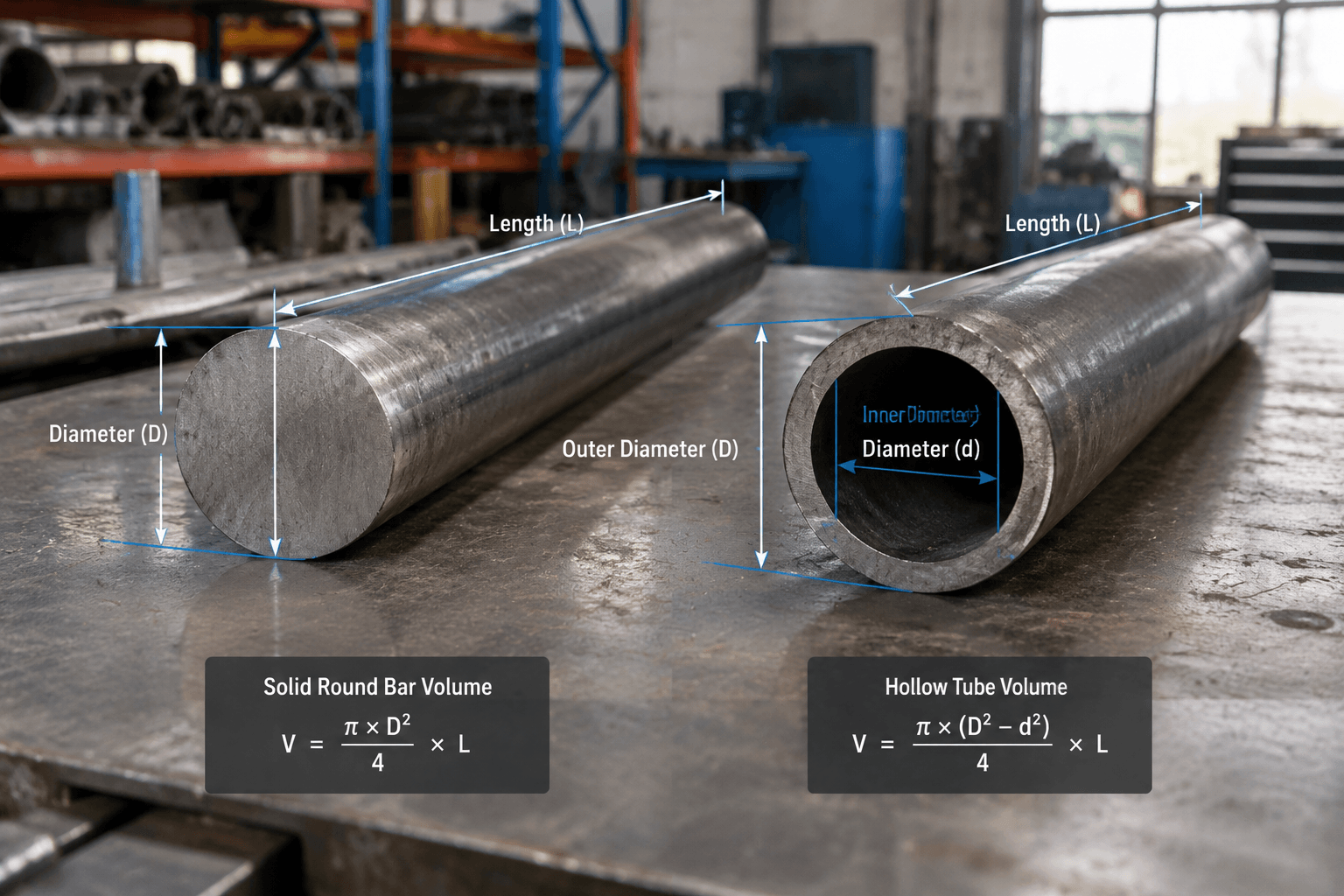
Solid round bar formula
For a solid round bar:
Volume = pi x d2 x L / 4
Here, d is the bar diameter and L is the length. With inch dimensions:
Mass in pounds = 0.2836 x pi x d2 x L / 4
Worked solid-bar example
Assume a nominal 4130 solid round bar has a diameter of 1.00 inch and a length of 12.00 inches.
- Calculate the volume: pi x 1.002 x 12.00 / 4 = 9.4248 in3.
- Multiply by the nominal density: 9.4248 in3 x 0.2836 lb/in3 = approximately 2.67 lb.
The result is a theoretical estimate for the stated nominal dimensions. It does not account for the actual measured diameter, cut-length tolerance, surface material, or the supplier’s measured shipment weight.
Hollow tube or bored-bar formula
For a round tube or a bored bar with a uniform circular bore:
Volume = pi x (D2 – d2) x L / 4
D is the outside diameter, d is the inside diameter, and L is the length. With inch dimensions:
Mass in pounds = 0.2836 x pi x (D2 – d2) x L / 4
Worked hollow-section example
Assume a nominal 4130 hollow section has an outside diameter of 2.00 inches, an inside diameter of 1.50 inches, and a length of 12.00 inches.
- Calculate the cross-sectional area: pi x (2.002 – 1.502) / 4 = approximately 1.374 in2.
- Calculate the volume: 1.374 in2 x 12.00 in = approximately 16.493 in3.
- Calculate the mass: 16.493 in3 x 0.2836 lb/in3 = approximately 4.68 lb.
The same method applies to a bored round bar when the bore is represented by its actual or specified inside diameter. For a nonuniform bore, interrupted section, keyway, cross-hole, chamfer, or other removed feature, calculate the remaining volume or use a dimensional model.
Nominal Weight Versus Actual Supplied Weight
Theoretical weight is useful for comparing designs, estimating material requirements, and preparing an early freight estimate. It should not be presented as the exact mass of every supplied product.
| Estimate input | What it provides | What it does not confirm |
|---|---|---|
| Nominal diameter, wall, bore, and length | Geometry-based theoretical mass | Actual measured dimensions or cut condition |
| Nominal 4130 density | A consistent material-mass assumption | Certified product identity or shipment mass |
| CAD volume | Estimated finished-part mass | Stock allowance, scale, coating, or production scrap |
| Scale measurement | Actual mass of the measured item | Whether the material meets the required grade or condition |
For purchasing, use the supplier’s quantity, product dimensions, applicable tolerances, and packing or shipping basis when an exact commercial weight matters. For a finished machined part, the CAD volume may be more relevant than the starting-bar volume, but it still represents a calculated mass unless the completed part is weighed.
Density Does Not Establish Strength or Grade Equivalence
4130 density is not a proxy for tensile strength, yield strength, hardness, impact resistance, or machinability. Mechanical performance depends on factors such as chemical composition, product form, section size, processing, heat-treatment condition, and the requirements of the applicable specification.
Nearby alloy steels can have broadly similar densities while having different responses to heat treatment and different required mechanical properties. That means density alone cannot establish whether 4130 is stronger, weaker, or interchangeable with 4140, 4145, 4330, or another alloy steel. A comparison must use the exact designation, product form, condition, dimensions, and applicable material requirements.
| Question | What density can answer | What requires specification review |
|---|---|---|
| How much might the material weigh? | Provides the mass factor for a volume calculation | Actual dimensions, tolerances, surface condition, and quantity |
| Will the material meet a strength requirement? | Nothing by itself | Grade, product form, condition, and mechanical-property requirements |
| Can one grade replace another? | Shows only that their mass estimates may be similar | Composition, specification, processing, certification, and design requirements |
4130 Bar and Tube Weight Calculator Worksheet
Use the following fields to prepare a nominal estimate. Choose either a solid section or a hollow section, keep all dimensions in the selected unit system, and label the result as theoretical mass.
For a solid bar, set the inside diameter to zero. In an inch-based calculation, use 0.2836 lb/in3. In a metric calculation, convert the dimensions to meters and use 7,850 kg/m3. Multiply the single-piece result by the quantity. The worksheet estimates nominal mass; it does not certify the actual shipment weight.
Information to Confirm Before Using the Estimate
- Exact grade and designation, such as the specified AISI or UNS designation.
- Applicable material or product specification.
- Product form: solid bar, tube, bored bar, plate, sheet, forging, or another form.
- Finished dimensions, stock dimensions, length, quantity, and dimensional tolerances.
- Required material condition, hardness, mechanical properties, and documentation where relevant.
For a custom 4130 component, a drawing or dimensional model, the exact material definition, product form, required condition, and order quantity support a more useful manufacturing review than density alone. See Custom CNC Machining From First Sample to Repeat Production for the relevant machining context.

Frequently Asked Questions
What 4130 chromoly density details should buyers define before requesting a quote?
Buyers should define the functional requirement, drawing notes, critical dimensions, material or process expectations, and any inspection points related to 4130 chromoly density. This helps suppliers quote the same manufacturing scope instead of making different assumptions.
How can RFQ details affect cost, fit, or lead time?
RFQ details can change tooling, forming, welding, finishing, inspection, or rework requirements. If buyers do not clarify it early, two supplier quotes may look comparable while covering different production risks.
Why should drawing requirements be reviewed before prototype approval?
drawing requirements may look acceptable on a single sample but become harder to control during batch production. Buyers should confirm whether the prototype reflects the same process, finish, and inspection conditions expected for production.
What inspection points matter most for 4130 chromoly density projects?
Important inspection points usually include fit-critical dimensions, holes or mating areas, cosmetic surfaces, finish build-up, welded or formed features, and any dimensions that affect downstream assembly. These points should appear in the RFQ or drawing notes.
How can buyers reduce prototype approval risk before batch production?
Buyers can reduce risk by clarifying drawings, locking key material and finish assumptions, defining inspection timing, approving a representative sample, and confirming which dimensions or surfaces require tighter process control.
How can Yishang help review 4130 chromoly density requirements?
Yishang can review drawings, RFQ notes, material requirements, tolerance expectations, finish details, samples, and assembly needs to identify unclear assumptions before quoting or batch production.