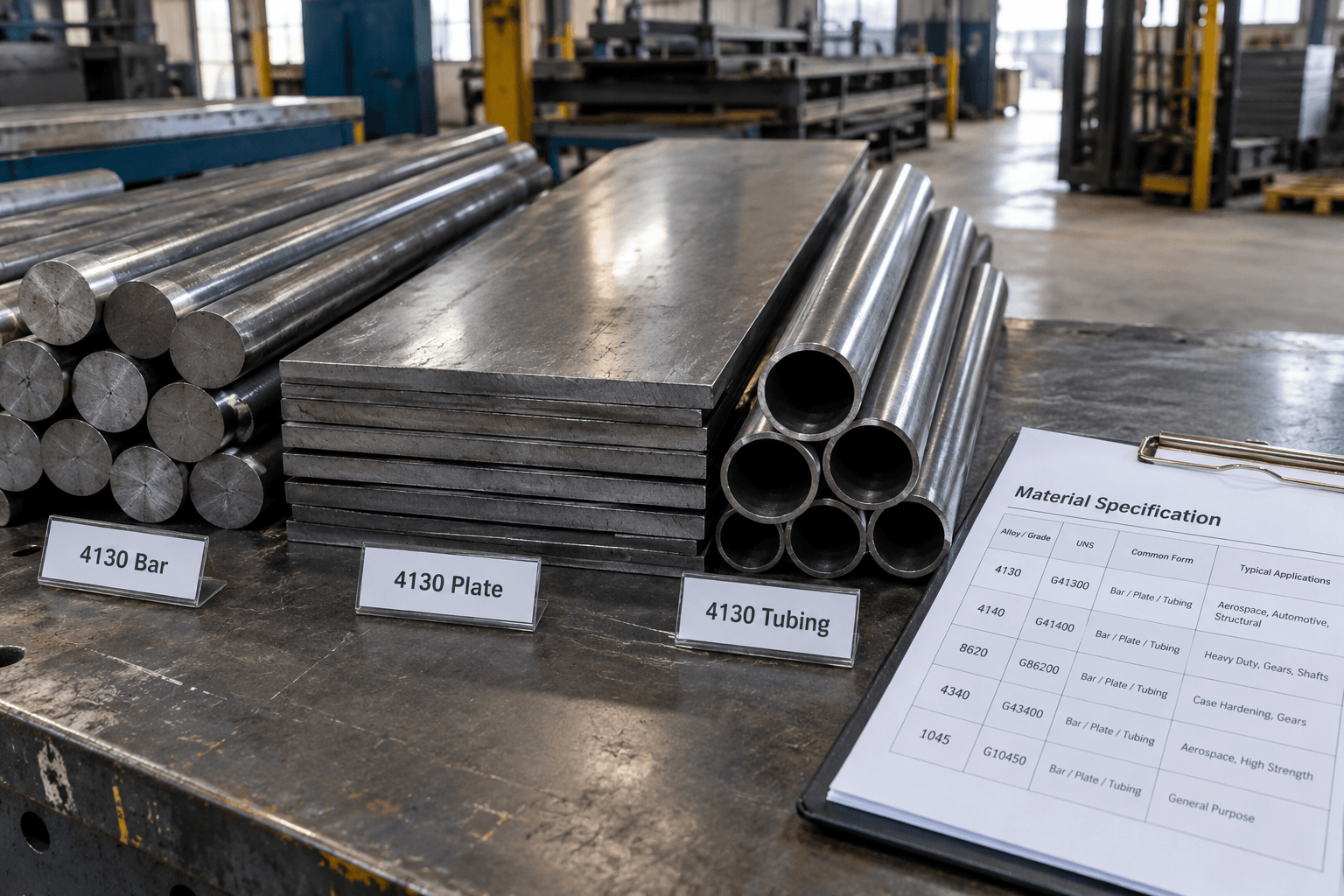
Short answer: 34CrMo4 is commonly used as a close international cross-reference for AISI 4130, but the two designations should not be treated as universally interchangeable. A valid 4130 equivalent must match the required product form, governing specification, delivery condition, chemistry limits, mechanical properties, dimensions, and fabrication requirements. A similar grade name or a comparable strength value is not enough to approve a substitution.
| Candidate | Relationship to AISI 4130 | Approval position |
|---|---|---|
| 34CrMo4 | Commonly cited international cross-reference or nearest designation | Verify the applicable product standard, chemistry, condition, and properties |
| 4130 in another specification system | May be a direct designation reference only when the specification and product form align | Confirm the exact standard and revision |
| 4140 / 42CrMo4 | Related chromium-molybdenum alloy steels with materially different chemistry and hardenability | Engineering review required; not an automatic equivalent |
| 1020 | Lower-alloy plain-carbon steel, not a direct 4130 equivalent | Requires redesign and documented engineering approval |
What the 4130 Designation Means
AISI 4130 identifies a chromium-molybdenum alloy steel within the AISI/SAE numbering system. The first two digits identify the principal alloy family, while the final two digits indicate the approximate nominal carbon level in the designation system. The number is therefore a grade designation, not a complete material specification.
The designation alone does not define whether the material is bar, plate, sheet, seamless tube, welded tube, forging, or another product form. It also does not establish whether the supplied material is annealed, normalized, quenched and tempered, or supplied in another condition. Those details affect the required properties and the way the material behaves during forming, welding, machining, and service.
For that reason, “4130 equivalent” can describe several different comparisons:
- Chemical equivalence: the specified element limits are sufficiently comparable for the intended use.
- Mechanical equivalence: the required yield strength, tensile strength, elongation, hardness, toughness, or fatigue-related properties are available in the relevant condition.
- Dimensional equivalence: the candidate is available in the required product form, outside dimensions, wall thickness, section size, and permitted tolerances.
- Application equivalence: the candidate can meet the design, joining, inspection, service, and regulatory requirements for the part.
A grade can be close in one category and unsuitable in another. The substitution decision must address all four.
4130 Equivalent Chart by Specification and Product Form
The following chart is a decision aid, not a certificate of interchangeability. The applicable product standard controls the allowable chemistry, test requirements, dimensions, tolerances, heat treatment, and certification details.
| Specification system or designation | Typical product-form question | Comparison status | What must be verified |
|---|---|---|---|
| AISI/SAE 4130 | Bar, plate, sheet, tube, forging, or other specified form | Reference grade | Product-specific specification, condition, chemistry, properties, and dimensions |
| 34CrMo4 | Often considered for bar, tube, forgings, and related alloy-steel products | Nearest commonly cited international match | Current national or international product standard, element limits, delivery condition, test method, and form |
| Other national 4130 designations | May vary by bar, plate, tube, or aerospace-related specification | Possible designation cross-reference | The exact standard number, revision, product form, and procurement condition |
| 4140 or 42CrMo4 | Usually considered when higher hardenability or strength is sought | Related alternative, not an automatic cross-reference | Carbon and alloy limits, section-size response, heat treatment, weld procedure, and design properties |
| 1020 | Plain-carbon bar, sheet, plate, or tube may be available in different forms | Non-equivalent alternative | Redesign, load and fatigue analysis, joining review, corrosion assumptions, and approval authority |
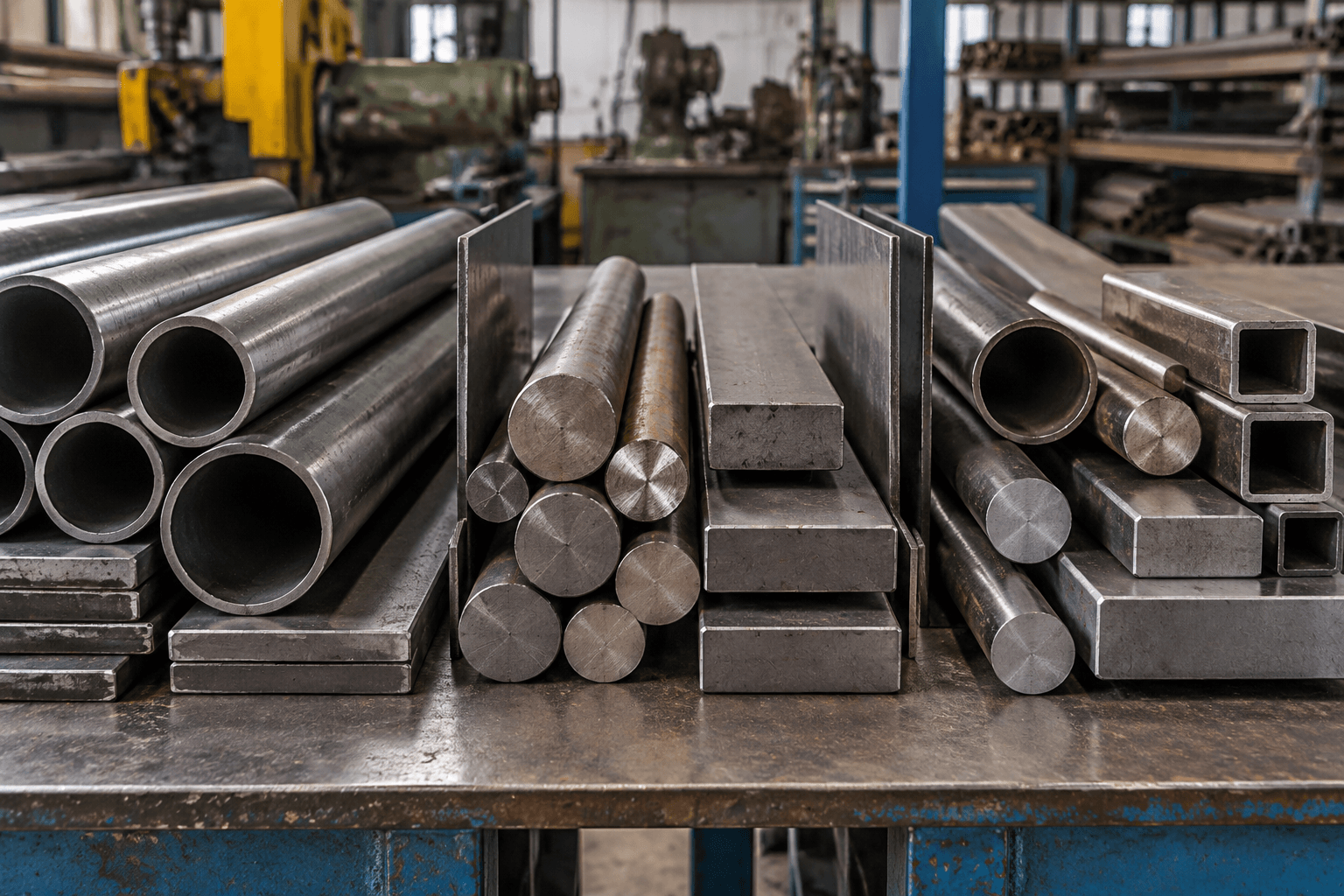
Product form is a critical boundary. A chemistry comparison for 4130 bar does not automatically validate a substitution for 4130 tubing. Tube manufacturing route, wall thickness, dimensional tolerance, seam condition, testing, and delivery condition can all differ. Likewise, a plate specification cannot be treated as interchangeable with a forging specification merely because both use the 4130 name.
When using a cross-reference table from a steel producer, standards organization, or controlled technical database, record the source, document number, revision date, product form, and condition. A cross-reference without those qualifiers is incomplete.
How Commonly Searched Grades Differ
34CrMo4
34CrMo4 is the grade most often discussed as a close international counterpart to AISI 4130. That does not mean every 34CrMo4 product has the same chemistry limits, cleanliness requirements, heat-treatment condition, mechanical-property requirements, or dimensional tolerances as a particular 4130 specification.
Before approval, compare the actual governing documents line by line. Confirm the carbon, chromium, molybdenum, manganese, silicon, phosphorus, sulfur, and any residual-element limits required by the application. Then compare the mechanical requirements in the same product form and condition. A designation-level match is a starting point for review, not the conclusion.
1020
1020 is a plain-carbon steel designation and is not a direct equivalent to 4130. It may be easier to source or fabricate for some low-demand components, but those practical advantages do not establish equal performance. Differences in alloy content, hardenability, achievable condition, strength, fatigue behavior, joining procedure, and service environment may affect the design.
Increasing wall thickness does not automatically make 1020 an acceptable replacement. The revised section must be checked for strength, stiffness, buckling, fatigue, fit, weight, weld access, and the actual loads and failure modes. That is a redesign question, not a material cross-reference.
4140 and 42CrMo4
4140 and 42CrMo4 belong to a related chromium-molybdenum family, but they are not interchangeable with 4130 by name. Their chemistry and hardenability can produce different responses across section sizes and heat-treatment conditions. A candidate that reaches a higher specified strength may also change weldability, distortion, residual stress, machining behavior, toughness, or the required joining procedure.
“Stronger” is therefore not the same as “equivalent.” The design authority must establish whether the higher or different property profile is acceptable for the part and whether the manufacturing process can support it.
How to Compare Chemistry and Mechanical Properties
Use matched conditions when comparing 4130 with a proposed alternative. A meaningful review should place the same product form, section range, heat-treatment condition, and test direction beside one another. Do not compare a normalized value for one grade with a quenched-and-tempered value for another and call the result a grade equivalence.
The chemistry review should identify the permitted range, not just a nominal composition. Pay attention to alloying elements that affect hardenability and welding, as well as residual elements and any product-specific restrictions. The mechanical review should identify the required property and its basis: minimum or typical value, test temperature, specimen orientation, section size, hardness condition, and governing test method.
Also check whether the specification provides properties for the supplied size. Heat treatment may not produce the same through-section result in thin tube, heavy bar, plate, and forgings. Mill test values for one heat or lot confirm that material, but they do not by themselves replace the design review or prove universal interchangeability.
4130 Substitution Decision Sequence
- Read the drawing and governing material document. Identify whether the requirement names AISI 4130, a product standard, a procurement specification, a heat-treatment condition, or a controlled supplier document.
- Lock the product form and dimensions. Record bar, plate, sheet, tube, forging, or another form, together with size, wall thickness, tolerances, surface condition, and delivery route.
- Define the required condition. State whether the design depends on annealed, normalized, quenched-and-tempered, cold-worked, or another condition. Do not infer condition from the grade name.
- Compare chemistry and properties. Use the applicable current specifications and matched test conditions. Identify every difference that could affect design or manufacture.
- Review fabrication consequences. Evaluate welding procedure requirements, preheat or post-weld treatment where applicable, forming limits, machining parameters, distortion, finishing, and inspection. These are consequences of the selected material and condition, not proof of equivalence.
- Confirm documentation and approval. Obtain the material certificate, heat or lot identification, test results required by the specification, and traceability records. Engineering or the responsible design authority should approve the substitution before purchasing or production.
For automotive or transportation components, the material review should remain tied to the component’s actual loads, joining method, inspection plan, and governing design requirements. A custom metal fabrication resource for automotive and transportation equipment may provide application context, but it does not replace material approval.
For machined interfaces, settle the material condition before defining machining allowances and process planning. The drawing and material specification remain the controlling documents. A machining supplier should receive the approved grade, form, condition, and inspection requirements rather than being asked to infer equivalence from a short grade name.
Documents That Confirm the Supplied Material
Request documentation that identifies the supplied grade and product form against the governing specification. Depending on the purchase requirement, this can include the heat or lot number, chemical analysis, mechanical test results, heat-treatment condition, dimensional inspection, non-destructive testing, and traceability information. The required documents should be defined by the drawing, purchase order, and applicable specification.
Check that the certificate describes the actual supplied product rather than a generic producer data sheet. Confirm that the reported condition and test results correspond to the size and form being purchased. If a substitute is proposed, retain the comparison, technical justification, and approval record with the procurement file.
4130 Equivalent
Where RFQ Assumptions Create Cost and Production Risk
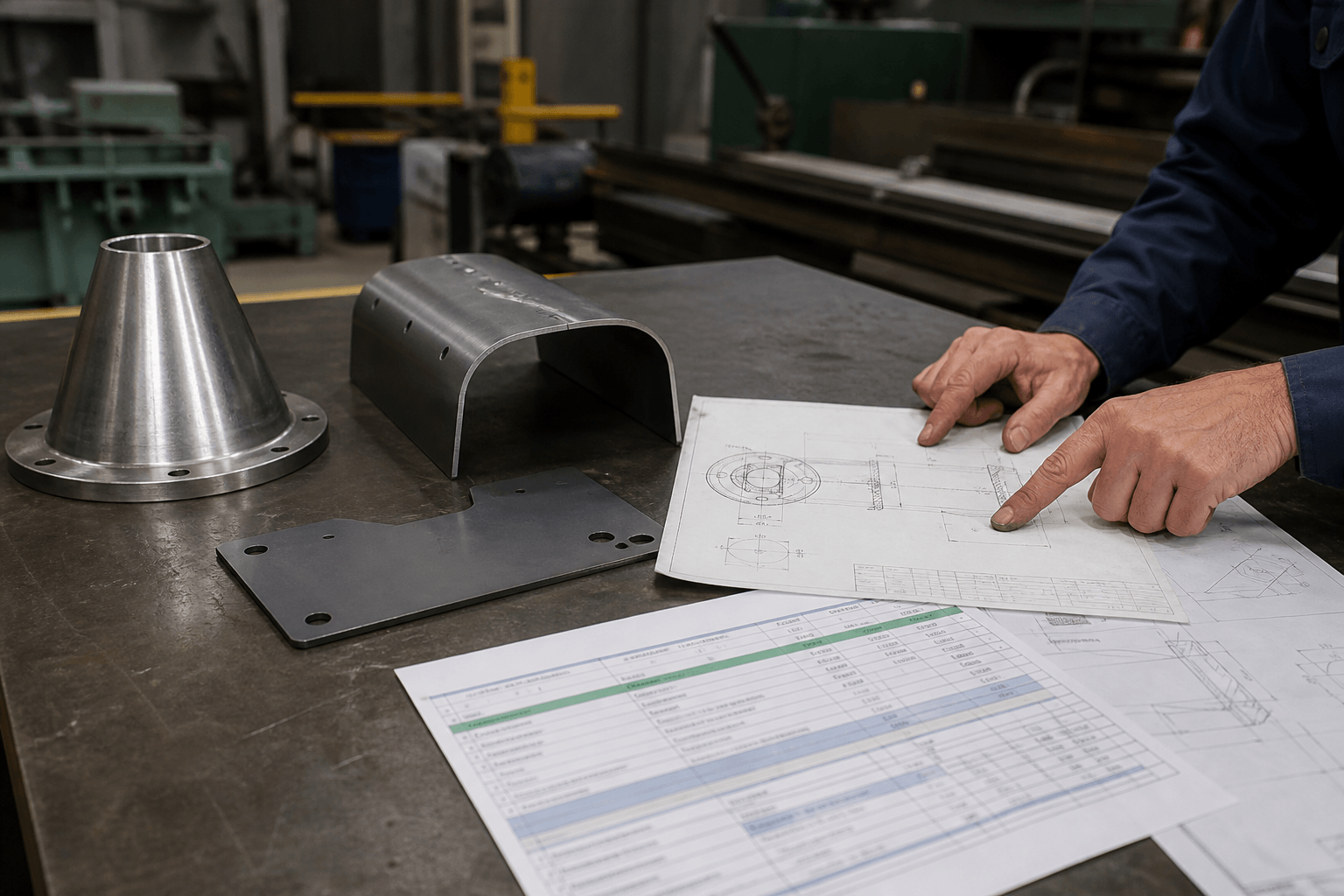
Many sheet metal fabrication problems begin before production starts. If drawings, tolerances, finish expectations, material grades, or assembly requirements are unclear, suppliers may quote based on different assumptions. That can make prices difficult to compare and may lead to rework, cosmetic rejection, assembly misalignment, or production delays later.
For OEM buyers, the goal is not simply to request the lowest price. The goal is to make sure each supplier is quoting the same manufacturing reality. Before confirming an order, clarify which dimensions are fit-critical, which surfaces are cosmetic, whether prototypes must match batch-production conditions, and how finished parts will be inspected.
Frequently Asked Questions
What 4130 equivalent details should buyers define before requesting a quote?
Buyers should define the functional requirement, drawing notes, critical dimensions, material or process expectations, and any inspection points related to 4130 equivalent. This helps suppliers quote the same manufacturing scope instead of making different assumptions.
How can RFQ details affect cost, fit, or lead time?
RFQ details can change tooling, forming, welding, finishing, inspection, or rework requirements. If buyers do not clarify it early, two supplier quotes may look comparable while covering different production risks.
Why should drawing requirements be reviewed before prototype approval?
drawing requirements may look acceptable on a single sample but become harder to control during batch production. Buyers should confirm whether the prototype reflects the same process, finish, and inspection conditions expected for production.
What inspection points matter most for 4130 equivalent projects?
Important inspection points usually include fit-critical dimensions, holes or mating areas, cosmetic surfaces, finish build-up, welded or formed features, and any dimensions that affect downstream assembly. These points should appear in the RFQ or drawing notes.
How can buyers reduce prototype approval risk before batch production?
Buyers can reduce risk by clarifying drawings, locking key material and finish assumptions, defining inspection timing, approving a representative sample, and confirming which dimensions or surfaces require tighter process control.
How can Yishang help review 4130 equivalent requirements?
Yishang can review drawings, RFQ notes, material requirements, tolerance expectations, finish details, samples, and assembly needs to identify unclear assumptions before quoting or batch production.