
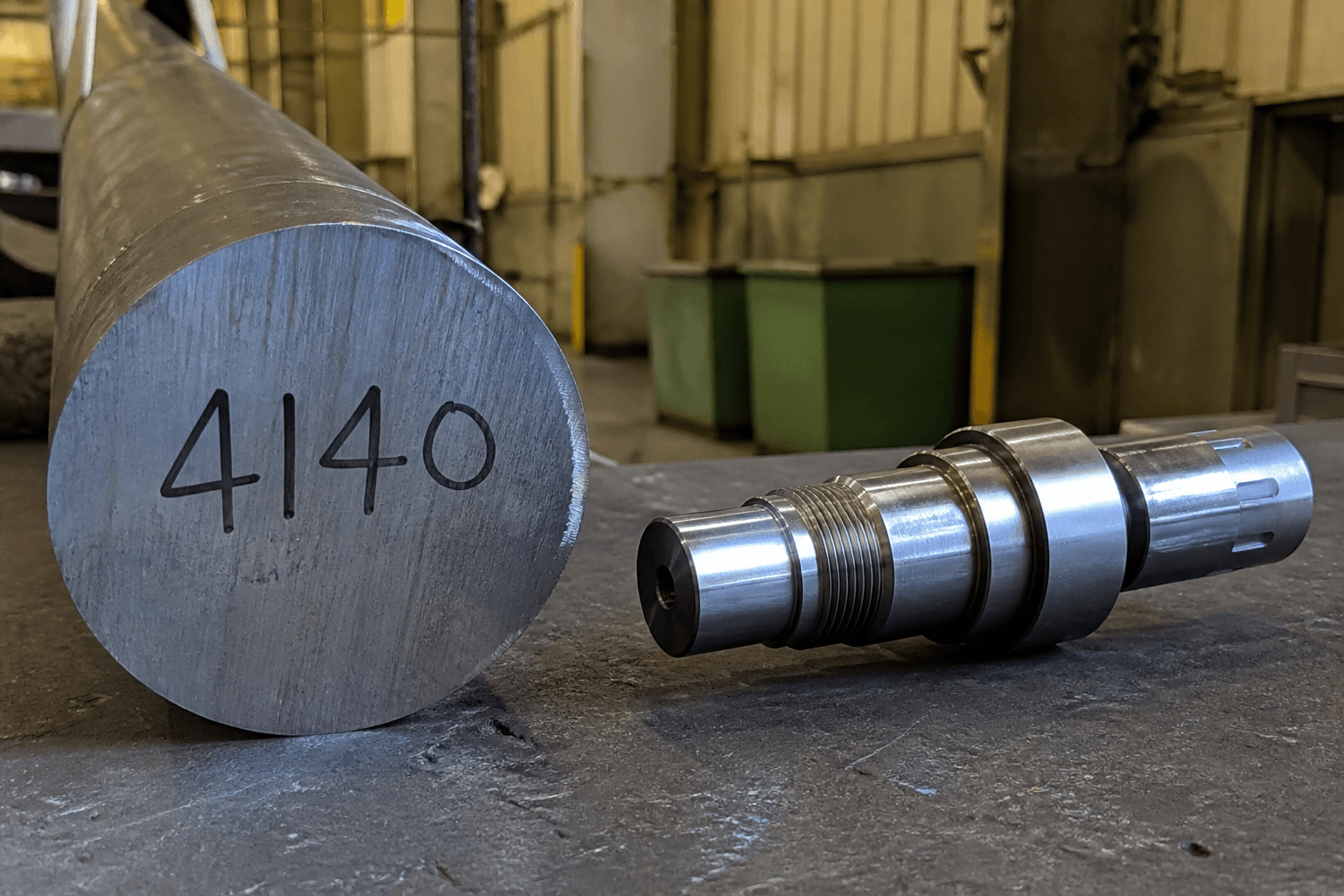
4140 metal is a medium-carbon chromium-molybdenum alloy steel valued for its combination of strength potential, toughness, hardenability, and wear resistance. The 4140 designation identifies an alloy grade, but it does not by itself define the final hardness, mechanical properties, product form, or delivery condition.
Those missing details matter. An annealed 4140 bar and a quenched-and-tempered 4140 forging can behave very differently even though both carry the same grade designation. Buyers therefore need to separate the grade name from the governing material specification and the condition required for the finished component.
What the 4140 designation means
Under the SAE/AISI designation system, 4140 belongs to the 41xx family of chromium-molybdenum alloy steels. Chromium and molybdenum are key alloying elements, which is why the grade is often called chrome-moly or chromoly steel.
The designation can be read as a compact grade identifier:
- “41” identifies the alloy family. It indicates a chromium-molybdenum steel rather than a plain carbon steel.
- “40” indicates nominal carbon content near 0.40%. Actual chemical limits are ranges defined by the applicable material specification, not by the shorthand alone.
This number does not communicate whether the material is bar, plate, tube, or forging. It also does not establish whether the steel is annealed, normalized, cold finished, or quenched and tempered. Even the term “AISI 4140” may function mainly as a grade reference unless it is connected to a recognized specification that covers the required product form and acceptance criteria.
A complete material definition therefore has several layers: nominal grade, governing specification, product form, dimensions, delivery condition, required properties, and verification documents.
Why published 4140 steel properties differ
General descriptions of 4140 emphasize strength, toughness, hardenability, and resistance to wear after suitable heat treatment. These are tendencies, not one universal property set. Published values may differ because the sources are describing different conditions, section sizes, test locations, or processing histories.
| Characteristic | General tendency | What changes the result |
|---|---|---|
| Strength | Higher strength potential than many low-carbon steels, particularly after quenching and tempering | Heat-treated condition, tempering requirements, section size, and test orientation |
| Toughness | Can provide a useful balance between strength and resistance to impact or shock loading | Hardness level, temperature, grain structure, section transition, and heat-treatment control |
| Hardenability | Chromium and molybdenum help the steel harden more deeply than plain carbon grades | Cross-section, quenching method, geometry, and chemical variation within specification limits |
| Wear resistance | Can be improved through appropriate hardening and surface engineering | Final hardness, contact pressure, lubrication, surface finish, and mating material |
| Machinability | Machinable with appropriate process planning, particularly in a suitable pre-machining condition | Hardness, microstructure, scale, stock condition, tool access, and interrupted cuts |
Annealed material is generally selected when substantial machining is required before heat treatment. Quenched-and-tempered material may reduce or eliminate later hardening operations, but its higher hardness can increase cutting forces and tool wear. Normalized material presents another structure and property profile.
Section size is especially important. A property measured from a small test coupon or near the surface of a bar may not represent the core of a large component. Consequently, typical values in a supplier datasheet should not be treated as specification minimums. The drawing or purchase document should identify the condition and the properties that actually govern acceptance.
Components that may justify considering 4140
4140 is commonly considered when a component needs more hardenability or strength potential than a basic low-carbon steel can conveniently provide. Selection should begin with the component demand rather than a familiar grade name.
- Shafts and axles: rotational loading, bending, torsion, fatigue exposure, and bearing-seat wear may support consideration of 4140.
- Pins, studs, and large fastener-type parts: the combination of shear loading, impact, and localized contact stress may require a controlled strength-and-toughness balance.
- Gears, sprockets, and power-transmission parts: tooth loading and wear can make hardenability and final hardness important, although the complete gear design and heat-treatment route remain decisive.
- Tooling and machine components: fixtures, holders, rolls, arbors, and other loaded parts may benefit from the grade’s heat-treatment response.
- Transportation-equipment components: loaded pivots, couplings, or drivetrain-related parts may be candidates, subject to the applicable design rules and validation.
These are application categories, not automatic approvals. Fatigue life, fracture risk, operating temperature, corrosion exposure, welding, geometry, inspection requirements, and applicable industry regulations must all be evaluated. Safety-critical parts require engineering validation under their governing standards.
4140 compared with 1018 and 4130
Neither 1018, 4130, nor 4140 is universally better. They address different combinations of fabrication needs, section geometry, mechanical performance, and cost. Comparisons are meaningful only when product form and material condition are reasonably equivalent.
| Selection factor | 1018 | 4130 | 4140 |
|---|---|---|---|
| Material family | Low-carbon plain carbon steel | Lower-carbon chromium-molybdenum alloy steel | Medium-carbon chromium-molybdenum alloy steel |
| Strength and hardness potential | More limited through-hardening response; often chosen without high bulk hardness | Greater hardenability than low-carbon steel, with lower carbon than 4140 | Higher hardness and strength potential through suitable heat treatment |
| Forming and welding considerations | Often more forgiving for forming and conventional welding | Frequently considered where alloy-steel performance and fabrication must be balanced | Higher carbon content makes welding and forming more condition-dependent |
| Typical selection logic | General machined parts, brackets, spacers, and components not requiring high hardenability | Tubular structures and loaded parts where its lower carbon level or available product specifications fit the design | Shafts, pins, gears, tooling, and other components needing greater strength or hardenability potential |
Choose 1018 when easy fabrication and moderate mechanical demands dominate. Consider 4130 when an alloy steel is required but lower carbon content, weldability considerations, or a particular tubing or product specification favors it. Consider 4140 when section hardening, wear behavior, or higher strength potential is central to the design.
Weldability should not be reduced to a simple yes-or-no label. Joint thickness, restraint, material condition, filler selection, preheat, post-weld requirements, and the consequences of changing the heat-treated microstructure all affect procedure development.
A 4140 callout is more than a grade number
A drawing note that says only “Material: 4140” leaves several sourcing and inspection questions unanswered. A clearer callout separates each requirement so that the mill, distributor, heat treater, machine shop, and buyer are evaluating the same material.
A placeholder-based callout might be structured as follows:
[governing specification and revision], grade 4140, , [delivery or heat-treated condition], [required mechanical property or hardness range], measured at [specified location and method], dimensions [applicable requirements], documentation [required certificate or test report].

- Governing specification: State the material standard applicable to the product form. A specification for bar may not govern plate, tubing, or forgings.
- Product form and route: Identify bar, plate, tube, or forging and, where relevant, hot-rolled, cold-finished, peeled, ground, or another required supply route.
- Condition: Define annealed, normalized, quenched and tempered, or another explicitly required condition. If heat treatment occurs after rough machining, show who controls it and which final requirements apply.
- Critical properties: Specify drawing-controlled mechanical or hardness requirements rather than assuming the grade automatically provides them. Include the test location when surface-to-core variation matters.
- Dimensions and allowances: State stock dimensions, machining allowance, straightness, surface condition, decarburization limits, or other features when they affect production.
- Verification: Identify whether a material certificate, chemical analysis, mechanical test results, hardness report, heat-treatment record, or traceability information is required.
An AISI 4140 equivalent material should not be accepted from a cross-reference chart alone. Compare the proposed grade’s composition limits, mechanical requirements, heat-treatment condition, dimensional standard, cleanliness or quality provisions, testing rules, and governing specification. The word “equivalent” may indicate similarity, not automatic interchangeability.
In short, 4140 is a versatile alloy grade, not a finished performance specification. Defining its form, condition, required properties, and verification method is what turns the grade name into a usable engineering requirement.
Frequently Asked Questions
Is 4140 the same material in annealed and quenched-and-tempered conditions?
The nominal grade is the same, but the microstructure, hardness, strength, toughness, residual stress, and machining behavior can differ substantially. Drawings and orders should state the required condition rather than relying on “4140” alone.
What should be checked before accepting an AISI 4140 equivalent material?
Check composition limits, governing standard, product form, dimensions, delivery condition, required mechanical properties, heat-treatment requirements, test methods, and documentation. Approval may also require an engineering review because two similarly named grades are not necessarily interchangeable.
How does 4140 differ from 1018 steel?
1018 is a low-carbon plain carbon steel generally favored for easier forming, welding, and moderate-duty machined parts. 4140 contains chromium and molybdenum and has more carbon, giving it greater hardenability and strength potential but making fabrication and heat-treatment control more important.
Is 4140 metal suitable for firearm components?
The grade is used in some regulated-product supply chains, but the name 4140 does not establish suitability for any firearm component. Suitability must be determined from the specific design, loads, dimensions, heat-treated condition, applicable law, governing specification, inspection plan, and validation requirements. A generic material description is not a safety approval.