
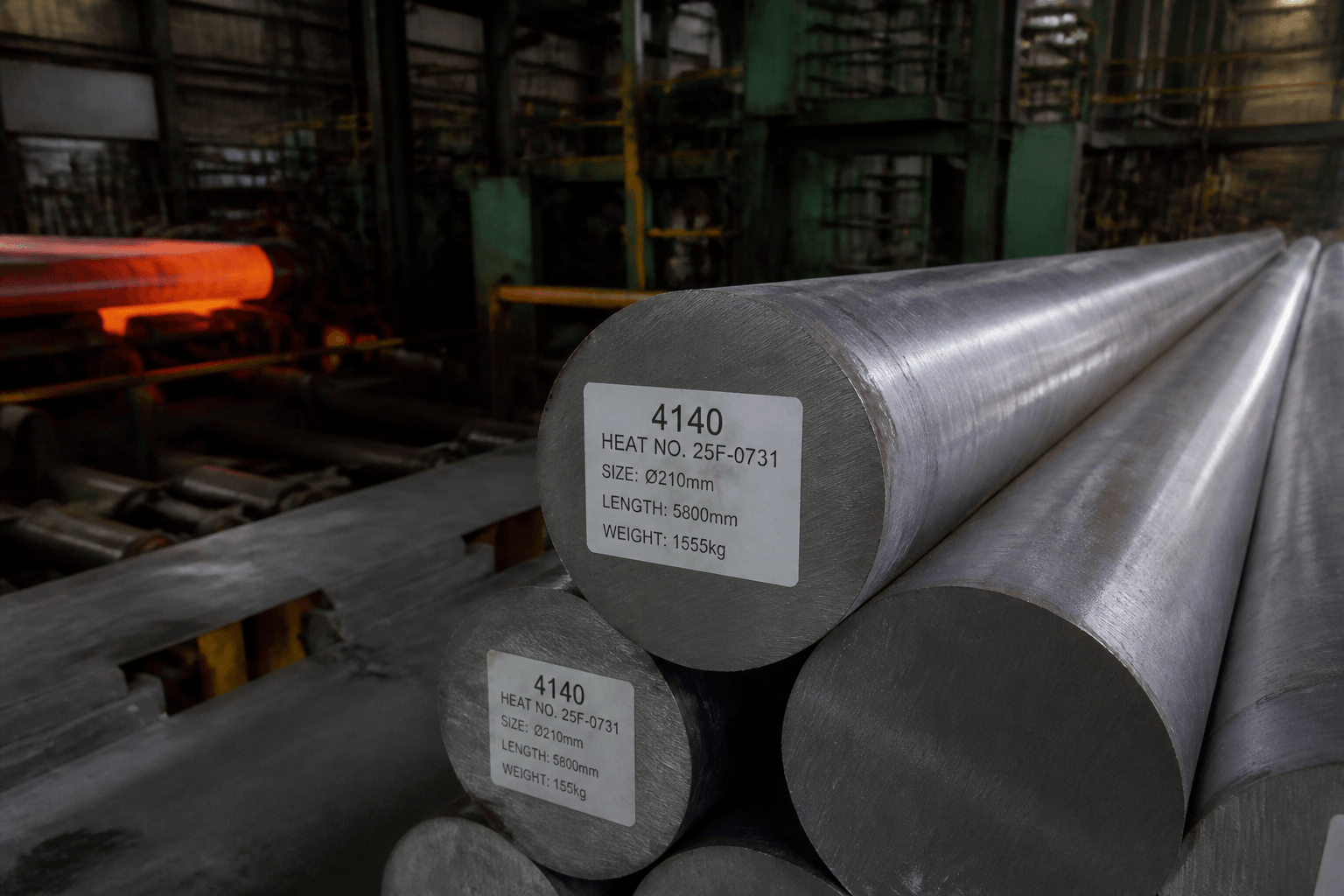
4140 steel is a chromium-molybdenum alloy steel containing carbon, manganese, silicon, chromium, and molybdenum, with phosphorus and sulfur controlled as residual or maximum-limit elements. The exact chemistry that applies to supplied material depends on the governing specification, product form, specification revision, and purchase requirements. The designation AISI 4140 identifies a grade family, but the label alone does not verify that a particular bar, tube, plate, or other product complies with a required standard.
For a conventional bar purchase, ASTM A29/A29M is one commonly referenced general specification for carbon and alloy steel bars. The table below shows the commonly published 4140 chemistry associated with that specification basis. Before using these values for acceptance, confirm the applicable edition, product form, and supplementary requirements on the purchase order or drawing.
| Element | Commonly cited 4140 composition, % | How to interpret the value |
|---|---|---|
| Carbon (C) | 0.38-0.43 | Controlled range; contributes to the grade’s response to hardening, but does not by itself establish finished properties. |
| Manganese (Mn) | 0.75-1.00 | Controlled alloying range in the cited chemistry basis. |
| Silicon (Si) | 0.15-0.35 | Controlled range; the applicable specification remains the acceptance authority. |
| Chromium (Cr) | 0.80-1.10 | Primary alloying addition associated with the 4140 grade designation. |
| Molybdenum (Mo) | 0.15-0.25 | Primary alloying addition associated with the 4140 grade designation. |
| Phosphorus (P) | 0.035 maximum | Maximum limit rather than a target amount. |
| Sulfur (S) | 0.040 maximum | Maximum limit rather than a target amount. |
These values should be read as specification chemistry, not as a promise of hardness, tensile strength, weldability, machinability, or service life. The certificate for the supplied heat should report the actual measured results, and those results must be checked against the governing specification rather than against an informal composition table.
Why 4140 Composition Tables Differ
Two credible references can show different 4140 values because they may be describing different things. A grade designation can identify a chemistry family, while a material standard defines requirements for a particular product form or supply condition. A bar specification may not be interchangeable with a plate, tube, forging, aerospace, or customer-specific specification. The specification revision can also change wording, supplementary requirements, or permitted limits.
It is also important to separate three types of numbers:
- Nominal or commonly cited chemistry: a reference description of the grade, often presented as a range or representative value.
- Specification limits: the minimum, maximum, or bounded range that the applicable standard permits for the ordered product.
- Heat analysis: the actual laboratory result reported for the melt or heat supplied to the customer.
A supplier certificate may therefore show results that are not centered in the published range while still complying with the governing specification. Conversely, a value that appears reasonable in a general 4140 chart may fail the purchase requirement if the order invokes a different product-form standard or additional chemistry restriction. The purchase order, drawing, and referenced specification control.
AISI 4140, ASTM References, AMS Designations, and Related Grades
AISI 4140 is commonly used as a grade designation. ASTM A29/A29M is a material specification that can define requirements for certain steel bar products. An AMS designation is a separate specification system with its own scope and requirements. These terms should not be treated as interchangeable labels.
| Reference type | What it tells the reviewer | What it does not establish by itself |
|---|---|---|
| AISI 4140 | A commonly recognized alloy-steel grade designation and chemistry family. | It does not identify the product form, specification revision, supplied condition, certification requirement, or acceptance criteria. |
| ASTM A29/A29M 4140 | A specification basis for applicable steel bar products when it is explicitly invoked by the order. | It does not automatically govern plate, tube, forging, powder, or another product covered by a different specification. |
| AMS 4140-related designation | A reference to an aerospace material specification that must be read in its complete form. | A similar grade number does not prove identical chemistry, processing, testing, or interchangeability. |
| Nearby alloy designation | A potentially related grade that requires a documented chemistry comparison. | Similarity in chromium, molybdenum, or carbon content does not prove substitution is acceptable. |
A comparison with another grade is meaningful only when the applicable specifications are identified and their chemistry requirements are compared directly. The same caution applies to B7 references: a B7 material designation may be associated with a particular fastener specification and product requirement, but it should not be treated as automatically identical to generic AISI 4140 bar. Grade chemistry alone does not establish interchangeability.

What Chemistry Indicates About 4140
The chromium and molybdenum additions help distinguish 4140 from plain carbon steel and are relevant to how the material responds to processing. Carbon, manganese, chromium, and molybdenum also affect the material’s response to hardening. However, composition is only one part of the engineering record.
Finished properties can depend on heat-treatment condition, section size, processing history, test location, and the requirements of the governing product specification. A chemistry certificate cannot by itself prove that a part meets a required hardness or tensile range. Those claims require the applicable mechanical-property requirements and, where required, test documentation.
The same boundary applies to welding, machining, and service selection. A composition table can help identify the grade family, but it cannot replace a qualified welding review, a machining assessment, a drawing requirement, or design data for the intended service. Annealed 4140, quenched-and-tempered 4140, and other supplied conditions may have different property requirements even when the nominal grade chemistry is related.
How to Check an AISI 4140 Chemistry Certificate
- Confirm the required grade and governing specification. Check whether the order calls for AISI 4140, ASTM A29/A29M 4140, an AMS designation, or another complete material specification. Record the applicable revision when the purchase documents identify one.
- Confirm the product form and dimensions. Identify whether the material is bar, plate, tube, forging, powder, or another form. Product form can determine which specification and chemistry requirements apply.
- Match the heat number. The heat number on the material certificate should correspond to the marking, bundle documentation, or traceability record for the supplied material.
- Review the certificate chemistry. Compare each reported element result with the limits in the governing specification. Do not compare only the carbon, chromium, or molybdenum values while ignoring phosphorus, sulfur, or other listed elements.
- Check the supplied condition and required tests. Confirm that the certificate identifies the ordered condition and includes the mechanical or supplementary test documentation required by the purchase order. Chemistry compliance does not replace condition or property verification.
- Match the certificate to the drawing and purchase order. Confirm that the grade, specification, product form, dimensions, condition, heat number, and documentation requirements are consistent across the records.
- Escalate discrepancies before acceptance. If the certificate uses a different standard, omits the heat number, reports an unexpected product form, or lacks required test information, ask the supplier or responsible engineer to resolve the discrepancy before the material is released.
For a custom component, verified stock chemistry is only one input to material approval. A drawing or purchase specification should define the required grade, governing standard, product form, supplied condition, and documentation. The later machining route, including custom CNC machining from first sample to repeat production, should be evaluated separately from the question of whether the raw material chemistry complies.
Specification Review for a 4140 Material Request
When requesting a material or machined component, provide the required grade and governing specification, product form and dimensions, supplied condition, and the relevant drawing or purchase specification. Include the material certificate details already available, especially the heat number and reported chemistry. This allows the chemistry question and any interchangeability question to be reviewed against the actual procurement requirement rather than against the label “4140” alone.
Where RFQ Assumptions Create Cost and Production Risk
Many sheet metal fabrication problems begin before production starts. If drawings, tolerances, finish expectations, material grades, or assembly requirements are unclear, suppliers may quote based on different assumptions. That can make prices difficult to compare and may lead to rework, cosmetic rejection, assembly misalignment, or production delays later.
For OEM buyers, the goal is not simply to request the lowest price. The goal is to make sure each supplier is quoting the same manufacturing reality. Before confirming an order, clarify which dimensions are fit-critical, which surfaces are cosmetic, whether prototypes must match batch-production conditions, and how finished parts will be inspected.

Frequently Asked Questions
What 4140 steel composition details should buyers define before requesting a quote?
Buyers should define the functional requirement, drawing notes, critical dimensions, material or process expectations, and any inspection points related to 4140 steel composition. This helps suppliers quote the same manufacturing scope instead of making different assumptions.
How can RFQ details affect cost, fit, or lead time?
RFQ details can change tooling, forming, welding, finishing, inspection, or rework requirements. If buyers do not clarify it early, two supplier quotes may look comparable while covering different production risks.
Why should drawing requirements be reviewed before prototype approval?
drawing requirements may look acceptable on a single sample but become harder to control during batch production. Buyers should confirm whether the prototype reflects the same process, finish, and inspection conditions expected for production.
What inspection points matter most for 4140 steel composition projects?
Important inspection points usually include fit-critical dimensions, holes or mating areas, cosmetic surfaces, finish build-up, welded or formed features, and any dimensions that affect downstream assembly. These points should appear in the RFQ or drawing notes.
How can buyers reduce prototype approval risk before batch production?
Buyers can reduce risk by clarifying drawings, locking key material and finish assumptions, defining inspection timing, approving a representative sample, and confirming which dimensions or surfaces require tighter process control.
How can Yishang help review 4140 steel composition requirements?
Yishang can review drawings, RFQ notes, material requirements, tolerance expectations, finish details, samples, and assembly needs to identify unclear assumptions before quoting or batch production.