
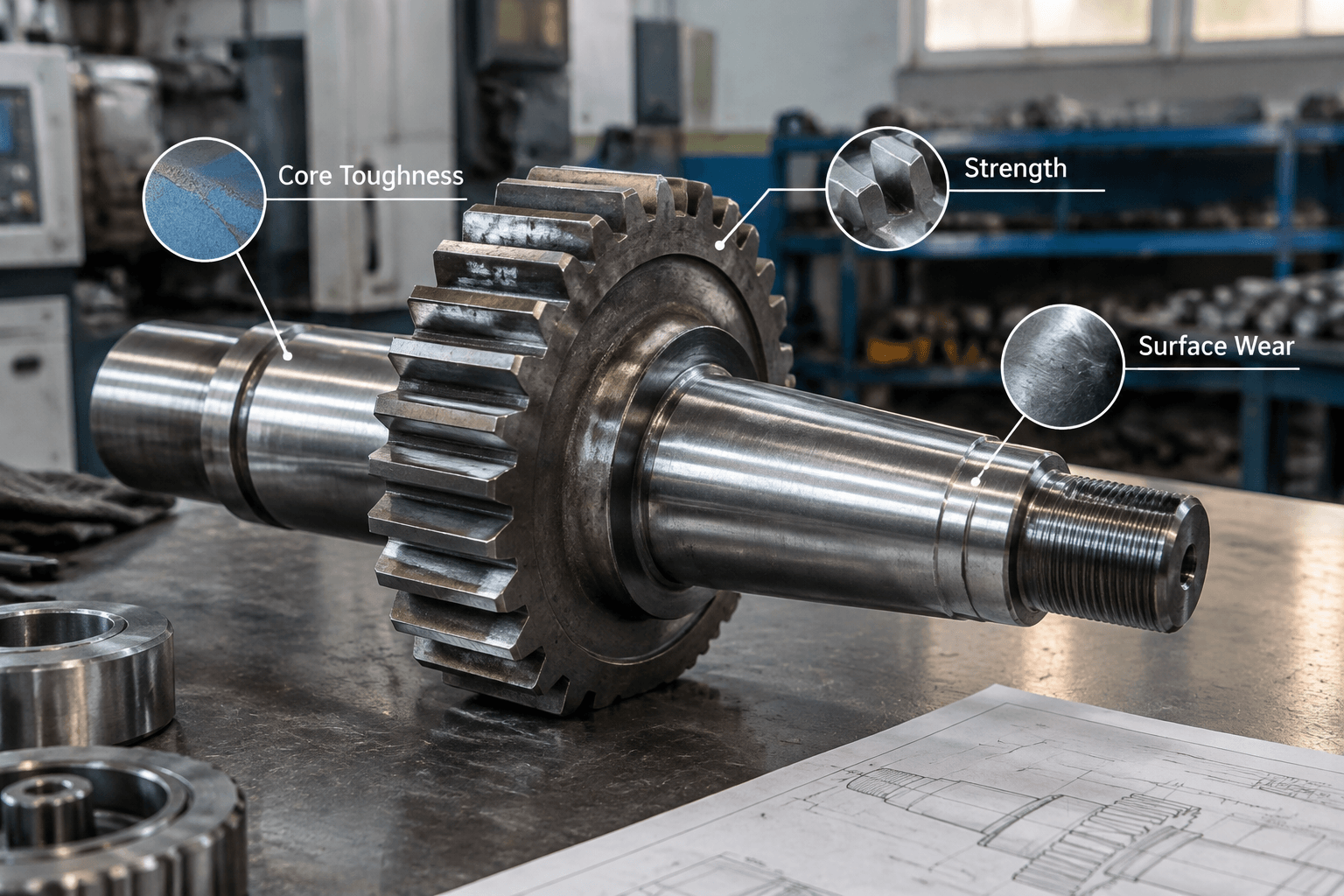
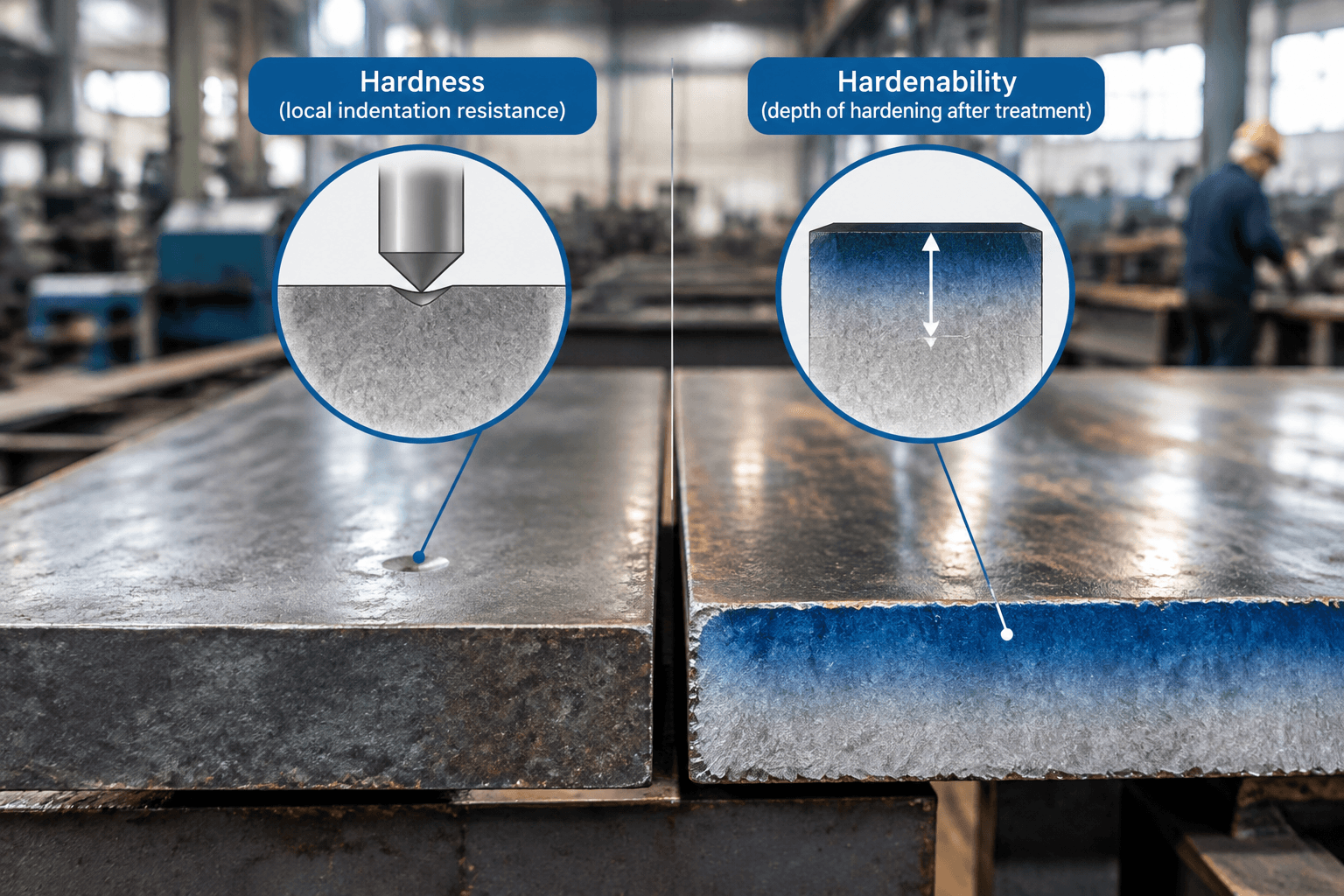
4140 steel is a medium-carbon chromium-molybdenum low-alloy steel whose defining properties include good hardenability and a useful balance of strength, toughness, and wear resistance after suitable heat treatment. Its hardness and strength depend on material condition; it is not stainless and normally needs protection against corrosion. Hardenability describes how deeply steel can harden during treatment, rather than how hard a delivered piece already is.
What gives 4140 its engineering properties?
Carbon enables substantial hardening through martensite formation. Chromium and molybdenum help delay transformation during cooling, allowing hardening deeper into a section than is generally possible with a plain-carbon steel of similar carbon content. Actual results still depend on section dimensions, austenitizing conditions, and cooling rate.
This response makes 4140 useful for components requiring a strong, tough core. However, alloy identity alone cannot establish impact resistance, fatigue life, or surface durability. Those outcomes also depend on processing, geometry, surface condition, and service environment.
Chromium content does not make 4140 stainless. Likewise, molybdenum does not establish a universal elevated-temperature rating: operating temperature, exposure time, prior tempering, and applicable design requirements must be considered.
4140 properties: what the value depends on
Physical properties such as density support mass estimates. Mechanical properties describe behavior under loading: elastic modulus measures stiffness and changes relatively little with heat treatment, while hardness, strength, and toughness depend strongly on material condition. The following map distinguishes typical reference values from condition-dependent behavior.
| Property | Meaning or representative value | Context needed |
|---|---|---|
| Density | Approximately 7.85 g/cm³ | Typical near-room-temperature reference value, suitable for preliminary mass estimates. |
| Elastic modulus | Approximately 190–210 GPa | Typical ambient-temperature reference range; describes elastic stiffness, not yield strength. |
| Hardenability | Ability to develop hardness through a section during quenching | Composition, prior structure, section size, and cooling conditions. |
| Hardness | Resistance to local indentation | Delivery condition, treatment, test method, and measurement location. |
| Strength | Yield strength marks plastic deformation; tensile strength is the maximum engineering tensile stress | Heat treatment, section size, specimen location, and test conditions. |
| Toughness | Ability to absorb energy and resist fracture | Microstructure, temperature, notch geometry, orientation, and test method. |
| Wear resistance | Resistance to material loss during surface interaction | Hardness, surface treatment, counterface, lubrication, and wear mechanism. |
The physical figures above are typical reference data reported by AZoM’s AISI 4140 material overview, not purchase-specification limits. They support preliminary calculations; temperature-specific design work needs data covering the actual operating range.
Increasing hardness through treatment does not produce a comparable increase in elastic stiffness. Two otherwise identical shafts can therefore have similar elastic deflection while differing substantially in the load that causes permanent deformation.
Mechanical values require a more specific record. A tensile result from a small heat-treated test bar cannot automatically describe the center of a large forging. Use values tied to the actual condition and relevant section, with traceable testing where required.
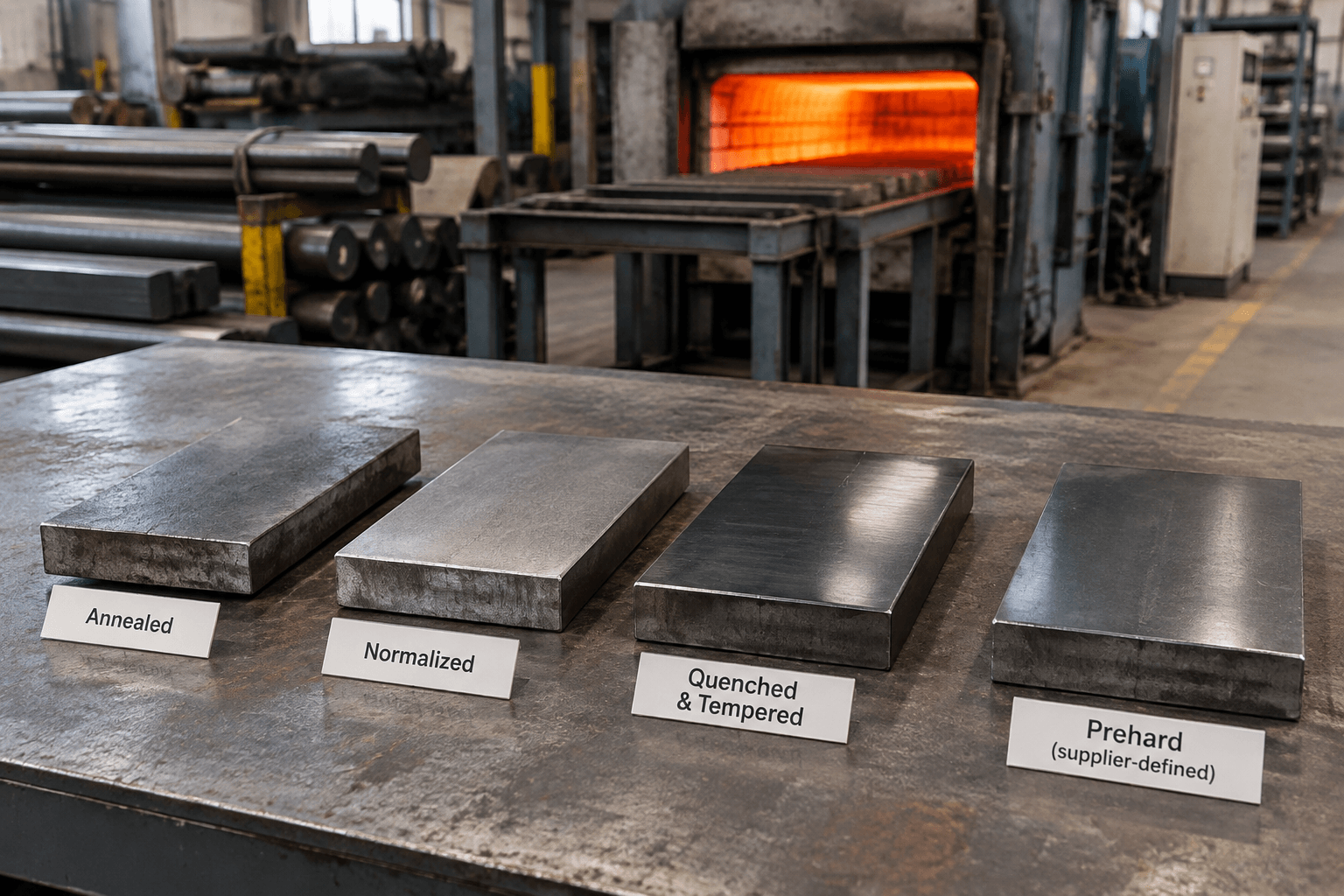
How delivery condition changes the property balance
Annealed 4140 is processed toward a softer structure, commonly involving ferrite and pearlite, to support machining or subsequent processing. Annealing can involve different cycles, so the word alone does not define an exact hardness. Parts may need further treatment to achieve their final service properties.
Normalized 4140 is heated into the austenitic range and air cooled. Compared with full annealing of comparable stock, normalization generally produces a finer structure and higher strength. Cooling depends on section size, so normalized stock should not be assumed to have one microstructure or hardness throughout every product form.
Quenched-and-tempered 4140 is quenched to form martensite to the extent permitted by cooling and hardenability, then tempered. Tempering generally reduces as-quenched hardness while improving ductility and toughness. The balance depends on the tempering treatment; quenching alone is not the usual finished condition for loaded engineering components.
“Prehard” commonly describes material supplied already hardened and tempered for machining in that condition. “HT” often means heat treated, but its meaning must be confirmed. Neither label establishes a universal yield strength or hardness. Interlloy’s 4140 product documentation, for example, identifies a hardened-and-tempered supply condition and connects properties to ruling section size. Such supplier descriptions are product-specific rather than universal grade requirements.
For a schematic distinction, imagine an indentation at one point on a shaft: that measures local hardness. A hardness traverse from surface to center after treatment reveals the depth and distribution of hardening. A hard surface alone does not demonstrate a hard core.
Why shafts, gears, and loaded components use 4140
Shafts and axles experience torsion, bending, or both. Suitable treatment can provide strength against permanent deformation while retaining toughness around shoulders and changes in section. Fatigue assessment must also consider fillet radii, keyways, surface finish, residual stress, and the loading spectrum.
Gears and pinions combine tooth-root bending with contact loading. Core strength and toughness support the tooth, while surface hardness and lubrication influence contact damage and wear. Where localized hardening is specified, surface and core requirements need separate attention. Tensile strength alone cannot establish gear durability.
Pins, studs, and tooling components may require resistance to bending, shock, or repeated contact. In a hypothetical pivot-pin application, increasing hardness could reduce one form of wear while reducing tolerance of impact or misalignment. Contact pressure, contamination, lubrication, and replacement strategy all affect the appropriate balance.
Processing also matters. Higher hardness generally makes conventional machining more demanding. Planning CNC machining of a specified material condition should account for cutting access, finishing allowance, and distortion from subsequent treatment. Welding requires particular care because hardenable heat-affected zones and hydrogen can increase cracking risk; a qualified procedure must address the actual joint and condition.
How 4140 compares with 1045 and 4340
| Grade | Metallurgical distinction | Engineering implication |
|---|---|---|
| 1045 | Medium-carbon plain-carbon steel | Generally lower hardenability; section size becomes especially important when seeking core properties. |
| 4140 | Medium-carbon chromium-molybdenum alloy steel | Greater hardenability supports a useful range of strength and toughness after appropriate treatment. |
| 4340 | Medium-carbon nickel-chromium-molybdenum alloy steel | Generally higher hardenability, useful when through-section treatment response is demanding. |
4340 is not automatically harder or stronger than 4140: different tempering conditions can reverse that comparison. Compare matching product forms, section sizes, treatments, and tests. Cross-standard grade names also require specification review before substitution. Price depends on condition, form, dimensions, quantity, and market availability.
If you are moving toward component planning, share the drawing or intended use, known material condition, and performance requirements with Yishang for an initial custom manufacturing discussion. Material suitability and process feasibility need assessment for the specific project.