
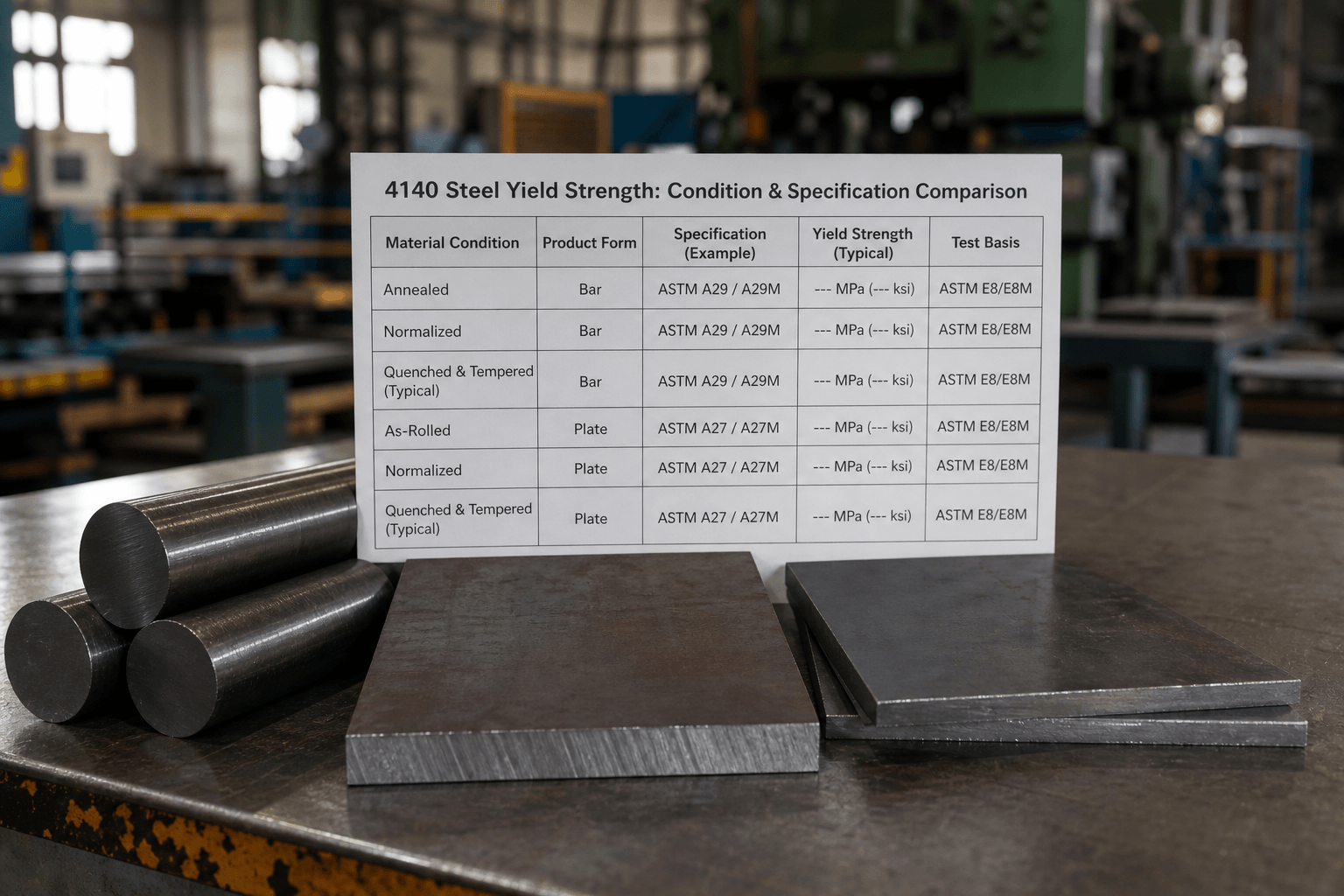
4140 steel does not have one universal yield-strength value. Its applicable yield strength depends on the material condition, product form, governing specification, specimen orientation, test temperature, and test method.
Short answer: To use a 4140 steel yield-strength value in a design, you must identify how the material was supplied or heat treated and then confirm the applicable minimum or measured value in the relevant material specification or test report. A value copied from a general 4140 chart is not sufficient unless those conditions match the component being designed.
This distinction matters because two parts both labelled “4140” can have substantially different mechanical properties. Annealed stock, normalized material, and quenched-and-tempered material are not interchangeable simply because the alloy designation is the same.
What Is the Yield Strength of 4140 Steel?
Yield strength is the stress at which a material begins to deform plastically. Below this point, a properly defined test specimen may return close to its original shape when the load is removed. Above it, permanent deformation can remain. For a loaded shaft, bracket, coupling, tooling component, or machined housing, the design may use yield strength to assess whether the part will take a permanent set under a specified static load.
Yield strength is different from tensile strength. Tensile strength is the maximum engineering stress reached during a tensile test before the specimen begins to lose load-carrying capacity through necking or proceeds to fracture. A material can have a high tensile strength but still require separate confirmation of its yield strength and ductility.
Hardness is also a different measurement. It indicates resistance to localized indentation or penetration under a defined hardness test. Hardness may provide useful evidence that a heat-treatment condition is in the expected range, but hardness alone does not prove yield strength, toughness, fatigue performance, or wear life.
For 4140, a responsible property statement therefore needs more than the alloy name. It should identify the condition, product form and dimensions, applicable specification, test basis, and whether the reported result is a required minimum or an individual measured result.
Why Two 4140 Parts Can Have Different Yield Strengths
4140 is a medium-carbon chromium-molybdenum alloy steel. Its alloy content supports hardenability, allowing the material to develop different combinations of strength, hardness and toughness through processing. The final property is controlled by the material condition and by factors such as section size and cooling history, not by the nominal grade alone.
| Material condition | What it generally indicates | What must be verified before using a yield value |
|---|---|---|
| Annealed | A relatively softened condition commonly selected to improve forming or machining before later processing. | The specified annealing condition, product form, dimensions, and the governing mechanical-property requirement. |
| Normalized | A heat-treated condition with a refined structure compared with an untreated or differently processed product. | The normalization procedure or supply designation, section size, specimen direction, temperature, and test method. |
| Quenched and tempered | A condition selected to develop a controlled balance of strength, hardness and toughness. | The specified treatment condition, tempering requirement, hardness limits where applicable, and certified mechanical results. |
| Otherwise specified | A purchaser or material standard may define a particular treatment, hardness range, or mechanical-property class. | The exact specification and revision, product form, test location, specimen orientation, temperature, and acceptance criteria. |
Product form also affects how a property value should be interpreted. Bar, plate, forged stock and a finished machined component may be covered by different requirements. A large section can cool differently from a small section during heat treatment, so a property measured in one location or on one size of product may not represent every location in a larger part.
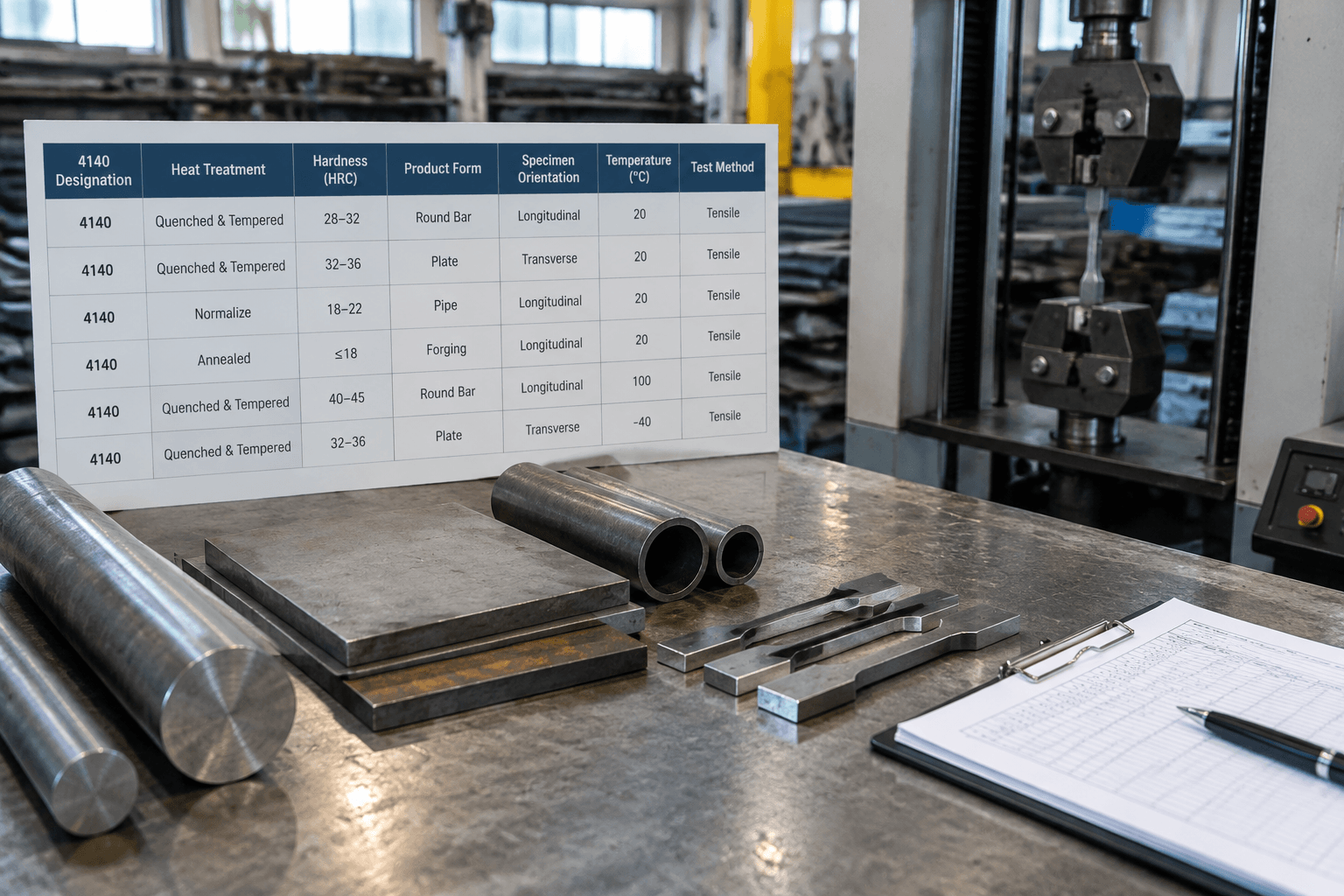
Specimen direction is another important variable. A tensile specimen taken longitudinally may not provide the same result as one taken transversely. Test temperature can also change the measured response, particularly where the component will operate outside normal room-temperature conditions. These details should accompany every numerical yield-strength claim.
How to Read a 4140 Mechanical-Properties Table
Published tables often combine values from different conditions, product forms or sources. Before using one in a calculation, check the following points:
- Identify the governing document. Confirm the material standard, product specification, drawing requirement or purchase specification that defines the grade and condition. “4140” by itself is not a complete procurement requirement.
- Confirm the product form. Check whether the data applies to bar, plate, forgings, tube, or another form, and whether the dimensions fall within the stated range.
- Separate minimum from typical. A minimum specified yield strength is an acceptance threshold. A typical value is an observed or representative result and should not automatically be used as the guaranteed design basis.
- Check the test basis. Review the tensile test method, specimen geometry, specimen direction, test temperature, and reported offset or yield definition where applicable.
- Check the condition. Match the annealed, normalized, quenched-and-tempered, or other stated condition to the material that will actually be supplied and used.
- Review the certificate or report. Confirm that the heat or lot identification, product description, condition, test results and acceptance requirements correspond to the ordered material.
This sequence also helps prevent a common mistake: using hardness as a substitute for a tensile property. A hardness value may be useful for process control or condition confirmation, but it is not automatically a conversion to yield strength. Any relationship between hardness and tensile properties depends on the material, condition and applicable correlation, and it should not replace the required mechanical test evidence.
Comparing 4140 With 4130, Mild Steel and Grade 8
Questions such as “Is 4140 stronger than 4130?” are incomplete unless the comparison basis is defined. Alloy name, without condition and product form, does not determine which part will perform better in a real application.
| Comparison | Useful engineering question | Important qualification |
|---|---|---|
| 4140 versus 4130 | Which specified conditions provide the required strength, toughness, hardenability and machinability? | Both are alloy steels, but their chemistry, hardenability, heat-treatment response and specified properties may differ. Compare matched conditions and specifications. |
| 4140 versus mild steel | Is the additional alloy content and heat treatment justified by the load, wear, fatigue or section-size requirement? | “Mild steel” covers a broad group of lower-carbon products. It is not one precise comparison grade or one guaranteed property set. |
| 4140 versus grade 8 | Are you comparing a material grade with a finished fastener property class for the same failure mode? | Grade 8 is a fastener strength classification, not an interchangeable 4140 material designation. Thread geometry, preload, proof requirements and fastener standards also affect the comparison. |
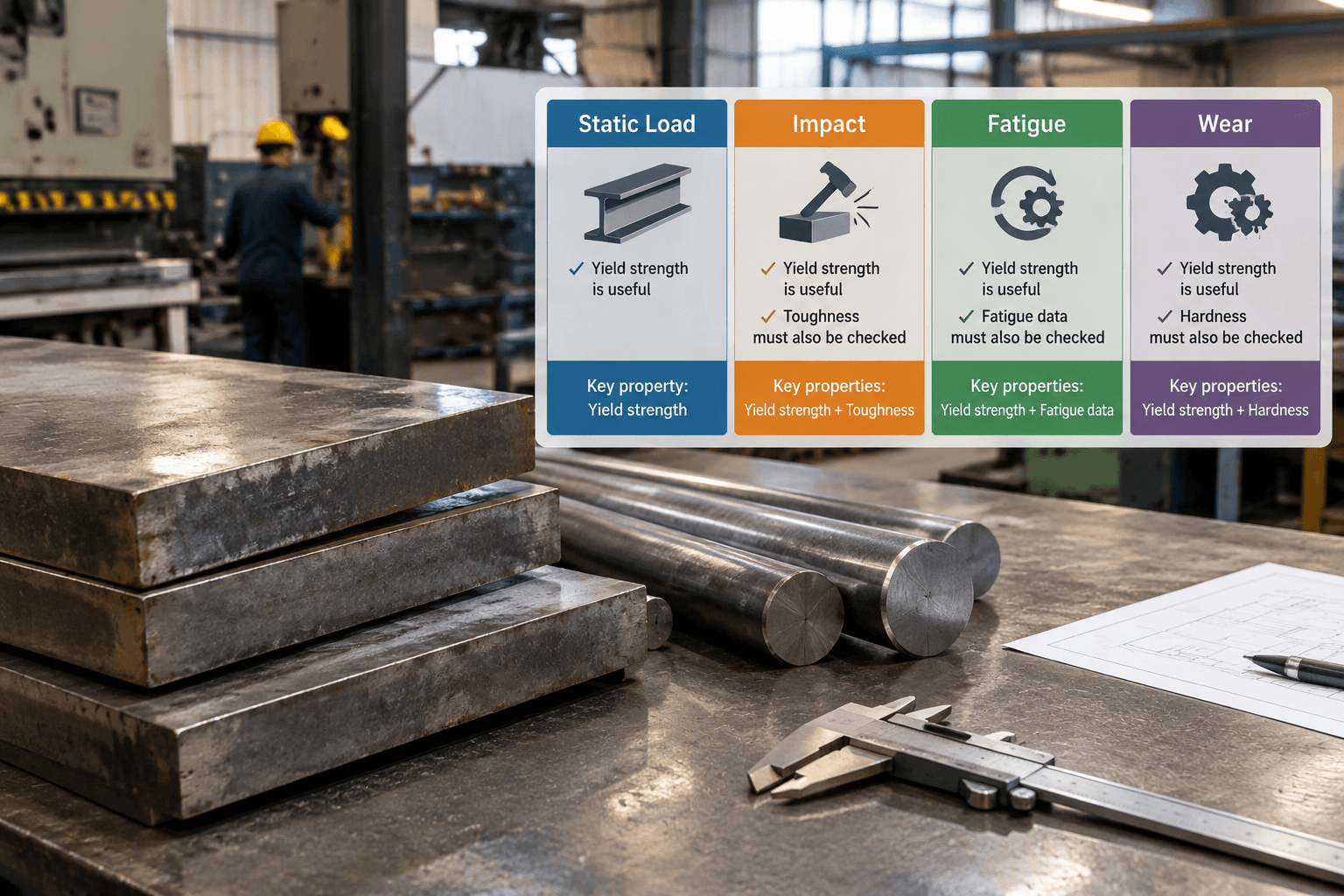
Material selection should follow the expected failure mode. Static loading may require a defined minimum yield strength. Impact loading may make toughness and notch sensitivity more important. Repeated loading requires fatigue data and an assessment of surface finish, stress concentration and residual stress. Sliding or abrasive contact may require hardness and wear evaluation. Dimensional stability after heat treatment may matter more than the highest available strength for a precision machined component.
4140 is not corrosion resistant simply because it is an alloy steel. If the component faces moisture, chemicals or outdoor exposure, the design may require a suitable protective system, environmental review and maintenance approach. Weldability, machining condition and possible distortion during heat treatment should also be considered separately from the yield-strength value.
How to Verify a 4140 Yield-Strength Value Before Design or Ordering
Use the following compact review whenever a value appears in a design note, material table, drawing, quotation or supplier document:
- Write the complete material designation, including the required condition or heat treatment.
- State the product form and relevant dimensions or section size.
- Identify the governing material standard or purchaser specification.
- Define the required minimum yield strength, if the design depends on a guaranteed threshold.
- Record the required hardness only as a separate control where it is relevant to the component.
- Specify the test temperature, specimen orientation and tensile test method where these affect acceptance.
- Require a material certificate or applicable test report that links the results to the supplied heat, lot or product.
- Check whether machining, heat treatment or other production steps can change the condition represented by the original certificate.
A useful specification format might state the grade, product form, dimensions, required condition, minimum mechanical properties, hardness requirement where applicable, certificate requirement and inspection records. The exact numerical requirements must come from the governing specification selected for the component; they should not be copied from an unlabeled online chart.
For a technical review of a custom-machined 4140 component, provide the part drawing or 3D model, required material condition or target property, product form and dimensions, load or service requirements, and the certificate and inspection documentation needed for acceptance. Yishang can then assess whether the specified condition and manufacturing route align with the component requirements. Its custom CNC machining service becomes relevant after the material condition and verification requirements have been defined.
Frequently Asked Questions
Is 4140 stronger than 4130?
Not automatically. The answer depends on the specific conditions, product forms, specifications and test bases being compared. Heat treatment, section size, toughness requirements and failure mode may matter more than the alloy names alone.
Is 4140 stronger than mild steel?
It can provide a higher-strength option in suitable conditions, but “mild steel” is a broad category rather than one exact grade. Compare the required minimum properties, condition, cost, machinability, corrosion exposure and service loads using identified specifications.
Is 4140 stronger than grade 8?
This is not a direct grade-to-grade comparison. Grade 8 identifies a fastener strength classification, while 4140 identifies an alloy steel. A valid comparison must define the fastener standard, finished condition, geometry, loading and failure criteria.
Is 4140 hard to machine after heat treatment?
Machinability depends strongly on the supplied hardness and heat-treatment condition, as well as the geometry, tooling and machining parameters. Softer material is generally easier to machine than hardened material, but the selected condition must still meet the component’s mechanical requirements.
Before approving a 4140 value for design use, make sure the number is attached to a condition, specification, product form and test basis. For a final technical review, submit the drawing or 3D model together with the required material condition and acceptance documentation.