
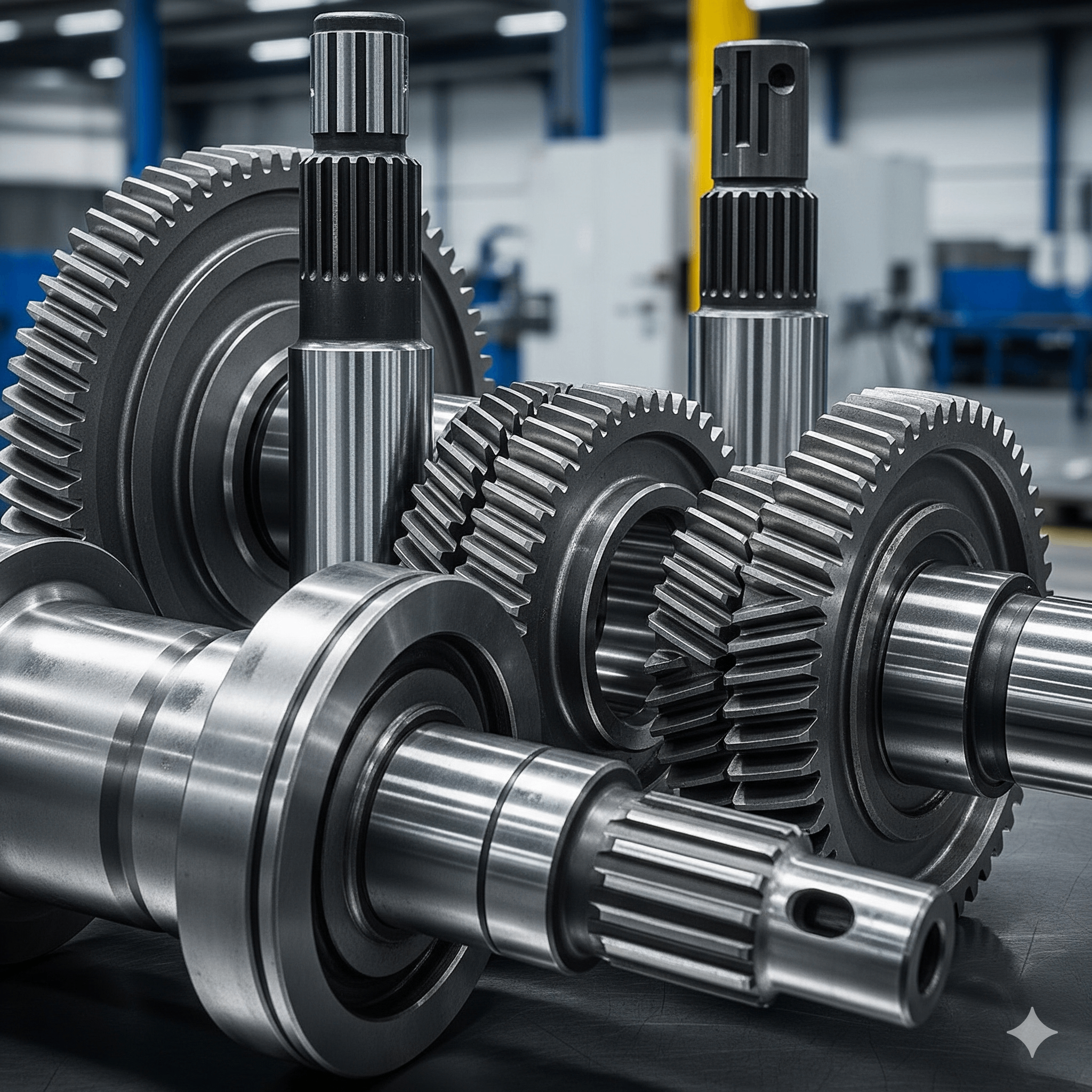
In the global machinery manufacturing industry, material procurement is no longer a simple purchasing task—it is a strategic pillar of supply chain risk management. DIN 41Cr4 (Material 1.7035) has established itself as the industrial benchmark for alloy steels, providing a sophisticated balance between high-tensile strength and procurement cost-efficiency.
For overseas procurement managers, selecting 41Cr4 is not merely an engineering requirement; it is a tactical move to ensure long-term production stability. At YISHANG, our 26-year trajectory in high-precision metal fabrication reveals that wholesale buyers prioritize two critical metrics: batch consistency and material predictability.
Whether you are sourcing for automotive power-trains or high-torque shafts, the reliability of DIN 41Cr4 1.7035 (listed in the Stahl-Eisen-Liste) is the primary safeguard against downstream rejection rates. In large-scale wholesale cycles, even microscopic variances in alloy purity can force costly CNC recalibrations at your facility. We treat every batch as a critical link in your production chain, ensuring chemical precision translates directly into fabrication performance.
1. Metallurgical Foundations: Decoding Chemistry for CNC Machinability
The chemical architecture of DIN 41Cr4 1.7035 is the fundamental “engine” behind its industrial performance. With a carbon content precisely calibrated between 0.38% and 0.45%, this steel possesses the optimal hardenability potential required for rapid thermal transformation. For wholesale buyers, this range ensures that every shipment responds identically to heat treatment.
Chromium (Cr), maintained at 0.90% to 1.20%, is the primary agent for resistance to wear. Beyond surface hardness, Chromium facilitates a refined grain structure, which increases the depth of hardness across the entire cross-section. At YISHANG, we emphasize that this structural uniformity is vital for large-diameter gears and axles where a “soft core” would lead to premature fatigue failure under high-torque industrial applications.
| Element | Min (%) | Max (%) | Impact on Fabrication |
|---|---|---|---|
| Carbon (C) | 0.38 | 0.45 | Core hardness and tensile strength. |
| Chromium (Cr) | 0.90 | 1.20 | Depth of hardening and wear resistance. |
| Manganese (Mn) | 0.60 | 0.90 | Deoxidation and hardenability stabilization. |
| Silicon (Si) | — | 0.40 | Elastic limit and fatigue strength. |
| Phosphorus/Sulfur | — | 0.025 | Controlled limits to prevent cold shortness. |
For your production floor, choosing a “Clean Steel” variant means a significant reduction in tool wear and a potential 10-15% increase in CNC throughput compared to standard-grade 40Cr alternatives. Choosing a supplier that masters these mechanical properties of DIN 41Cr4 is the most effective form of risk mitigation. YISHANG eliminates uncertainty by providing a detailed Mill Test Report (MTR) with every shipment.
2. Shop Floor Realities: Heat Treatment Techniques and Distortion Control
The technical versatility of 41Cr4 1.7035 steel is unlocked through strategic heat treatment methods. To ensure consistent performance, the following temperature regimes are standard for high-quality components:
- Normalizing: 850°C – 880°C (Air cooling) to achieve a homogeneous grain structure.
- Soft Annealing: 680°C – 720°C (Slow furnace cooling) for optimal cold workability.
- Hardening (Quenching): 820°C – 860°C (Oil quench is highly recommended).
- Tempering: 540°C – 680°C (Adjustable based on the required HRC).
| Heat Treatment Method | Hardness/Property Result | Strategic Industrial Application |
|---|---|---|
| Quenching & Tempering | 28-34 HRC / High Toughness | Power Transmission Shafts, Axles |
| Normalizing | Homogeneous Grain Structure | Pre-Machining Preparation for CNC |
| Carbonitriding | 58-62 HRC / Extreme Wear | Steering Knuckles, Wear Pins |
| Induction Hardening | Localized Hardness | Gear Teeth, Camshaft Lobes |
Building on these heat treatment techniques, YISHANG advises clients on the “Total Cost of Fabrication.” For example, induction hardening only the teeth of a 41Cr4 gear is often more cost-effective than full carbonitriding, provided the application’s torque requirements are met. This nuanced approach ensures you avoid the trap of “over-specifying,” which needlessly inflates your wholesale procurement costs.
3. Physical Properties: Thermal Stability in High-Precision Engineering
Understanding the physical profile of DIN 41Cr4 is essential for FEA (Finite Element Analysis) and precision assembly design. Unlike basic data sheets, our experience allows us to provide a more detailed look at the material’s behavior across temperature ranges:
- Modulus of Elasticity: ~210 GPa (at room temperature).
- Thermal Conductivity: 42 W/(m·K) – crucial for heat dissipation in transmission gears.
- Density: 7.85 g/cm3.
- Coefficient of Thermal Expansion: 11.0 to 14.5 (10^-6/K) between 20°C and 600°C.
For custom metal fabrication involving large-scale industrial racks or vending machine chassis, knowing the exact thermal expansion coefficient is crucial for ensuring that assemblies remain stable. This technical data is vital for engineering teams focused on long-term structural behavior under operational heat cycles.
4. Global Equivalents: 41Cr4 vs. 42CrMo4 – A Critical Comparison
In global procurement, the most common question is: “Can I replace 41Cr4 with 42CrMo4, or is 41Cr4 sufficient?” While 42CrMo4 (1.7225) offers higher hardenability and creep resistance due to its Molybdenum content, 41Cr4 remains the superior choice for medium-load applications in terms of ROI.
| Feature | 41Cr4 (1.7035) | 42CrMo4 (1.7225) | Procurement Logic |
|---|---|---|---|
| Main Alloys | Cr | Cr, Mo | 41Cr4 is more cost-effective. |
| Core Hardness | Moderate | Very High | 41Cr4 suits cross-sections < 100mm. |
| Machinability | Excellent | Moderate | 41Cr4 reduces CNC tool wear. |
| Application | Axles, Knuckles | Heavy-duty shafts | Use 41Cr4 for better TCO. |
Navigating global specifications is a primary pain point. Common equivalents include ASTM A29 5140 (USA), GB 3077 40Cr (China), and JIS G4104 SCr440 (Japan). While functionally similar, a professional buyer must recognize that “equivalent” does not mean “identical” regarding hardenability bands (Jominy curves). At YISHANG, we supply materials that harmonize these international standards, protecting your production line from metallurgical volatility.
5. FAQ: Expert Insights for Industrial Procurement
Q1: Is 41Cr4 steel weldable? Technically, 41Cr4 is classified as having “limited weldability.” Due to its hardenability, preheating to 200°C – 300°C is mandatory to prevent cold cracking in the HAZ (Heat-Affected Zone). Post-weld stress relieving is highly recommended.
Q2: How does 41Cr4 perform in terms of wear resistance? Thanks to its 1% Chromium content, 41Cr4 offers excellent resistance to abrasive wear, especially when induction hardened or carbonitrided. It is widely used in the machinery manufacturing industry for parts requiring surface durability.
Q3: What is the primary difference between 41Cr4 and 40Cr? While often used interchangeably, DIN 41Cr4 typically follows more stringent European purity standards (RoHS/ISO) compared to standard GB 40Cr, resulting in more predictable heat treatment outcomes.
6. Strategic Conclusion: Why YISHANG is Your 41Cr4 Partner
As global manufacturing pivots toward higher precision, the demand for stable materials like DIN 41Cr4 1.7035 is accelerating. Its repeatability in CNC machining services and metal fabrication services makes it the ideal candidate for automated smart factories.
For the modern wholesale buyer, the total cost of ownership (TCO) is the only metric that matters. A non-certified “bargain” steel might save 5% on the initial invoice, but it can increase rejection rates by 20% due to micro-cracking or inconsistent hardenability. YISHANG focuses on providing “clean steel,” ensuring that your high-speed machining projects proceed without hidden costs.
Ready to secure your supply of precision-grade 41Cr4 steel? Contact YISHANG today for a technical consultation and a high-volume wholesale quote.