

Why Thickness Strategy Matters to Overseas Procurement Teams
For overseas sourcing teams, material thickness is not just a drawing number. It affects raw material availability, fabrication difficulty, shipping weight, assembly fit, and total landed cost.
A thickness choice that looks minor on paper can create real supply chain consequences. Even a small change in gauge may lead to different stock availability, higher MOQ, slower procurement, or added tooling and process adjustments.
That is why thickness should be treated as a sourcing variable as well as an engineering one. The best gauge is usually the one that balances structural need, fabrication capability, and supply consistency at the same time.
Why “Thicker” Is Not Always “Safer”
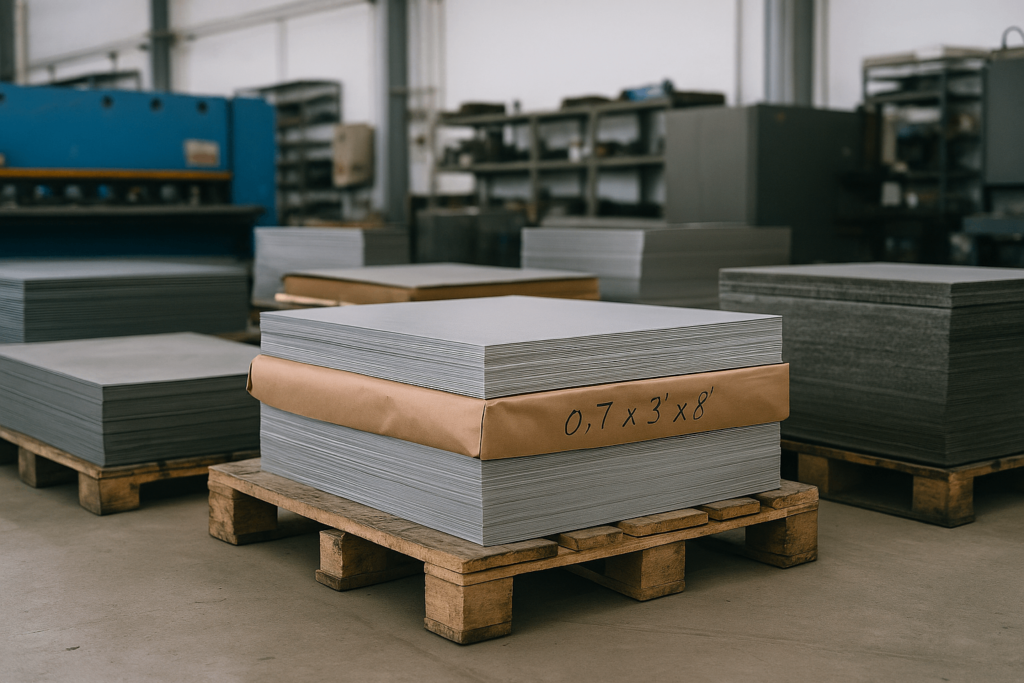
A common mistake in custom metal projects is assuming that adding thickness always improves the design. In practice, extra thickness can increase bending difficulty, raise freight cost, slow laser cutting, and create fit or finish problems without adding useful performance.
The right choice depends on load path, part geometry, reinforcement strategy, and manufacturing method—not on thickness alone.
Aligning Thickness with Supply Chain & Capability Constraints
Thickness decisions affect more than structural strength. They also influence sourcing speed, stock availability, machine suitability, and production efficiency.
Gauge Availability vs. Customization Risk
Before confirming a thickness, buyers should check whether that gauge is part of the supplier’s normal stock range. Common gauges are usually easier to source and quote, while non-standard thicknesses may require custom procurement, coil conversion, or longer replenishment cycles.
Uncommon gauges can increase lead time, raise MOQ, and add avoidable supply risk.
Fabrication Limitations & Thickness Sensitivity
Even standard gauges must match the actual fabrication route. A thicker sheet may reduce bending efficiency, increase punch load, or slow cutting speed. A thinner sheet may deform during forming, welding, transport, or finishing.
Thickness should therefore be reviewed together with process capability rather than chosen by material specification alone.
Cost Leverage Through Thickness Optimization
Thickness directly affects material consumption, processing time, scrap rate, and shipping weight. In some cases, a thinner gauge with better geometry or reinforcement can deliver the same function at lower total cost.
This is why thickness optimization can be an effective cost lever when it is based on actual structural need rather than habit or overdesign.
What Can Go Wrong with the Wrong Gauge?
Too Thick, Too Expensive
A gauge that is unnecessarily thick may increase raw material cost, freight weight, bending load, and machining time. In some designs, extra thickness also makes fit-up less efficient and can create avoidable downstream adjustments.
Too Thin, Too Fragile
A gauge that is too thin may lead to warping, vibration, denting, transit damage, or poor finish stability. In sheet metal assemblies, under-specification often shows up later as alignment issues, visible deformation, or failed field performance.
The wrong gauge can therefore create either over-cost or under-performance, depending on which side of the decision is missed.
Functional Requirements Meet Fabrication Realities
Good gauge decisions begin with actual use conditions rather than CAD assumptions alone.
| Application | Material | Typical Thickness | Notes |
|---|---|---|---|
| POS Rack | Galvanized Steel | 1.2mm | Supports powder-coated finishes and moderate stiffness needs |
| Instrument Housing | AL 5052 / 6061 | 1.5mm | Lightweight with reasonable fatigue performance |
| Outdoor Unit Cover | 304 / 316 Stainless Steel | 1.2mm | Corrosion resistance and outdoor stability |
| Structural Frame | 4130 / 4140 Steel | 2.0mm | Higher strength under structural load |
Actual thickness selection should still be checked against part geometry, span, reinforcement, and manufacturing process.
Gauge Availability: Design with Supply Chain in Mind
Standard stock gauges usually create lower sourcing risk and faster quotation cycles than uncommon thicknesses.
| Material | Common Stock Gauges (mm) |
| Aluminum 5052 / 6061 | 0.8, 1.0, 1.2, 1.5, 2.0 |
| Stainless Steel 304 / 316 | 1.0, 1.2, 1.5, 2.0, 3.0 |
| Galvanized / Galvanneal | 1.0, 1.2, 1.5, 2.0 |
| Brass | 0.5, 1.0, 1.5 |
Designing around commonly stocked gauges can reduce procurement friction, especially for export projects with fixed timelines or repeated batch orders.
Tolerance and Finish Considerations

CAD dimensions alone do not define final assembly fit. Coating build-up, springback, and forming variation all affect how thickness behaves in production.
Typical sources of variation include:
Powder coat thickness: 50–150μm
Hole-to-edge tolerance: ±0.13mm
Multi-bend offset error: ±0.25–0.76mm
Where assemblies require tight fit after finishing, buyers should account for coating thickness, bend behavior, and interface clearance early in DFM review.
Thickness Review Before Release
Before releasing a drawing or purchase order, it is useful to confirm whether the selected thickness has been checked against stock availability, fabrication method, finishing impact, and final-use loads.
A practical review should include:
Whether the gauge is commonly stocked by the supplier
Whether bending, punching, welding, or machining limits have been checked
Whether coating or anodizing build-up affects critical fit
Whether weight and freight impact are acceptable for shipment scale
Whether the thickness reflects real structural need rather than default habit

Final Word for Global Procurement Teams
Material thickness is not only an engineering input. It is a procurement decision that shapes cost, lead time, manufacturability, yield, and field performance.
Before approving a gauge, buyers should confirm whether it matches both the structural requirement and the supplier’s real production capability.
In many projects, the smartest thickness is not the thickest or thinnest option. It is the one that delivers the required function with the least manufacturing friction and the lowest avoidable supply risk.
A Practical RFQ Screening Rule
If a supplier can quote the material grade but cannot explain stock gauges, bending limits, finish build-up, and freight impact, the thickness recommendation is incomplete.
For custom metal fabrication, good thickness selection always sits at the intersection of design, process, and supply chain reality.