
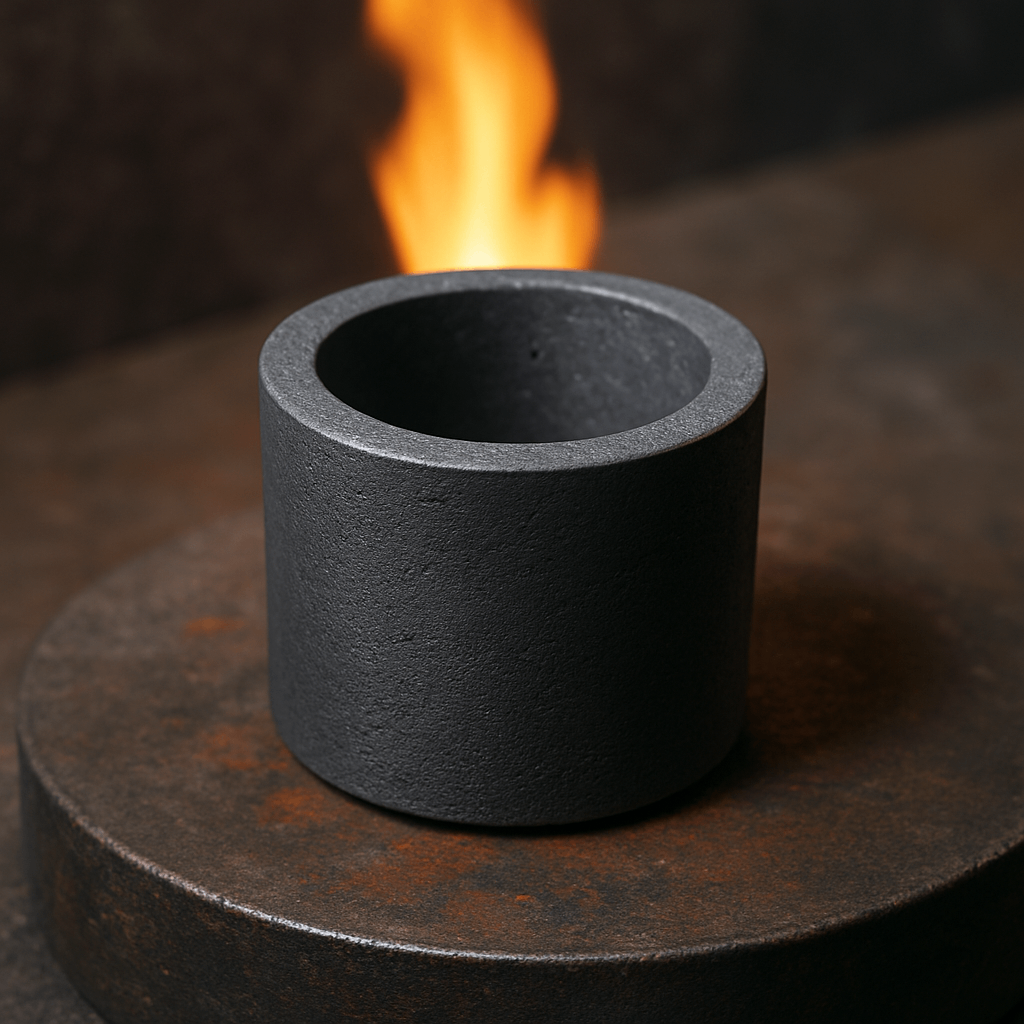
For engineers, procurement managers, and OEM decision-makers, understanding the thermal behavior of graphite is more than academic—it directly affects component reliability, supply chain planning, and cost-efficiency. Selecting the right graphite material ensures operational stability in high-temperature industrial applications such as aerospace, steelmaking, and advanced braking systems.
The answer, however, is a fascinating paradox. Under standard atmospheric pressure, graphite does not have a true melting point. Instead of liquefying, graphite undergoes a physical transformation known as sublimation. When subjected to extreme temperatures—even in high heat industrial environments—it bypasses the liquid phase entirely, transitioning directly from a solid into a gaseous state.
This guide provides a definitive technical overview of graphite’s unique thermal behavior for industrial use. It explores the atomic principles that govern its performance, outlines the extreme conditions necessary to produce liquid carbon, and translates these properties into tangible advantages across key high-temperature applications.
The Central Paradox: Sublimation, Not Melting
For high-temperature specifications, it is crucial to differentiate between melting and sublimation. Unlike metals that liquefy, graphite transitions directly from solid to gas at approximately 3,600°C under standard atmospheric conditions. For engineers and purchasing teams, this means graphite components maintain shape and structural integrity in extreme heat without unexpected melting, reducing production risks and improving lifecycle reliability.
The temperature at which this occurs—the graphite sublimation point—is approximately 3,600°C (6,512°F). At this temperature, rather than forming a pool of liquid carbon, graphite transforms directly into a gas.
It is crucial for technical specifications to recognize that this is a physical change, not a chemical reaction such as combustion, which requires an oxidizing environment. This unique characteristic is foundational to graphite’s value and raises two key questions in materials science:
Why does graphite defy conventional melting? And under what specific, controllable conditions can it be induced to liquefy?
The Atomic Secret: Why Graphite Defies Melting
Graphite’s thermal stability comes from its unique atomic structure. Each carbon atom forms strong in-plane covalent bonds, while layers are weakly held by van der Waals forces. For buyers, verifying supplier material certifications ensures that the graphite exhibits the expected in-plane strength and sublimation characteristics, essential for consistent high-temperature performance.
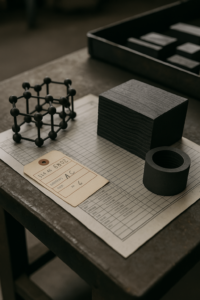
A Tale of Two Bonds: Covalent Strength vs. van der Waals Weakness
Graphite consists of countless, perfectly stacked layers of carbon atoms, with each individual layer forming a sheet of graphene. Within these sheets, carbon atoms are arranged in a hexagonal, honeycomb-like lattice.
Each carbon atom undergoes sp2 hybridization, forming three extremely strong covalent bonds with its neighbors. These bonds create one of the most robust two-dimensional networks known, giving graphite its exceptional in-plane strength, rigidity, and high tensile modulus.
In contrast, the forces binding these resilient graphene layers together are markedly weak. These layers are held only by subtle secondary attractions known as van der Waals forces. This contrast in bonding—formidable strength within layers and extreme weakness between them—defines graphite’s performance characteristics.
The Path of Least Resistance: An Engineering Perspective
As graphite is heated, thermal energy causes its atoms to vibrate more vigorously. From an engineering perspective, energy disperses along the path of least resistance. It is much easier for this energy to overcome the weak van der Waals forces and separate the layers than to break the powerful covalent bonds within them.
Severing these in-plane bonds is a prerequisite for entering a liquid phase. Therefore, under standard pressure, graphite reliably transitions to gas via layer separation—sublimation—rather than melting.
The Quest for Liquid Carbon: Engineering an Exotic State
Although achieving liquid carbon is theoretically possible, it requires extreme pressures and temperatures far beyond standard industrial capabilities. Procurement teams should recognize that standard graphite materials will sublimate rather than melt, ensuring that specifications and process plans account for this unique behavior.
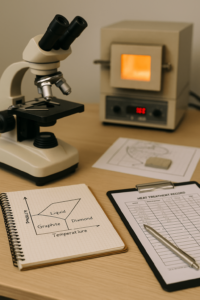
A Century of Scientific Challenge
For more than a century, the precise melting curve of carbon has been debated. This context is important for procurement managers evaluating historical references. Early experiments, dating back to the early 20th century, reported inconsistent melting points varying by thousands of degrees.
These inconsistencies stemmed not from lack of scientific rigor, but from technical limitations:
- The Soot Problem: At extreme temperatures, graphite rapidly sublimates, creating a dense cloud of carbon soot. This cloud obscures the sample and distorts thermal readings.
- The Pyrometry Problem: Early optical pyrometers were too slow to capture peak temperatures during fleeting high-heat events, leading to underestimates.
- The Emissivity Enigma: Accurate thermal measurement depends on knowing a material’s emissivity. For liquid carbon, this remains an uncertain value, creating inherent measurement ambiguity.
Modern consensus has emerged through advanced methods like Laser-Heated Diamond Anvil Cells (LH-DAC), in-situ X-ray diffraction, and sophisticated ab initio** molecular dynamics simulations**. This triangulated approach yields high-confidence data for use in engineered carbon materials.
Mapping the Extremes: The Carbon Phase Diagram
The carbon phase diagram defines its stable states. Two critical landmarks stand out:
- The Graphite-Liquid-Vapor Triple Point: The minimal condition under which liquid carbon exists, requiring ~10.1 MPa pressure and 4,500 to 4,800 K temperature.
- The Graphite-Diamond-Liquid Triple Point: A state where solid graphite, diamond, and liquid carbon coexist, occurring at 12–15 GPa pressure.
From Theory to the Forge: Industrial Imperatives for High-Temperature Performance
For industrial buyers, the practical implication is clear: graphite’s thermal behavior yields operational advantages. Its resistance to extreme heat is not isolated—it aligns with a package of properties uniquely suited to critical processes.
| Application | Key Benefit | Procurement Tip |
|---|---|---|
| EAF Electrodes | High conductivity, withstands 3,000°C | Verify resistivity, density, and porosity levels |
| Crucibles & Refractories | Chemical inertness, thermal shock resistance | Confirm supplier QA data and cycle-life performance |
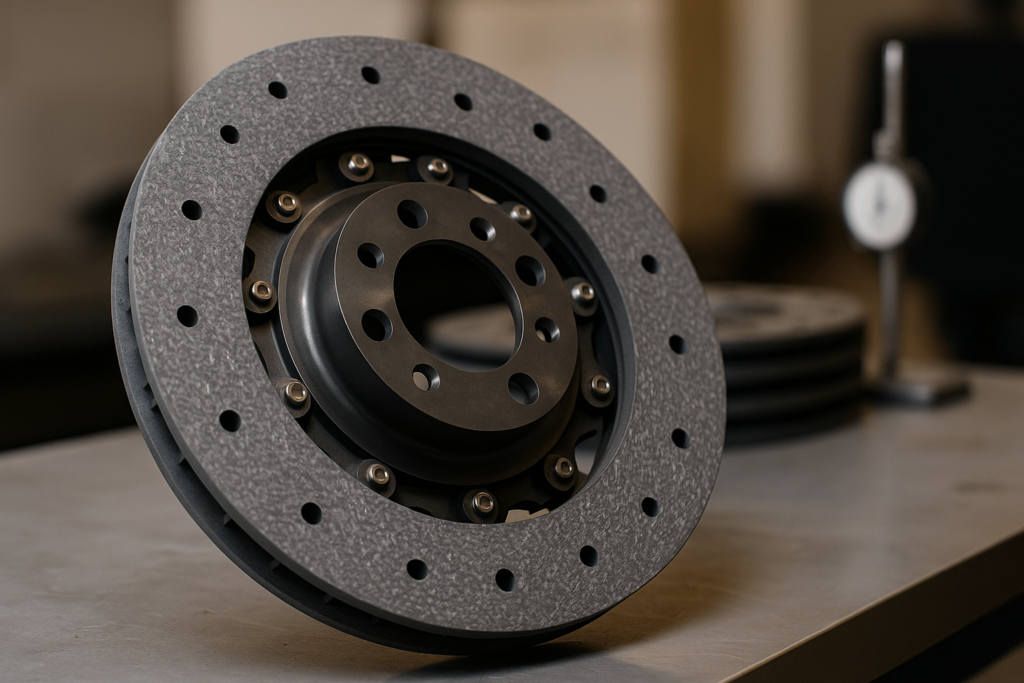
| Carbon-Carbon Brakes | High-temperature friction, lightweight | Request wear-rate data and heat-cycle testing |
| Aerospace Components | Thermal stability in extreme conditions | Ensure dimensional tolerance and certified materials |
A High-Temperature Showdown: Graphite vs. Its Rivals
Graphite outperforms other refractory materials like tungsten and diamond for industrial high-heat applications. Its combination of sublimation stability (~3,600°C), lower density, superior thermal shock resistance, and cost-effectiveness makes it the preferred material for critical OEM and ODM applications. Buyers should prioritize graphite for applications requiring high-temperature endurance and structural reliability.
Graphite vs. Tungsten
Tungsten melts at 3,422°C, but graphite sublimates at a slightly higher 3,600°C. More critically, graphite’s lower density and superior thermal shock resistance offer better performance in rapidly changing thermal environments, where tungsten’s brittleness is a liability.
Graphite vs. Diamond
Both are carbon allotropes. Diamond sublimates at ~3,800°C, slightly above graphite. Yet graphite’s machinability, conductivity, and lower cost make it more practical for most industrial uses, especially where engineered carbon materials are needed.
Strategic Summary for Procurement and Engineering
Strategic Takeaways for Procurement:
Sublimation defines graphite performance—reliable up to ~3,600°C.
Liquid carbon requires extreme pressure—irrelevant for most industrial applications.
Layered atomic structure ensures high in-plane strength and predictable thermal response.
Compared to tungsten or diamond, graphite offers superior performance at lower cost.
Ensure supplier provides material certifications, QA test data, and thermal property documentation.
For customized graphite components or high-temperature applications, consult YISHANG’s materials specialists. They provide OEM-grade solutions with full QA documentation and support in over 50 countries.
Key takeaways for high-temperature applications:
- Sublimation Defines Performance: Graphite sublimes at ~3,600°C, not melts—this predictability is crucial in industrial design.
- Liquid Carbon Is a Special Case: Achieving a liquid state demands extreme pressure, beyond most real-world needs.
- Atomic Structure Predicts Behavior: Its layered architecture underpins graphite’s high-temperature reliability.
- Competitive Edge: Compared to alternatives like tungsten, graphite delivers superior thermal and mechanical performance at a lower operational cost.
For technical consultation or to inquire about custom graphite components, contact the materials specialists at YISHANG—trusted partners for OEM & ODM metal solutions in over 50 countries.