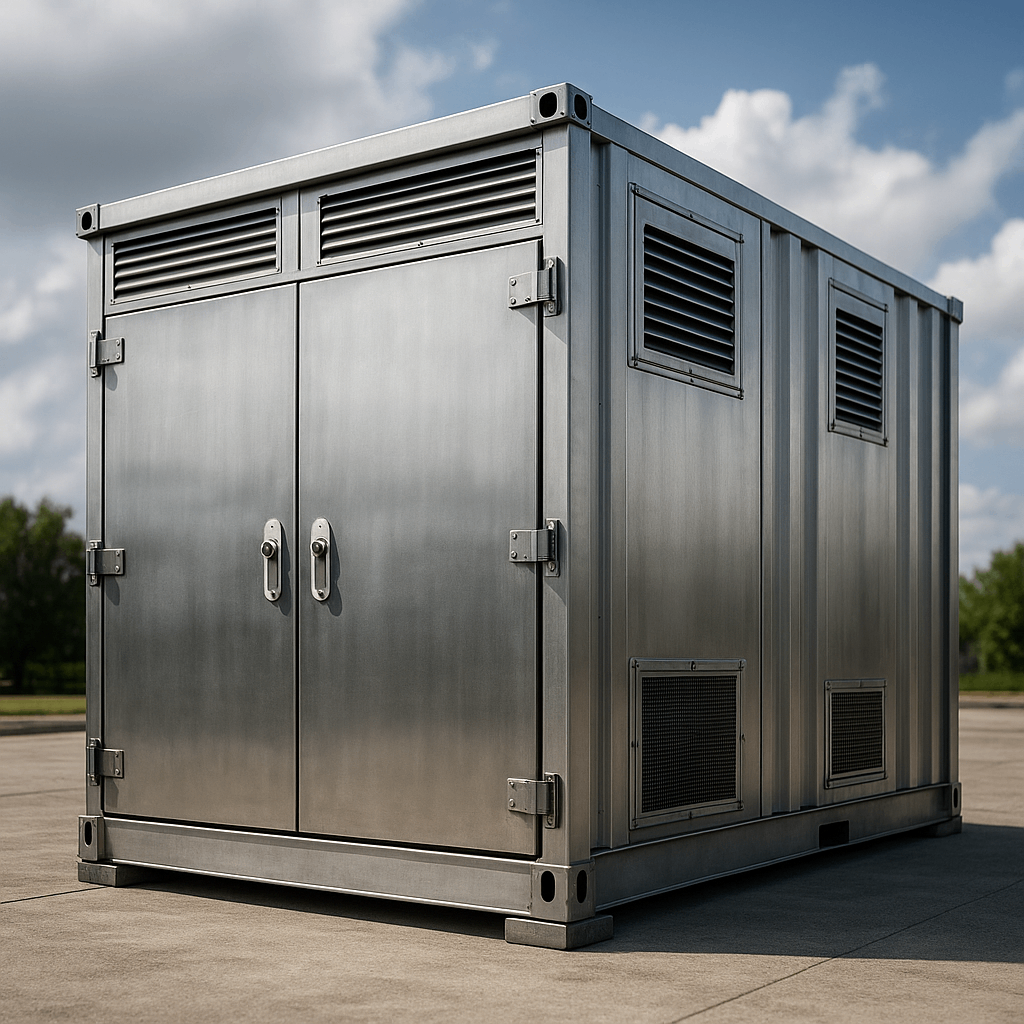
In battery energy storage projects, the enclosure is not just an outer shell. It helps protect the battery system, supports thermal control, influences maintenance access, and affects long-term outdoor reliability.
For developers, integrators, EPC teams, and procurement managers, enclosure design should be treated as an engineering and sourcing decision, not only as a sheet metal housing purchase. Material selection, fabrication quality, internal layout, cooling strategy, and project requirements all affect the final result.
This guide explains the main design and manufacturing considerations for custom energy enclosures used in BESS and related electrical applications. It focuses on the practical points buyers and engineers usually need to confirm before prototype approval and volume production.
Why Energy Enclosures Matter in BESS Projects
A custom energy enclosure affects much more than external appearance. In real projects, it influences weather protection, internal temperature control, service access, structural reliability, and long-term maintenance cost.
For this reason, enclosure planning should start early in the project, especially when the system will be deployed outdoors, in corrosive environments, or in regions with demanding structural requirements.
Key Design Requirements for Custom Energy Enclosures
Environmental Rating Requirements
Outdoor energy enclosures are often specified according to project requirements such as IP rating or NEMA rating. These systems are related but not identical, so they should not be treated as direct substitutes.
- IP ratings mainly describe protection against dust and water ingress.
- NEMA ratings may also address broader environmental considerations depending on the specified enclosure type and use environment.
For procurement teams, the key point is to confirm the actual installation condition first, including rain exposure, dust level, corrosion risk, and cleaning conditions, before finalizing the enclosure requirement.
Structural Design Requirements
Large energy enclosures may need to handle wind load, site vibration, transport stress, and project-specific structural conditions. In practice, structural design should consider outdoor wind exposure, seismic or site movement requirements, enclosure base rigidity, door and panel reinforcement, and ventilation openings with their effect on structural strength.
A practical design should balance enclosure strength, internal airflow, manufacturability, and maintenance access.
Material and Fabrication Choices That Affect Long-Term Reliability
Good enclosure performance depends on both design and manufacturing. Even when the drawing is correct, the final result still depends on material choice, sheet metal processing accuracy, welding quality, assembly control, and surface finishing.
Material Selection for Energy Enclosures
The material should be selected according to the installation environment, corrosion exposure, structural requirement, weight target, and cost plan.
304 vs. 316 Stainless Steel
For many general industrial applications, 304 stainless steel is a practical option with good corrosion resistance and broad availability. For coastal or more corrosive environments, 316 stainless steel is often a better choice because it offers stronger resistance to chloride-related corrosion.
Steel, Aluminum, and Other Material Options
In custom energy enclosures, common material options may include stainless steel, low carbon steel, galvanized steel, and aluminum. Each has different advantages in terms of strength, corrosion resistance, weight, and finishing compatibility.
| Material | Main Advantage | Main Limitation | Typical Use Direction |
| Stainless Steel 304 | Good durability and corrosion resistance | Higher cost than carbon steel | General outdoor or industrial enclosures |
| Stainless Steel 316 | Better corrosion resistance in harsher environments | Higher material cost | Coastal or chemical-adjacent projects |
| Low Carbon Steel | Good structural strength and cost efficiency | Needs proper surface protection | Cost-sensitive industrial applications |
| Galvanized Steel | Better corrosion protection than plain carbon steel | Surface treatment compatibility must be checked | Outdoor utility-related enclosures |
| Aluminum | Lower weight and good corrosion resistance | Lower rigidity than some steel structures | Weight-sensitive or easier-to-handle designs |
Fabrication and Finishing Quality
For a custom enclosure, fabrication quality directly affects fit-up, sealing performance, door alignment, assembly stability, and final appearance. Important process points usually include laser cutting accuracy, bending consistency, welding control, machining of critical openings, assembly precision, and powder coating or other surface finishing quality.
When doors, panels, vents, or internal mounting points must align precisely, manufacturing repeatability becomes especially important.
Internal Protection: Thermal Management and EMC Design
Besides external protection, an energy enclosure also needs to manage the internal operating environment. In battery and electrical systems, this usually means paying close attention to temperature behavior, airflow path, cable layout, and electromagnetic interference control.
Cooling Strategy: Passive or Active
The right cooling method depends on battery density, site climate, operating profile, and maintenance expectation.
| Cooling Strategy | Main Advantage | Main Limitation | Typical Use Direction |
| Passive Cooling | Lower system complexity and lower maintenance demand | Limited cooling capacity and strong dependence on ambient conditions | Simpler or lower-heat applications |
| Active Air Cooling | Better temperature control than passive methods | Requires power consumption and maintenance planning | Many general BESS or electrical enclosure projects |
| Active Liquid Cooling | Stronger thermal control for demanding systems | Higher cost and more complex system design | High-density or performance-critical projects |
When planning the enclosure, the cooling strategy should be confirmed together with vent design, fan or HVAC placement, service access, and internal component layout.
EMC and Shielding Considerations
For some energy and electrical applications, electromagnetic compatibility is also important. In these cases, enclosure design may need to consider grounding continuity, controlled cable routing, shielded openings or connectors, vent structures that do not unnecessarily weaken shielding performance, and internal layout that reduces interference risk.
These design points should be reviewed together with the actual equipment requirement rather than treated as a generic feature for all projects.
Safety, Modularity, and Lifecycle Planning
In energy enclosure projects, safety and compliance requirements should be reviewed early. Depending on the market and project type, buyers may need to confirm applicable standards, fire protection expectations, structural requirements, and service access design before production starts.
Compliance and Project Requirement Review
For North American or project-specific BESS applications, buyers may need to review requirements related to standards such as UL 9540 or UL 9540A at the system or project level. For enclosure suppliers, the practical role is often to support manufacturable design, structural execution, documentation coordination, and feature implementation according to customer or project requirements.
Why Modular Design Helps
Modular enclosure design can offer several practical advantages, including easier transport and installation, simpler maintenance access, better scalability for phased projects, more flexible internal arrangement, and easier replacement or service of individual sections.
Lifecycle and Sustainability Considerations
For long-term projects, buyers may also review coating durability, corrosion resistance, repairability, material recyclability, and how efficiently the enclosure design uses material and manufacturing resources.
How Different Energy Applications Require Different Enclosure Strategies
Different applications do not use the same enclosure priorities.
| Application | Main Enclosure Focus |
| Grid-scale BESS | Structural durability, transport efficiency, maintainability, project-scale consistency |
| Commercial & Industrial Systems | Space use, modularity, serviceability, site integration |
| Public EV Charging | Outdoor durability, public safety, corrosion resistance, appearance |
FAQ
What is a custom energy enclosure?
A custom energy enclosure is a metal housing designed to protect battery, electrical, or energy-related equipment according to project-specific size, layout, environmental, and service requirements.
How do I choose the right material for an outdoor energy enclosure?
The material should be selected according to corrosion risk, structural demand, weight target, finishing method, and total project budget.
Is IP rating the same as NEMA rating?
No. They are related but not identical. The actual project environment should be reviewed before the enclosure requirement is finalized.
What affects enclosure reliability the most?
Material choice, fabrication quality, weld and coating quality, structural design, cooling strategy, and repeatable manufacturing control all affect long-term reliability.
Why does modular enclosure design matter?
It can improve transport efficiency, simplify maintenance, support phased expansion, and make system service easier over time.
Custom Energy Enclosure Manufacturing Support from YISHANG
YISHANG Metal Products Co., Ltd. is a metal products factory with more than 26 years of experience in custom metal manufacturing for wholesale and OEM/ODM projects.
We support custom fabrication of metal enclosures and related industrial metal products using materials such as stainless steel 304 / 316, low carbon steel, galvanized steel, aluminum, copper, and brass.
Our manufacturing capabilities include sheet metal laser cutting, bending, deep drawing, stamping, welding, CNC machining, surface finishing, design support, prototyping, assembly, packaging, quality inspection, and shipment support.
We are certified to ISO 9001 and RoHS. For custom energy enclosure projects, we can support design review, prototype development, fabrication planning, and volume production for wholesale customers.