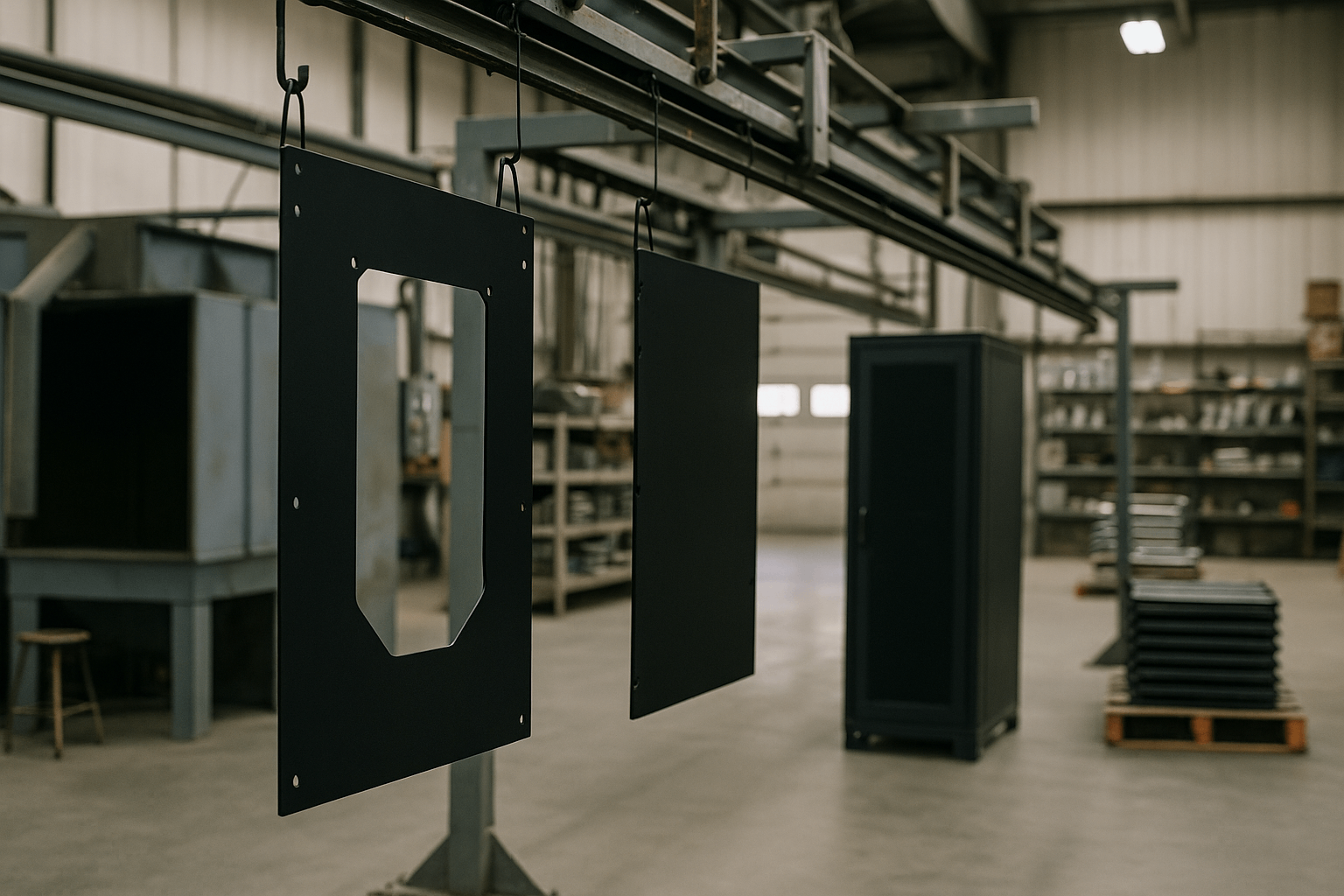
In sheet metal sourcing, surface finish is no longer a minor secondary detail. It affects corrosion resistance, outdoor durability, appearance stability, maintenance frequency, and regulatory fit across the product lifecycle.
For buyers, the real decision is not whether one finish is universally “outdated.” The more useful question is where older finishes still fit, where their limitations become costly, and when newer alternatives provide better long-term value.
This guide compares e-coat, black oxide, powder coating, and zinc-nickel plating from a buyer’s perspective, focusing on performance, total lifecycle cost, and application fit rather than marketing claims.
Why Finish Choice Now Carries More Procurement Risk
As buyer expectations increase, finish selection has become more closely tied to warranty cost, replacement risk, and customer perception. A finish that was once acceptable in a lower-demand application may no longer be suitable if the product is now expected to survive outdoor use, longer service life, or stricter compliance screening.
Where E-Coat and Black Oxide Still Fit — and Where They Fall Short
Older finishing systems are not automatically obsolete. In many cases, they are still viable when their limitations match the application.
E-Coat
E-coat remains useful where uniform coating coverage and priming performance are important, especially on complex geometries. However, it is often less suitable as a standalone exterior finish when long-term UV stability and simplified process flow are priorities.
Black Oxide
Black oxide remains attractive where dimensional change must stay extremely low. But its corrosion resistance is limited unless it is supported by sealants and ongoing maintenance. That makes it less attractive in humid, outdoor, or higher-risk service environments.
Buyer Takeaway
Neither finish is “wrong” by default. The issue is whether the finish matches the real environment, maintenance expectations, and lifecycle cost target.
Why Powder Coating and Zinc-Nickel Are Often Stronger Alternatives
In many modern applications, powder coating and zinc-nickel plating are selected because they solve problems that legacy finishes may handle less efficiently.
Powder Coating
Powder coating is often favored where buyers need decorative appearance, strong outdoor durability, and a relatively simple one-step finishing route. It can also reduce the waste-management burden associated with some wet finishing processes.
Zinc-Nickel Plating
Zinc-nickel plating is often chosen where corrosion resistance must be significantly stronger than conventional light-duty finishes. It is especially relevant in high-risk industrial, transport, or outdoor environments where finish failure can lead to warranty cost or assembly replacement.
Buyer Takeaway
These finishes are not automatically better in every scenario, but they are often better aligned with modern expectations around durability, repeatability, and long-term reliability.
How Buyers Should Compare Performance and Lifecycle Cost
Surface finish decisions are often made too narrowly on unit price. In practice, buyers should compare:
- corrosion resistance in the target environment;
- wear or abrasion behavior where contact exists;
- UV stability if the product is exposed outdoors;
- maintenance frequency over time;
- rework, warranty, or replacement risk if the finish underperforms.
Why Price-Per-Part Is Not Enough
A cheaper finish can become more expensive if it requires a second coating step, more maintenance, or leads to earlier field failure. That is why total lifecycle cost often gives a more realistic comparison than unit price alone.
Why Compliance and Use Environment Matter
In export-oriented sourcing, finish selection is also influenced by environmental and regulatory requirements. Buyers should verify whether the selected finish aligns with destination-market expectations for restricted substances, outdoor service conditions, and product durability.
FAQ
Is e-coat still useful in modern manufacturing?
Yes. It can still be useful where uniform coating and priming performance matter, especially if UV exposure is limited or if a topcoat system is already planned.
Is black oxide always a poor choice?
Not always. It can still be useful where dimensional change must remain minimal and corrosion exposure is limited, but it is usually not the best choice for long-term outdoor protection.
When is powder coating a better option?
Powder coating is often a stronger option when appearance, UV stability, and general outdoor durability are all important.
When is zinc-nickel plating worth the extra cost?
It is often worth considering in high-corrosion-risk applications where field failure would create higher lifecycle cost than the coating premium itself.
Conclusion
The finish decision should be based on use environment, durability targets, dimensional requirements, maintenance expectations, and total lifecycle cost—not just on habit or on the lowest quoted piece price.
For buyers, e-coat and black oxide still have valid use cases, but they are not always the best fit for modern outdoor, high-durability, or compliance-sensitive applications. In many such cases, powder coating or zinc-nickel plating may offer a stronger long-term result.