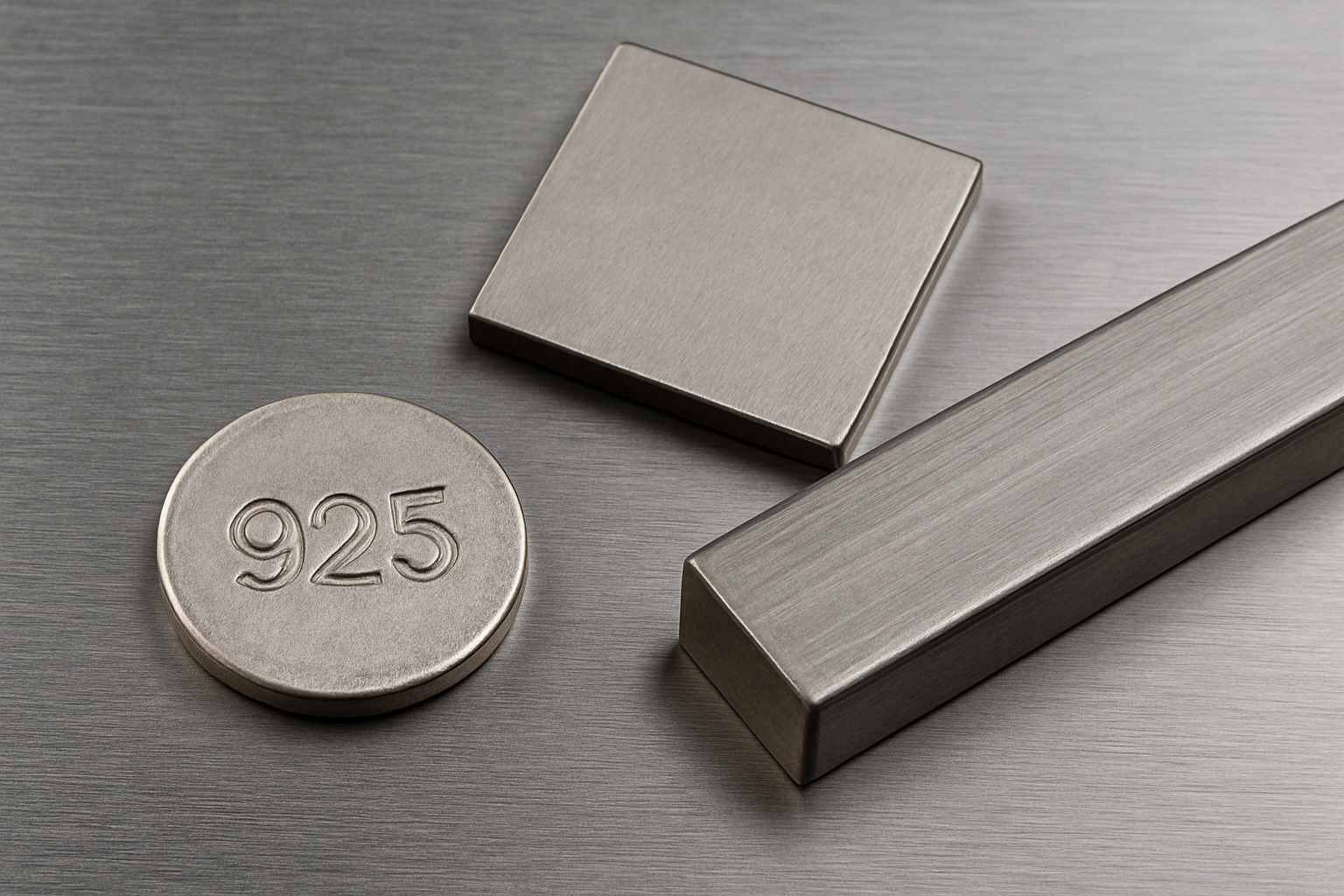
For procurement managers, jewelry designers, and wholesale buyers, material selection is the cornerstone of product quality, market positioning, and profitability. In the digital sourcing landscape, a confusing term has proliferated: “925 stainless steel.” This label implies a novel hybrid material, suggesting the prestige of “925” silver with the industrial resilience of stainless steel. This contradiction creates challenges for professionals who rely on precise material specifications.
As a China-based OEM/ODM manufacturer with 26+ years of experience in stainless steel fabrication, YISHANG has authored this technical brief to provide definitive clarity. “925 stainless steel” is a metallurgical fiction—a marketing misnomer born from SEO keyword tactics. An alloy cannot simultaneously meet the legal definition of sterling silver and the compositional requirements of stainless steel.
This guide deconstructs the myth from a scientific standpoint. More importantly, it delivers a comprehensive, data-driven comparison of the two real, high-performance materials at the center of this confusion: 925 Sterling Silver and 316L Stainless Steel. Our goal is to equip you with expert knowledge required to make strategic sourcing decisions aligned with your manufacturing processes, quality standards, and business objectives.
Solving the Mystery: The Origin of a Misleading Term
The term “925 stainless steel” is a direct product of the digital marketplace. It exemplifies keyword stuffing, an SEO tactic where sellers combine high-traffic but unrelated search terms to maximize visibility. For instance, a vendor selling a stainless steel chain knows that many consumers are searching for “925 silver.” By combining the terms, they attempt to reach a broader audience, unintentionally creating a misleading and technically impossible material label.
The conflict lies in the fundamental nature of the terms. “925” is a legally binding fineness mark, guaranteeing an alloy of 92.5% pure silver by weight—a hallmark of a precious metal. In contrast, “stainless steel” refers to a family of iron-based alloys defined by a minimum chromium content of 10.5%, valued for strength and corrosion resistance.
Claiming a material is both is a chemical impossibility. Some online data sheets for this fictional alloy even list compositions totaling over 160%, illustrating the level of misinformation that sourcing managers must navigate. This guide now transitions to a technical analysis of the real materials involved.
The Contenders: A Metallurgical Profile
Strategic sourcing begins with understanding the intrinsic properties of a material—dictated by its composition and microstructure.
The Timeless Classic: 925 Sterling Silver
Sterling silver is an alloy with centuries of legacy, defined by its composition: 92.5% pure silver (Ag) and 7.5% copper (Cu). Pure silver is too soft for most applications, so copper is added for mechanical enhancement.
Microstructurally, sterling silver consists of a silver-rich alpha-phase matrix and a copper-rich eutectic phase. This heterogeneity impedes dislocation movement in the crystal lattice, enhancing hardness and strength.
Sterling silver’s initial softness makes it commonly selected for artisan-crafted designs. Its high malleability and ductility support complex handcrafted details, intricate filigree, and precise stone settings—tasks that are more difficult with harder materials.
The Modern Marvel: 316L “Surgical” Stainless Steel
316L stainless steel is a product of advanced engineering. As an austenitic stainless steel, it features a face-centered cubic (FCC) crystal structure stable across a wide temperature range, contributing to its toughness and ductility.
It consists of iron alloyed with 16–18% chromium (Cr), 10–14% nickel (Ni), and 2–3% molybdenum (Mo). The presence of molybdenum distinguishes it from grade 304 stainless steel, improving resistance to pitting in chloride-rich environments.
The “L” in 316L indicates low carbon (under 0.03%), preventing sensitization during welding and preserving corrosion resistance. With proven use in medical and marine sectors, it is a go-to material where durability and low maintenance are priorities.
The Ultimate Showdown: A Technical Comparison for Procurement
Wholesale decisions should rest on quantifiable data regarding performance, compliance, and cost.
Fabrication & Performance: Durability Under Scrutiny
Mechanical properties directly affect both manufacturing and product longevity.
Hardness (Resistance to Scratching)
Measured on the Vickers scale (HV), hardness indicates wear resistance:
- 316L Stainless Steel: Approx. 129 HV in annealed state—suitable for daily-use products.
- 925 Sterling Silver: Ranges from 71 HV (annealed) to 140 HV (spring hard), offering a balance between forming ease and durability.
Strength & Ductility (Formability & Resilience)
- Tensile Strength: 316L averages 515 MPa; sterling silver ranges from ~207 MPa to ~552 MPa, depending on temper.
- Elongation: Annealed sterling silver achieves ~41% elongation, ideal for forming operations. While 316L is machinable, it requires higher tooling force.
Compliance & Market Access: The Biocompatibility Factor
Compliance is essential, especially in regulated markets like the EU.
- Nickel in 316L Stainless Steel: Though containing 10–14% nickel, its leaching rate remains below 0.5 µg/cm²/week, meeting EN 1811:2023 standards. The stable austenitic matrix minimizes nickel release, ensuring EU REACH compliance.
- Sterling Silver Allergens: Primarily alloyed with copper, which rarely causes allergic reactions. Risk increases with lower-quality alloys that may contain nickel. Sourcing certified nickel-free sterling ensures hypoallergenic quality.
Material Cost & Market Positioning: The Bottom Line
The materials differ dramatically in cost and market role:
- Sterling Silver: As a precious metal, priced around $1.36 USD/g, it supports fine jewelry positioning.
- 316L Stainless Steel: Cost-effective at $0.0035–$0.007 USD/g, enabling high-volume, trend-driven lines.
| Technical Specification | 925 Sterling Silver | 316L Stainless Steel |
|---|---|---|
| Primary Value Proposition | Intrinsic, Precious Metal, Artisanal | Functional, Performance, Cost-Effective |
| Composition | 92.5% Ag, 7.5% Cu | Fe, 16–18% Cr, 10–14% Ni, 2–3% Mo |
| Microstructure | Ag-rich matrix with Cu-rich phase | Austenitic (FCC) |
| Vickers Hardness (HV) | 71 (Annealed) – 140 (Spring Hard) | ~129 (Annealed) |
| Tensile Strength (MPa) | 207 – 552 | ~515 |
| EU Nickel Compliance | If nickel-free | Leaching < 0.5 µg/cm²/week |
| Approx. Material Cost (USD/g) | ~$1.36 | ~$0.005 |
A Deeper Look: Surface Science and Fabrication Considerations
Luster vs. Polish
- Silver: Highest reflectivity among metals in visible light—produces a warm, brilliant finish.
- Steel: Polishes to a sleek luster, though more subdued and cooler-toned than silver.
Passive Layer Formation
Stainless steel forms a self-healing chromium oxide layer (Cr₂O₃) that enhances corrosion resistance. This passive film regenerates when damaged, supporting long-term durability.
Coating Technologies
- PVD Coating: High-durability method with molecular-level bonding—ideal for stainless steel.
- Electroplating: Mechanically weaker, more prone to flaking.
- Other Options: Powder coating and bead blasting offer textured or colored finishes.
Strategic Sourcing Guide: Aligning Material to Product Line
- Use 925 Sterling Silver for:
- Fine or Heirloom Jewelry that justifies premium pricing.
- Bridge Jewelry where material prestige meets affordability.
- Use 316L Stainless Steel for:
- Lifestyle & Durable Fashion requiring low-maintenance.
- High-Volume Production in trend-driven categories.
- Men’s Jewelry where weight and strength are desired.
FAQ: Clarifying Key Buyer Questions
Is 925 stainless steel a real material?
No. It is a marketing label with no metallurgical basis. A single alloy cannot be both 92.5% silver and a stainless steel.
Can stainless steel jewelry trigger allergies?
316L stainless steel is EU-compliant and generally safe for sensitive skin due to low nickel leaching.
Why do some suppliers use the 925 stainless steel label?
Often due to SEO practices—pairing popular search terms to attract clicks, not to describe a real material.
What’s the best material for affordable men’s jewelry?
316L stainless steel offers excellent scratch resistance, strength, and visual weight at a low cost.
Does 925 stainless steel rust or tarnish?
316L stainless steel does not rust under normal conditions and is more corrosion-resistant than 925 silver, which may tarnish over time due to oxidation.
Is 925 stainless steel hypoallergenic?
As a mislabel, it’s not a real alloy. But genuine 316L stainless steel is considered hypoallergenic and meets international skin safety standards.
Quality Assurance: In-House Identification Techniques
- Hallmarks: Look for “925,” “STER,” or “STERLING” for silver; “316L” or “SS” for stainless steel.
- Magnet Test: Silver is non-magnetic; steel may exhibit slight attraction.
- Tarnish Test: Silver may darken cloth due to oxidation; steel remains unaffected.
- Weight & Shine: Silver is heavier and whiter; steel is grayer and lighter.
Conclusion: An Informed Sourcing Strategy
“925 stainless steel” is a misleading term. The real choice lies between sterling silver and 316L stainless steel—two legitimate materials with distinct strengths.
Sterling silver offers intrinsic value and design flexibility. Stainless steel delivers unmatched durability and cost efficiency. Choosing the right one depends on your brand, product goals, and buyer expectations.
YISHANG encourages informed sourcing. As an ISO 9001 and RoHS-certified manufacturer with 26+ years of OEM/ODM experience, we provide stainless steel components tailored for global B2B clients.
Ready to source reliable stainless steel components?
Contact YISHANG’s technical team for custom drawings, bulk pricing, and expert support for your next project.