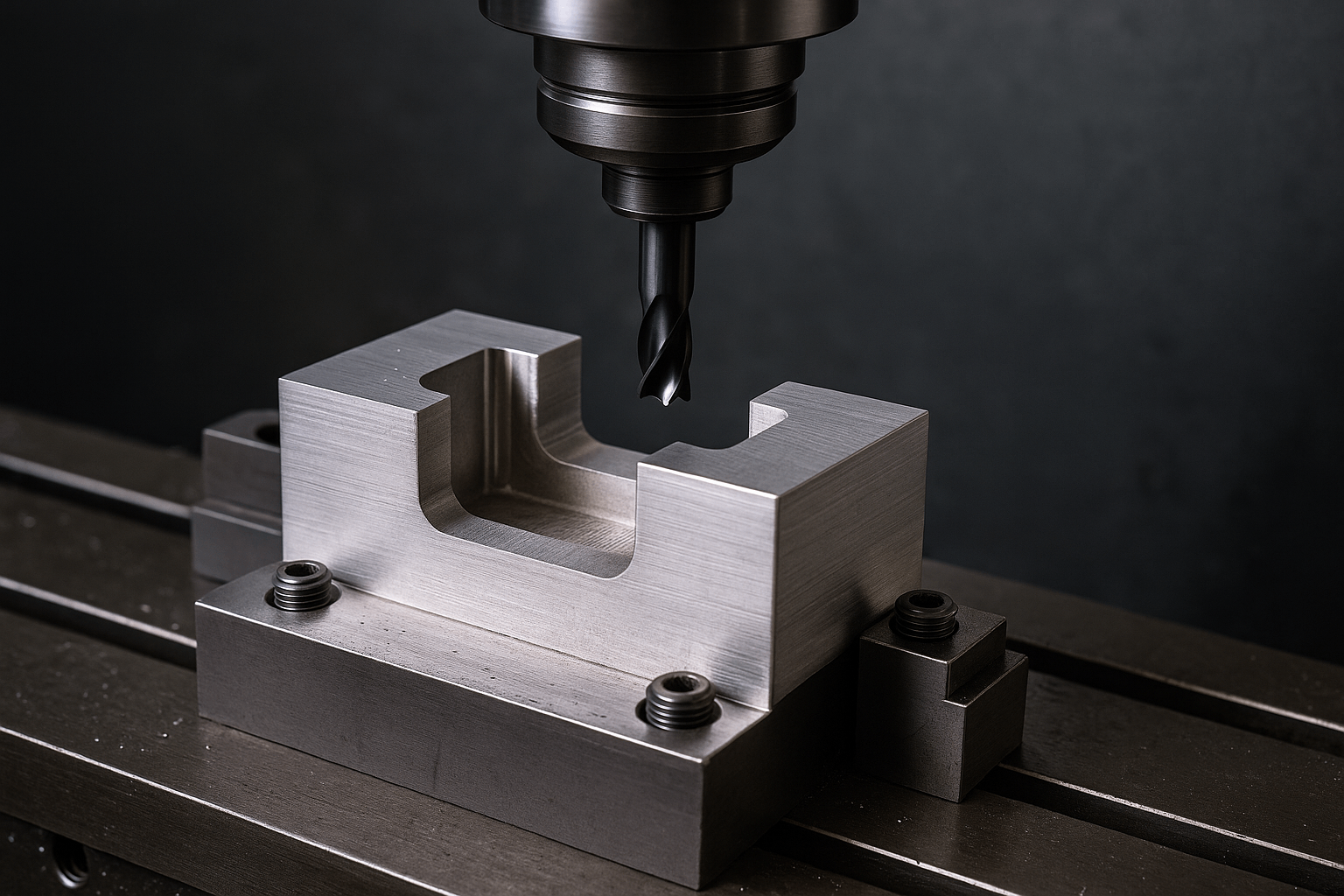
The Undercut Dilemma: A High-Stakes Manufacturing Challenge
In custom metal manufacturing, some of the most important features are not obvious at first glance. A small relief groove, an internal slot, a sealing channel, or a recessed pocket can decide whether a part assembles smoothly, seals properly, or survives long-term use.
These hidden or recessed features are often called undercuts. Undercut machining refers to the process of creating features that standard straight cutting tools cannot easily reach. Compared with simple drilling, milling, or turning, undercuts require more attention to tool access, fixture design, machining sequence, tolerance control, and inspection.
For procurement managers and engineers, the main issue is not only whether an undercut can be machined. The real question is whether it can be produced consistently, at the right cost, and at the required volume. Understanding the undercut machining process helps buyers reduce RFQ ambiguity, avoid unrealistic designs, and choose a supplier that can support custom CNC metal parts and related metal fabrication projects.
Part 1: The Strategic Value of Undercuts in Product Design
Undercuts add complexity, so they should not be used without a clear reason. When designed properly, however, they can improve assembly, reduce part count, support sealing, save weight, or make another manufacturing step more reliable.
For OEM buyers, the value of an undercut should always be linked to function. If the feature improves performance or reduces downstream assembly cost, it may be worth the added machining complexity. If it only makes the part look more sophisticated, it may be a cost driver that should be simplified.
The Bedrock of Mechanical Assembly
Undercuts are often used in mechanical assembly. T-slots, dovetails, recessed shoulders, and locking grooves can help parts slide, locate, or interlock without adding extra fasteners.
For buyers sourcing brackets, frames, machine components, fixtures, or custom metal assemblies, this can reduce part count and simplify assembly. The benefit is not just a cleaner design. It may also reduce labor time, fastener cost, and alignment problems during production.
Strategic Lightweighting for Performance
Undercuts can also remove unnecessary material from non-critical areas. This is useful when a part needs to stay strong but cannot be too heavy.
In automotive, equipment, electronics, and portable industrial products, even small weight reductions can improve handling, shipping cost, or product performance. The key is to remove material only where it does not weaken the load path. This is why undercut design should be reviewed together with strength, wall thickness, and actual service conditions.
Ensuring Fluid Dynamics and Sealing
Many sealing and fluid-control parts depend on precise grooves, channels, and recessed surfaces. O-ring grooves, internal shoulders, and fluid passages must be machined with the right size, surface finish, and edge condition.
For procurement teams, these details matter because a small machining error can cause leakage, poor fit, unstable pressure, or early failure. When a part includes sealing-related undercuts, the RFQ should clearly define dimensions, tolerances, surface roughness, burr requirements, and inspection method.
Aiding the Manufacturing Process
Some undercuts exist mainly to make another process more reliable. For example, a relief groove at the end of a thread gives the cutting tool enough clearance to finish the thread cleanly. A small recessed area may also prevent interference during assembly or reduce stress concentration near a shoulder.
These details may look minor on a drawing, but they often prevent rework. For wholesale and OEM production, small manufacturability improvements can make repeat orders more stable.
Part 2: A Visual Taxonomy of Common Undercut Types
Clear communication starts with naming the feature correctly. When buyers, engineers, and suppliers use the same terms, it becomes easier to quote, design tooling, and inspect the final part.
Common undercut types include:
T-slots and keyways
Used for fixturing, sliding adjustment, torque transmission, or mechanical positioning.
Dovetails
Used for self-locking or sliding joints where strong mechanical engagement is required.
O-ring grooves
Used for seals in hydraulic, pneumatic, fluid-control, or enclosure applications.
Relief grooves
Used at the end of threads, shoulders, or turned features to give tools clearance and reduce stress concentration.
Internal grooves and recessed channels
Used for retaining rings, sealing, oil flow, wire routing, or hidden assembly functions.
Contoured undercuts
Used in parts where motion, clearance, or fluid flow requires a non-straight internal shape.
Thread-related undercuts
Used to improve thread completion, assembly clearance, or fastening in compact designs.
Part 3: The Strategic Decision Matrix: Choosing the Right Machining Approach
For procurement managers, the machining approach affects price, lead time, tolerance, surface finish, and production risk. The right method depends on feature depth, tool access, material, batch size, and whether the part can be redesigned for simpler machining.
A good supplier should not only say “we can make it.” They should explain which machining method is practical, what risks exist, and whether a design change could reduce cost without affecting function.
Part A: The Tooling Arsenal – A Specialized Cutter Showdown
Standard end mills are not always suitable for undercuts. Depending on the geometry, the supplier may need T-slot cutters, dovetail cutters, lollipop cutters, form tools, boring tools, or custom-ground tools.
| Tool Type | Common Use | Buyer Benefit | Limitation to Consider |
| Lollipop / spherical cutter | Curved undercuts, deburring, 3D relief areas | Good access to rounded or hidden features | Tool rigidity can be limited, especially with long reach |
| T-slot cutter | Slots, tracks, retaining features | Repeatable for standard slot geometries | Often requires pre-machining and enough side clearance |
| Dovetail cutter | Sliding joints, locking features | Creates strong mechanical engagement | Non-standard angles may require custom tooling |
| Form tool | Repeated custom profiles | Efficient for repeated production | Tool cost must be justified by volume |
| Boring or internal grooving tool | Turned parts and internal grooves | Useful for shafts, sleeves, bushings, and round parts | Access, chip control, and inspection can be challenging |
Tool material and coating also matter. Coated tools may improve tool life and reduce wear, especially in stainless steel or harder materials. However, the best choice depends on material grade, cutting depth, batch size, and surface finish requirement.
Part B: The Machining Platforms – An Escalation Path
The machine platform should match the feature, not the marketing claim. Some undercuts can be produced on standard CNC milling or turning equipment with the right tool and setup. Others may require multi-axis machining, special fixtures, or secondary operations.
For buyers, the practical question is: what is the simplest reliable process that meets the drawing?
Level 1: 3+2 Axis Machining
3+2 axis machining positions the part at a fixed angle before cutting. It can reduce repeated setups and improve consistency for angled features.
This method is useful when the part has multiple faces or features that are difficult to reach from one direction. It can improve accuracy compared with moving the part manually between several setups, but it still requires careful programming and fixturing.
Level 2: Multi-Axis Machining
For complex curved undercuts or features that require continuous tool movement, multi-axis machining may be required. This can reduce setup changes and improve access to difficult surfaces.
However, multi-axis machining is not always necessary. It usually costs more and requires stronger programming control. Buyers should ask whether the feature truly requires multi-axis machining or whether the same function can be achieved with a simpler design or process.
Level 3: EDM or Special Processes
Some features may be difficult or impossible to cut with standard mechanical tools. Sharp internal corners, narrow slots, very hard materials, or blind cavities may require EDM, broaching, grinding, or other special processes.
If such processes are needed, they should be clearly stated during supplier selection. For buyers, the key is not to assume every CNC supplier has every special process in-house. Ask early whether the supplier can make the feature internally, through a qualified partner, or by redesigning the part.
Part 4: A 6-Step Workflow for Process Control and Quality Assurance
A reliable undercut machining project depends on a controlled workflow. For buyers, the process should be clear before samples or mass production begin.
Step 1: DFM review
The supplier reviews the drawing, tool access, tolerances, undercut depth, corner radius, material, surface finish, and production volume. This is the best time to simplify the design or adjust hard-to-machine features.
Step 2: Material and tool planning
The supplier selects cutting tools, tool length, coatings, cutting parameters, and machining sequence based on material and geometry. Stainless steel, aluminum, brass, copper, and carbon steel do not behave the same during machining.
Step 3: Fixturing and setup strategy
A stable setup is essential. Poor clamping can cause vibration, dimensional error, or inconsistent results. For repeat orders, a dedicated fixture may reduce setup time and improve consistency.
Step 4: CNC programming and toolpath review
The toolpath should be checked for collision risk, clearance, chip evacuation, and cutter engagement. Complex undercuts should be reviewed carefully before machining starts.
Step 5: Sample machining and adjustment
The first sample helps confirm whether the design, tool, fixture, and inspection method are practical. If needed, the supplier can adjust the process before bulk production.
Step 6: Inspection and packaging
Hidden features can be difficult to inspect, so the inspection method should be agreed in advance. Finished parts should also be packed properly to protect edges, surfaces, threads, and precision features during export shipment.
Part 5: Navigating the 3 Toughest Undercut Machining Challenges
Undercut machining often creates problems that are not obvious in a 2D drawing. A capable supplier should identify these risks early and explain how they will be controlled.
Challenge 1: The Physics of the Cut
Many undercut tools are long or narrow because they must reach hidden surfaces. Longer tool overhang increases vibration and deflection, which can affect size, surface finish, and tool life.
Practical controls include using the shortest possible tool extension, reducing cutting depth when needed, improving fixture rigidity, choosing suitable tool geometry, and adjusting speed and feed. For buyers, this means deep undercuts may cost more because they require slower and more careful machining.
Challenge 2: Chip Evacuation
Undercuts often trap chips in narrow spaces. If chips are not removed, they may scratch the surface, damage the tool, generate heat, or cause re-cutting marks.
Chip control may require coolant, air blast, toolpath changes, step cutting, or special tool geometry. Buyers should pay attention to this issue when parts require clean grooves, sealing surfaces, or cosmetic finishes.
Challenge 3: CAM and Programming Errors
Complex toolpaths increase programming risk. A feature may look simple on the model but create tool interference, fixture collision, or unreachable surfaces during machining.
To reduce risk, the supplier should review the toolpath, setup direction, fixture clearance, and inspection plan before cutting. For complex custom CNC parts, a sample run is often worth the time because it can reveal problems before a larger batch is produced.
Part 6: Design for Manufacturability: A Collaborative Approach to Cost Reduction
DFM is the most effective way to reduce cost in undercut machining. Many expensive undercuts are not required by function. They exist because the design was created without considering tool access or production method.
When the buyer shares application details, annual volume, assembly requirements, and critical dimensions, the supplier can often suggest a simpler and more reliable design.
The Golden Question: Can This Undercut Be Eliminated?
The first DFM question is simple: does the undercut need to exist?
Sometimes the same function can be achieved with a split part, a welded insert, a standard groove, a formed sheet metal feature, a spacer, or a small design change. Eliminating or simplifying the undercut can reduce tooling cost, machining time, inspection difficulty, and lead time.
Yishang can support OEM and ODM buyers by reviewing drawings and suggesting practical adjustments based on CNC machining, sheet metal fabrication, welding, assembly, and surface treatment experience.
If You Can’t Avoid It, Optimize It
If the undercut is necessary, buyers can still reduce cost by improving the design:
Use standard tool angles and sizes
Standard cutters are faster to source and easier to replace than custom tools.
Avoid excessive depth
Deeper undercuts often require longer tools, slower machining, and more careful inspection.
Provide enough tool clearance
The drawing should allow the cutter body, not just the cutting edge, to enter and exit safely.
Increase internal radii where possible
Larger radii improve tool life, reduce stress concentration, and make machining more stable.
Define only critical tolerances tightly
Not every hidden feature needs the same tolerance. Over-controlling non-critical surfaces increases cost.
Share real application details
If the supplier knows the part function, they can suggest a more practical design.
Part 7: Undercuts in the Real World: Industry Application Examples
Undercut features appear in many industries, not only in highly specialized parts. The specific tolerance and inspection level depend on the application.
Automotive and Machinery Components
Grooves, slots, relief areas, and internal channels may be used in brackets, housings, shafts, fixtures, and mechanical assemblies. Burr control and repeatability are important for smooth assembly.
Electronics and Equipment Enclosures
Recessed areas, cable channels, locking slots, and internal mounting features may be used in sheet metal or CNC-machined parts. These features must align with assembly and surface finishing requirements.
Medical Equipment Support Structures
For medical equipment frames, carts, housings, or support parts, hidden grooves and recessed features may support assembly, sealing, or cable routing. Clean surfaces and stable dimensions are important.
Energy Storage and Electrical Systems
Battery cabinets, power equipment, busbar supports, and enclosure components may require recessed slots, mounting features, or clearance grooves. These details affect assembly safety and maintenance.
Custom Fixtures and Industrial Tooling
Undercuts are often used in locating fixtures, clamping systems, sliding parts, and assembly aids. For OEM buyers, these custom metal parts can improve production efficiency and repeatability.
Part 8: The Horizon: What’s Next for Complex Machining?
Complex machining is becoming more flexible as CNC programming, inspection tools, tooling materials, and manufacturing software improve. For buyers, this does not mean every project needs the newest technology. It means early design review and supplier communication are becoming even more important.
Hybrid Process Planning
Many custom metal parts combine machining, sheet metal fabrication, welding, bending, surface treatment, and assembly. The best solution may not be one process, but a practical combination of several processes.
Smarter Programming and Inspection
Better CAM software, toolpath verification, and inspection planning help reduce errors in difficult features such as undercuts, internal grooves, and complex pockets.
More Practical DFM Collaboration
The future advantage for buyers will come from suppliers who can suggest cost-effective alternatives, not just manufacture exactly what is drawn.
Conclusion: From Hidden Challenge to Competitive Advantage
Undercut machining is not only a technical challenge. It is a sourcing and design decision that affects cost, lead time, quality, and repeatability.
For OEM buyers, the best result usually comes from early communication. Before placing an order, review whether the undercut is truly necessary, whether the feature can be simplified, how it will be machined, how it will be inspected, and whether the supplier can support repeat production.
Yishang Metal Products Co., Ltd. supports custom metal fabrication and OEM/ODM projects with CNC machining, sheet metal laser cutting, bending, stamping, welding, surface treatment, design support, prototyping, assembly, quality inspection, packaging, and export shipment. With ISO 9001 and RoHS certification and 26+ years of metal products manufacturing experience, Yishang helps buyers develop custom metal parts, frames, cabinets, brackets, fixtures, enclosures, and industrial components for practical B2B applications.
If your project includes undercuts, internal grooves, recessed features, or complex machined details, share your drawings, material requirements, quantity, tolerance needs, and application details with Yishang for DFM review, quotation, and sample discussion.