Introduction: From Technical Process to Business Imperative
In global B2B metal manufacturing, viewing surface treatment as a basic “cleaning” task is a costly misjudgment. When stainless steel components come out of welding or thermal processing, the heat tint and oxide scale aren’t cosmetic blemishes—they are direct indicators of metallurgical compromise.
Beneath these discolored areas lies a vulnerable layer of chromium-depleted steel, stripped of its corrosion resistance. This isn’t just a quality control issue; for wholesale buyers, it’s a business liability. An inadequately restored part can lead to field failures, client claims, and damage to supplier credibility.
This guide is not about generic cleaning—it’s a full framework for stainless steel surface integrity restoration. You’ll gain a step-by-step understanding of how to identify risks, evaluate descaling philosophies, avoid technical missteps, and verify outcomes based on internationally accepted standards.
Part 1: Risk Identification — What Your Stainless Steel Surface is Really Telling You
Before defining a finishing process, accurate diagnosis is critical. A sharp eye for surface defects is the foundation of smart procurement. Skipping this step may pass on a hidden flaw into the final assembly.
Decoding the “Rainbow”: The Business Implications of Heat Tint Colors
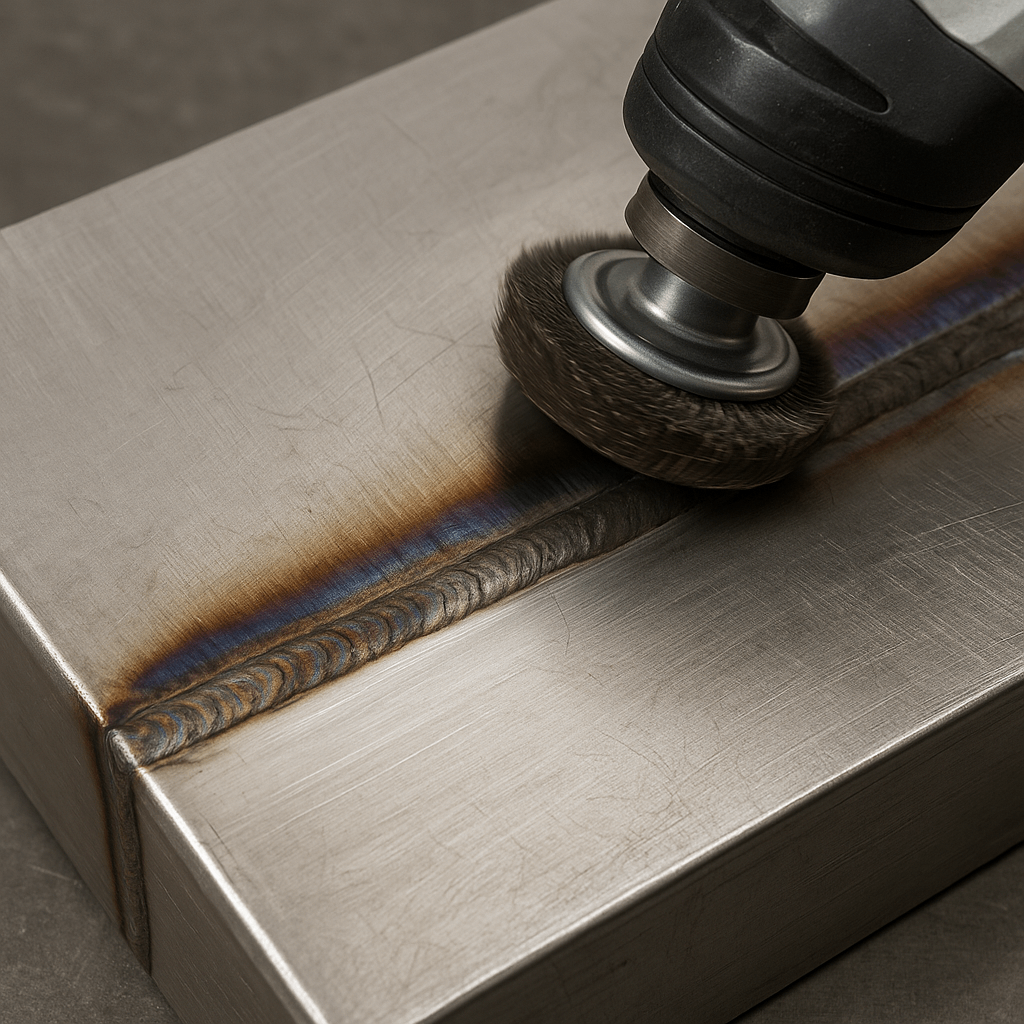
Heat tint color gradients in weld zones provide visual data on the thermal history and damage severity. Straw tones suggest minor oxidation; darker blues and blacks indicate thicker, porous oxide layers and more chromium depletion. These are not visual imperfections but quality control signals.
For sourcing professionals, dark stainless steel heat tint colors suggest that simple cosmetic touch-ups are inadequate. A restoration process—validated and traceable—must be part of the supplier’s quality protocol.
Identifying the Real Enemy: Distinguishing Different Types of Surface Defects
Surface defects differ in impact and treatment needs. Key types include:
- Weld Scale (Heat Tint): Accelerates corrosion by depleting chromium in the heat-affected zone.
- Annealing/Heat-Treat Scale: Uniform but corrosive layer that can cover an entire surface.
- Free Iron Contamination: Microscopic carbon steel particles embedded in the stainless surface—undetectable visually, but a major corrosion risk.
Preventing contamination requires dedicated tools and controlled finishing environments—an important audit point when qualifying suppliers.
When Restoration is “Mandatory”—High-Risk Application Scenarios
Certain industries demand guaranteed passivity and low surface roughness:
- Hygienic Manufacturing: Food, medical, and pharmaceutical sectors require oxide- and crevice-free surfaces to prevent bacterial growth. This is especially critical in food grade stainless steel surface treatment, where contamination risks must be mitigated.
- Marine or Chemical Exposure: Chloride-rich environments intensify localized attack if oxide or contamination exists. Knowing how to prevent flash rust on stainless steel is essential for such high-risk use cases.
- Painted/Coated Components: Residual scale causes poor adhesion, coating failure, and customer rejections.
For these cases, skipping descaling or using incomplete methods is not just a shortcut—it’s a supply chain vulnerability.
Part 2: Strategic Trade-offs — Three Restoration Philosophies and Their Impact on Your Bottom Line
Descaling is not a one-size-fits-all procedure. It’s a trade-off between speed, cost, safety, and the degree of corrosion protection. Here’s how each method aligns with buyer priorities:
Philosophy 1: The Speed vs. Risk Equation (Mechanical Methods)
Mechanical methods like brushing, grinding, and blasting are fast and cost-efficient, but inherently risky. While abrasive blasting with non-contaminating media can help, improper abrasives (e.g., carbon steel shot) pose permanent contamination threats.
Surface roughness may also increase, impacting downstream finishing or hygiene performance. More importantly, mechanical descaling requires post-passivation—without it, residual iron and open grain structure will flash rust, especially in export shipping.
Philosophy 2: The Gold Standard for Integrity (Chemical Pickling)
Stainless steel acid pickling chemically dissolves oxide and underlying chromium-depleted metal. It yields a matte, uniform finish and is essential in welded parts and regulatory-compliant sectors.
Pickling gels or immersion baths use nitric and hydrofluoric acids—effective but hazardous. A compliant supplier must manage proper neutralization, PPE, and acid disposal systems (per 40 CFR guidelines). The cost may be higher, but so is product reliability and risk mitigation.
Knowing the best method to clean stainless steel weld discoloration is essential to ensure long-term resistance in harsh applications.
Philosophy 3: The Investment in Perfection (Electropolishing)
Electropolishing stainless steel goes beyond cleanup—it re-engineers the surface. The result is smoother, brighter, cleaner, and inherently more corrosion-resistant.
This is the go-to process for medical enclosures, vacuum chambers, and visible components in premium industrial systems. Though costlier upfront, it often reduces returns and increases component lifespan by factors of 5–10, justifying the ROI in high-spec markets.
Part 3: Critical Execution — The Dividing Line Between Professional and Amateur
Surface treatment isn’t just about having the right tools—it’s about the discipline of process. Even suppliers using the same chemicals can yield vastly different results.
Fatal Mistake #1: Skipping Pre-treatment
Residual oil or particulate blocks acid action. Degreasing before pickling is not optional—it’s foundational. Missing this step leads to patchy passivation and hidden corrosion nodes.
Fatal Mistake #2: Cross-Contamination
Any prior contact with carbon steel—from grinding discs to gloves—can embed iron in stainless surfaces. A competent vendor must maintain separate tooling workflows for stainless vs. mild steel. This is a top-tier audit point.
Fatal Mistake #3: Equating “Pickling” with “Passivation”
Pickling ≠ Passivation. The former removes oxide scale; the latter removes iron ions and reforms the passive layer.
Both are required for components exposed to aggressive environments. A supplier who treats these as interchangeable may leave parts vulnerable post-cleaning. If you’re unsure how to passivate stainless steel after pickling, always refer to ASTM A967 protocols.
The Expert’s Choice: The Modernization of Passivation Processes
Citric acid offers a safer, ASTM-compliant alternative to nitric acid. Though gentler, it effectively removes free iron without aggressive byproducts.
Suppliers like YISHANG have adopted citric-based passivation as part of their export finishing line, especially for applications involving food contact, electronics, and ROHS-compliant assembly.
Part 4: Outcome Verification & Decision Framework — How to Ensure Flawless Results
Quality control must move beyond visual checks. A matte finish doesn’t mean the surface is passive.
Beyond the Naked Eye: Industry Standards for Verifying Restoration Success
The gold standards are:
- ASTM A380: Cleaning, descaling, and preparation protocol
- ASTM A967: Passivation protocol for stainless steel
Test methods include:
- Water-Break Test: Water should form a continuous film; beading signals contamination.
- Copper Sulfate Test: Presence of copper = presence of free iron = failure.
These aren’t optional—they’re basic deliverables in high-reliability sourcing. Understanding the ASTM A967 test methods is essential when auditing stainless steel vendors.
Your Final Decision Checklist (Choosing the Optimal Path for Your Next Project)
| Decision Factor | Mechanical Descaling | Chemical Pickling | Electropolishing |
|---|---|---|---|
| Primary Goal | Speed and prep | Structural purity | Maximum corrosion resistance |
| Resulting Finish | Rough, inconsistent | Uniform, matte | Ultra-smooth, mirror-like |
| Corrosion Resistance | Low (until passivated) | High (post-passivation) | Very high (inherent) |
| Relative Cost | Low | Medium to high | High |
| Environmental Risk | Dust generation | Acid disposal required | Controlled, less toxic |
| Best Used For… | Fabrication prep | Welded structures, general metalwork | Cleanroom, food/med/tech equipment |
Before issuing a PO, ask your supplier:
- Have you documented ASTM compliance for surface treatment?
- Will passivation be done using citric or nitric acid?
- Are your tools segregated for stainless-only processing?
- Can I verify surface passivity via standard testing?
Conclusion: The Mindset Shift from Manufacturer to Materials Expert
Descaling is not a finishing touch—it’s a technical guarantee. Surface integrity impacts warranty risk, customer trust, and global acceptance.
By insisting on process validation and results-based testing, you evolve from component buyer to long-term stakeholder. For applications where finish defines function, specify standards—not shortcuts.
✅ Looking for stainless steel weld descaling and ASTM-compliant passivation at scale? Contact YISHANG’s engineering team today for custom surface finishing solutions tailored to your industry.
Frequently Asked Questions (FAQs)
Q1: What is the best method to descale stainless steel welds?
A: Chemical pickling followed by citric acid passivation is the most effective method, especially for components used in food-grade or marine environments.
Q2: Can stainless steel rust after mechanical descaling?
A: Yes. Without proper passivation, residual free iron from mechanical descaling can lead to flash rusting, especially during overseas shipping.
Q3: Is pickling the same as passivation?
A: No. Pickling removes oxide scale and chromium-depleted layers, while passivation removes free iron and enhances the protective oxide layer. Both are typically required.
Q4: How do I test if stainless steel has been properly passivated?
A: Standard tests include the water-break test and copper sulfate test, as outlined in ASTM A967.
Q5: Which surface treatment is best for pharmaceutical-grade stainless steel parts?
A: Electropolishing is ideal for pharmaceutical applications due to its ultra-smooth, contamination-resistant surface and enhanced corrosion protection.