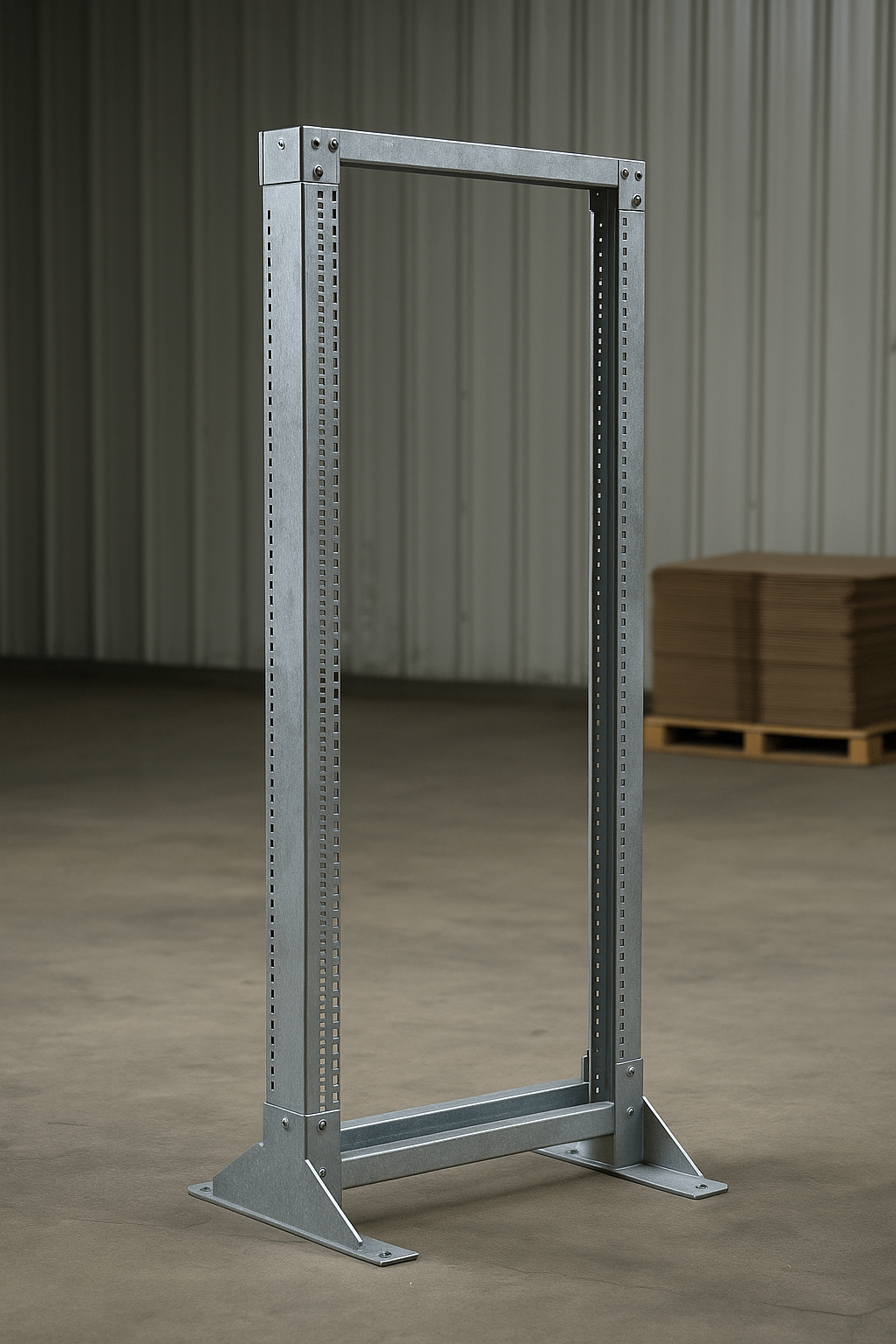
In the world of IT infrastructure procurement, the two-post open-frame rack is often viewed through a simplistic lens: a cost-effective solution for basic network deployments. This perspective, however, overlooks the profound impact that this foundational component can have on operational efficiency, long-term reliability, and the Total Cost of Ownership (TCO).
For a procurement manager, data center outfitter, or wholesale distributor, the choice of a rack is not a minor detail—it is a foundational investment in the integrity of a network.
This isn’t just another basic two post rack guide. It’s a practical playbook developed from over 26 years of real-world, industrial-grade metal manufacturing experience. We’ve seen where small engineering oversights can lead to big financial consequences.
This guide highlights the seven most critical 2 post rack mistakes commonly encountered in the field—offering direct, technical insight to help you make a well-informed, risk-aware procurement decision.
Part 1: The Strategic Go/No-Go Decision: Qualifying the 2-Post Rack for Your Application
The most common error is misapplication. Before you even evaluate suppliers or specifications, it’s critical to assess whether a two-post rack is a fit for your technical and operational environment. Skipping this step often leads to system-level issues no installation fix can undo.
Myth vs. Reality: Debunking 3 Common Industry Misconceptions
The two-post rack’s legacy has allowed several misconceptions to persist. A clear understanding of these myths is crucial for buyers to make sound decisions during project planning and technical evaluation.
Myth #1: “Two-post racks are a legacy solution, primarily for telecom equipment.”
Reality: Although they originated in the telecom space, modern 2 post rack use cases span far beyond. Today’s racks are used in high-density network distributions and edge computing environments, especially where physical space is limited.
For shallow-depth devices like patch panels and switches, the open-frame design enables optimal airflow and tool-free access—lowering maintenance overhead and cooling costs.
Myth #2: “Mounting servers on a two-post rack is fundamentally unsafe.”
Reality: Mounting a full-depth server directly on the front posts can be dangerous. But dismissing the idea outright overlooks safe, engineered solutions—namely, a 2 post conversion kit that creates a balanced four-point mounting.
It’s not the concept that’s unsafe—it’s improper implementation that creates risk.
Myth #3: “The primary advantage of a two-post rack is its low upfront cost.”
Reality: This is short-term thinking. While the initial price may be lower, long-term costs—downtime, repairs, rework—often exceed the savings. Total Cost of Ownership (TCO) is where the real value (or loss) shows up.
A better-built rack might cost more today but protects your investment across its lifecycle.
The 60-Second Procurement Qualification Checklist
Use this 2 post vs 4 post rack checklist to quickly assess suitability:
- Equipment Type: Mostly
shallow-depthdevices like patch panels or switches? - Access Needs: Require 360° accessibility for frequent MACs (Moves, Adds, Changes)?
- Space Constraints: Tight back-to-wall clearance?
- Load Profile: Equipment below 50 lbs, or plan to use center-mount kits for heavier loads?
- Security Environment: Is it in a locked room or secure cage?
If YES to 3 or more: A two-post rack could be the right call. If NO to 3 or more: Strongly consider a four-post or enclosed rack instead.
Part 2: The Buyer’s Playbook: Differentiating Quality from Commodity
Once you decide a two-post rack is suitable, your next challenge is differentiating quality builds from lookalike commodities.
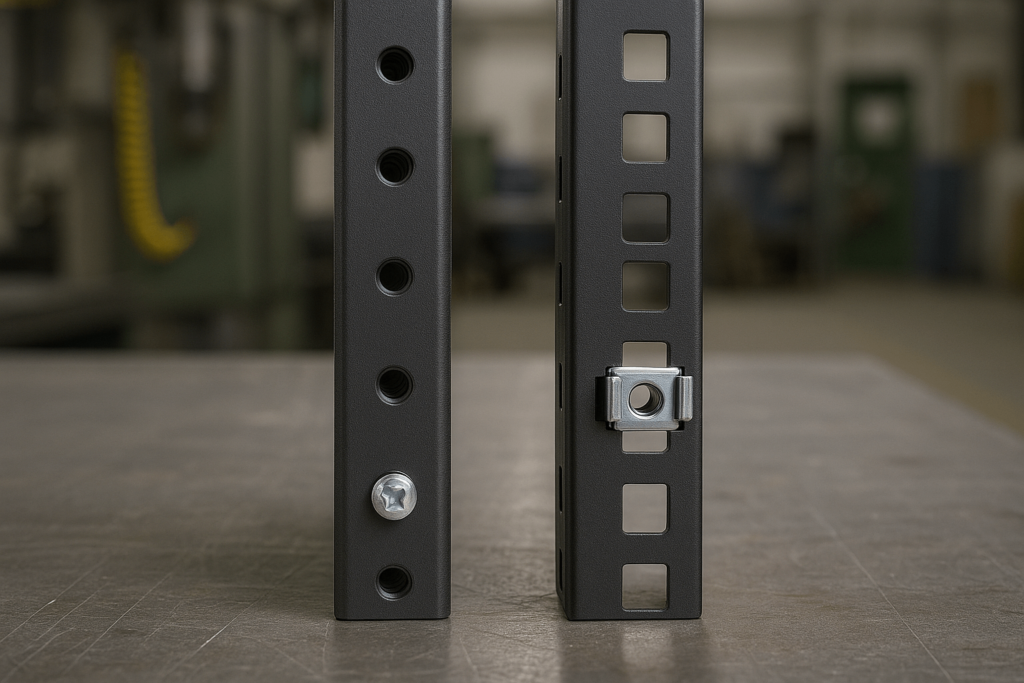
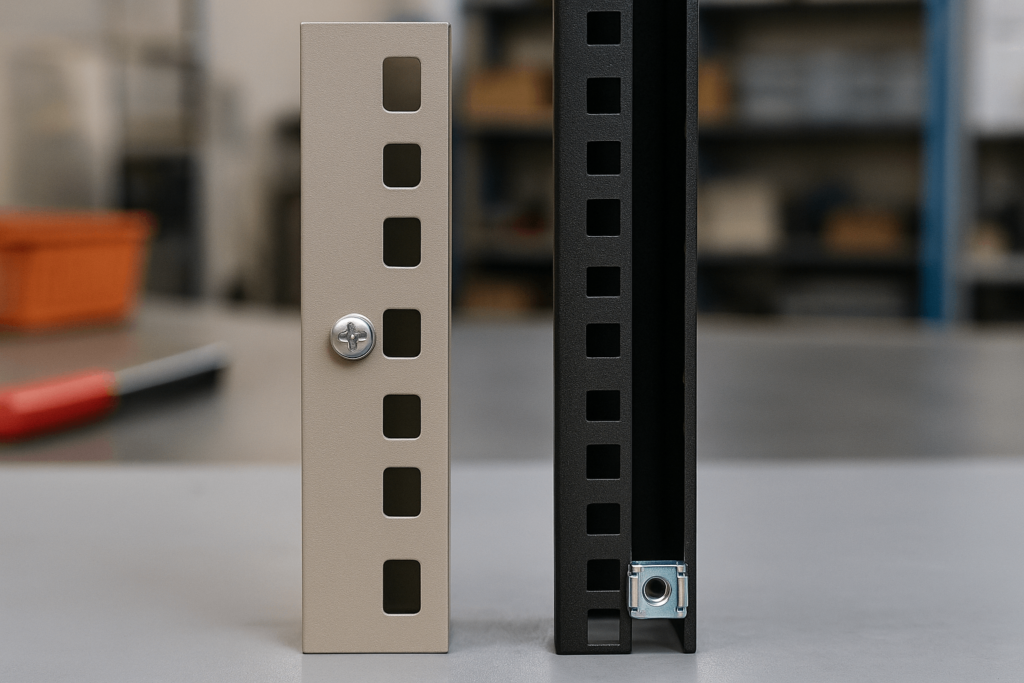
Trap #1: The False Economy of Threaded Holes
Threaded holes (e.g., 10-32, 12-24) may seem quicker to install, but once a thread strips, that U-space is lost. Forever.
Universal square holes with EIA-310-D compliance and cage nuts are the superior choice. Why? Because damaged threads become a replaceable part—not a permanent defect.
🛠️ Pro Tip: Stripped threads in the field are a nightmare. Avoid them altogether by choosing square-hole rails.
Trap #2: Misjudging Materials—It’s About Application, Not Strength Alone
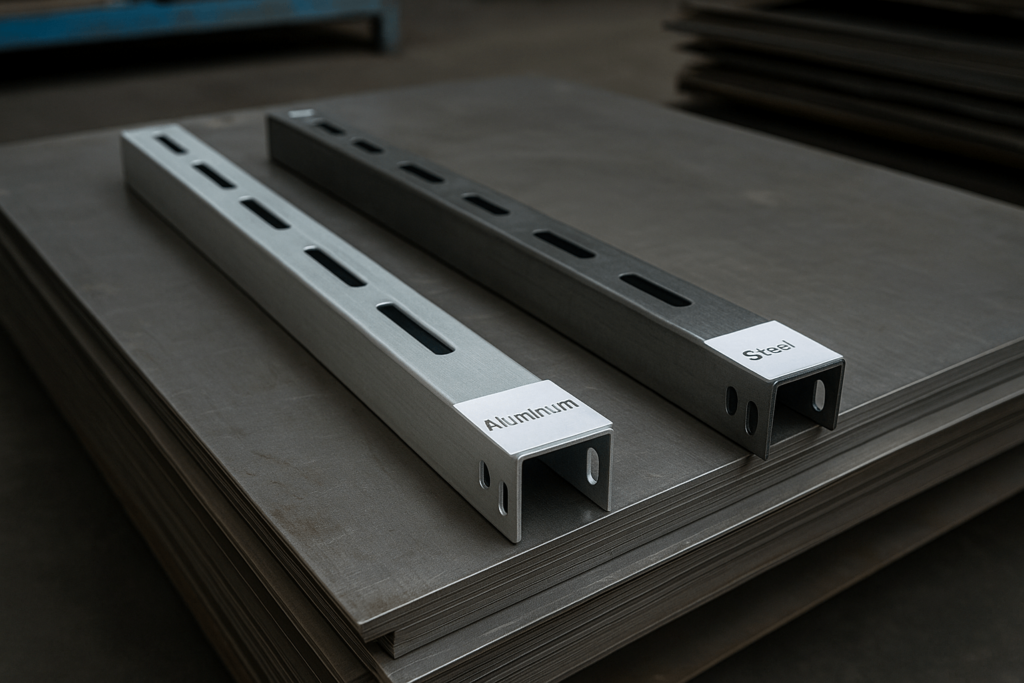
Which is better—steel vs aluminum server racks? It depends on your deployment:
- Humid Environments: Aluminum resists corrosion better than scratched powder-coated steel.
- Heavy Static Loads: 11/13-gauge cold-rolled steel has the stiffness for data center-grade loads.
- Mobile Systems: Aluminum’s lighter weight improves safety and transport efficiency.
It’s not about which is “best,” but which suits your application.
Trap #3: Ignoring Manufacturing Signals Hidden Behind the Spec Sheet
Spec sheets don’t always tell the full story. Here’s what truly separates high-quality racks:
- Base Frame Geometry: Wide, fully welded base = stability. Essential for tipping resistance.
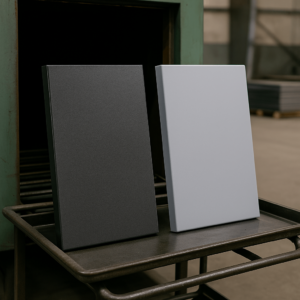
- Powder Coating Process: Multi-stage pretreatment + high-temp curing = corrosion resistance that lasts. Read more about our powder coating process
- Cantilever Load Engineering: Beyond static ratings—how well does the design resist forward tipping? That’s where true quality shows.
Application Fit Matrix for Two-Post Racks
| Use Case | Recommended? | Key Considerations |
|---|---|---|
| Edge computing rooms | ✅ Yes | Space-constrained, shallow-depth gear |
| Core server rooms | ❌ No | Better suited for 4-post enclosed cabinets |
| Patch panel-heavy setups | ✅ Yes | Full front accessibility, MAC-friendly |
| Rugged industrial sites | ⚠️ Conditional | Grounding and anchoring critical |
| Co-location environments | ❌ No | Need for enhanced physical security |
Part 3: Deployment Integrity—From the Pallet to a Rock-Solid Installation
Even the best rack fails if installed poorly. Ensure best practices are followed from unpacking to anchoring.
Trap #4: Skipping Floor Anchoring
Never treat anchoring as optional. Unanchored racks are an accident waiting to happen.
- Use a hammer drill, not a rotary drill.
- Clean out dust before anchor installation—residue reduces strength.
- Choose certified wedge anchors (3/8″ or 1/2″) and follow proper depth specifications.
Trap #5: Improper or Missing Grounding
A grounded PDU ≠ a grounded rack. You must:
- Use a dedicated ground lug.
- Expose bare metal contact—scrape coating where needed.
- Ground each rack individually. Never daisy-chain.
Standards like ANSI/TIA-942 demand it, and so should you. Explore grounding standards
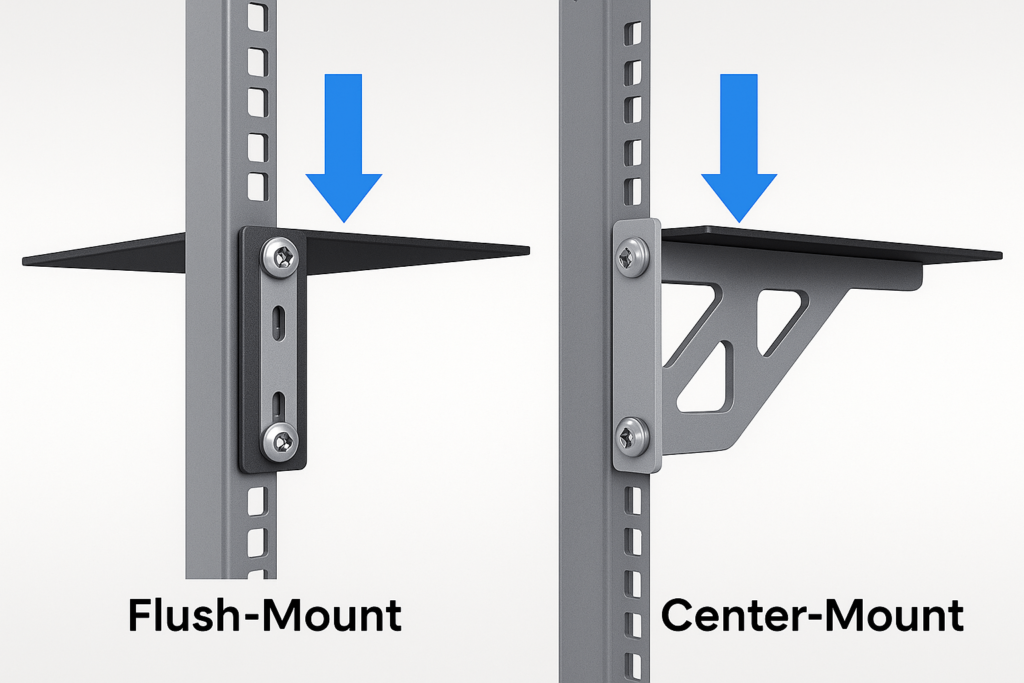
Trap #6: Using the Wrong Conversion Kit Type
There’s a physics lesson here:
- Flush-Mount Kits: Shift the load forward, increasing tipping force.
- Center-Mount Kits: Align weight over the base, enhancing stability.
Always choose center-mount designs for server installation. It’s the safe, engineered approach. Compare center-mount brackets
Part 4: Operational Efficiency—Cable Management as a System
Good cable management isn’t cosmetic—it’s operational. It reduces downtime, eases maintenance, and preserves signal quality.
Trap #7: Using Zip Ties
They’re cheap. And they’re terrible.
Zip ties can damage cables, can’t be reused, and slow down MAC work. Velcro straps are the industry standard: adjustable, reusable, and safe.
📌 For long-term savings and safety—ditch the zip ties.
Bonus Tip: Separate Power & Data
Run power on one side, data on the other. Parallel bundling invites EMI and troubleshooting nightmares.
- Use vertical cable managers.
- Cross paths at 90° if needed.
This layout isn’t just neat—it’s electrically sound.
Frequently Asked Questions (FAQ)
Q1: Is a two-post rack safe for servers?
Yes, when using a proper center-mount conversion kit, stability and load distribution are optimized.
Q2: What’s the difference between flush-mount and center-mount kits?
Flush-mount kits shift weight forward and increase tipping risk. Center-mount kits align the load over the base for better balance.
Q3: Do I need to ground a two-post rack even if the PDU is grounded?
Yes. The PDU does not ground the rack frame. A dedicated ground wire is required to meet standards like ANSI/TIA-942.
Q4: Can I mount switches and patch panels in a 2 post rack?
Absolutely. These shallow-depth devices are ideally suited for two-post open frame racks.
Q5: How do I determine if a two-post rack is right for my deployment?
Use our 60-second qualification checklist in Part 1 to assess load, access needs, and security environment.
Q6: What kind of floor anchors should I use for rack installation?
Certified wedge anchors (3/8″ or 1/2″) with cleaned concrete holes are industry standard.
Conclusion: Buy a System, Not a Shell
Two-post racks, when applied correctly, are more than cheap metal frames. They’re part of a high-performance infrastructure system.
Wholesale buyers and infrastructure engineers alike must prioritize engineering quality, lifecycle cost, and partner capability.
At YISHANG, we embed 26 years of fabrication experience into every frame. From welds to coatings to packaging, we help build infrastructure that lasts.
📦 When you’re ready to move beyond specs and into durable, engineered performance—partner with a manufacturer who lives the lifecycle with you.