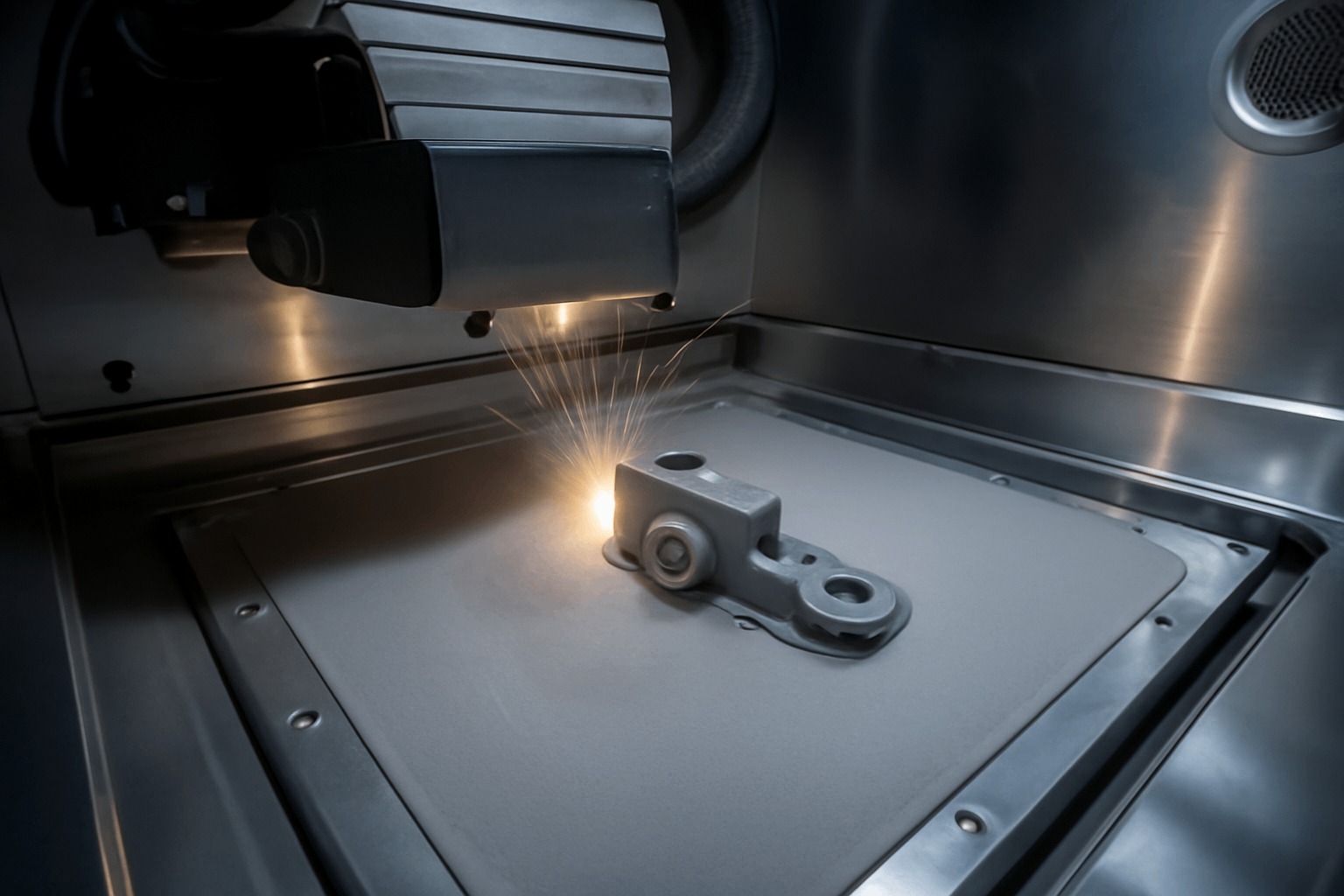
Understanding LPBF From a Procurement Perspective
For international buyers and sourcing managers, the challenge is rarely just finding a supplier. The real challenge is finding a manufacturing partner that can deliver precision, flexibility, documentation, and repeatability without forcing every project into expensive tooling or high minimum order quantities.
Traditional metal fabrication processes such as stamping, casting, and CNC machining still have clear advantages. But they also come with familiar sourcing pressures: tooling cost, longer development time, design-change penalties, and limited flexibility for small batches or customized variants.
Laser Powder Bed Fusion, commonly known as LPBF, gives buyers another route. Instead of cutting or forming metal from solid stock, LPBF builds parts layer by layer from fine metal powder using a laser-controlled process. The result is a digitally driven production method that can support complex geometries, rapid iteration, and short-run metal part manufacturing without dedicated molds.
For global OEM and ODM buyers, this matters. Whether the project involves stainless steel enclosures, aluminum housings, sensor brackets, structural frames, or complex metal inserts, LPBF can reduce early-stage sourcing friction while improving design freedom and traceability.
What Is LPBF and Why It Matters
Laser Powder Bed Fusion uses a high-powered laser to selectively melt thin layers of metal powder on a build platform. Common materials include stainless steel 304/316, aluminum alloys, and low-carbon steel. Each new layer fuses with the previous one until the final part is complete.
For procurement teams, the biggest difference is not only technical. It is commercial.
LPBF does not require dedicated tooling or die preparation. That means OEM and ODM buyers can test multiple design versions without paying for a new tool each time. Mounting holes, cable ports, internal channels, sensor brackets, or enclosure interfaces can often be changed digitally rather than mechanically.
For projects where the design is still evolving, this flexibility is valuable. It allows buyers to validate performance, improve fit, and respond to customer feedback before committing to larger-scale fabrication.
LPBF is especially useful for industries where precision and traceability matter, including energy storage, industrial electronics, automotive components, machinery, and custom enclosure systems.
Why LPBF Strengthens Supply Chain Efficiency
Modern supply chains reward agility. Buyers increasingly need smaller batches, faster samples, documented quality, and the ability to manage several part variations at once.
LPBF supports that shift because production starts from digital files. A single supplier can run multiple part variants in one build cycle, helping buyers manage regional versions, prototype updates, or specialized customer requirements without rebuilding tooling.
Another procurement advantage is documentation. Every build can be tied to digital records, including powder batch information, machine parameters, operator logs, inspection data, and post-processing records. For buyers managing audits or regulated supply chains, this traceability can be just as important as the part itself.
Buyer Takeaway: LPBF gives procurement teams more flexibility, shorter development cycles, and stronger production visibility — three things that are increasingly important in global sourcing.
Solving Procurement Pain Points with LPBF
Small Batch, High Efficiency — No Tooling Required
Traditional manufacturing often penalizes low-volume orders. Tooling cost must be absorbed somewhere, so small-batch buyers either pay a high unit price or accept a larger MOQ than they actually need.
LPBF changes that equation. Because production is file-based, buyers can order small batches, pilot runs, market-specific variants, or functional prototypes without investing in molds.
A CAD file can be adjusted for different enclosure layouts, port positions, mounting interfaces, or regional design requirements. For sourcing teams, this means fewer sunk costs in the early stage and more room to refine the product before scaling.
Material utilization is another advantage. LPBF can use metal powder efficiently, and unused powder may be recycled depending on material and process controls. This helps stabilize material use, especially for complex parts that would generate heavy waste through machining.
Faster Sampling, Shorter Development Cycles
For OEM projects, time-to-market often determines competitiveness. Waiting weeks for tooling or machining samples can slow the entire project.
LPBF can shorten sampling cycles because functional metal prototypes can be produced directly from the digital model. In many cases, buyers can review and test physical parts far earlier than they could with casting, stamping, or conventional tooling.
This is useful when teams need to validate:
- fit and assembly;
- wall thickness;
- mounting points;
- airflow or cable-routing features;
- ergonomic or structural details;
- functional interfaces with other components.
Designs can also be revised mid-project. Instead of waiting for tool modification, the digital file is updated and the next version can move into production quickly.
Traceable Quality and Global Compliance
Every LPBF job can generate a production record. Depending on supplier capability and project requirements, this may include laser parameters, scan strategy, powder source, heat treatment records, dimensional inspection, photos, and packaging data.
For procurement teams, this traceability supports quality control and compliance review. When combined with post-processing such as CNC machining, polishing, anodizing, or powder coating, LPBF can deliver parts that are not only functional but also ready for assembly or export.
YISHANG supports LPBF-related sourcing with documentation workflows aligned with B2B buyer expectations, including quality records, material tracking, and export-ready communication.
Buyer Takeaway: LPBF helps reduce MOQ barriers, shorten sampling time, and create clearer production records — giving buyers better control over cost, schedule, and quality.
Inside the LPBF Process — What Buyers Should Know
From CAD to Part: Digital Preparation
The LPBF process begins long before the laser starts. Engineers first review the CAD model for printability, support placement, surface orientation, heat management, and dimensional risk.
This step is important because LPBF is powerful, but not magic. Poor orientation, weak support design, or unmanaged thermal stress can affect accuracy, surface quality, and post-processing cost.
Process variables may include laser power, scan speed, hatch distance, layer thickness, and build orientation. These settings influence density, surface finish, distortion control, and mechanical behavior.
For buyers, the practical point is simple: a capable LPBF supplier should not only accept a file and print it. They should review the part for manufacturability and explain where design changes may improve cost, quality, or reliability.
Finishing and Post-Processing
After printing, LPBF parts often require post-processing. This is normal and should be discussed during the RFQ stage.
Common finishing steps include:
- heat treatment for stress relief;
- support removal;
- CNC machining for high-precision interfaces;
- polishing, anodizing, or powder coating;
- inspection and dimensional verification.
Hybrid projects may combine LPBF-printed features with sheet metal panels, CNC-machined surfaces, or welded structures. For example, printed brackets may be integrated into a larger metal enclosure to reduce weld points, simplify assembly, or improve sealing performance.
The best results often come from treating LPBF as part of a broader manufacturing strategy rather than as a stand-alone replacement for every process.
Compliance and Transparency
Procurement audits increasingly require more than finished-part photos. Buyers may need proof of material source, process consistency, dimensional conformity, and packaging control.
A transparent LPBF workflow may include:
- powder batch tracking;
- operator and machine records;
- inspection reports;
- post-processing logs;
- photo records;
- packaging reports.
For global buyers, this level of visibility reduces uncertainty. It also makes supplier comparison easier, especially when several vendors are quoting similar-looking parts.
Buyer Takeaway: The value of LPBF is not only in printing the part. It is in controlling the full digital-to-physical workflow from CAD review to final inspection.
Comparing LPBF With Other Metal 3D Technologies
LPBF vs SLM and DMLS
In the market, terms such as LPBF, SLM, and DMLS are sometimes used interchangeably. This can confuse buyers.
LPBF is the broader process category: a laser selectively fuses metal powder layer by layer. SLM and DMLS are often used as process or commercial terms within the same general family of metal powder bed fusion technologies.
For procurement teams, the exact label matters less than the supplier’s process capability. Buyers should ask:
- What material can be printed?
- What density can be achieved?
- What tolerances are realistic?
- What post-processing is included?
- What inspection documentation is provided?
- Has the supplier produced similar industrial parts before?
This is especially important for IP-rated housings, brackets, sensor mounts, and outdoor metal components where sealing, density, and dimensional stability affect final performance.
LPBF vs SLS (Polymer Sintering)
SLS is commonly associated with polymer powder sintering, while LPBF is used for metal parts. Buyers sometimes confuse the two because both are powder-based additive processes.
The distinction is important. Polymer SLS parts may be useful for prototypes, fixtures, or lightweight plastic components, but they cannot replace metal parts in applications that require electrical conductivity, heat resistance, sealing strength, structural load capacity, or fire-related performance.
LPBF is a better fit for electrical boxes, battery casings, brackets, machinery components, and other industrial-grade metal applications where polymer parts cannot meet the requirement.
Buyer Takeaway: LPBF is suitable when the project requires real metal performance, not just a 3D-printed shape.
Hybrid Manufacturing: LPBF Meets Traditional Fabrication
The Smart Balance Between Additive and Sheet Metal
LPBF is not always the lowest-cost choice for large simple structures. A large flat panel, for example, is usually better made through sheet metal fabrication.
The smarter approach is often hybrid manufacturing. YISHANG can combine LPBF-printed complex features with traditional processes such as laser cutting, bending, CNC machining, welding, and surface finishing.
This gives buyers the best of both worlds:
- LPBF for complex internal geometry or small precision features;
- sheet metal for large panels and cost-efficient structural areas;
- CNC machining for high-tolerance interfaces;
- finishing processes for appearance and corrosion protection.
Used correctly, hybrid manufacturing can reduce assembly complexity, improve customization, and keep costs under control.
Rapid Design Modification and Localization
Many OEM buyers need regional or customer-specific changes. One market may require different ventilation holes. Another may need a sensor port, cable opening, or mounting bracket adjustment.
With LPBF, these updates can often be made in the digital file without tool modification. That helps buyers respond faster to certification differences, customer feedback, or late-stage engineering changes.
For global sourcing teams, this flexibility is especially useful when launching products across multiple regions with slightly different technical requirements.
Secure Data and IP Protection
Digital manufacturing depends on CAD data. That makes intellectual property protection an important part of supplier selection.
Buyers should confirm how the supplier manages:
- NDA agreements;
- CAD file access;
- version control;
- internal data permissions;
- secure transfer channels;
- production record storage.
YISHANG supports controlled data handling for OEM and custom metal projects, helping buyers protect sensitive design information during development and production.
Buyer Takeaway: LPBF fits best when it is integrated into a secure, flexible, and well-documented manufacturing workflow.
Cost, Efficiency, and Sustainability for Buyers
Cost Comparison Table
| Cost Element | Conventional Fabrication | LPBF Process |
|---|---|---|
| Tooling | High upfront investment | None |
| Material Efficiency | 40–50% | 90–95% |
| Setup Time | Long | Minimal |
| Design Change | New tooling required | Digital update |
| Lead Time | 15–20 days | 3–5 days |
LPBF does not always produce the lowest unit price. For simple high-volume parts, stamping or casting may still be more economical. Its value is strongest when the part is complex, the quantity is moderate, the design may change, or the buyer needs fast samples without tooling.
For small-batch, high-value, or design-sensitive parts, LPBF can reduce total cost by shortening development time, avoiding tooling waste, and making design changes easier.
Environmental & Supply Chain Impact
Sustainability now influences many purchasing decisions. LPBF can reduce material waste because it builds near-net-shape components instead of removing large amounts of material from solid stock.
It can also support localized or on-demand manufacturing, reducing storage needs and helping buyers avoid overproduction.
For procurement teams working toward ESG or green sourcing goals, the benefits may include:
- less scrap;
- reduced tooling waste;
- shorter development cycles;
- lower inventory pressure;
- more efficient small-batch production.
Buyer Takeaway: LPBF offers sustainability value not only through material efficiency, but also through smarter production planning.
The Future of Metal Additive Manufacturing
From Prototyping to Serial Production
LPBF is no longer limited to concept models or early prototypes. With improved machines, better process control, and multi-laser systems, more industries are using metal additive manufacturing for bridge production and selected serial parts.
Aerospace, EV manufacturing, industrial automation, medical equipment, and energy-related sectors are already exploring or adopting LPBF where conventional processes limit design flexibility.
Emerging Materials and New Capabilities
Material options continue to expand. Stainless steel, aluminum, titanium, copper, and high-strength steels are opening new applications in housings, thermal components, brackets, sensor mounts, and functional assemblies.
For buyers, this means LPBF should not be viewed as a niche technology only for unusual shapes. It is becoming a practical option for selected metal parts where performance, design freedom, and speed matter.
Strategic Adoption for Buyers
Forward-looking procurement teams should begin qualifying LPBF suppliers before urgent projects appear.
Early supplier qualification helps buyers:
- understand realistic tolerance and finish levels;
- build internal pricing references;
- prepare documentation expectations;
- identify suitable part categories;
- shorten approval cycles for future projects.
Buyer Takeaway: Early LPBF adoption can strengthen sourcing resilience and make future design changes easier to manage.
Conclusion — Turning Digital Manufacturing Into Competitive Value
For global OEM and ODM buyers, Laser Powder Bed Fusion is more than a metal 3D printing method. It is a sourcing tool that can reduce tooling dependence, shorten sampling cycles, support customization, and improve production traceability.
It is not the right answer for every part. Simple, high-volume components may still belong to stamping, casting, or conventional sheet metal fabrication. But for complex metal parts, fast development, short runs, and hybrid assemblies, LPBF can create real procurement value.
YISHANG supports buyers by combining LPBF with traditional metal fabrication, CNC machining, finishing, documentation, and export-ready project support. The result is a more flexible path from digital design to market-ready metal component.
FAQ for Buyers
Q1: What metals are best for LPBF?
Stainless steel 304/316, aluminum alloys, and low-carbon steel are common options. Depending on project requirements, copper and titanium may also be considered for specific applications.
Q2: How does LPBF improve production lead time?
LPBF removes tooling setup and allows file-based production. This can shorten sample development from weeks to days, especially when the part is complex or still being revised.
Q3: Is LPBF suitable for industrial enclosures?
Yes, especially for complex brackets, internal features, sealing-related components, sensor mounts, and custom metal inserts. For larger enclosure panels, LPBF is often best combined with sheet metal fabrication.
Q4: Can YISHANG handle hybrid or large-structure projects?
Yes. YISHANG can combine LPBF parts with sheet metal fabrication, CNC machining, welding, and finishing to balance cost, strength, accuracy, and scalability.
Q5: Is LPBF cost-effective for mass production?
It depends on the part. LPBF is strongest for complex, customized, small-batch, or high-value components. For simple high-volume parts, conventional fabrication may still be more economical.