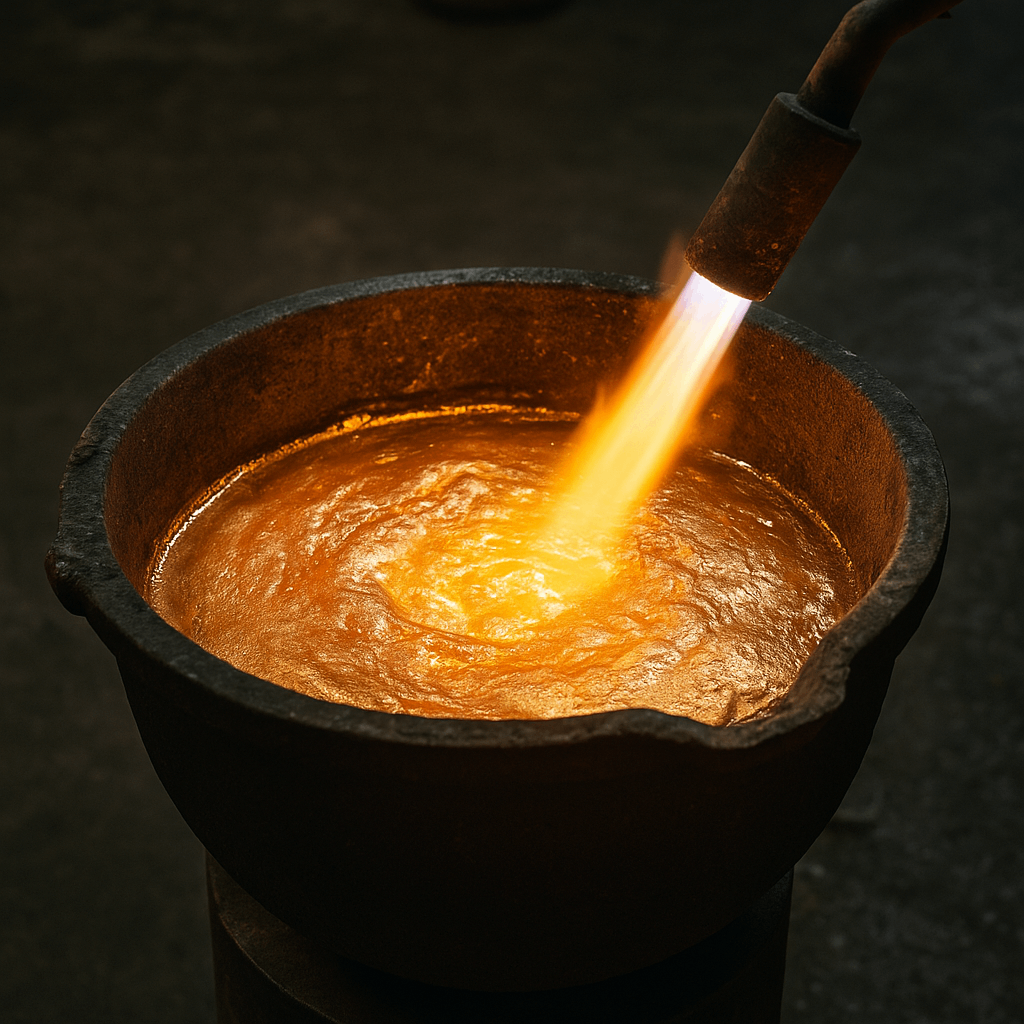
For international procurement teams sourcing brass components, the question “how hot to melt brass” is never just a technical curiosity. It is a practical issue that directly influences supplier reliability, production predictability, and total landed cost.
When brass enters its melting interval, the way a factory manages heat, alloy behaviour, and furnace stability becomes a visible reflection of its process discipline. That discipline—or lack of it—later affects casting quality, machining consistency, plating response, and downstream assembly performance.
For buyers managing recurring programmes or multi-region supply, the real concern is not a textbook melting point. It is whether each batch behaves consistently enough to support stable production and predictable commercial outcomes.
At What Temperature Does Brass Melt? (Quick Reference)
Brass does not melt at one exact point. Most commercial grades melt across a range that is typically about 900–955°C (1650–1750°F), depending on copper-zinc ratio and alloy additions.
For buyers, this quick reference is useful not because it provides a final answer, but because it helps confirm whether a supplier’s stated melt window is technically reasonable for the alloy being quoted.
Rethinking the Question — Why Procurement Should Focus on Melt Stability Instead of a Fixed Temperature
For procurement teams, the real issue is usually not the published melting point itself. The more important question is whether the supplier can control melt stability, repeatability, alloy behaviour, and heat consistency in real production.
Brass Is an Alloy Family, and Each Grade Behaves Differently Under Heat
Brass is not one material. It is a family of alloys, and each grade has its own melting interval, flow behaviour, and sensitivity to zinc loss, segregation, and shrinkage.
That is why two factories quoting the same brass grade may still produce very different results if their furnace control and process discipline are not equally strong.
Why Melting Temperature Must Match the Production Objective
In manufacturing, brass is not melted simply to reach a liquid state. It is melted to achieve the right behaviour for casting flow, alloy uniformity, mold filling, and downstream stability.
A supplier that adjusts temperature strategy according to alloy, furnace condition, and production purpose is usually operating with stronger engineering maturity than one that treats temperature as a fixed chart value.
The Practical Temperature Range — Why 900°C Is Only a Benchmark
The commonly quoted 900–940°C range is only a benchmark. In real production, the effective melting window depends on how heat is transferred, how the alloy responds, and how much control the furnace system provides.
Why the 900–940°C Figure Over‑Simplifies Real‑World Melting
Published temperature ranges do not show how real furnaces behave. Crucible mass, heat loss, airflow, insulation quality, and melt-pool uniformity all affect how quickly and how evenly the alloy actually melts.
For buyers, this matters because a supplier who relies only on nominal temperature charts may still struggle with unstable batch quality.
How Alloy Grade and Furnace Capability Influence Actual Melt Temperature
High-zinc and high-copper brasses do not respond to heat in the same way, and furnace type changes the result further. Induction furnaces usually allow tighter temperature control, while gas furnaces often require closer monitoring to avoid uneven heating.
This difference has direct sourcing relevance because furnace capability strongly affects consistency, scrap rate, and repeatability over time.
Why Controlled Overheat Is Essential for Predictable Casting Behaviour
In industrial brass melting, factories usually apply a controlled superheat above the liquidus range so the metal flows properly into molds and remains stable during transfer.
This overheat must be controlled carefully. Too little may cause poor fill or cold shuts. Too much increases zinc evaporation, composition drift, and unnecessary process risk.
Brass Temperature Rating vs Melting Point — Understanding Service Limits
Buyers should also separate melting temperature from service temperature rating. Melting range refers to how the alloy behaves in manufacturing. Temperature rating refers to how the finished brass part performs in use.
This distinction is important in fittings, connectors, valves, and engineered brass components where service limits must be evaluated independently from foundry melting conditions.
The Science Behind Melting — What Actually Happens in the Metal
What happens inside brass during heating directly affects casting behaviour, machining response, and final component reliability. For buyers, this is useful because melting science often shows whether a supplier truly understands process control or is only following habit.
Temperature vs Heat — Why Many Furnaces Underperform
A high flame temperature does not guarantee that the brass itself is being heated evenly or efficiently. Real melting performance depends on heat transfer, thermal penetration, and furnace consistency.
This is one reason why two suppliers working at similar stated temperatures may still produce different results.
The Phase Transition Zone — The Most Critical Stage for Quality
Brass passes through a transition zone rather than flipping instantly from solid to liquid. During this stage, viscosity changes, partially liquid regions develop, and alloy stability becomes more sensitive.
If this phase is handled poorly, defects such as segregation, turbulence, or incomplete melt behaviour become more likely.
Zinc’s Boiling Point — The Central Challenge in Brass Melting
Zinc is one of the main reasons brass melting requires careful control. Because zinc becomes volatile near brass melting conditions, overheating can alter alloy chemistry, affect corrosion behaviour, and reduce long-term consistency.
Suppliers who actively manage zinc loss usually show stronger metallurgical discipline and better process maturity.
Why Melt Behaviour Predicts Supplier Reliability
Melt behaviour is often one of the clearest indicators of whether a supplier can support stable long-term production. If melting is controlled well, the results usually carry forward into more consistent casting, machining, and inspection outcomes.
Melt Stability as a Foundation for Dimensional and Mechanical Consistency
Stable melting helps create more uniform grain structure, more predictable fill behaviour, and better dimensional repeatability. These improvements reduce variation that might otherwise appear later during machining or assembly.
Temperature Strategy as an Indicator of Process Maturity
A supplier that can explain its temperature strategy clearly—approach zone, dwell time, overheat window, and zinc-loss control—usually demonstrates broader process discipline across the factory.
For procurement teams, this makes melt-related discussion a practical supplier-evaluation tool.
Melt Behaviour’s Impact on Cost, Throughput, and Lead Time
Poor melt control often creates hidden cost in the form of scrap, rework, unstable machining time, delayed production flow, and inconsistent quality decisions. Over repeated orders, those costs become significant.
How Melt Behaviour Translates to Cost Control and Manufacturing Stability
For large-volume brass programmes, melt stability is closely tied to manufacturing cost control. The more stable the melt, the more predictable the downstream process becomes.
Melt Stability Minimises Hidden and Accumulating Costs
Unstable melts often create secondary cost through selective rejection, extra machining, added inspection effort, or finishing failures that were not visible earlier in the process.
Suppliers with stable melting discipline are more likely to protect total cost over time, not just offer an attractive initial quote.
Stable Melting Creates Predictable Production Flow
Stable melting supports smoother casting rhythm, fewer remelt interruptions, and better capacity planning. For buyers, this contributes to more reliable lead times and lower schedule disruption.
Melt Control as a Practical Risk‑Management Criterion
When procurement teams ask about furnace type, temperature window, zinc-loss control, and melt monitoring, they are not asking academic questions. They are testing whether the supplier runs a controlled operation that can scale without losing consistency.
How Manufacturers Choose the Right Melting Strategy
A melting strategy is not just a furnace setting. It is an engineered sequence that determines whether the brass will reach the correct condition for stable production.
Strategic Heating Logic — Why the Sequence Matters
Professional suppliers usually manage melting in stages: controlled heat-up, full homogenisation, and then a narrow overheat window suitable for casting or transfer.
This sequence matters because each stage affects alloy uniformity, zinc stability, and flow behaviour.
Why Reliable Furnaces Don’t Target “The Exact Melting Point”
Reliable factories do not try to hold brass exactly at its nominal melting point. In practice, that would create unstable flow and higher defect risk.
Instead, they target an engineered range that balances fluidity, alloy protection, and production control.
Why Melt Strategy Shapes Downstream Quality and Cost
Melting strategy affects much more than the pouring step. It influences how the casting machines, how consistently it plates or finishes, and how much variation appears from batch to batch.
Troubleshooting Melt Issues — What the Symptoms Reveal About Process Control
Melt-related problems are useful for buyers because they reveal how a supplier solves process issues. A factory that can explain symptoms, root causes, and corrective action usually has a stronger control culture than one that only sorts defects after they appear.
Symptom Patterns and What They Indicate
Visible issues such as weak fill, porosity, brittle sections, heavy dross, or unstable machining behaviour often point back to specific melt problems. What matters is whether the supplier can connect those outcomes to the correct process cause.
Root Causes and Their Link to Operational Maturity
Common root causes include poor heat transfer, uncontrolled atmosphere, furnace inconsistency, contaminated scrap, or poorly managed overheat margins. A mature supplier tracks and controls these factors systematically.
How Procurement Can Use Melt Troubleshooting as an Evaluation Tool
Procurement teams can use melt troubleshooting as an interview tool. Asking how suppliers monitor uniformity, control zinc loss, or respond to recurrent melt defects often reveals more than a polished presentation or a simple certificate list.
Small Workshop vs Industrial Production — What It Really Means for Buyers
Small workshops and industrial factories may quote similar brass melting temperatures, but their actual production stability is often very different. The difference comes from equipment, insulation, measurement discipline, atmosphere control, and how heat variability is managed.
For buyers, the key issue is project fit. A workshop may be acceptable for simple or low-risk orders, but repeat programmes, safety-relevant parts, or high-volume supply usually demand stronger industrial melting control.
What This Means for Purchasing and Sourcing Teams
For purchasing teams, melt behaviour is a practical supplier-assessment tool. A factory that treats melting as a controlled engineering process usually delivers more stable quality, fewer defects, and stronger long-term reliability.
Buyers should look for evidence of furnace capability, temperature-window control, zinc-loss management, and documented troubleshooting discipline rather than relying only on general promises.
FAQs About Brass Melting Temperature and Temperature Rating
What temperature does brass melt at?
Most common brass grades melt within about 900–955°C, depending on alloy composition.
Why does brass melt across a range instead of a single point?
Because brass is an alloy, it has a solidus–liquidus interval rather than a single melting point.
What is a typical brass temperature rating for fittings?
Many standard brass fittings operate safely within typical service ranges such as −65°F to 250°F, depending on design and pressure conditions.
Can brass be overheated during melting?
Yes. Excessive overheating increases zinc evaporation and can change alloy performance.
Does furnace type affect melting stability?
Yes. Furnace design strongly affects heat uniformity, process control, and repeatability.
Conclusion — Understanding Melting Behaviour Strengthens Supplier Selection
Brass melting should not be understood as reaching one fixed number. It is about controlling alloy behaviour through the right temperature strategy, furnace capability, and process discipline.
For procurement teams, that understanding becomes a useful way to distinguish between suppliers who only melt metal and suppliers who can support stable long-term production with fewer surprises.
Need Technical Support for Brass Projects?
At Yishang Metal Products Co., Ltd., we support OEM and wholesale buyers with custom metal manufacturing for brass and other industrial components. With 26+ years of experience, we support processes including fabrication, machining, finishing, assembly, inspection, and export-oriented production support.
For projects involving brass parts, custom metal components, or engineering-led sourcing requirements, we work with customers to align material choice, manufacturability, and supply stability more clearly.
📩 If you need technical support for brass-related projects or other custom metal components, send us your drawings or requirements to discuss the most suitable manufacturing approach.