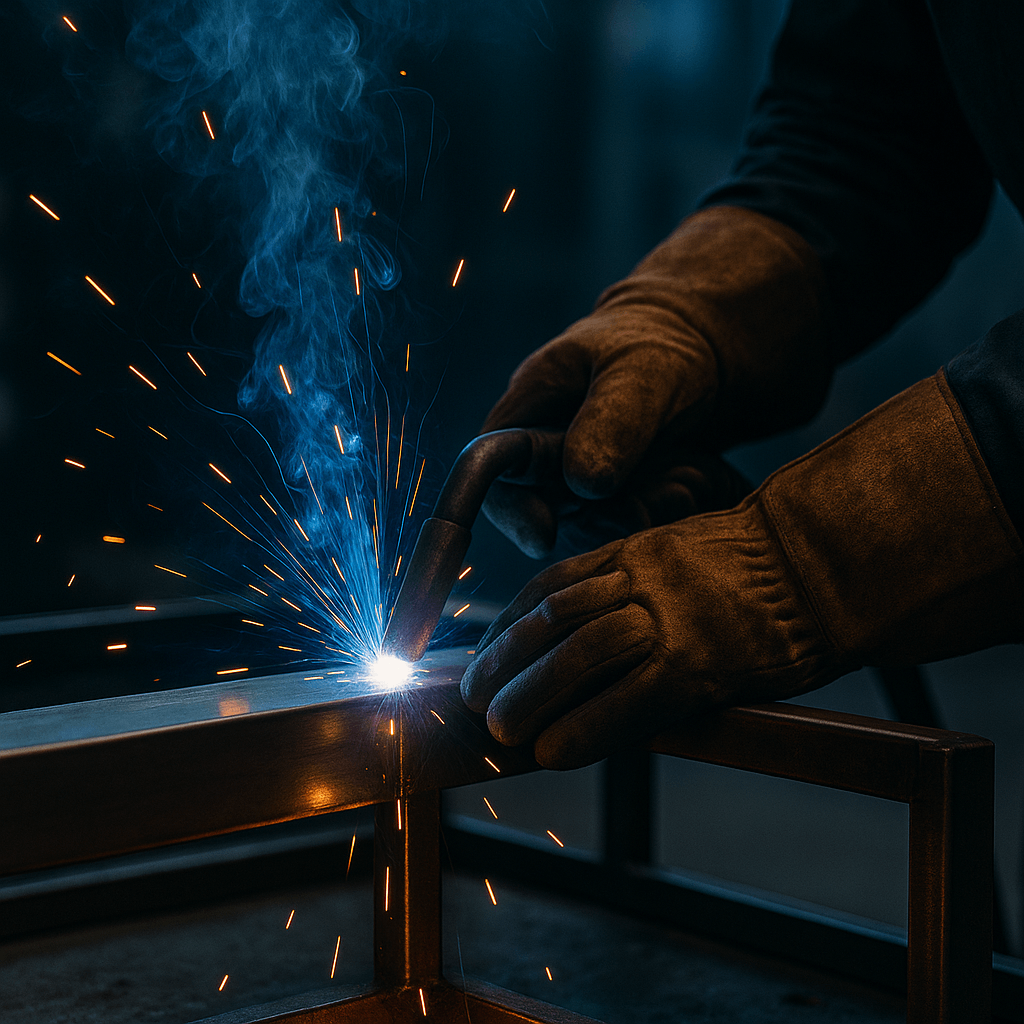
In the complex environment of custom metal manufacturing, the bill of materials may outline steel thickness, cutting methods, and surface treatments — but behind the single word “assembly” often hides one of the biggest drivers of cost, lead time, and warranty risk: the welding process.
For many overseas buyers and procurement managers, welding is still treated as a commodity. Some RFQs simply say “TIG weld all seams”, assuming it is always the safest or “best” option. Others do not specify welding at all, leaving suppliers free to choose whatever is cheapest or fastest. Both approaches create hidden financial and structural risks for distributors, wholesalers, and OEM brands.
In theory, there are many types of arc welding. In practice, for OEM metal cabinets, sheet metal enclosures, brackets, display racks, and frames, four processes dominate real production:
- MIG welding (GMAW)
- TIG welding (GTAW)
- Stick welding (SMAW)
- Flux-Cored Arc Welding (FCAW)
Besides, stud welding is a critical arc-based fastening method for waterproof sheet metal enclosures, so we include it here as an extra process that buyers should understand.
What Are the 4 Types of Arc Welding?
The four main types of arc welding used in modern manufacturing are:
- Shielded Metal Arc Welding (SMAW / Stick welding) – manual, versatile, ideal for field work.
- Gas Metal Arc Welding (GMAW / MIG welding) – high‑speed, cost‑effective for mass production.
- Gas Tungsten Arc Welding (GTAW / TIG welding) – precise, clean, and suitable for visible stainless steel.
- Flux‑Cored Arc Welding (FCAW) – deep penetration for structural steel and heavy‑duty applications.
These four processes account for over 90% of real‑world welding in OEM sheet metal and structural manufacturing.
What Is Arc Welding?
Arc welding is a group of metal‑joining processes that use an electric arc to melt the base metal and create a fused joint. The arc forms between an electrode and the workpiece, generating temperatures over 3,000°C, enough to melt steel. Depending on the process, the electrode may be:
- Consumable (MIG, Stick, FCAW)
- Non‑consumable (TIG)
Arc welding requires shielding gas, flux, or both to protect the molten pool from contamination.
At YISHANG, a metal products manufacturer in China with 26+ years of experience in sheet metal parts, metal cabinets, metal display racks, and welded frames, we treat welding as a strategic cost-control and quality-control step, not just “assembly”. This guide is written from a factory floor perspective to help international buyers, wholesalers, and sourcing managers specify the right welding method for each project and understand the impact on total landed cost.
Key Takeaways for Busy Procurement Managers
If you do not have time to read the full article, these are the core points:
- The 4 types of arc welding you will see most often in RFQs and drawings are MIG, TIG, Stick (SMAW), and FCAW.
- MIG is usually the best balance of cost and speed for high-volume, general-purpose steel and aluminum parts.
- TIG is slower but gives high cosmetic and hygienic quality, ideal for visible stainless steel, food, and medical equipment.
- Stick welding (SMAW) is mainly used for field work and outdoor installation, not for precision sheet metal cabinet production.
- FCAW is ideal for thick, structural steel and heavy-duty frames where deep penetration is required.
- Stud welding adds threaded fasteners without holes, helping to keep IP-rated cabinets waterproof.
- The “best” process is the one that meets design, performance, and cost targets at the same time, not the one that simply looks the nicest in photos.
You can use this article as a practical sourcing guide when comparing welding quotes from different suppliers in China or other manufacturing countries.
Decision Matrix: Matching Welding Process to Product Goals: Matching Welding Process to Product Goals
Every arc welding method is a balance of heat input, speed, penetration, operator skill, and finish quality. Selecting the wrong one can:
- Add unnecessary labor hours
- Increase grinding and polishing
- Create distortion and rework
- Lead to product failures in the field
The simplified decision matrix below is based on real production data from long-term OEM projects.
[Image Placeholder: Comparison chart for MIG vs TIG vs Stick vs FCAW vs Stud Welding. Alt Text: Comparison table of 4 arc welding processes plus stud welding, including commercial advantages and risks]
| Welding Process | ISO Designation | Typical OEM Use Case | Key Advantage | Risk If Poorly Executed | Relative Cost | Typical Deposition Rate |
|---|---|---|---|---|---|---|
| GMAW (MIG) | 135 | Mild steel brackets, frames, general sheet metal | Fast & scalable for mass production | Cold lap – weld sits on top with weak fusion | $ (Low) | 2–5 kg/h |
| GTAW (TIG) | 141 | Stainless 304/316, thin aluminum, visible seams | High aesthetic & sanitary finish | High labor cost and slow speed | $$$ (High) | 0.5–1.5 kg/h |
| SMAW (Stick) | 111 | Outdoor install, repair, thick structures onsite | Works well on less‑clean surfaces & wind | Higher spatter, more variability | $$ (Medium) | 1–3 kg/h |
| FCAW | 136 | Structural steel, heavy‑duty frames (>8mm) | Deep penetration & high strength | Slag inclusions if cleaning is poor | $$ (Medium) | 3–8 kg/h |
| Stud Welding | 78 | Sheet metal cabinets, enclosures, panels | Fast, waterproof fastening without holes | Weak studs if surface prep is poor | $$ (Medium) | 10–20 studs/min |
You can use this matrix during RFQ review to quickly check if a supplier’s suggested welding process matches your application, volume, and price point.
MIG Welding (GMAW) – The Efficiency Arc Welding Method for High-Volume Production (GMAW) – The Efficiency Engine for High-Volume Production
Gas Metal Arc Welding (MIG/GMAW) is the most common process in industrial fabrication and is usually the best starting point for cost-effective OEM metal parts.
When MIG Welding Is the Best Choice
For overseas buyers sourcing from China or other manufacturing hubs, MIG is often the “workhorse” for:
- Large batch runs (≥ 500 pcs per order)
- Mild steel brackets, mounting plates, supports, frames
- Energy storage racks, vending machine frames, agricultural equipment parts
- Medium-thick aluminum components where speed matters more than appearance
- Welds that will be powder coated, painted, or hidden inside the assembly
In other words, if you are buying a welded steel product for resale and the welds are not the main selling point visually, MIG is usually the most economical arc welding process.
How Shielding Gas Selection Influences Cost
Many buyers focus on hourly labor rates but forget that spatter cleanup time can quietly increase the unit price.
Using low-cost 100% CO₂ shielding gas may look attractive in theory, but in practice it can create an unstable arc and heavy spatter. Spatter must be removed by grinding or sanding and can damage coatings.
At YISHANG, we typically use C25 gas (75% Argon / 25% CO₂) for carbon steel MIG welding to:
- Stabilize the arc and reduce spatter
- Improve bead consistency and wetting
- Reduce time spent on post-weld grinding and polishing
- Lower the true cost per finished part, not just the welding time
For aluminum MIG welding, we use high-purity argon or argon mixes depending on thickness and joint design.
The Critical Risk: Cold Lap in MIG Welding
Cold lap — when the weld metal simply sits on top of the base metal without proper fusion — is one of the most dangerous MIG welding defects. Visually, the weld may look acceptable, but in mechanical tests it will fail early.
Common causes include:
- Voltage set too low for the joint
- Travel speed too slow or too fast
- Using wire that is too large for thin sheet metal
Procurement Checkpoint: When evaluating a supplier’s MIG capability for 1.5–3.0 mm sheet metal, ask specifically which wire diameters they use. For thin parts, 0.8–1.0 mm wire is normally safer than 1.2 mm. You can also ask whether they perform macro-etch tests or bend tests on sample welds for new projects.
TIG Welding (GTAW) – The Precision Choice for Visible, High-End, or Hygienic Parts
Gas Tungsten Arc Welding (TIG/GTAW) is often seen in marketing photos because it produces clean, attractive weld beads. For certain applications, it is absolutely the right choice — but it is not necessary for every project.
When TIG Welding Is Worth the Extra Cost
TIG welding is a good fit when you are sourcing:
- Stainless steel 304/316 parts for medical or food equipment
- High-end display fixtures with visible stainless welds
- Thin aluminum components where distortion must be controlled
- Products where weld appearance is part of the brand image
If the welds are directly visible to your customer, or if the product must withstand regular cleaning and chemical exposure, TIG welding often provides the best balance of corrosion resistance and appearance.
“Sugaring” – The Hidden Stainless Steel Enemy
Stainless steel is often chosen for its corrosion resistance, but this benefit can be destroyed at the weld zone if back-purging is ignored. Without proper argon back-purging, the root side of a stainless weld can oxidize, forming rough dark grains known as sugaring.
Sugaring problems include:
- Reduced corrosion resistance
- Easier cracking under stress
- Hidden contamination risk in food and medical equipment
Professional stainless steel TIG welding includes:
- Proper argon back-purging for enclosed joints
- Careful heat control to avoid overheated zones
- Clean, sharpened tungsten electrodes and clean filler rods
- Thorough degreasing and cleaning before welding
[Image Placeholder: TIG weld vs sugaring defect. Alt Text: Comparison of stainless steel sanitary TIG weld and a sugared weld]
Procurement Checkpoint: When sourcing stainless steel tanks, cabinets, or frames, ask whether the supplier performs back-purging and what gas they use. You can also request sample photos of both the face side and root side of TIG welds.
When TIG Can Save Money – Autogenous TIG
Although TIG is normally slower than MIG, there are cases where it can be surprisingly efficient. For perfectly fitted, laser-cut sheet metal joints, we can often use autogenous TIG welding (no filler wire).
Benefits include:
- Smooth, narrow seams that need minimal finishing
- Reduced filler metal consumption
- Adequate strength for thin-gauge stainless steel enclosures
This is particularly useful for precision sheet metal parts that will later be brushed or polished.
FCAW & SMAW – Heavy-Duty Arc Welding Processes for Structural Steel & Field Conditions
In many “4 types of arc welding” guides, Stick welding (SMAW) and Flux-Cored Arc Welding (FCAW) are grouped together because they are both suited for heavier steel and outdoor conditions. For procurement managers, it is helpful to understand the difference.
FCAW – The Structural Workhorse
Flux-Cored Arc Welding (FCAW) uses a tubular wire with flux inside. It delivers deep penetration and high deposition rates, making it a strong choice for:
- Heavy-duty steel frames and structural components
- Construction equipment, loaders, and agricultural machinery
- Thick base materials (often > 8 mm)
With dual-shield FCAW (flux core wire plus shielding gas), you can get:
- Very high weld strength
- Good toughness and impact resistance
- Stable arc with relatively high travel speeds
Because of the slag layer, FCAW requires careful inter-pass cleaning to avoid slag inclusions.
Procurement Checkpoint: Ask suppliers which FCAW wire classification they use (for example, AWS E71T-1) and whether they perform mechanical testing (tensile, impact) for structural projects.
Stick Welding (SMAW) – The Field Repair Solution
Shielded Metal Arc Welding (SMAW), commonly known as Stick welding, is one of the oldest arc welding processes and is still widely used in field conditions.
Advantages for installers and field service teams:
- Works better than MIG or TIG in windy outdoor environments
- Handles relatively dirty or rusty surfaces better
- Equipment is simple, robust, and portable
However, for precision sheet metal parts, electrical cabinets, or thin enclosures produced in a factory, SMAW is usually not the optimal choice because:
- Spatter and slag increase finishing work
- Heat input is harder to control on thin material
- Productivity is lower compared with MIG or FCAW
For overseas buyers sourcing from a factory, SMAW should mostly appear in discussions about on-site installation, repair, or heavy structural work, not for the main production of high-precision sheet metal parts.
Stud Welding – The Waterproofing and Assembly Game-Changer
Although not one of the “classic four” types of arc welding, stud welding is essential for many OEM sheet metal products, especially metal cabinets, electrical enclosures, vending machines, and energy storage systems.
Instead of drilling holes and welding nuts, stud welding fuses a threaded fastener directly to the base sheet, using an electrical arc and short weld time.
CD vs DA Stud Welding
For industrial sheet metal fabrication, two main processes are used:
- Capacitor Discharge (CD) Stud Welding
- Very short weld time and low heat input
- Minimal distortion of thin sheet metal
- Almost no visible marks on the reverse side
- Ideal for powder-coated panels, advertising boxes, and display cabinets
- Drawn Arc (DA) Stud Welding
- Higher heat input
- Suitable for thicker plates and larger studs
- Common on structural steel and heavy-duty equipment
6.2 Commercial Benefits for Buyers
By choosing stud welding in the design stage, you can:
- Eliminate manual nut welding and drilling
- Keep enclosures waterproof and dustproof (important for IP-rated cabinets)
- Improve appearance on the external face of the product
- Reduce assembly time in both the factory and final installation
Procurement Checkpoint: For each new project, you can request pull-out or break-off torque test reports for sample studs to verify that the weld strength is consistent.
Advanced Optimization: Pulse MIG as the Middle Ground
Traditionally, buyers had to choose between fast but rougher MIG welding and slower but beautiful TIG welding. Modern Pulse MIG (GMAW-P) technology reduces this trade-off and is now an important option for sourcing aluminum and stainless steel sheet metal parts.
Benefits of Pulse MIG for OEM Projects
Compared with conventional MIG, Pulse MIG can offer:
- A more TIG-like bead appearance
- Lower heat input and less distortion on thin material
- Better weldability for thin aluminum panels
- Higher travel speeds than TIG, improving productivity
[Image Placeholder: Side-by-side MIG vs Pulse MIG. Alt Text: Standard MIG weld vs Pulse MIG weld on aluminum]
At YISHANG, for many aluminum enclosure projects we have moved from manual TIG welding to Pulse MIG, helping customers reduce their overall welding and finishing cost by around 15–20% while keeping cosmetic quality within specification.
When Should Procurement Ask for Pulse MIG?
You do not always need to specify Pulse MIG by name. However, it is worth discussing in projects that combine:
- Thin aluminum sheet metal
- Medium to high volume production
- Visible weld seams that must look clean
- Tight distortion limits
In RFQs or technical calls, you can ask potential suppliers:
“Do you have Pulse MIG capability for aluminum or stainless steel, and can you show reference parts?”
Processes Procurement Can Usually Ignore
Many articles on welding list every possible process, which can confuse non-engineers. For sheet metal fabrication, metal cabinets, vending machines, and display racks, you can usually ignore:
- SAW (Submerged Arc Welding) – best suited for long, thick welds such as pipelines and large beams.
- Atomic Hydrogen Welding – obsolete in modern production.
- PAW (Plasma Arc Welding) – high equipment cost and overkill for general industrial parts.
By focusing on MIG, TIG, Stick, FCAW, and stud welding, procurement teams can have effective technical discussions without getting lost in rarely used methods.
Simple Quality Control Checks for Incoming Arc‑Welded Parts for Incoming Welded Parts
You may not have welding engineers in your team, but you can still perform simple, low-cost checks on incoming batches.
Fingernail Undercut Test
Run your fingernail across the toe of the weld (where weld metal meets base metal). If your nail catches sharply, there may be undercut, a groove that weakens the joint and can become a corrosion starting point.
Flashlight Porosity Test
Shine a strong LED flashlight at a low angle across the weld. Look for:
- Tiny pinholes or pores
- Surface cracks
- Inconsistent bead width
Porosity is often caused by poor shielding gas coverage, contamination, or incorrect parameters.
Dimensional and Distortion Check
For sheet metal cabinets and frames:
- Measure key distances and diagonals
- Check door gaps and panel flatness
- Compare a few pieces from different areas of the batch
If you see a pattern of distortion or misalignment, it can indicate excessive heat input or poor fixturing during welding.
Procurement Tip: Ask your supplier to prepare a simple weld quality inspection report (with photos and dimensions) for the first batch. This improves traceability and shows how they control welding consistency.
FAQs on the 4 Types of Arc Welding for Procurement Managers
Q1: What is the strongest type of arc welding?
For thick structural steel, FCAW generally provides the deepest penetration and strongest joints.
Q2: What are the 4 types of welding machines?
MIG welders, TIG welders, Stick welders, and Flux‑cored welders — each matching the four main arc welding processes.
Q3: Which welding process is most cost‑effective?
For high‑volume OEM metal parts, MIG welding usually offers the best balance of speed, cost, and consistency.
Q4: Why is TIG welding more expensive?
TIG requires higher operator skill and is slower, increasing labor costs.
Q5: How should I specify welding in my RFQ?
Provide simple guidance: MIG for carbon steel, TIG with back‑purging for visible stainless steel, stud welding for waterproof cabinets. Your supplier should refine final parameters.
Conclusion: Using Welding Choices to Protect Your Margins
A “better” weld is not only about shiny appearance or maximum strength. For professional buyers, the best welding process is the one that:
- Meets the functional and safety requirements of the product
- Delivers the required cosmetic level for your market
- Fits your target price and lead time
Before sending your next RFQ for custom metal fabrication, consider:
- Material and environment: Does stainless steel need back-purging or extra corrosion protection at the welds?
- Batch size and lifecycle: Is manual welding enough, or should the supplier use robots or Pulse MIG for repeatability?
- Finish requirements: Are welds hidden and painted, or visible and part of the design? Could stud welding reduce grinding and sealing work?
- Structural load: Does the design require deeper penetration from FCAW, or is standard MIG sufficient?
- Total cost of ownership: Are you willing to pay more for TIG welds where needed, and specify MIG or FCAW for less critical joints to protect margins?
Professional partners do more than simply follow drawings — they help optimize them for DFM (Design for Manufacturability) and weldability so that you can win more business while keeping quality consistent.
Why Work With YISHANG for OEM Arc Welding and Metal Fabrication
YISHANG is a metal products factory in China focused on wholesale and custom OEM/ODM projects, not retail.
- 26+ years of experience in sheet metal fabrication
- Exporting custom metal products to 50+ countries
- Core products: metal cabinets, display racks, frames, vending machine parts, energy storage structures, and other welded assemblies
- Materials: stainless steel 304/316, low carbon steel, galvanized steel, aluminum, copper, and brass
- Services: laser cutting, bending, deep drawing, stamping, CNC machining, welding (MIG/TIG/FCAW/Stud), surface treatment, assembly, packaging, and shipping
- Certifications: ISO 9001 and RoHS compliance for relevant materials
If you are planning a new project that requires MIG, TIG, Stick, FCAW, or stud welding, our engineering team can:
- Review your drawings and technical requirements
- Suggest the most suitable arc welding process for each joint
- Propose cost-saving alternatives using Pulse MIG, stud welding, or design adjustments
- Provide samples and weld inspection reports for your internal quality approval
Ready to optimize your next welded metal product?
Share your RFQ and drawings with YISHANG, and our team will help you choose the right welding process combination to balance cost, durability, and appearance for your target market.