Metal casting is one of the oldest metalworking methods, but for modern wholesale buyers it remains one of the most strategic. When you source cast components at scale, you are not just buying a metal part. You are effectively buying a full manufacturing flow that includes tooling design, melting control, casting formation, inspection, machining, and delivery stability.
For overseas importers, sourcing managers, and industrial buyers, the real question is not simply what castings are in theory. The more important question is how the casting route affects quality consistency, landed cost, lead time, and downstream risk in the market you serve.
A single casting defect in the wrong component can lead to claims, project delays, returned goods, or long-term brand damage. That is why casting knowledge matters at RFQ stage, not only after production begins.
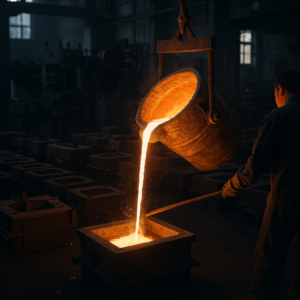
What Are Metal Castings? A Practical Definition With Procurement Relevance
A casting is often defined as a metal part formed by pouring molten metal into a mold and allowing it to solidify. That definition is correct, but for buyers it is not yet useful enough.
From a sourcing perspective, a casting is better understood as a component whose shape, internal soundness, and basic performance are created during controlled solidification. This matters because once the metal has solidified, the part’s internal condition is largely set. Machining and finishing can improve dimensions and appearance, but they cannot fully correct serious internal porosity, shrinkage, or structural inconsistency.
For procurement teams, that is the real meaning of casting: you are not just buying a part number, you are buying a complete process capability.
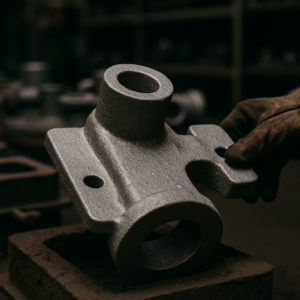
A Quick Overview of Common Casting Methods
The most common casting routes in industrial RFQs are sand casting, die casting, investment casting, and permanent-mold or gravity casting.
Each method has a different logic behind it. Sand casting is flexible and often suits larger or more varied parts. Die casting is usually chosen for high-volume non-ferrous components that need tighter consistency. Investment casting is better suited to smaller complex shapes with finer detail. Permanent-mold and gravity casting often sit between flexibility and repeatability.
For buyers, the key point is not memorizing the methods. It is understanding that each process brings its own tooling cost, defect risk, volume sweet spot, and quotation structure.
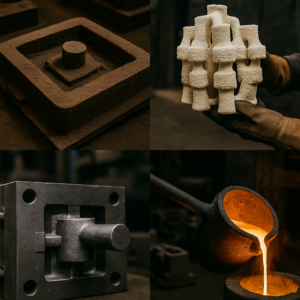
The Universal Steps in Any Casting Manufacturing Process
No matter which casting method is used, the basic flow is similar: tooling or mold design, mold preparation, melting and pouring, cooling and solidification, cleaning, inspection, and then machining or finishing where needed.
This sequence matters in procurement because price, lead time, and risk are all tied to how well these stages are planned. The earlier the geometry, material, and inspection logic are clarified, the fewer surprises appear later in production.
Why Castings Exist — Geometry, Structure and Commercial Logic
Casting remains relevant because not every component is better made by fabrication, forging, or machining from solid stock. In many industrial applications, casting solves problems those other routes handle poorly or too expensively.
Casting Solves Geometry Problems That Fabrication Cannot
Casting is especially useful when the part includes internal cavities, complex outer contours, multiple integrated features, or heavy load paths that are difficult to fabricate efficiently.
In these situations, machining from billet may waste too much material and time, while welded fabrication may introduce distortion, extra inspection work, and long-term weakness at joints. Casting allows a more integrated near-net-shape solution.
Casting Enables Structural Integrity and Long Service Life
A cast component is typically a monolithic structure, which means fewer joints, fewer welded transitions, and more continuous load paths. That can be important in parts exposed to vibration, cyclic loading, shock, or internal pressure.
For buyers, this shows up later as better service life, lower warranty exposure, and fewer field complaints in demanding applications.
When Casting Provides the Most Economical Path
Casting also becomes attractive when it creates a better cost structure. That usually happens when tooling can be amortized over real volume, machining can be reduced, material waste can be cut, and part geometry allows metal to be placed only where it is needed.
In those cases, casting is not just technically suitable. It becomes commercially stronger over the full project life.
Inside the Casting Development Process — How Engineering Decisions Shape Cost, Quality and RFQs
Casting cost and quality are both shaped early, long before first shipment. Differences between suppliers often come from how they interpret the same drawing in terms of mold strategy, solidification risk, inspection depth, and machining allowance.
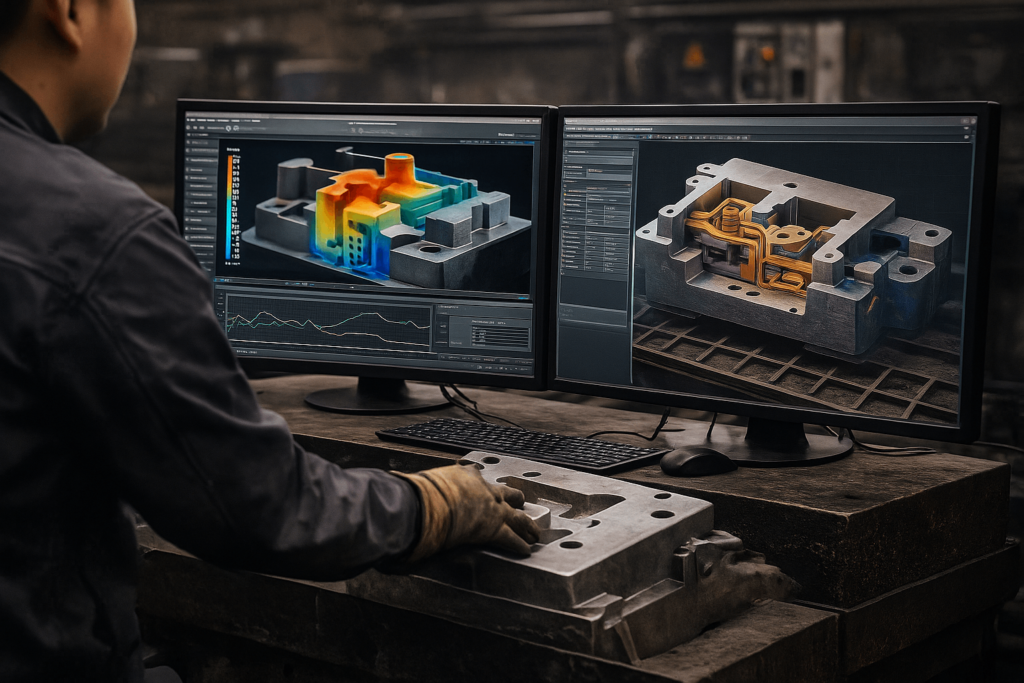
Geometry Determines Mold Strategy
The 3D shape of the part determines parting lines, core usage, gating strategy, riser layout, and overall mold complexity. More complex geometry is not automatically a problem, but it usually increases tooling effort and process risk.
For buyers, clear drawings and usable 3D models are among the best ways to reduce quotation confusion and avoid later quality disputes.
Material Controls Solidification Behaviour
Material grade has a direct effect on shrinkage, pouring temperature, feeding behavior, and defect sensitivity. Steel castings, cast iron, and non-ferrous alloys do not behave the same way in solidification.
That is why buyers should specify exact grades and required properties using recognized standards rather than generic notes such as “cast steel” or “metal casting material.”
Solidification Predicts Defects and Scrap Rate
Porosity, shrinkage cavities, hot tears, and cold shuts are usually linked to how the metal solidifies. These are not random problems. They follow thermal behavior, feeding paths, and part geometry.
A supplier that uses simulation and can explain hot spots, feed paths, and scrap control is usually in a stronger position to deliver stable casting quality.
Defects Define Inspection and Documentation
Inspection requirements should follow the real risk of the part. High-consequence components may require UT, X-ray, pressure testing, dimensional reports, or tighter sampling plans, while lower-risk parts may not.
For buyers, agreeing on inspection scope at RFQ stage avoids later disputes over both price and acceptance criteria.
Engineering Choices Shape Final Pricing
Quote differences often reflect assumptions about tooling life, scrap rate, inspection depth, machining stock, and process stability. A low quote may depend on optimistic assumptions or reduced quality control. A higher quote may include more realistic process protection.
That is why price comparison in casting should always be tied to process assumptions, not only to unit cost.
When Casting Is the Right Production Choice — A Decision Framework for Industrial Buyers
Casting is not always the right answer, but in many industrial programs it becomes the best answer once buyers compare geometry, program life, and real service demands.
When Geometry and Function Favour Casting
Casting is usually worth serious consideration when the part includes internal passages, integrated load-bearing features, complex contours, or service conditions where welded joints would be a weakness.
In these cases, casting often supports both function and manufacturing efficiency better than alternative routes.
When Volume and Project Life Justify Tooling
Tooling investment only makes sense when annual volume and project life are strong enough to absorb it. For repeat industrial programs, this often becomes financially attractive faster than buyers first assume.
Sharing realistic forecasts with the supplier helps build a better quotation structure and reduces disagreement later.
When Reliability and Lifecycle Cost Matter Most
Where downtime, warranty exposure, or service failure is costly, lifecycle thinking matters more than a small unit-price difference. In those cases, a stable casting process may create better long-term value than a cheaper alternative with more risk.
Managing Casting Risks — A Practical Guide for Procurement Teams
Casting projects always involve risk, but most procurement failures happen because that risk was not identified clearly enough in the RFQ or approval stage.
Porosity Risks and How Buyers Reduce Them
Porosity can affect sealing, fatigue life, and long-term reliability depending on where it appears and how severe it is.
Buyers can reduce porosity risk by defining pressure-test expectations, agreeing acceptance standards, and requiring NDT where the application justifies it.
Shrinkage and Hot Spot Risks
Shrinkage problems often appear in heavy sections, junctions, and thermal hot spots. These areas need proper feeding and better solidification control.
Procurement teams can support better results by accepting sensible design feedback from the foundry and reviewing sample evidence before approving mass production.
Cracks, Distortion and Cooling‑Stress Failures
Cracks, hot tears, and distortion usually come from cooling stress, restraint, or poor section transitions. These risks increase with sharp corners, uneven wall thickness, or stress-sensitive geometry.
Marking critical zones on drawings and discussing them early with the supplier can reduce failure risk significantly.
Casting Value Today — A Manufacturing and Procurement View
Even with the growth of CNC, laser cutting, and other advanced processes, casting still holds strong value because it combines structural performance, cost stability, and process integration in ways many other methods cannot.
Casting Strengthens Structural Integrity
Cast parts often perform well in structural roles because they avoid weld seams and preserve continuous load paths. This is especially relevant in housings, valve bodies, pump components, frames, and heavy-duty brackets.
Casting Supports Stable and Competitive Costs
Once tooling and process settings are stabilized, casting can become a very repeatable and cost-predictable manufacturing route for complex parts. That repeatability helps buyers forecast cost more accurately across long-term supply programs.
Casting Integrates With CNC and Finishing for Turnkey Supply
Many buyers now prefer suppliers who can combine casting, CNC machining, heat treatment, finishing, and final inspection in one supply flow. This reduces coordination burden and can shorten overall lead time.
Key Sourcing Factors — Helping Buyers Build a Strong RFQ
A strong casting RFQ should clearly define the technical and commercial points that drive price and quality.
| Technical Factor | Why It Matters | Buyer Action |
| Geometry complexity | Drives tooling design and process risk | Provide detailed 2D/3D drawings and highlight critical regions |
| Material grade | Controls solidification and mechanical properties | Specify ASTM, EN, or ISO grade and target properties |
| Casting tolerance | Influences machining cost and feasibility | Define tolerance class and key datums clearly |
| Annual volume | Determines tooling payback and production planning | Share forecast, MOQ, and expected program life |
| NDT requirements | Defines inspection scope and cost | State UT, X-ray, sampling rate, or pressure-test expectations |
| Machined features | Affects downstream routing and cost | Provide thread, tolerance, and surface-finish details |
This kind of RFQ structure improves quotation quality and makes supplier comparisons more meaningful.
Why Many Casting Guides Do Not Help Buyers — And What This One Does Differently
Many online casting articles explain only basic definitions or process names. They rarely connect those ideas to how buyers actually work.
This guide takes a different approach by focusing on the points where engineering, cost, quality, and RFQ structure meet. That is what buyers usually need most when making real sourcing decisions.
FAQ — Common Questions From Casting Buyers
Q1. Is casting cheaper than machining or fabrication?
It depends on geometry, quantity, and project life. For simple low-volume parts, machining or fabrication may be cheaper because tooling is limited. Once geometry becomes more complex and volume becomes more stable, casting often lowers cost over the life of the program.
Q2. What information should I include in an RFQ for casting parts?
At minimum, include 2D/3D drawings, exact material grade, tolerance expectations, annual volume, machining requirements, finishing notes, and any NDT or pressure-test requirements.
Q3. How do I choose between different types of metal casting?
Start with part function, size, surface expectation, alloy family, and program volume. Then compare which process route best balances risk, tooling, and unit cost.
Q4. How can I reduce the risk of casting defects in my projects?
Define realistic quality levels, agree inspection scope early, and work with suppliers who can explain process control rather than only promising final sorting.
Q5. What industries rely most on casting in industry today?
Casting remains essential in sectors such as construction machinery, agriculture, mining, fluid handling, power equipment, railway, and heavy transport.
Conclusion — Better Casting Knowledge Leads to Better Sourcing Decisions
Metal castings remain important because they combine shape flexibility, structural continuity, and scalable cost logic in a way many other manufacturing routes cannot always match.
For overseas buyers and sourcing managers, understanding casting from a procurement perspective is not just technical knowledge. It is a practical way to prepare stronger RFQs, compare suppliers more intelligently, and reduce risk across the supply chain.
At Yishang Metal Products Co., Ltd., we support OEM and wholesale customers with custom metal manufacturing across fabrication, machining, finishing, assembly, and export-oriented supply support. For projects that involve cast components together with downstream machining or related metal structures, we work with customers to align technical requirements, manufacturability, and delivery expectations more clearly.
📩 If you are evaluating custom metal parts, industrial components, or integrated sourcing options for your next project, send us your drawings or requirements to discuss the most suitable manufacturing route.