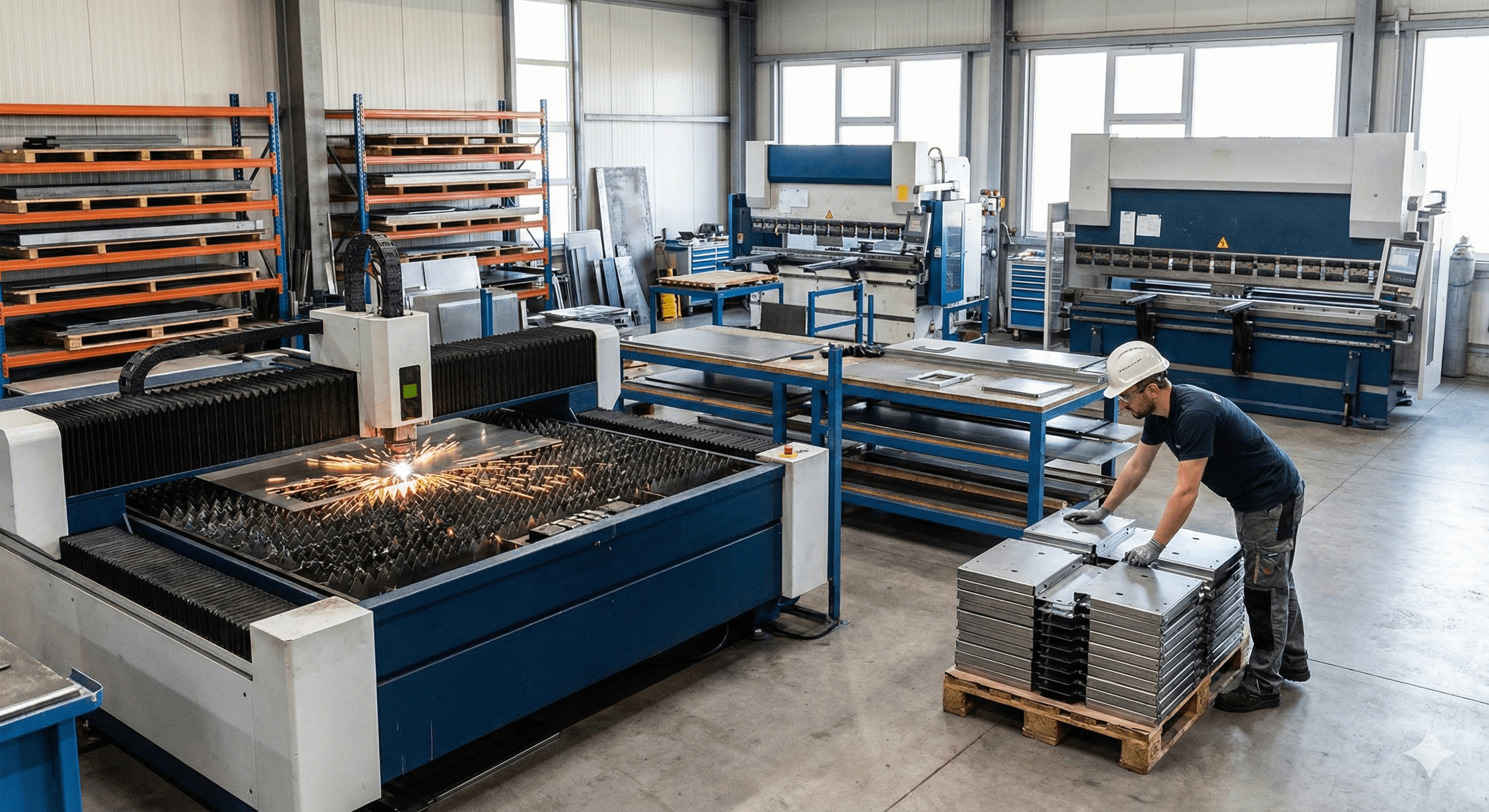
In the high-stakes environment of global supply chain management, the distinction between a profitable product line and a logistical bottleneck often hinges on the earliest stages of component design. For wholesale buyers and procurement directors overseeing complex Bills of Materials (BOM), custom sheet metal fabrication is a critical variable requiring strategic planning, not just transactional purchasing.
It is a common misconception in the general market to view fabrication merely as a commodity process of cutting and bending steel. However, seasoned industry veterans understand that nearly seventy percent of a product’s final landed cost is locked in during the initial engineering phase. This occurs long before raw materials are requisitioned or the machines start running.
The challenge for international buyers is not just finding a sheet metal factory that can read a drawing. The real goal is partnering with sheet metal fabrication companies that understand the invisible economics of production. A custom enclosure or chassis that functions perfectly in a CAD simulation can easily become a source of margin erosion if the design does not account for the physical realities of mass production.
This guide serves as a strategic framework for decision-makers. We move beyond basic definitions to explore how specific engineering choices—regarding geometry, material selection, process scalability, and quality documentation—directly influence your bottom line. By mastering these variables, you can transform your custom metal manufacturing procurement from a cost center into a competitive advantage.
Phase 1: Engineering Out the Cost through Geometry
The most immediate opportunity for cost reduction lies in the geometry of the part itself. When we analyze technical drawings from overseas clients, we often encounter the “Tolerance Trap.” This is the tendency to apply strict precision tolerances, such as $\pm 0.05\text{mm}$, across every single feature of a part.
While this ensures theoretical perfection on a screen, sheet metal parts are made from dynamic materials carrying internal stresses. Demanding such high precision on non-critical flanges forces the factory to abandon high-speed, automated processes. Instead, the sheet metal workshop must utilize slow, secondary machining or Wire EDM cutting to guarantee those dimensions.
By simply adopting ISO 2768-m standards for non-mating features, procurement teams can often reduce unit costs by a significant margin. This allows custom sheet metal fabricators that make custom parts to utilize their most efficient machinery, passing the savings on to the buyer.
Managing Material Deformation and Bend Relief
Furthermore, the physical behavior of metal during forming dictates the success of the manufacturing process. Engineers must be acutely aware of the “Minimum Distance Rule” regarding hole placement near bend lines. When a hole is positioned too close to a radius, the tensile forces of bending will distort the feature.
This distortion turns a perfect circle into an oval, causing fastener failure during assembly. Addressing this by adding a bend relief or adhering to a distance of 2.5 times the material thickness ($2.5 \times t$) is a preventative measure against batch-wide rejection rates.
The Logic of Nesting Efficiency
Optimizing the “flat pattern” for nesting efficiency is equally crucial. By straightening complex curves to allow for common-line cutting, we can drastically reduce raw material waste. For buyers requesting sheet metal fabrication quotes for large volume orders, this material efficiency is a key driver of price competitiveness.
Efficient nesting means less scrap metal and faster cutting times. When you are sourcing custom metal parts, asking your supplier about their nesting strategies reveals their level of sophistication. A focus on maximizing material yield is a hallmark of professional sheet processing services.
Phase 2: Strategic Material Selection and Supply Chain Logic
Beyond geometry, the selection of materials acts as a major lever for both cost and lead time control. The decision between different metal grades is often oversimplified. To assist in decision-making, we have compiled a comparison of common materials used in custom industrial fabrication:
Quick Reference: Material Selection Guide
| Material Grade | Key Property | Best Application | Cost Factor |
| SS 304 | Standard Corrosion Resistance | Indoor Enclosures, Kitchen Equipment | Medium |
| SS 316 | High Chloride Resistance | Marine Hardware, Medical Devices | High |
| Al 5052 | Excellent Formability | Bent Chassis, Brackets | Medium |
| Al 6061 | Structural Strength | Machined Plates (Avoid Bending) | Medium |
| SECC/SGCC | Pre-Galvanized | Server Racks, Electronic Cases | Low |
| Copper C1100 | High Conductivity | Busbars, Electrical Contacts | Very High |
Stainless Steel: The Hidden Cost of Corrosion
The choice between grades of stainless steel is critical. Grade 304 is the industry workhorse, but it can be a liability in marine or high-chloride environments. In these settings, Grade 316’s molybdenum content is required to prevent pitting corrosion. For a wholesale buyer, the risk of a warranty claim due to rust in the field far outweighs the initial material savings.
Engineers use the PREN (Pitting Resistance Equivalent Number) to evaluate this. While 304 offers a baseline, 316 offers a significantly higher PREN. Conversely, over-specifying 316 for a standard indoor electrical enclosure is an unnecessary drain on the budget. Experienced steel fabrication services will often recommend alternative grades that meet performance criteria at a lower price point.
The Logistics of Pre-Plated Materials
A sophisticated logistics strategy involves using pre-plated materials to shorten lead times. In producing electronic chassis, the traditional workflow involves fabricating parts from Cold Rolled Steel (SPCC) and then transporting them to a secondary facility for zinc plating. This extra step introduces bottlenecks.
By switching to pre-galvanized steel (SECC or SGCC), the plating process is eliminated. The material arrives with a protective zinc layer, allowing parts to move directly from fabrication to assembly. This substitution can shave three to five days off the production cycle—a critical advantage for custom fabrication services.
Aluminum Alloy Selection: 5052 vs. 6061
When it comes to aluminum sheet metal fabrication, selecting the right alloy is equally important. Many engineers default to Aluminum 6061 due to its popularity in machining. However, 6061 is often too brittle for complex bending operations and can crack at the fold lines.
For bent sheet metal components like battery enclosures or complex brackets, Aluminum 5052 is the superior choice. It offers excellent formability and corrosion resistance. Competent aluminum sheet metal fabricators will always verify the alloy temper before starting production to ensure the sheet metal parts do not fail during forming.
Phase 3: Scalability – From Quick Turn to Mass Production
For wholesale buyers, the ultimate goal is often volume growth. However, the path to mass production often starts with a single prototype. A robust supply partner must handle both quick turn sheet metal fabrication and high-volume stamping.
The Role of Quick Turn Prototypes
In the early stages, speed is currency. Quick turn sheet metal fabrication utilizes fiber laser cutting and NC bending to produce functional prototypes in as little as 3-5 days. This allows engineers to validate fit and function without investing in hard tooling.
This phase is critical for validating designs for custom metal pieces. It allows for rapid iteration. At YISHANG, our engineering team uses this phase to provide DfM feedback, ensuring that any design flaws are caught before the project scales up.
The Process Crossover Point: Laser vs. Punching
As volumes increase, the cost-per-part of laser cutting remains static. It does not benefit significantly from economies of scale. This is where a strategic partner will advise a transition to CNC Turret Punching.
Unlike a laser that traces every hole, a punch press creates features in a fraction of a second. It can also form louvers and embossments in the same operation. Identifying the volume where punching becomes cheaper than lasering (typically around 1,000 units) is a key value-add provided by top-tier fabrication services.
Hard Tooling ROI: Investing in Stamping
For truly high volume, moving to Metal Stamping is the ultimate step in cost reduction. While stamping requires an upfront investment in Non-Recurring Engineering (NRE) for custom dies, it reduces the unit cost precipitously—often by more than eighty percent.
The press acts instantly, forming parts in seconds. A savvy procurement strategy anticipates this shift. It involves calculating the Return on Investment (ROI) based on total lifecycle volume. Sheet metal fabrication services that offer both CNC and stamping capabilities are best positioned to guide you through this transition, ensuring a seamless migration as your custom metal parts manufacturing needs grow.
Phase 4: Compliance, Risk, and Surface Finishing
The manufacturing journey concludes with surface finishing, where aesthetic quality meets regulatory compliance. For products destined for international markets, adherence to standards is non-negotiable.
Custom metal part finishing ensures longevity and safety. In powder coating, technical nuances such as the “Faraday Cage Effect” must be managed. Deep recesses in a design can repel electrostatic powder, leaving corners exposed to rust. A competent manufacturing partner identifies these risks during the DfM review.
Mitigating Hydrogen Embrittlement in Steel
For high-tensile custom steel parts undergoing plating, strict process controls must prevent Hydrogen Embrittlement. This latent defect occurs when hydrogen atoms infiltrate the metal structure during plating, causing catastrophic failure weeks after installation.
Professional metal fabrication services mitigate this by implementing a baking process immediately after plating to release trapped hydrogen. Buyers must verify their supplier understands these protocols, especially for structural components like clips or springs.
Export Compliance and Documentation
Compliance with RoHS and REACH is critical. Manufacturers must maintain full traceability of the base metal, conversion coatings, and powder coat pigments. Failure here can result in goods being seized at customs.
Sheet metal quotes should implicitly include the assurance of compliance documentation. When engaging with a sheet metal factory, asking for material certifications is standard vetting. At YISHANG, we maintain rigorous records to ensure clients face no hurdles importing their goods.
Phase 5: Quality Assurance and Validation
In the B2B wholesale market, trust is built on documentation. A “good looking” sample is not enough to authorize a shipment of 10,000 units. A robust Quality Assurance (QA) framework is the differentiator between a workshop and a manufacturing partner.
The Importance of FAI and PPAP
Before mass production begins, a professional partner will provide a First Article Inspection (FAI) report. This document verifies that the first unit off the production line meets every dimension specified in the drawing.
For automotive or high-stakes industrial clients, the Production Part Approval Process (PPAP) goes even further. It documents the entire production process. Requesting these documents signals that you expect rigorous quality control for your metal parts.
Traceability and Mill Certificates
Material traceability is vital for custom made metal parts. Your supplier should be able to provide Mill Test Certificates (MTC) for every batch of steel or aluminum used. This proves the chemical composition and mechanical properties of the raw material. If a failure occurs in the field years later, this traceability allows for a root-cause analysis.
Conclusion: The Strategic Advantage of an Integrated Partner
In the realm of metal fabrication services, the lowest quote on paper is rarely the lowest total cost of ownership. The true value of a manufacturing partner lies in their ability to act as an extension of your engineering team.
This involves identifying cost-saving geometry changes, optimizing material choices for supply chain velocity, and planning the roadmap for scalability from the very first prototype. By prioritizing these strategic elements, wholesale buyers secure a reliable, compliant, and profitable supply chain.
For procurement managers looking to streamline their sourcing of custom metal pieces and steel metal fabrication services, the focus must shift from price-per-unit to value-per-cycle. This holistic view is what separates successful import programs from those plagued by delays.
Whether you are looking for aluminum sheet fabrication, complex steel enclosures, or custom industrial fabrication, the principles of engineering optimization remain the same. It requires a dialogue between buyer and factory that goes beyond the drawing.
At YISHANG, we are dedicated to fostering this collaborative environment. We understand the pressures of the global market and the need for precision, speed, and reliability.
Ready to optimize your supply chain? Contact our engineering team today to discuss how we can bring efficiency to your next project.