
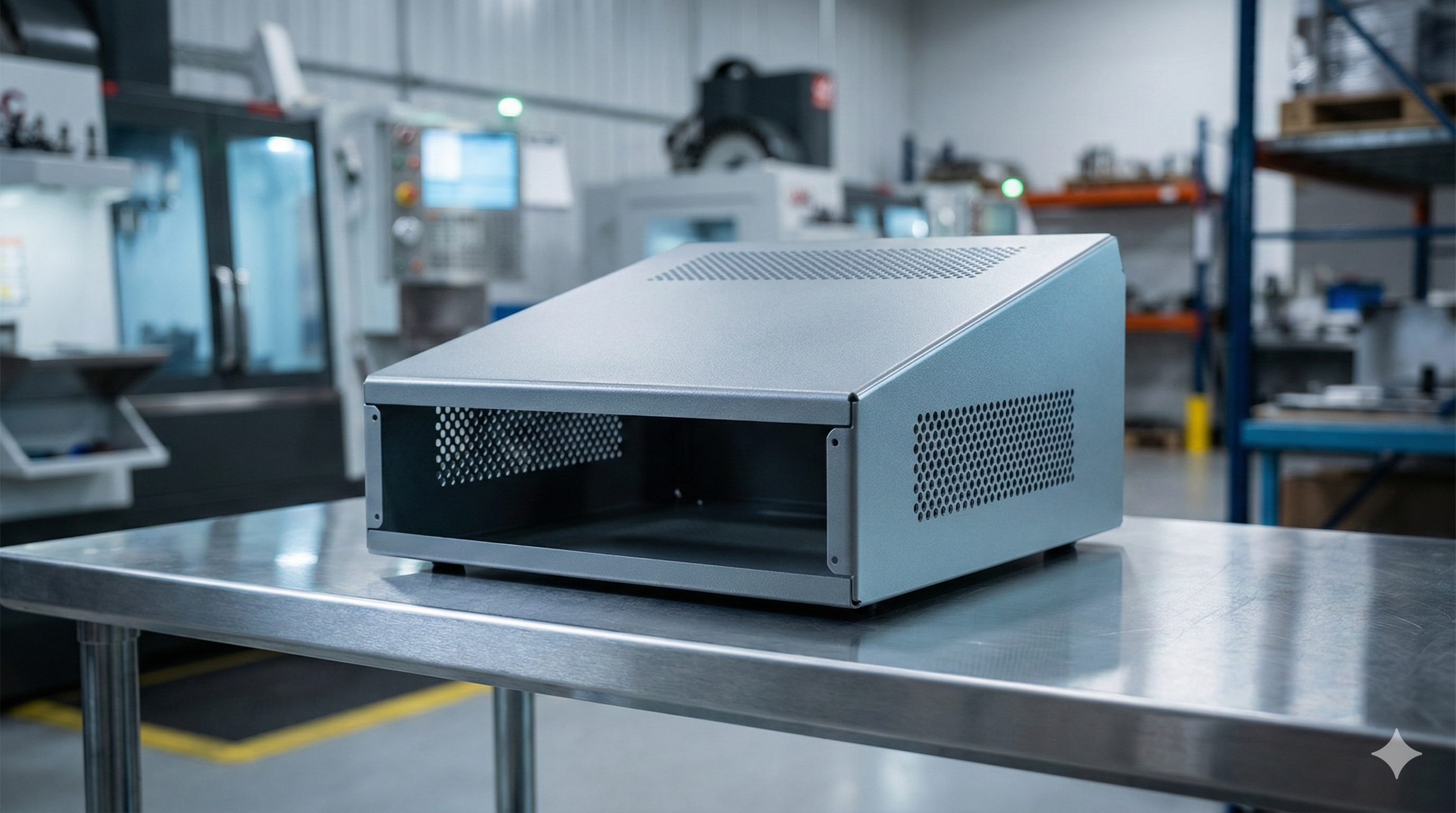
Moving beyond the prototype—how to engineer your custom enclosure design for high-volume manufacturing and global logistics efficiency.
For wholesale buyers in the industrial metal sector, success has a specific definition. It is the ability to scale from a sample order to a 10,000-unit contract. You must achieve this without variability in quality or landed cost. Fabricating a single perfect box is simple. However, orchestrating a complex manufacturing process is difficult. You must deliver identical precision across thousands of units. Simultaneously, you need to protect your margin against raw material volatility.
In the B2B wholesale market, custom enclosures serve a dual purpose. Technically, they protect sensitive electronics. Commercially, they are commodities. Therefore, you must optimize them for the balance sheet. A custom enclosure design might look exceptional in a CAD render. Yet, if it ignores volume production realities, it becomes a liability. Poor fitment causes line stoppages. Poor volume planning incurs excessive shipping costs. Additionally, hidden scrap rates erode margins.
Experienced procurement professionals understand the “sticker price” (EXW price) is only the tip of the iceberg. The real costs hide elsewhere. Specifically, they hide in efficiency losses, quality variance, and logistical density. Conversely, these areas also hold the real savings.
YISHANG draws on 26 years of experience serving international wholesalers across 50+ countries. Consequently, this guide shifts the focus from basic fabrication to strategic procurement. We do not just build to print. Instead, we scrutinize the lifecycle of custom enclosures. We focus on volume scalability, quality assurance (QA), and logistics optimization. This guide is your blueprint. Use it to turn sheet metal fabrication into a streamlined asset in your global supply chain.
I. Strategic Material Sourcing: Stability Meets Economics
Material selection is the foundational economic decision for a wholesale buyer. It determines unit cost. Furthermore, it defines the stability of your supply chain. Design engineers often prioritize theoretical durability. In contrast, a procurement manager must ask harder questions. Is this material available in consistent batches? How does processing difficulty impact my tooling budget? Finally, does it insulate me from commodity market fluctuations?
The Hidden Costs of Stainless Steel
We frequently identify value-engineering opportunities in material specification. Engineers often reflexively specify 304 Stainless Steel for indoor applications. 304 offers excellent corrosion resistance. However, it introduces significant mass production costs. Buyers often overlook these during the quoting phase.
Stainless steel contains high nickel content. This exposes the buyer to global price volatility. A spike in nickel prices can invalidate your cost projections overnight. Consequently, distributor margins suffer.
Moreover, stainless steel impacts the manufacturing process itself. It work-hardens rapidly. This characteristic reduces the lifespan of punch press dies and laser consumables. In fact, tool life drops by up to 30% compared to milder steels. Manufacturers ultimately amortize these consumable costs into your unit price.
The Galvannealed Solution
For volume orders of electronic equipment housing or server racks, we advise a shift. Consider Galvannealed Steel (SECC/SGCC) paired with a high-performance powder coat system. This combination offers a dual-layer defense. First, the zinc substrate provides cathodic protection. It sacrifices itself to heal scratches. Second, the polyester powder coat provides a durable aesthetic finish.
Procurement Insider Insight: Data supports this shift. Consider a wholesaler purchasing 5,000 units annually. Switching from stainless steel to powder-coated galvannealed steel can reduce the Bill of Materials (BOM) cost by 30-40%. You achieve this without compromising functional lifespan in non-marine environments. Therefore, buyers can reallocate the budget. You can invest in higher-value internal components. Alternatively, you can improve competitive pricing.
Of course, specific applications demand stainless steel. Food processing and medical environments are examples. In these instances, YISHANG optimizes the gauge (thickness). Engineers often over-specify thickness “just to be safe.” We use strategic stiffening ribs instead. Thus, we reduce material weight and cost by 25% while maintaining rigidity.
Aluminum Alloy Selection Risks
Sourcing aluminum enclosures presents another challenge. This is especially true for heat-sensitive electronics. The specific alloy selected profoundly impacts manufacturing yield rates.
Engineers familiar with machined parts often specify 6061-T6 aluminum. This is a hidden risk in high-volume bending. Its high hardness makes it brittle during forming. Consequently, micro-cracking occurs along bend lines.
This defect is often invisible to the naked eye. However, it propagates under vibration during shipping. For a distributor, this leads to increased field failures. A return rate increase of just 1% can wipe out a batch’s profit margin.
Therefore, YISHANG standardizes on Aluminum 5052-H32. This alloy offers superior elongation. It ensures a repeatable bending process with virtually zero cracking. Additionally, 5052 creates a more consistent anodic layer. This ensures uniform color matches across different production batches.
II. Design for Volume Manufacturing (DFM): The Profit Multiplier
In the wholesale business, efficiency drives margin. Design for Manufacturing (DFM) maximizes throughput. It also minimizes human error at scale. A robust DFM process protects your margins before you sign the purchase order.
Maximizing Material Utilization
One invisible aspect of cost is material nesting. Manufacturers cut sheet metal parts from standard sheet sizes. Your custom enclosure design geometry dictates the yield.
Imagine a back panel designed at 600mm wide. We can fit two rows perfectly on a 1220mm sheet. However, if the design calls for 615mm, we can only fit one row. Material utilization drops from 90% to 50%. You pay for the scrap.
YISHANG engineers identify these “threshold dimensions.” We might suggest a minor reduction of 15mm. This change doubles the yield per sheet. Consequently, it drastically reduces the raw material cost per unit.
Optimizing for Assembly (DFA)
Designers often neglect the assembly stage. Yet, assembly labor is a major cost driver for wholesalers. If a worker must align three parts manually, you pay for unnecessary labor.
We advocate for Design for Assembly (DFA). Specifically, we integrate self-locating tabs and slots. Tabs ensure parts “snap” together in perfect alignment. This occurs before welding or riveting.
Why this matters to a Wholesaler: This geometric feature reduces fixture setup time. It also minimizes the required skill level. As a result, dimensional repeatability improves. For the buyer, this means faster lead times. Scaling a 30-second saving across 10,000 units saves over 80 hours of billable labor.
Tolerance Management Strategy
Distributors fear one specific nightmare scenario. The lids from Batch A do not fit the bodies from Batch B. This lack of interchangeability stems from cumulative tolerances. Sheet metal involves cutting, punching, bending, and welding. Each step introduces slight variance.
Standard round holes leave no room for error. A shift of just 0.5mm can make assembly impossible. Workers must then drill holes manually (“reaming”). This damages the coating and slows the line.
We implement a strategic solution. We use oblong (slotted) holes for mounting points. Slots provide “floating” adjustments. They absorb natural manufacturing variance. By adhering to ISO 2768-m standards, we ensure 100% functionality. Replacement parts sent to the field will fit perfectly every time.
III. Case Study: The 32% Cost Reduction
A recent project for a European industrial controls distributor illustrates our approach.
The Challenge: The client imported fully welded, IP66-rated stainless steel enclosures. They used these for an indoor factory automation project. High unit costs eroded their advantage. Additionally, shipping “air” caused excessive freight charges.
The YISHANG Solution:
- Material Swap: We replaced 304 Stainless Steel with Powder Coated Galvannealed Steel (SECC). The indoor environment did not require marine-grade protection.
- Design Change: We converted the welded structure to a “Flat-Pack” (RTA) design. We used waterproof gaskets and rivets. This maintained the IP rating while allowing flat shipping.
- Logistics: Consequently, container capacity increased from 45 units to 180 units.
The Result:
- Unit Cost: Reduced by 18% (Material savings).
- Freight Cost: Reduced by 65% (Volume efficiency).
- Total Landed Cost: Reduced by 32%.
This demonstrates the tangible impact of strategic procurement.
IV. Quality Assurance: Consistency as a Deliverable
For B2B buyers, “quality” is a statistical deliverable. You need assurance that the 5,000th unit matches the golden sample. Achieving this requires a rigorous Quality Management System (QMS).
Process Control Validation
We encourage partners to adopt automotive-standard validation. Tools like PPAP or First Article Inspection (FAI) are essential. These protocols validate the manufacturing process before mass production begins.
First, we check critical dimensions. Then, we document process capability (Cpk). We also verify paint adhesion using cross-hatch testing (ASTM D3359). Finally, we ensure all tooling is calibrated.
This freezes process parameters. Thus, we mitigate “process drift” over time. For our partners, this documentation provides a necessary audit trail. It moves the relationship from transactional to strategic.
Finishing and Shielding Integrity
Surface finish issues cause most rejections. A scratch or color mismatch damages brand perception. Therefore, we utilize color difference meters. We keep Delta-E values within strict limits.
We also conduct rigorous environmental testing:
- Corrosion Resistance: Salt spray testing (ASTM B117) validates performance.
- UV Stability: We test outdoor units against ASTM G154 standards. This ensures the powder coat resists chalking.
Furthermore, we implement masking protocols for EMI/RFI shielding. Powder coating insulates. Therefore, we mask critical grounding points. This allows for electrical continuity. We test conductivity on these points. This ensures the Faraday cage effect functions correctly.
V. Logistics Engineering: The Battle for Margin
Logistics is often the most overlooked aspect of custom enclosures. Shipping empty space drains profitability. Logistics engineering delivers tangible value here.
The “Flat-Pack” (RTA) Advantage
Transitioning to Ready-to-Assemble (RTA) designs changes the game. Consider a standard electrical cabinet. A 40-foot container might hold only 40 welded units. The freight cost per unit becomes astronomical.
We redesign that cabinet with bolt-together construction. Consequently, we can ship it as flat panels. Container capacity increases to 200+ units. This slashes per-unit freight cost by up to 75%.
This strategy requires tighter tolerances. YISHANG’s precision fabrication makes it viable. Additionally, flat-packed inventory saves warehouse space. It allows you to stock higher volumes.
Export-Grade Packaging
Transit damage poses a significant risk. A bent corner renders an enclosure unsellable. Standard cardboard often fails. Therefore, we implement reinforced protocols based on ISTA guidelines.
- High-density EPE foam replaces brittle Styrofoam.
- Double-walled corrugated cartons offer high burst strength.
- Palletization strategies prevent shifting during turbulence.
We calculate stacking strength (BCT). This ensures bottom cartons survive the weight of tiers above. For a manager, this means fewer insurance claims.
Strategic Kitting Services
Finally, we offer customized kitting services. We pack accessories like cable glands or rails directly inside the packaging.
This simplifies your receiving process. You receive one complete SKU. Consequently, picking errors in your warehouse decrease. The installer enjoys a better “out-of-box” experience.
VI. Conclusion: Building a Scalable Partnership
The supplier you choose acts as an extension of your operations. A cheap price means nothing if quality varies. Similarly, low unit prices do not guarantee low Total Landed Cost (TLC).
Successful procurement requires a holistic view. You must integrate material science, DFM efficiency, and logistics. Move the conversation beyond “How much is this box?”. Instead, ask “How do we optimize total cost?”.
At YISHANG, we speak the language of scale. We make procurement predictable. Engage with our engineering team today. Do not just ask for a quote. Ask for a strategic review of your current designs.
Contact our engineering team today to start your free DFM and cost-reduction analysis.