
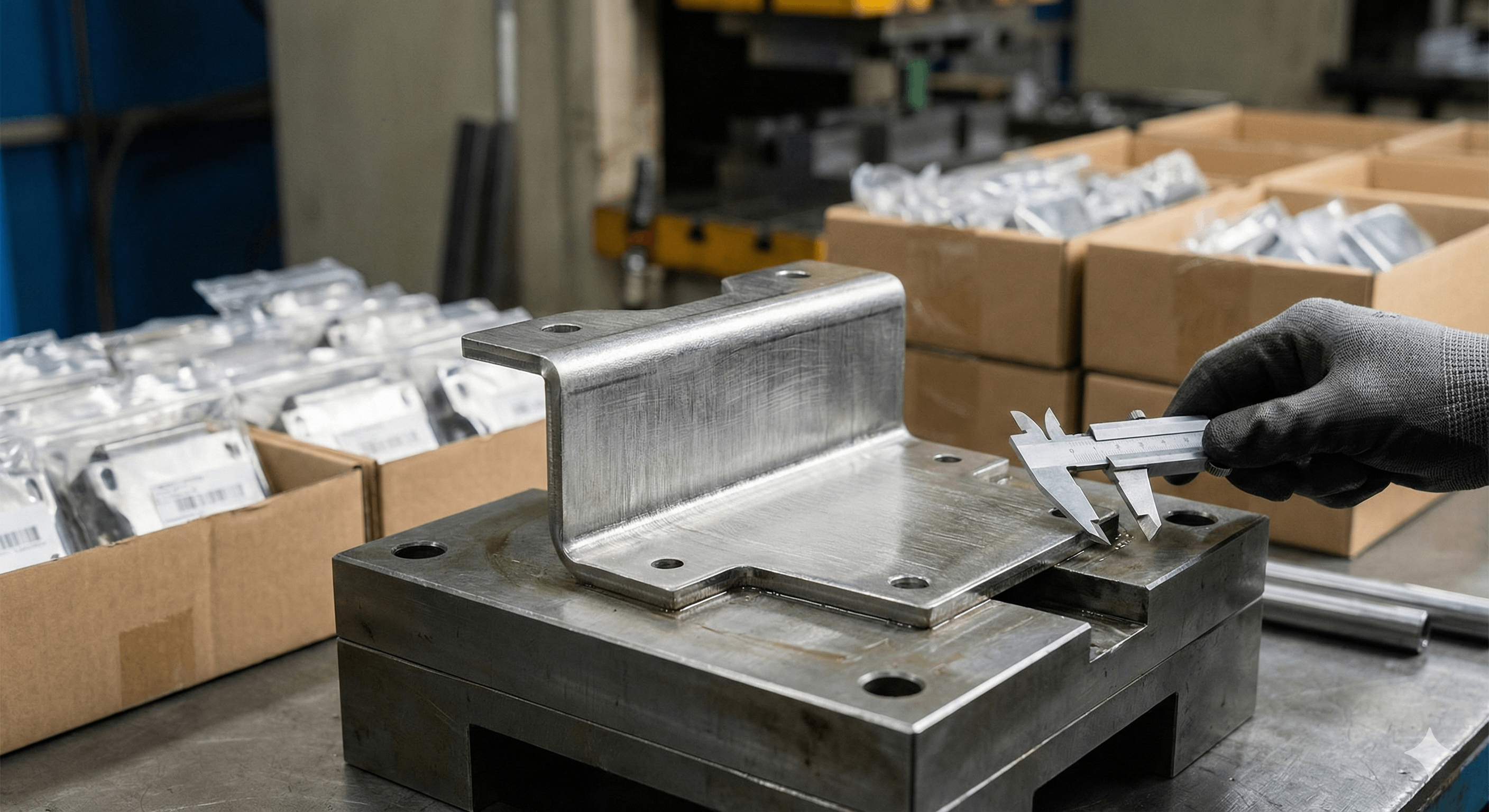
In the rigorous and high-stakes ecosystem of global OEM supply chains, the custom metal bracket occupies a paradoxical position. It is often the lowest-cost item on a Bill of Materials (BOM), yet it represents a disproportionately high risk to the final assembly.
For OEM procurement managers and sourcing agents, the bracket is not merely a bent piece of steel; it is a critical interface. A failure here does not just mean a broken part; it means warranty claims, stopped production lines, and damaged brand reputation.
Unlike sourcing standard fasteners, sourcing custom sheet metal brackets requires a strategic balance between structural engineering, material science, and logistics mathematics. A well-executed procurement strategy can reduce Total Landed Cost by 30%, while a poor one can lead to infinite quality loops.
Drawing on YISHANG’s 26 years of fabrication data exporting to over 50 countries, this guide is written for the wholesale buyer. We strip away the basics to focus on the commercial and engineering levers that drive profitability in metal bracket fabrication.
We will analyze the hidden cost drivers, the material “traps” that inflate budgets, and the scalable manufacturing technologies that separate generic job shops from true OEM partners.
Phase 1: Mitigating Liability Through Structural Engineering
Risk mitigation is the primary KPI for any procurement professional. The most expensive bracket you will ever buy is the one that fails in the field. Understanding the physics of failure allows you to audit your supplier’s technical competence before a Purchase Order is ever issued.
The Fatigue Factor: Static vs. Dynamic Loads
A frequent disconnect in custom metal bracket design is the confusion between yield strength (static) and fatigue limit (dynamic). Most RFQs we receive specify a load capacity based on a static weight—for example, a shelf holding a 20kg inverter.
However, in automotive, industrial machinery, and power generation applications, the real threat is vibration. A bracket that holds 20kg comfortably in a warehouse may snap after 10,000 cycles of micro-vibration in a running vehicle.
This failure almost always occurs at the bend radius, the point of highest stress concentration. If your current supplier produces brackets with a “zero radius” (sharp internal corner) to achieve a tight fit, they are inadvertently creating a fracture point.
YISHANG engineers advocate for a minimum fillet radius of 1x Material Thickness (1t) for all dynamic applications. This simple geometric adjustment distributes stress across a wider area, exponentially increasing the cycle-life of the part without adding any material cost.
Value Engineering: Geometry Over Gauge
When a bracket fails testing, the knee-jerk reaction from inexperienced designers is to increase the material gauge—upgrading from 2.0mm to 3.0mm steel.
From a procurement standpoint, this is a financial error. It increases raw material spend by 50% and balloons the shipping weight, inflating logistics costs.
A superior Value Engineering (VE) approach focuses on increasing the Moment of Inertia through geometry:
Stamped Gussets: Adding a small triangular rib across the bend can increase stiffness by 200%.
Return Flanges: Folding the edges of a flat strip transforms it into a C-channel, resisting torsion.
By implementing these features, we often help clients downgrade material thickness while improving performance. This creates a stronger, lighter, and cheaper custom steel bracket.
The Science of Grain Direction
Sheet metal has a physical “grain” structure created during the rolling process at the steel mill. Bending parallel to this grain is easier but significantly weaker, leading to cracking on the outer radius of hard alloys.
For critical structural applications, YISHANG nesting engineers orient parts so that bends run perpendicular to the grain. While this may slightly reduce material utilization rates on the nesting sheet, it eliminates the risk of catastrophic cracking.
This attention to detail—choosing liability protection over minor scrap savings—is a hallmark of a mature OEM partner.
Phase 2: Strategic Material Selection for ROI
In wholesale manufacturing, raw material costs can constitute 60% to 70% of the unit price. Selecting the “safest” material is often a waste of capital, while selecting the cheapest is a liability. Finding the commercial “sweet spot” is key to ROI.
The Stainless Steel ROI Analysis (304 vs. 316)
We frequently observe “Over-Specification” in the medical and food equipment sectors. Buyers often request 316 Stainless Steel for indoor brackets, assuming “higher grade” equals “better quality.”
While 316 contains Molybdenum for superior resistance to chlorides (salt water), it carries a 30-40% price premium over 304. For indoor applications, 304 Stainless Steel offers identical mechanical strength and sufficient corrosion resistance.
Unless your product is deployed in a coastal region (within 5km of the ocean) or a chemical plant, paying for 316 is an unnecessary drain on your budget.
Conversely, for outdoor Energy Storage Systems (ESS), using 304 to cut costs is dangerous. It will succumb to “tea staining” and pitting within months. We use the PREN (Pitting Resistance Equivalent Number) to provide data-backed recommendations, ensuring you pay only for the protection you need.
The Aluminum Temper Trap (5052 vs. 6061)
For lightweight custom sheet metal brackets in the EV and Aerospace sectors, Aluminum is the standard. However, a common pitfall is specifying 6061-T6 due to its fame as “structural aluminum.”
6061-T6 is heat-treated for stiffness, making it brittle. When bent to a 90-degree angle, the outer fibers stretch beyond their limit and tear. This leads to high rejection rates and potential structural weakness.
YISHANG recommends 5052-H32 for formed brackets. It possesses excellent workability and high fatigue strength. By switching to 5052, we eliminate cracking issues, improving the yield rate to near 100% and stabilizing your supply chain.
The Hidden Risk of Galvanic Corrosion
A subtle but costly failure mode occurs when custom metal brackets are mated to dissimilar metals—for example, mounting a Stainless Steel bracket directly to an Aluminum chassis.
In the presence of humidity, this creates a galvanic cell. The Aluminum becomes the anode and corrodes rapidly, potentially loosening the connection over time.
A professional fabricator will flag this risk immediately. We suggest solutions such as using insulating washers (nylon) or applying compatible surface treatments (like Zinc-Nickel plating) to break the electrical path, protecting your assembly’s long-term integrity.
Phase 3: Design for Manufacturability (DFM) to Lower Unit Price
The most significant opportunity for cost reduction occurs before the tooling is cut. Sheet Metal DFM (Design for Manufacturability) is the process of aligning your design with machine capabilities to minimize waste and cycle time.
The “2t” Rule: Avoiding Secondary Operations
Placing a hole too close to a bend is the most common error in metal bracket fabrication. During bending, the metal near the radius stretches and deforms.
If a hole sits within this deformation zone, it distorts into an oval. This prevents screws from seating correctly and disrupts assembly lines.
To fix this, the factory must drill the hole after bending—a manual “secondary operation” that adds labor cost to every unit.
The Fix: Ensure holes are placed at least 2x Material Thickness (2t) away from the bend line. This allows the holes to be punched or laser-cut in the flat stage, keeping the process fully automated and the unit price low.
Tolerance Optimization: The Cost of Precision
Does a mounting bracket truly require a tolerance of +/- 0.05mm on a flange length? In sheet metal, maintaining machining-level tolerances is difficult due to material springback.
Demanding tight tolerances on non-critical dimensions forces the factory to slow down press brakes and increases QC rejection rates. These costs are inevitably passed on to you.
Adopting ISO 2768-m (Medium Class) tolerances is the industry standard for bent parts. This standard accounts for natural material variance. Relaxing non-critical tolerances allows YISHANG to run machines at maximum speed, reducing your unit cost without compromising fit or function.
Welding vs. Bending Strategy
Designers often create box-like brackets with welded corners. While robust, manual welding and subsequent grinding/polishing are the most expensive labor processes in fabrication.
Whenever possible, we recommend a “fold-up” design using bend reliefs. If the corner does not need to be watertight, leaving a tight seam (butt joint) eliminates the need for welding entirely.
For high-volume production, we can use Spot Welding or rivet insertion, which are significantly faster and cheaper than TIG welding.
Phase 4: The Economics of Scale (Laser vs. Stamping)
For the wholesale buyer, the critical financial decision is: “When should I invest in Hard Tooling?” Understanding the break-even point between Laser Cutting and Progressive Die Stamping is essential for long-term budget planning.
The Agile Phase: Laser Cutting & CNC Bending
For orders under 1,000 to 2,000 units, or for products in the “Market Validation” phase, flexibility is the priority.
Technology: High-power Fiber Laser Cutting + CNC Press Brake.
Tooling Cost: $0.
Advantage: You can modify the design instantly (e.g., moving a mounting hole) without scrapping expensive molds. This de-risks your new product launch.
The Volume Phase: Progressive Die Stamping
Once demand stabilizes and volumes exceed 5,000 units annually, metal stamping becomes the economic engine.
Technology: Progressive Die (Hard Tooling).
Investment: $3,000 – $10,000+ upfront.
Advantage: The unit price drops drastically—often by 40% to 60%. Production shifts from “parts per minute” to “parts per second.”
The ROI Calculation: If a stamping die costs $5,000 but saves $1.00 per part compared to laser cutting, the Return on Investment is achieved after just 5,000 units.
Any volume beyond that point represents pure margin expansion. YISHANG manages this entire transition, offering a hybrid approach where we start with laser and migrate to stamping as your sales grow.
Tooling Maintenance and Life Cycle
A hidden cost in stamping is tool maintenance. A cheap mold will wear out quickly, leading to burrs and out-of-tolerance parts.
YISHANG designs tooling with high-grade tool steel (SKD11 or D2), ensuring millions of hits before refurbishment. We also maintain the tooling in-house at no extra cost for the life of the project, removing a common headache for procurement managers.
Phase 5: Surface Compliance & Quality Assurance
In global B2B commerce, a product is only as good as its documentation and compliance. A rusty bracket or a non-compliant coating can result in customs seizures.
RoHS & REACH Compliance
For buyers in the EU and North America, environmental compliance is non-negotiable. Cheap zinc plating often utilizes Hexavalent Chromium (Cr6+), which is banned under RoHS due to toxicity.
YISHANG strictly utilizes Trivalent Chromium (Cr3+) passivates and lead-free powder coatings. We provide full material certifications (MTC) and compliance declarations with every shipment, ensuring your goods clear customs without delay.
Salt Spray Testing Standards
“Corrosion Resistant” is a vague term. Professional procurement requires specific metrics based on ASTM B117 Salt Spray Tests.
Standard Blue Zinc: Typically survives 24-48 hours before white rust appears.
Yellow Chromate: Survives 72-96 hours.
Zinc-Nickel Alloy: Can survive 500+ hours (Automotive Grade).
Powder Coating: Can survive 500-1000+ hours depending on pretreatment.
We encourage buyers to specify the required Salt Spray Hours in the RFQ. This ensures all vendors quote on the same quality standard, preventing “apples to oranges” price comparisons.
Quality Control Reporting
You cannot inspect every part in a 50,000-unit shipment. You rely on the factory’s QC. Standard reporting should include:
Material Mill Certs: Proving the raw steel matches the spec.
ISIR (Initial Sample Inspection Report): For the first article.
Critical Dimensions Check: A random sampling of key features verified against the drawing.
YISHANG provides these digital reports automatically, giving you visibility into the factory floor from thousands of miles away.
Phase 6: Logistics Strategy for Landed Cost
Many buyers fixate on the Ex-Works (EXW) price, ignoring the Packaging Efficiency. Metal brackets are heavy, dense, and often oddly shaped. If packed inefficiently, you are paying to ship “air.”
Nesting & Stackability
Our engineers view packaging as an extension of product design. We analyze how brackets can nest inside each other to maximize density in the carton.
By adjusting a flange angle by just 1 degree, we might allow parts to stack tightly, increasing the units per pallet by 40%. In an era of volatile ocean freight rates, this optimization significantly reduces the Landed Cost per Unit.
Packaging Integrity
Brackets are heavy enough to crush standard cardboard boxes. We utilize reinforced, double-wall export cartons and custom pallets. For delicate finishes (like powder coating), we interleave protective foam to prevent scratching during the vibration of ocean transit.
Frequently Asked Questions (FAQ)
Q: What is the most cost-effective material for custom brackets? A: For indoor applications, Cold Rolled Steel (SPCC) with Zinc Plating is typically 30-40% cheaper than Stainless Steel while offering sufficient corrosion resistance. For outdoor use, 5052 Aluminum offers the best balance of weight, cost, and formability.
Q: What is the standard lead time for custom bracket fabrication? A: At YISHANG, prototype orders (via laser cutting) typically ship in 3-5 days. High-volume production orders (via metal stamping) usually have a lead time of 2-3 weeks after tooling approval.
Q: How does bend radius affect bracket strength? A: A sharp internal bend radius (zero radius) creates stress concentration points that lead to cracking. We recommend a minimum bend radius equal to the material thickness (1t) to maximize fatigue resistance and structural integrity.
Q: Can YISHANG handle both low-volume and high-volume orders? A: Yes. We use Laser Cutting for orders under 2,000 units (zero tooling cost) and transition to Progressive Die Stamping for volumes over 5,000 units to reduce unit prices by up to 50%.
Conclusion: Partnering for Strategic Advantage
Sourcing custom metal brackets is not a transactional activity; it is a strategic one. The difference between a commodity vendor and a manufacturing partner lies in the ability to look beyond the drawing.
A reliable partner goes beyond the basics by identifying risks in grain direction, calculating the ROI of stamping tooling, and optimizing packaging to save you freight costs.
At YISHANG, we do not just fabricate parts; we engineer solutions for profitability. With 26 years of experience, ISO 9001 quality systems, and a deep understanding of the wholesale market, we are positioned to be the backbone of your supply chain.
Is your current bracket design fully optimized for mass production?
Stop paying for inefficiency. Contact YISHANG’s engineering team today. Send us your drawings for a Free DFM & Cost-Reduction Review, and let us prove how engineering depth translates to commercial success.