
Introduction: The Hidden Economics of OEM Frames
For procurement managers and supply chain directors, sourcing custom metal frame fabrication for OEM projects is a high-stakes equation. It involves balancing the rigid demands of mechanical engineering with the fluid realities of global logistics and cost control.
When you are responsible for sourcing 500 units of an automation chassis, a medical device support, or a complex industrial enclosure, the definition of “quality” shifts. It is no longer just about a strong weld on a single prototype; it is about repeatability across a production run.
A prototype that fits perfectly is useless if the subsequent 499 units suffer from dimensional drift that stalls your assembly line in Europe or North America. In the world of mass production, consistency is the currency of trust.
Furthermore, the hidden costs of international sourcing—freight inefficiencies, unexpected rework due to distortion, and compliance failures—can rapidly erode the savings of manufacturing overseas. A “cheap” unit price is often negated by the high cost of quality failures or “shipping air” across the ocean.
This guide is written for the professional buyer and the project engineer. We move beyond basic manufacturing definitions to explore the strategic engineering decisions that drive success in volume OEM machinery frames.
Drawing on YISHANG’s 26 years of export manufacturing data, we analyze how to optimize your frame designs for mass production, stabilize your supply chain, and fundamentally reduce the Total Cost of Ownership (TCO).
Phase I: DFM Strategy – Engineering for Volume and Logistics
The most significant opportunities for cost reduction in mass production are realized long before the metal hits the laser cutter. In an OEM context, true Design for Manufacturing (DFM) is about “manufacturability at scale.” It asks the critical question: How can we design this frame to minimize labor hours and maximize shipping density?
The “Self-Fixturing” Revolution via Tube Laser Technology
A primary friction point in scaling up production is the reliance on manual alignment. Traditional fabrication often depends on skilled workers manually measuring, cutting, and clamping each tube on a welding table.
While effective for low-volume customization, this introduces human variability that becomes a liability across a large order. Tolerance stacking—the accumulation of minor errors in cutting and positioning—can lead to frames that are out of square, requiring expensive manual rework.
To combat this, YISHANG advocates for designs that utilize modern tube laser cutting services. By engineering “Self-Fixturing” features—such as complex tab-and-slot joints—into the CAD model, we fundamentally change the assembly process.
This approach allows tubes to mechanically interlock with precision before a single weld is tacked. For the B2B buyer, this technical detail translates into two distinct commercial advantages:
Cost Reduction: It drastically reduces the labor hours required for manual jigging and setup. Less time on the welding table means a significantly lower unit cost.
Geometric Consistency: It ensures that the first frame and the five-hundredth frame are geometrically identical. The accuracy is now dictated by the laser’s repeatability (typically ±0.05mm) rather than a welder’s tape measure, ensuring seamless integration on your final assembly line.
Logistics-Driven Design: Stopping the “Shipment of Air”
A common oversight in sourcing structural steel frames is the “Monolithic” design trap. Designing a massive, fully welded frame often results in shipping mostly “air” inside a container.
For global sourcing projects, this poor container utilization spikes the landed cost per unit. We have seen cases where the freight cost exceeded the actual product manufacturing cost due to inefficient volume.
Experienced fabricators will analyze your design to see if a modular frame design is feasible. This involves breaking the frame into flat-pack sub-assemblies that can be densely stacked.
By utilizing precision-machined mating surfaces and dowel pins for alignment, we can deliver a modular solution that bolts together on-site with the same rigidity as a welded unit. This engineering pivot can triple shipping density, protecting your margins against volatile international shipping rates.
Phase II: Material Strategy – Stability in the Global Supply Chain
For wholesale buyers, material selection is not just a question of mechanical yield strength; it is a strategic question of supply chain stability, process reliability, and regulatory compliance.
Standard vs. Custom Profiles: A Cost-Benefit Analysis
Consider the choice between standard Rectangular Hollow Sections (RHS) and custom press-braked profiles. Standard tubes are readily available, but they come with generic mill tolerances on corner radii and wall thickness that vary by batch. This inconsistency can cause fitment issues with precision internal components.
For high-precision OEM metal chassis, transitioning to custom profiles formed from Cold Rolled Steel sheet allows for exact control over dimensions. This ensures that internal components—such as sliding rails, electronics trays, or battery modules—fit perfectly every time.
This eliminates the need for expensive filing or adjustment during your final assembly. While the upfront tooling cost for custom profiles may be higher, the elimination of assembly line friction often results in a lower total project cost. This is a classic example of spending more on the component to save more on the system.
Compliance and Traceability (RoHS & Mill Certs)
For industries serving the European (EU) or North American markets, compliance is non-negotiable. A reliable OEM partner does not just buy metal; they verify it.
From the mill certificate to the final product, ensuring that materials like Stainless Steel 304 or Aluminum 6061-T6 meet strict chemical composition standards is essential. This traceability protects you from legal and compliance risks associated with RoHS or REACH regulations in your home market.
YISHANG emphasizes specifying materials that are widely available in the mature Chinese supply chain. This strategy ensures short lead times and immunity to minor market fluctuations, providing a layer of resilience to your procurement schedule. We act as your firewall, ensuring no substandard material enters the production stream.
The Physics of Material Selection
Moreover, understanding the physical behavior of these materials is crucial for quality control. For instance, stainless steel has a much higher thermal expansion coefficient than carbon steel.
Without a material-specific welding strategy, stainless frames are prone to severe warping. Recognizing these material constraints early in the procurement discussion allows us to implement the necessary process controls before production begins, preventing costly delays during the pilot run.
Phase III: Process Control – Mitigating Distortion in Batch Production
In a prototype scenario, a skilled welder can spend hours straightening a single warped frame to meet specifications. In mass production, however, this manual correction is a bottleneck that kills efficiency and consistency.
Therefore, the goal of volume metal frame fabrication is to prevent distortion before it happens. This requires rigorous process control and separates a general job shop from a scalable OEM manufacturer.
The Heat Management Strategy
Welding introduces intense localized heat, creating internal forces known as residual stress. We employ a systematic approach known as a “Heat Management Strategy” to counteract this.
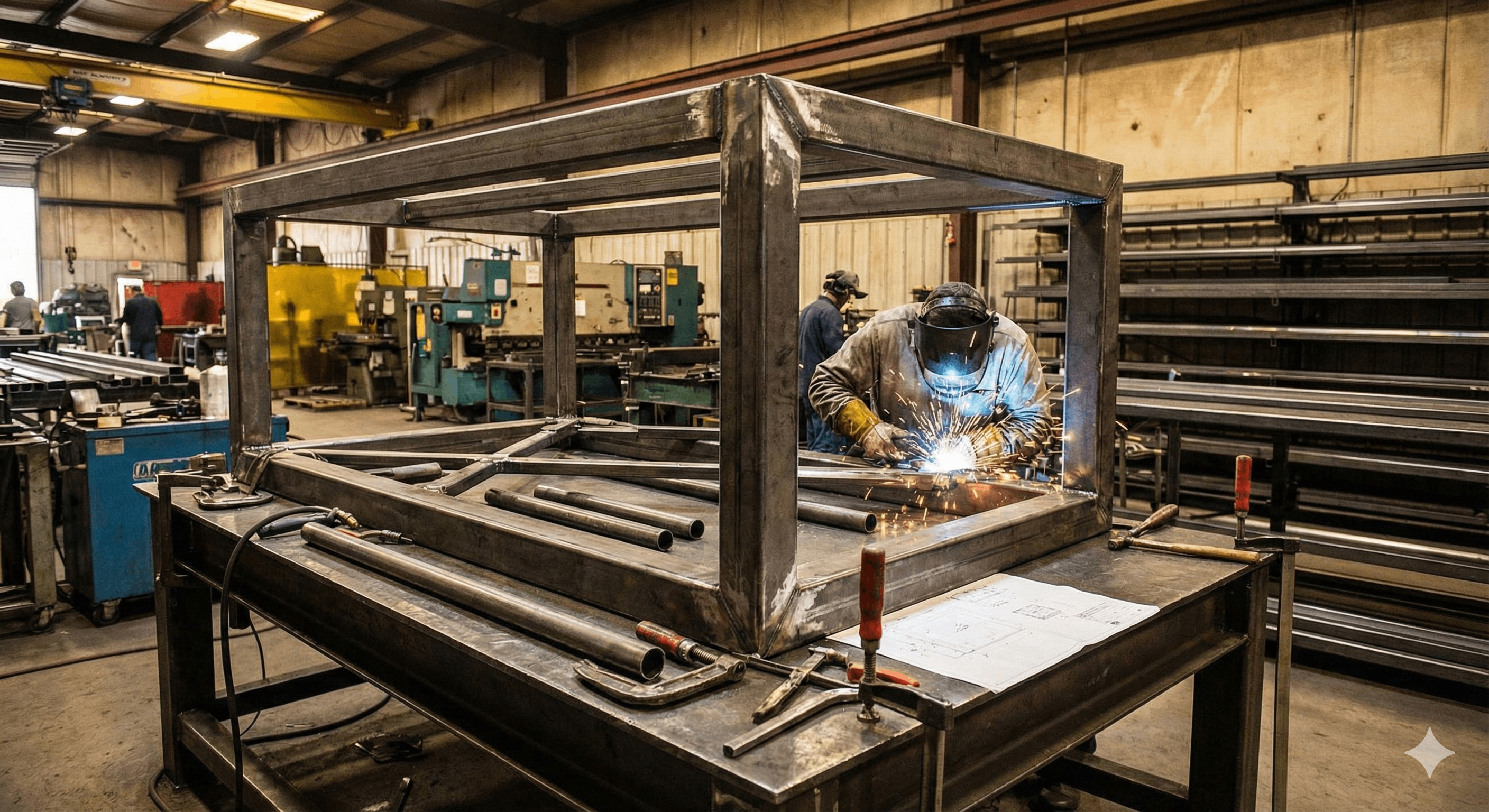
This starts with the use of 3D modular welding tables. Unlike welding on a flat floor, these tables allow us to clamp the frame in three dimensions, securing the X, Y, and Z axes in a rigid geometry.
However, fixtures alone are insufficient. We utilize “Pre-setting” techniques—intentionally clamping parts slightly out of square to counteract the known pull of the cooling weld. For example, if we know a T-joint will pull inward by 1 degree, we clamp it 1 degree outward.
This is combined with strictly enforced welding sequences. By balancing heat input through back-stepping and intermittent welding (stitch welding), we neutralize the build-up of residual stress.
For the buyer, this technical discipline means the frames you receive are geometrically stable and ready for immediate integration.
Comparison: Standard Shop vs. OEM Manufacturer
To visualize the difference in process maturity, consider the following comparison of fabrication methodologies:
| Fabrication Aspect | Standard “Job Shop” Approach | YISHANG OEM Standard |
| Cutting Method | Band Saw (Rough edges, ±1.0mm) | Fiber Laser Tube Cutting (Clean edges, ±0.05mm) |
| Fixturing | Manual Floor Clamping | 3D Modular Welding Tables (Rigid X/Y/Z constraint) |
| Weld Quality | Continuous welding (High distortion) | Back-stepping & Stitching (Balanced heat input) |
| Alignment | Tape Measure & Hammer | Self-Fixturing Tab & Slot Design |
| Stress Relief | Often Skipped | Thermal or Vibratory Stress Relief (VSR) Mandatory |
Robotic vs. Manual: A Volume Decision
The choice between robotic and manual welding plays a key role here. For orders exceeding 50-100 units, robotic welding offers unbeatable consistency.
Robots provide a constant travel speed and heat input that manual welding cannot match over a long shift. This results in uniform weld penetration and predictable thermal behavior across the entire batch.
However, for lower volumes or complex geometries with limited access, skilled manual welding remains vital. YISHANG assesses your volume and design complexity to recommend the most cost-efficient method, balancing tooling setup costs against unit labor savings.
Phase IV: Post-Weld Precision – Decoupling Tolerances
For projects requiring the highest level of precision—such as optical equipment bases, semiconductor machine frames, or medical device supports—welding accuracy alone is often insufficient.
The metal moves during cooling; it is an unavoidable law of physics. To achieve tolerances of ±0.05mm over a 2-meter span, we must integrate subtractive manufacturing into the fabrication workflow.
Stress Relief: The Prerequisite
This process begins with stress relief. Before a welded frame is machined, the internal tensions locked in by the welding process must be released.
If you machine a frame that still has high residual stress, the removal of material will disturb the equilibrium. This causes the frame to warp during the machining process or, worse, weeks later during shipping.
We utilize Thermal Stress Relief (baking the frame in a furnace) or Vibratory Stress Relief (VSR) depending on the material and application. This step stabilizes the geometry, ensuring that the frame remains “dead” and dimensionally stable throughout its lifecycle.
Large Gantry CNC Milling
Once stabilized, the frame enters our Large Gantry CNC Machining centers. Here, we mill critical mounting interfaces after the frame has been welded.
This process effectively decouples the fabrication tolerance from the functional tolerance. You can utilize a cost-effective welded structure (±1mm) while still achieving micron-level flatness where it truly matters (e.g., linear rail mounts).
For the procurement manager, this hybrid approach offers the best balance of performance and budget. It avoids the excessive cost of trying to weld to impractical tolerances while guaranteeing the precision required for high-tech applications.
Phase V: Surface Finishing – The Invisible Risks
The quality of a metal frame is often judged by its finish upon arrival. In the export market, this finish must survive weeks at sea inside a container with varying humidity levels.
A common failure point in overseas sourcing is the degradation of powder coating or plating due to improper preparation. This is often where “cheap” fabrication reveals its true cost.
The “Weeping Weld” Phenomenon
Issues like “weeping welds”—where trapped acid from the pre-treatment pickling process seeps out later—are symptomatic of a disconnect between design and execution.
When acid is trapped in overlapping joints that are not seal-welded, it expands days or weeks later. This ruins the paint from the inside out, creating rust streaks and potential rejection by your end customer.
An experienced OEM partner will insist on DFM adjustments to prevent this. We add strategic drain and vent holes to ensure that chemical pre-treatments can flow freely and coat every internal surface. This prevents internal corrosion and ensures that the cosmetic finish remains pristine from the factory floor to your warehouse.
Overcoming the Faraday Cage Effect
Moreover, complex frames often suffer from the “Faraday Cage effect” during powder coating. The electrostatic field prevents powder from reaching deep corners.
YISHANG employs manual reinforcement strategies to ensure full coverage in these hard-to-reach areas. We verify this through Salt Spray Testing and dry film thickness measurements, providing data-backed confidence in the coating’s longevity.
Turnkey Assembly Value
Finally, consider the strategic value of “Turnkey Assembly.” Sourcing a bare frame often means you must handle the installation of fasteners, casters, or glass panels at your own facility.
By shifting these labor-intensive tasks to the fabricator, you streamline your production line. We provide a single point of accountability, delivering a sub-assembly ready for immediate use. This holistic approach reduces handling risks, lowers packaging waste, and ultimately accelerates your time-to-market.
Phase VI: Quality Control – Verification Before Shipment
In the B2B world, trust is built on data, not promises. A reliable manufacturing partner provides transparency through rigorous Quality Control (QC) protocols that are visible to the client.
Dimensional Verification (CMM & Faro Arm)
For critical dimensions, standard tape measures are insufficient. We employ CMM (Coordinate Measuring Machines) and portable Faro Arms to verify the geometric tolerances (GD&T) of the final machined surfaces.
This generates a detailed report proving that the frame meets the strict flatness and parallelism requirements before it is crated. This data is shared with your engineering team, providing peace of mind before the container door closes.
Compliance with Global Welding Standards
To serve our diverse client base in North America and Europe, YISHANG aligns its fabrication processes with internationally recognized codes. We do not just “weld metal”; we adhere to specific procedure qualification records (PQR).
AWS D1.1 / D1.6: For structural steel and stainless steel frames destined for the US market.
ISO 3834-2: Comprehensive quality requirements for fusion welding, preferred by our European partners.
EN 15085: For clients in the rail and transport sector requiring strict safety margins.
Specifying these standards in your RFQ (Request for Quote) ensures that our Inspection Test Plan (ITP) matches your local regulatory requirements.
Structural Integrity Testing (NDT)
Beyond dimensions, we verify the strength of the connections. This includes Macro-Etch Testing to check weld penetration depth and Dye Penetrant Inspection (DPI) to detect invisible surface cracks in critical joints.
For batches requiring high reliability, these Non-Destructive Testing (NDT) reports serve as your insurance policy against field failures. We do not guess; we verify.
FAQ: Common Questions on OEM Frame Sourcing
To assist in your procurement research, here are answers to the most common questions we receive from wholesale buyers.
Q: What is the ideal file format for quoting specific frame weldments?
A: For the most accurate DFM review, we recommend providing 3D STEP or IGES files for the assembly, along with 2D PDF drawings specifying critical tolerances, weld symbols, and surface finish requirements (e.g., Ra values).
Q: How do you handle frame distortion in long chassis structures?
A: We utilize a combination of pre-setting fixtures (clamping out-of-square to counteract pull), balanced weld sequencing (back-stepping), and post-weld stress relief. For ultra-precision needs, we include a post-weld CNC machining stage.
Q: Can YISHANG source specific material grades like Corten steel or DOM tubing?
A: Yes. Our supply chain covers standard carbon steel (Q235/A36), stainless steel (304/316L), and aluminum (5052/6061). We can also source specialized alloys upon request and verify them with mill certificates.
Q: What is the maximum size frame you can fabricate and ship?
A: We can handle large-scale frames. However, for cost-effective export, we recommend designing modular frames that fit within standard 20ft or 40ft shipping containers to minimize freight costs.
Conclusion: Partnering for Scalable Success
Sourcing custom metal frame fabrication from overseas is a strategic decision that extends far beyond comparing unit prices on a spreadsheet. It requires a partner who understands the engineering behind mass production, the physics of global logistics, and the imperative of quality consistency.
A low initial quote loses its value instantly if it leads to assembly line stoppages or high rejection rates. Real value is found in a supply chain that delivers predictable precision, order after order.
At YISHANG, we view ourselves not just as a factory, but as an extension of your engineering and supply chain teams. Our ISO 9001 processes, combined with decades of insight into the needs of wholesale buyers, ensure that your projects are built on a solid foundation.
Is your current frame design optimized for global scalability?
Contact the YISHANG engineering team today for a comprehensive DFM review. Let us identify opportunities to drive down costs and drive up precision in your next OEM project.