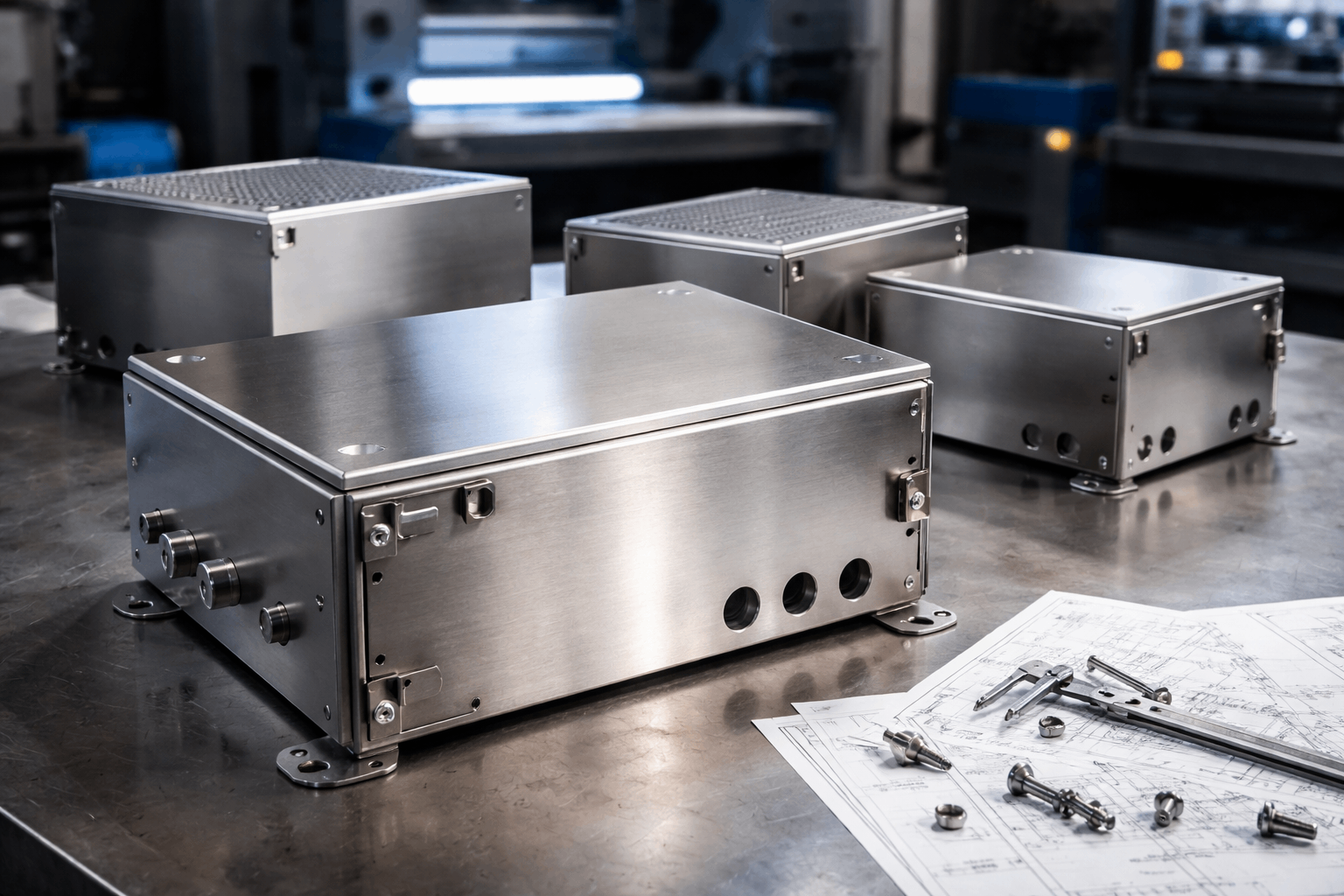
Industrial buyers rarely remember the enclosure that worked. They remember the one that triggered delays, warranty claims, field rework, or an uncomfortable redesign after launch. For overseas wholesale purchasers, a sheet metal enclosure is not a single-use component. It is a repeatable product platform that must withstand batch production, long-distance logistics, different end-user environments, and years of service without creating downstream risk.
Wholesale buyers evaluate suppliers very differently from end users. Their focus is not on appearance or novelty, but on repeatability and risk control. Typical questions sound practical rather than aspirational: Will production batches remain consistent? Will the enclosure survive shipping and installation without cosmetic or functional damage? Are specifications clear enough to prevent disputes? Will service teams blame the metal housing when electronics fail? This article follows the cause-and-effect chain wholesalers care about most—requirements → design decisions → manufacturing repeatability → field performance → lifecycle cost—using language and assumptions aligned with B2B sourcing behavior.
Why Sheet Metal Enclosures Often Look Fine — Until They Are Put into Use
A metal box enclosure can pass inspection and still be misaligned with real operating conditions. Panels look square, cutouts line up, and doors close smoothly. Yet weeks or months after deployment, problems emerge: rising internal temperatures, condensation inside the cabinet, corrosion along seams, or doors that no longer align with latches. For wholesale buyers, these are not minor technical inconveniences. They quickly become returns, customer complaints, and pressure to revise specifications mid-cycle.
The reason is rarely mysterious. Many projects validate appearance and dimensional fit far more rigorously than operational stress. A sheet metal box is a working structure, not static packaging. It experiences temperature swings, vibration during transport, impacts during handling, and repeated human interaction. Designs that perform well on a lab bench can degrade quickly when installed inside kiosks with restricted airflow, mounted outdoors in coastal climates, or serviced frequently in industrial settings.
The most disruptive failures are delayed. They surface after installation, when products are already in distribution. In most cases, the root cause traces back to an early assumption that was never clearly defined. The enclosure was treated as a cosmetic shell instead of a system boundary. Sealing was implied rather than specified. Thermal behavior was assumed rather than validated. Manufacturability was delegated to production instead of addressed during design.

What wholesale buyers consider an enclosure failure
From a procurement perspective, enclosure failure extends beyond visible damage. A cabinet that runs hotter than expected can shorten electronics life; many engineers rely on the rule of thumb that reliability roughly halves for every 10°C rise in operating temperature. A door that deforms during shipping delays installation and triggers “bad batch” claims. A chipped finish undermines perceived quality even when structural integrity remains intact.
For wholesale distribution, the impact is cumulative. One defective custom metal box can be reworked. A pattern of failures becomes a program risk: mixed revisions in the market, unstable lead times, and an expanding support burden. This is why experienced sourcing teams treat enclosure performance as a supply chain issue, not merely an engineering concern.
Enclosure Design Starts Too Late in Most Projects
In many programs, enclosure design begins only after the internal system layout is finalized. On paper, the task appears simple: build a box that fits. In practice, this timing forces airflow, sealing, stiffness, and service access to adapt to constraints that were never designed with them in mind. The result is often a metal electronic enclosure that meets drawings but struggles in real use.
From a system perspective, the enclosure defines more than outer boundaries. It shapes airflow paths, influences heat dissipation, supports internal assemblies, and determines how technicians interact with the product over time. When enclosure design starts late, common fixes are reactive: vents added where they are least effective, reinforcement added where it complicates assembly, or material substitutions driven by fabrication convenience rather than environment.
For wholesale supply programs, late changes introduce instability. Specifications shift after first production, revisions overlap in the market, and inventory management becomes complex. A more scalable approach is to treat enclosure design as part of early system definition—especially when products ship to multiple regions with different climates, installation practices, and compliance requirements.
How overseas buyers search and evaluate enclosure suppliers
Wholesale buyers rarely search like end users. Their queries are problem-driven and risk-focused, often built around symptoms rather than inspiration. Searches commonly include enclosure overheating issues, tolerance problems in custom sheet metal enclosures, corrosion at cut edges, and batch consistency in metal enclosure manufacturing.
This is why marketing-style content underperforms in B2B SEO. Buyers want information that helps them write better RFQs, identify risky assumptions, and compare suppliers on repeatability. Content that supports those goals aligns naturally with both buyer intent and search engine evaluation.
The Variables That Actually Control Sheet Metal Enclosure Performance
Enclosure performance is often reduced to dimensions and features. In reality, long-term performance depends on interacting variables that are not always obvious during early design reviews. When wholesalers face post-installation issues, one or more of these variables is usually underestimated.
Thermal behavior is a major driver. Internal heat interacts with airflow restrictions, vent placement, wall thickness, and surface finish. Small geometry decisions can create stagnant air zones or localized hot spots. Environmental exposure is equally important. Outdoor installations, wash-down conditions, chemical vapors, and coastal environments dramatically change corrosion risk profiles for metal housings.
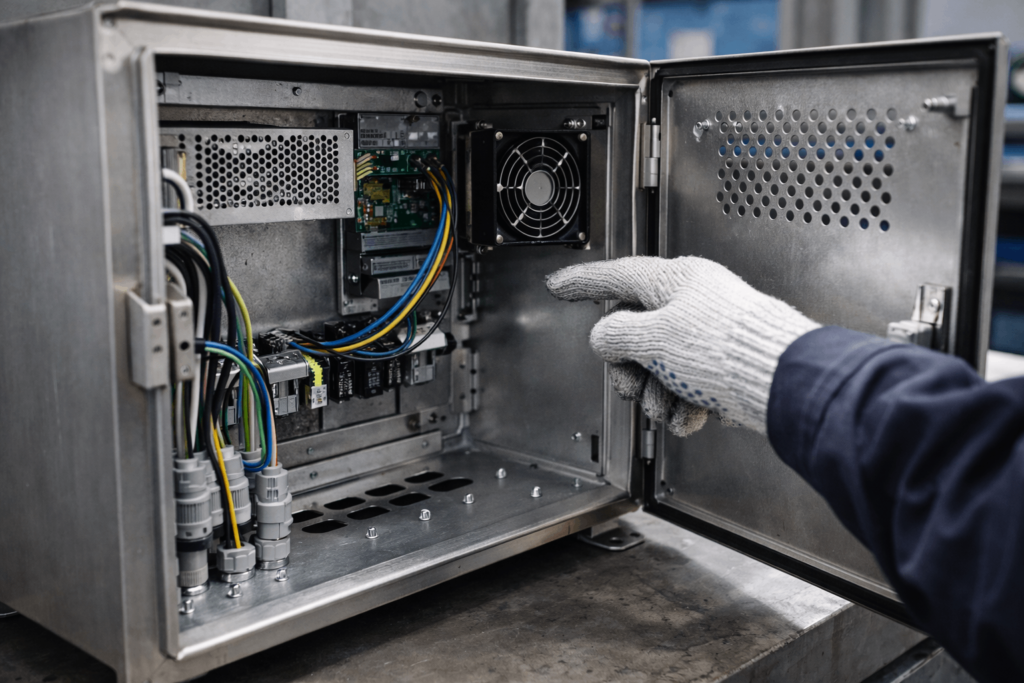
Mechanical stress adds another layer. Vibration, shock loads, and stacking during transport can gradually deform sheet metal boxes. Human interaction further shapes reliability. Frequent access, repeated panel removal, and limited service clearance accelerate wear when the enclosure is not designed for realistic maintenance cycles. Effective custom metal enclosures manage these variables together rather than optimizing a single attribute in isolation.
Translating variables into procurement language
A common sourcing challenge is vague claims such as “high quality” or “industrial grade” without clarity on what those terms mean. The simplest way to reduce ambiguity is to link each performance variable to a design decision and an RFQ question.
| Performance variable | Field symptom | Design decision | RFQ question |
|---|---|---|---|
| Heat buildup | hot spots, derating | airflow path, vent strategy | What ambient range and mounting context is assumed? |
| Moisture/chemicals | corrosion, condensation | material grade, drainage, finish | What environment and finish system are specified? |
| Vibration/shock | door misalignment | reinforcement, hinges | What transport or vibration loads are considered? |
| Service frequency | stripped threads | access geometry, hardware | How many service cycles is the design rated for? |
This framing allows wholesale buyers to compare a metal enclosure supplier based on engineering clarity rather than marketing promises.
Material Choice Is a Commitment, Not a Specification
Material selection is one of the most underestimated enclosure decisions. Buyers often treat material as a line item—stainless steel, galvanized steel, aluminum—then move on. In practice, material choice commits the program to specific behaviors: corrosion resistance, stiffness, forming limits, welding distortion, and even thermal response.
Problems arise when materials are chosen based on reputation rather than operating assumptions. Stainless steel may be specified without clarifying chloride exposure. Galvanized steel may be selected for cost without an edge protection strategy. Aluminum may be chosen for weight savings without considering panel stiffness in larger sheet metal boxes or vibration behavior in mobile equipment.
Evaluating materials through failure behavior
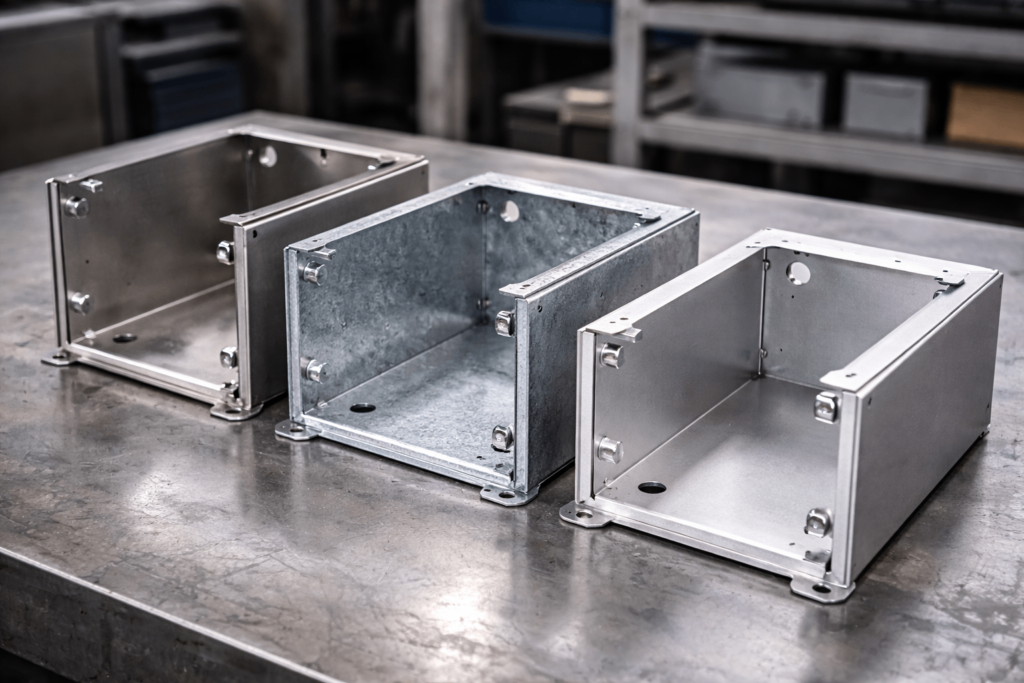
A more reliable approach is to ask how each material fails in the intended environment. 304 stainless steel performs well indoors, but in chloride-rich environments, 316 stainless steel offers better resistance to pitting. Galvanized steel protects effectively until cut edges or weld zones expose base metal. Aluminum resists corrosion and reduces shipping weight, but often requires reinforcement and careful fastener selection for repeated service.
Including a short environment statement in RFQs—such as indoor, outdoor shaded, coastal, or wash-down—prevents many cases of incorrect material selection in custom metal enclosures.
IP and NEMA language that reduces disputes
Ambiguous terms like “waterproof” or “dustproof” often lead to disputes. Replacing them with recognized frameworks improves clarity. Many teams use IEC 60529 IP ratings globally, while NEMA enclosure types are common in North America.
| Rating reference | What it defines | Why buyers use it |
|---|---|---|
| IP rating | protection against solids and water | globally recognized, precise |
| NEMA type | environment and application | widely used in US markets |
Using these frameworks aligns expectations across borders and simplifies procurement discussions.
Heat Is the Most Commonly Misjudged Factor in Enclosure Design
Thermal assumptions frequently drive enclosure complaints. Designers may assume metal walls dissipate heat naturally or that adding vents is sufficient. In reality, sheet metal electronic enclosures behave as integrated thermal systems where small changes have outsized effects.
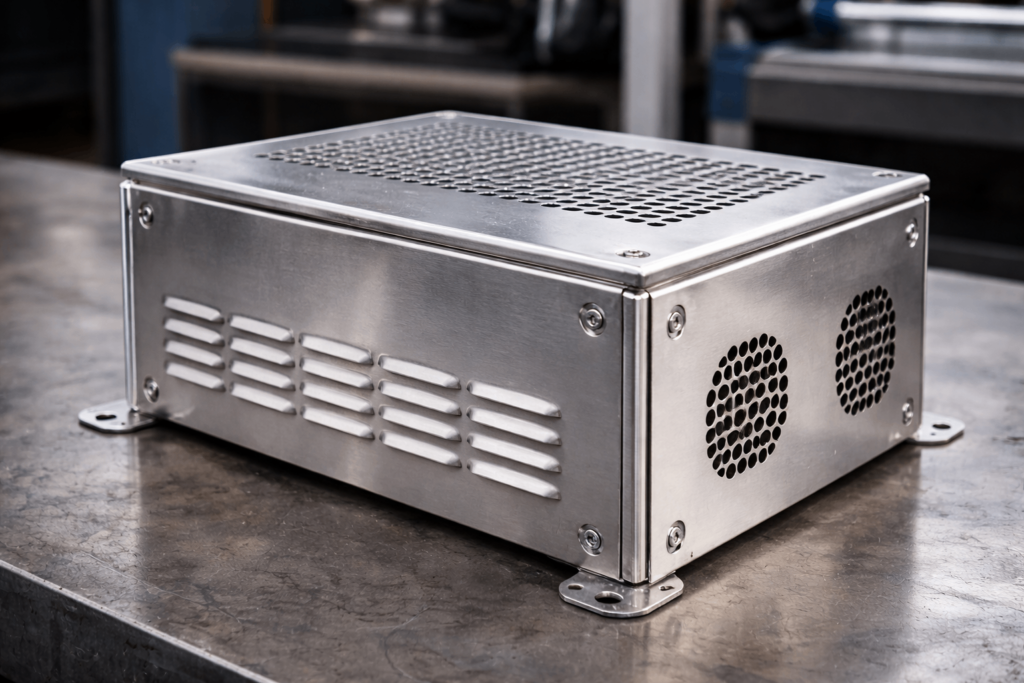
Heat management depends on internal convection, conduction through the metal, and external radiation. Geometry matters. Reinforcement flanges can block airflow. Poor vent placement can short-circuit cooling paths so air bypasses hot components. Surface finishes chosen for durability may slightly influence emissivity. Together, these factors determine whether internal temperatures remain stable.
A practical airflow pattern buyers can ask for
Many enclosure designs rely on a simple, predictable airflow concept: cooler air enters low, warmer air exits high, supporting natural convection. When fans are used, their placement should reinforce this path rather than fight it. Buyers should also confirm that ventilation features do not compromise the required IP or NEMA rating.
A procurement-friendly thermal checklist
| Parameter | Define upfront | Why it matters |
|---|---|---|
| Ambient range | indoor or outdoor limits | defines cooling margin |
| Mounting context | kiosk, wall, machine bay | affects airflow |
| Duty cycle | continuous or intermittent | drives steady temperature |
| Heat sources | total dissipation | informs vent and fan layout |
What Manufacturing Reality Changes in a Sheet Metal Enclosure Design
A clean drawing does not guarantee a consistent product. Manufacturing introduces variation through bending, welding, fastening, and finishing. Designs that do not tolerate this variation often struggle in high-volume production.
Springback varies by material and thickness. Welding introduces localized distortion. Fastener insertion can deform thin panels. Finishing processes can alter effective dimensions. These effects accumulate, making batch-to-batch variation a common issue for wholesale programs.
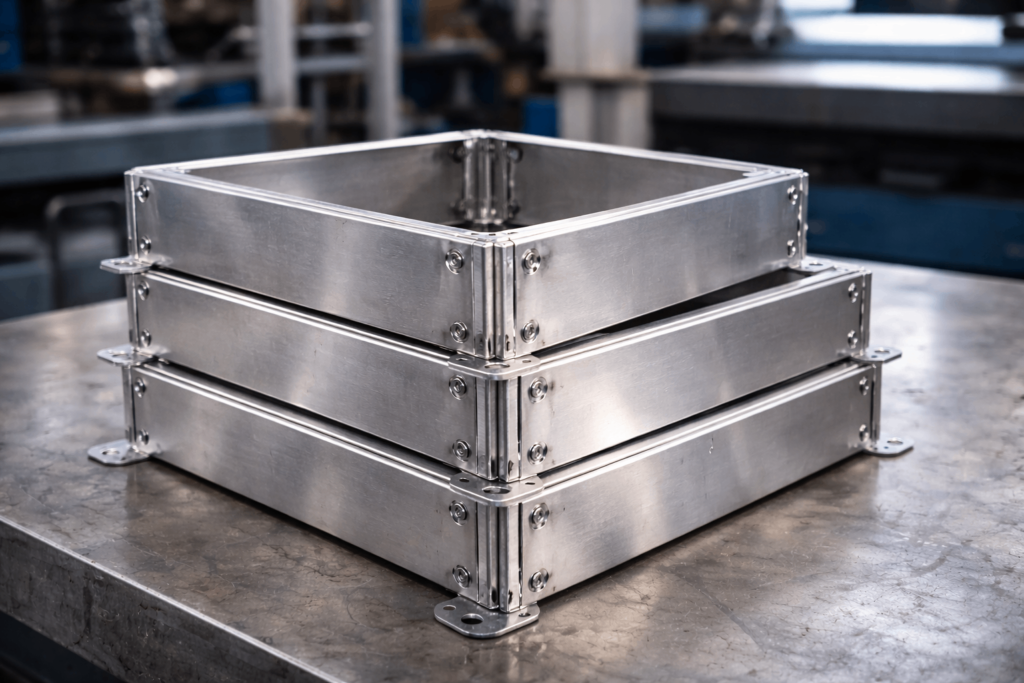
Designing for manufacturability reduces this risk. Functional tolerances should be tight only where they control sealing or alignment. Non-critical dimensions should allow normal sheet metal variation. Alignment features should make assembly repeatable. This is how experienced sheet metal enclosure manufacturers protect consistency.
Where tolerance strategy matters most
| Feature | Tolerance intent | Protected outcome |
|---|---|---|
| Door and latch interface | function-based | sealing, alignment |
| Mounting patterns | controlled | assembly fit |
| Non-critical surfaces | relaxed | lower cost |
| Visible gaps | defined | perceived quality |
Batch Consistency and Revision Control in Wholesale Programs
For wholesale buyers, consistency across batches matters as much as initial quality. Even small uncontrolled changes can create mixed revisions in the market, leading to installation confusion and support issues.
Clear revision control, approved samples, and defined critical-to-quality features reduce this risk. Buyers who treat consistency as a specification rather than an assumption experience fewer downstream disruptions.
The Cost of Designing for Unit Price Instead of Lifecycle
Unit price pressure is unavoidable, but focusing only on initial cost often increases long-term risk. Thinner gauges or reduced reinforcement may save marginally per unit while increasing susceptibility to damage and deformation.
A useful distinction is between manufacturing cost and the cost of uncertainty. Designs sensitive to variation, handling, or environment carry hidden costs that surface after shipment. Stable programs reduce both by aligning design decisions with real use conditions.
Why Many Enclosure Problems Appear After the First Year
Some issues appear immediately; others surface months later. Corrosion develops at seams and edges. Fatigue accumulates through vibration and repeated access. Gaskets lose compression over time.
These delayed failures explain why first-year performance alone is insufficient. In distribution markets, enclosures may be installed in environments never anticipated by the original design team.
What Customization Actually Solves in Sheet Metal Enclosures
For wholesale programs, custom sheet metal enclosures reduce uncertainty. Standard enclosures compromise to serve many use cases. Custom designs align access, reinforcement, and airflow with real operating conditions.
Prototyping validates assumptions before scale, reducing the risk of discovering limitations after products reach the field.
How Experienced Manufacturers Think About Enclosure Design Differently
Experienced manufacturers design for variability rather than ideal conditions. They anticipate material variation, handling stress, and service behavior. They treat the enclosure as part of a system.
This mindset produces metal housings that perform consistently across batches and markets and signals genuine E‑E‑A‑T to both buyers and search engines.
A Well-Designed Sheet Metal Enclosure Rarely Draws Attention
A well-designed sheet metal enclosure ships without damage, installs smoothly, and operates without surprises. Over time, it quietly protects the system while remaining easy to service.
For overseas wholesale buyers sourcing custom metal boxes, sheet metal electronic enclosures, or other metal housings, early alignment on environment, service expectations, and volume prevents the most expensive problems later.
If you would like to sanity-check an RFQ or compare manufacturability options for a new enclosure program, the team at YISHANG is happy to review requirements and suggest a practical path forward.