
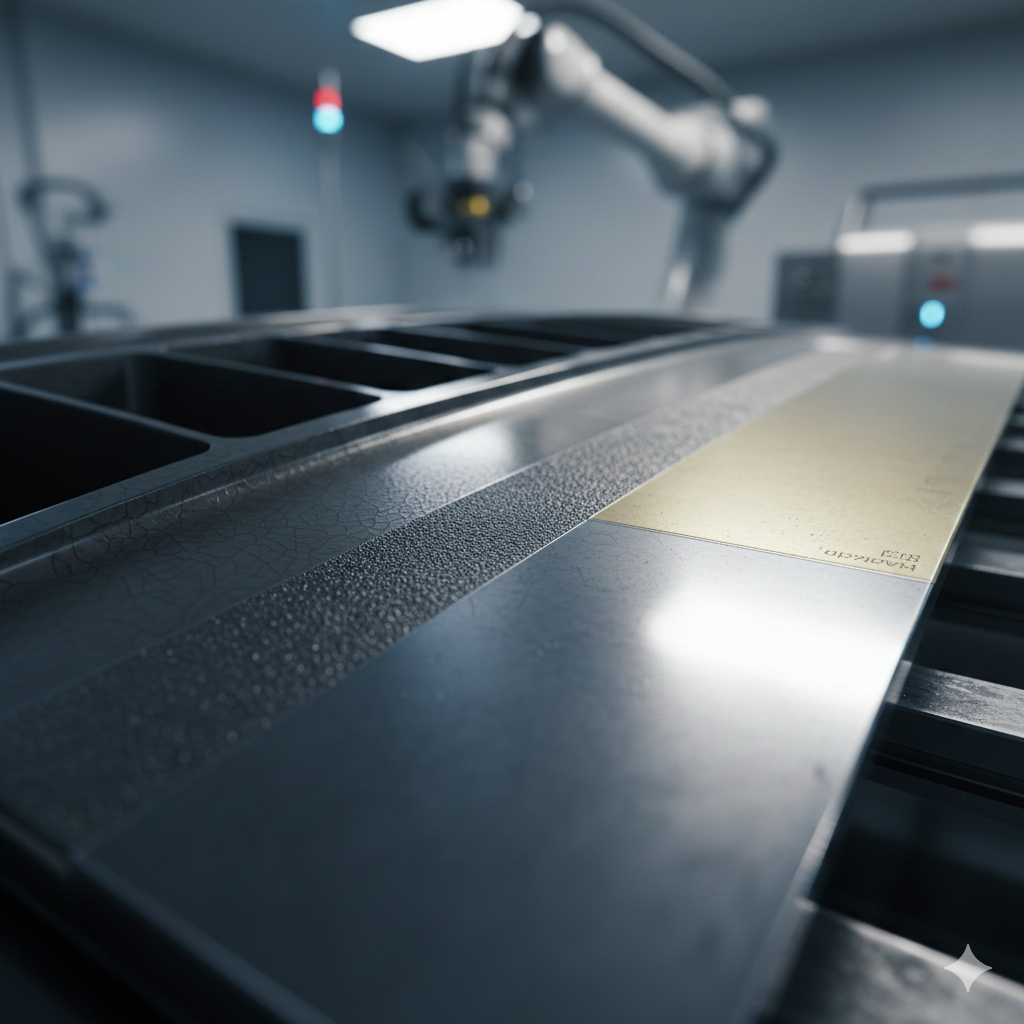
In the contemporary aerospace supply chain, the traditional distinction between structural engineering and surface finishing has effectively dissolved. For international procurement specialists, the surface is now a functional organ. It is the primary interface between an expensive asset and a destructive environment.
At YISHANG, we understand that your risk is not limited to a single part failure. It involves systemic risks like batch-wide recalls or unplanned Aircraft on Ground (AOG) events. This guide deconstructs the complexities of aerospace surface finishing, helping you evaluate technical reliability.
Beyond aesthetics, aerospace finishes are engineered systems designed to compensate for the vulnerabilities of high-strength alloys. By viewing the surface as a dynamic component, we ensure metal integrity remains uncompromised through every flight cycle.
Substrate Vulnerability: Pitting, IGC, and Hydrogen Risks
A deep understanding of metallurgical degradation is essential for any manufacturing partner. We must move beyond “rust” and address specialized failure modes like Intergranular Corrosion (IGC). In 7075 aluminum, IGC can penetrate grain boundaries without showing external distress.
This localized attack hollows out the structural capacity, turning a precision component into a liability. For the engineering buyer, a supplier’s control over heat-treatment is a key quality indicator. At YISHANG, our protocols minimize these latent risks before coating begins.
[Technical Insight]: Hydrogen Embrittlement remains a silent killer for high-strength steel. It occurs when hydrogen atoms enter the metal lattice during plating. Without precise de-embrittlement “baking” cycles, parts fail suddenly under load.
Addressing these issues at the source reduces long-term liability for the distributor. It ensures the integrity of assemblies in high-vibration environments. Our goal is to provide you with “risk-free” components that meet stringent Nadcap and ISO standards.
The 2025 Regulatory Shift: Beyond REACH Compliance
The global supply chain is in a “Chemistry Revolution” regarding aerospace surface finishing. For decades, Hexavalent Chromium (Cr6+) was the gold standard for “self-healing” protection. However, REACH and RoHS mandates have forced a mandatory transition.
This transition created a performance gap that procurement managers must navigate carefully. Trivalent Chromium (Cr3+) and other chrome-free alternatives are not simple “plug-and-play” swaps. They require different handling to reach identical Salt Spray Test (SST) benchmarks.
| Finish Category | 2025 Status | SST (Hours) | Feature |
| Hexavalent (Cr6+) | Restricted | 336 – 1000+ | Self-healing |
| Trivalent (Cr3+) | Industry Standard | 168 – 336 | Low-toxicity |
| Non-Chrome (TCP) | Sustainable | 96 – 168 | Bio-compatible |
At YISHANG, we prioritize Low-VOC and waterborne systems to align with 2025 sustainability trends. We help you choose “greener” chemistries that meet MIL-SPEC without compromising safety. This regulatory shield protects your business from future supply chain disruptions.
The Synergy of Fabrication and Metrology: Ra Control
The cause of finishing failure often occurs long before the plating tank. In precision manufacturing, Laser Cutting or CNC Machining alters the substrate’s surface energy. Laser cutting, for instance, creates a Heat Affected Zone (HAZ).
If the HAZ is not remediated, subsequent aerospace finishes are prone to delamination. Similarly, the rise of 3D printing introduces high Surface Roughness (Ra). Standard tools cannot reach internal lattices, making chemical polishing essential.
[Procurement Note]: Most aerospace parts require a standard roughness of 8 uin Ra. Achieving this without post-machining reduces your lead times and costs. At YISHANG, we manage both fabrication and metrology to ensure consistency.
Choosing a partner who manages the entire QMS mitigates inter-process risks. We use XRF Thickness Gauging and Eddy Current Testing to ensure every batch is uniform. This holistic approach prevents the “tolerance stack-up” issues that plague complex assemblies.
Strategic Economics: MRO Optimization and TCO
The ultimate driver for B2B procurement is the Total Cost of Ownership (TCO). We advocate for a Life Cycle Cost (LCC) model where value is measured by maintenance intervals. A cheap finish saves cents initially but costs thousands in AOG events.
Quality aerospace surface finishing is essentially financial insurance. If a coating pushes a major inspection from 5,000 to 10,000 hours, the operational ROI is measured in millions. This is the logic that top-tier aerospace wholesalers use to select partners.
By focusing on aerodynamic smoothness, we also help your clients achieve measurable fuel savings. High-quality coatings reduce drag, which is a top priority for airline operators in 2025. At YISHANG, we don’t just sell metal; we provide efficiency and reliability.
Environmental Frontiers: Atomic Oxygen and AO Erosion
In Low Earth Orbit (LEO), the enemy is not moisture, but Atomic Oxygen (AO). These reactive atoms act like microscopic sandblasters, eroding standard coatings. Spacecraft require specialized inorganic finishes like vacuum-deposited gold.
Another challenge is Outgassing. In a vacuum, organic compounds can evaporate and contaminate sensors. This necessitates vacuum-stable finishes and strict “bake-out” procedures. These details ensure that your satellite or rocket components perform as intended.
For high-mach engines, Thermal Barrier Coatings (TBCs) are the standard. These ceramic layers act as heat shields, allowing engines to run at temperatures that would melt the base alloy. This level of engineering is what separates YISHANG from general metal shops.
Adhesion Science: The Molecular Interface
Coating longevity is tied to the strength of the bond at the molecular interface. Adhesion failure is a critical risk in high-vibration environments. Understanding the thermodynamics of wetting is critical during the pre-treatment phase.
At YISHANG, we use multi-stage cleaning to ensure a pristine surface. Removing exogenous iron is essential for preventing “tea staining” in stainless steels. We don’t skip the “unseen” stages because we know they dictate the product’s final lifespan.
We provide comprehensive adhesion testing, including ASTM-standard tape and cross-hatch analysis. This guarantees that your aerospace finishes can withstand the stresses of takeoff and landing. This technical transparency is why global wholesalers trust our quality reports.
Conclusion: Your Partner in Precision
Aerospace surface finishing is a strategic asset, not an afterthought. From mitigating Hydrogen Embrittlement to meeting 2025 sustainability goals, the surface is where engineering meets reality. At YISHANG, we are here to help you solve these challenges.
Mastery of the surface finish is the defining factor of excellence in modern aviation. We invite you to collaborate with us to ensure unparalleled reliability for your high-spec projects.
Ready to enhance your supply chain with precision-engineered metal solutions? Contact YISHANG today for a technical consultation and professional quote.