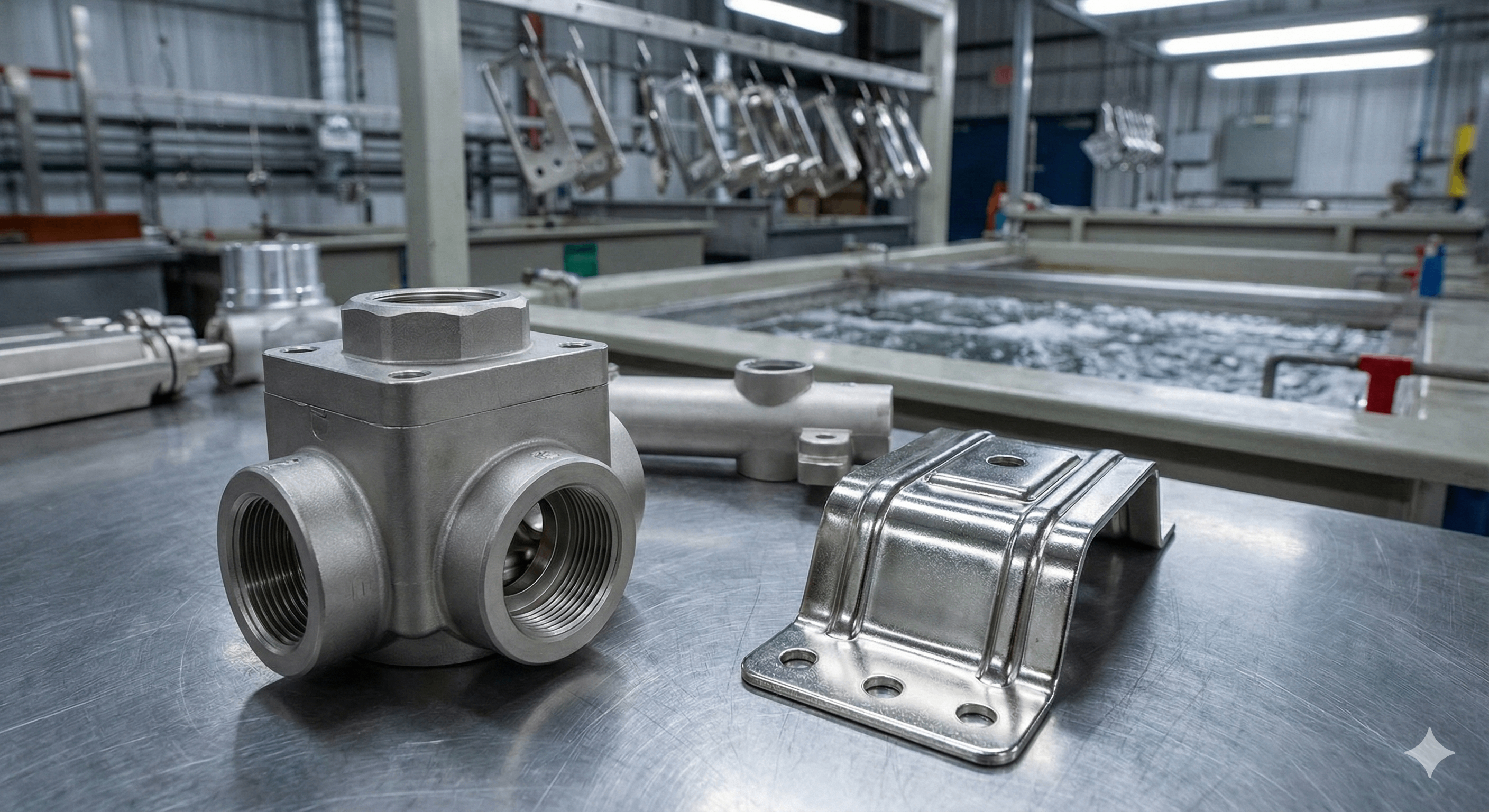
In the high-stakes environment of global supply chain management, the specification of surface finishes is often the subtle divide between a profitable product line and a catastrophic recall. For procurement managers and sourcing engineers overseeing volume production, the notation “Nickel Plate” on a technical drawing is dangerously insufficient.
It fails to capture the complexity of a process that acts as the final, critical defense for your components against environmental degradation and mechanical wear. A finish that appears flawless on a pre-production sample can fail disastrously in the field—peeling, blistering, or corroding—if the underlying electrochemical process is not rigorously aligned with the substrate and the service environment.
This disconnection between design intent and manufacturing reality is a primary driver of batch rejections, assembly line stoppages, and costly recalls. B2B buyers need more than just a vendor; they need a technical partner who understands the chemistry behind the quote.
This guide is crafted for procurement professionals who need to navigate the technical nuances of nickel electroplating services. It moves beyond aesthetics to dissect the science of surface engineering, converting technical chemistry into actionable procurement strategies.
By understanding the variables that impact batch consistency, dimensional accuracy, and corrosion resistance, you can transform your surface finishing specifications from a generic line item into a robust control point for risk mitigation and supply chain efficiency.
Strategic Selection: Electrolytic vs. Electroless Nickel
The distinction between electrolytic and electroless nickel is not merely a technical choice found in a textbook; it is a strategic decision that directly impacts unit cost, production throughput, and assembly yields.
While both processes deposit nickel, the mechanisms governing their application dictate their suitability for volume manufacturing. Understanding these differences allows buyers to balance performance requirements against budget constraints effectively when selecting an electroplating supplier.
Electrolytic Nickel: The Cost-Effective Workhorse
Electrolytic nickel plating relies on an external electrical current to drive deposition. In mass production scenarios, this method is the industry standard for cost efficiency, particularly for stamped parts, brackets, and simple enclosures where geometric complexity is low.
However, procurement teams must be keenly aware of the “current density distribution” phenomenon. Electricity naturally concentrates on edges and corners, creating the “Dog-bone Effect”—a build-up of material on outer edges while recessed areas remain thinly coated.
Pro Tip: For simple geometries, this uneven distribution is acceptable and economical. It allows for high-speed plating lines that keep unit costs low.
However, for precision turned parts with tight thread tolerances, this characteristic can lead to significant rejection rates during assembly. If a bolt cannot fit into a plated nut because of edge build-up, the entire batch becomes scrap.
Within the electrolytic family, Sulfamate nickel represents the high-performance tier. Unlike standard Watts baths, sulfamate chemistry produces a deposit with exceptionally low internal stress and high ductility.
This makes it a mandatory specification for components subjected to flexing, crimping, or thermal cycling, such as lead frames or aerospace connectors. While the raw material cost is marginally higher, the investment prevents microscopic cracking that leads to functional field failures.
Electroless Nickel: The Geometry Solver
In contrast, Electroless Nickel (EN) offers a solution for geometric complexity that electrolytic methods simply cannot match. By utilizing an autocatalytic chemical reaction rather than electrical current, EN deposits a perfectly uniform layer regardless of part shape.
For sourcing managers purchasing complex manifolds, valve bodies, or medical devices with blind holes, EN eliminates the risk of unplated internal surfaces. It ensures that critical internal features (like internal threads or O-ring grooves) receive the exact same protection as the visible exterior.
Furthermore, specifying the phosphorus content allows for targeted performance tuning.
- Low Phosphorus (1-4%): Offers tool-steel-like hardness (up to 60 HRC as plated) and excellent solderability, making it ideal for electronic components subject to wear.
- Mid Phosphorus (5-9%): The general industrial standard, offering a balanced compromise between corrosion resistance and cost. It is the go-to choice for automation components.
- High Phosphorus (10%+): Provides superior corrosion resistance due to its amorphous structure. It is non-magnetic, critical for medical imaging equipment (MRI) and high-frequency electronics.
Quick Comparison: Electrolytic vs. Electroless
To aid in rapid decision-making, use this comparison matrix when reviewing your engineering requirements:
| Feature | Electrolytic Nickel (Watts) | Electroless Nickel (Mid-Phos) | Electroless Nickel (High-Phos) |
|---|---|---|---|
| Primary Driver | Electrical Current | Chemical Reaction | Chemical Reaction |
| Uniformity | Low (Dog-bone effect) | Perfect (1:1 ratio) | Perfect (1:1 ratio) |
| Hardness (As Plated) | 150-500 HV | 500-550 HV | 450-500 HV |
| Magnetic? | Yes | Yes | No |
| Cost | $ (Lowest) | $$(Moderate) | $$$ (Highest) |
| Best Application | Brackets, Stampings | Precision Threads, Valves | Medical, Marine, Chemical |
Ensuring Substrate Integrity: Hidden Process Controls
A shiny surface often masks poor adhesion, a defect that typically reveals itself only after the product has been shipped and put into service. For wholesale buyers, adhesion failure is a critical operational risk that disrupts production lines and damages vendor ratings.
Ensuring that your manufacturing partner utilizes rigorous pre-treatment protocols is the most effective way to prevent latent adhesion failures. The integrity of the bond between the nickel and the substrate is determined by chemical engineering, not by the plating tank itself.
The Challenge of Aluminum Alloys
Plating on aluminum presents the most significant challenge due to the metal’s rapid oxidation. If a supplier attempts to plate directly over aluminum’s natural oxide layer, the batch will inevitably fail adhesion tests.
The industry-standard countermeasure is the Zincate process, specifically the double-zincate protocol. This involves chemically depositing a sacrificial zinc layer, stripping it to create a hyper-clean surface, and immediately re-applying a finer zinc layer before nickel plating.
When auditing potential partners for aluminum heatsinks or automotive components, specific inquiries about their control of the zincate line can serve as a litmus test.
A capable nickel plating service will have strict controls on the zincate bath’s temperature and concentration to ensure specific alloy compatibility (e.g., distinguishing between 6061 and 7075 series aluminum, which react differently).
Activating Stainless Steel and Copper
Similarly, stainless steel requires a specialized activation step known as the Wood’s Nickel Strike. Because stainless steel is designed to be passive and corrosion-resistant, it naturally repels adhesion efforts.
The Wood’s Strike uses a highly acidic bath to etch the surface and deposit a thin anchor layer of nickel. Without this aggressive activation, the functional nickel layer is merely resting on the surface rather than bonding to it.
This creates a high risk of delamination under thermal shock or physical impact. Buyers must confirm their supplier uses this activation step, as skipping it to save time is a common shortcut in low-cost shops.
For copper and brass components used in electronics, nickel acts as a critical diffusion barrier. Without this barrier, copper atoms will eventually migrate into the final gold or tin finish, causing oxidation and contact failure.
Specifying a nickel underplate preserves solderability and contact resistance over years of storage and use. This is a critical detail for procurement managers sourcing electronic connectors or PCB components where long-term reliability is paramount.
The Economics of Accuracy: Optimization for Bulk Procurement
Transitioning from prototype to mass production requires a keen focus on cost drivers. A savvy procurement strategy recognizes that the lowest quoted price often carries hidden costs in the form of higher scrap rates, manual labor, or inconsistent quality.
Optimizing the design and specification for the nickel electroplating services you require is a powerful lever for significant cost reduction. It shifts the conversation from “price per piece” to “total landed cost.”
Rack vs. Barrel Plating: The Labor Factor
The choice between rack and barrel plating is the primary determinant of labor costs in the finishing process. Understanding the trade-offs here is essential for accurate budgeting and quality expectations.
Barrel plating involves tumbling thousands of parts in a rotating drum submerged in the plating solution. This method is highly efficient and economical for durable hardware like nuts, bolts, and small stampings.
The bulk processing nature drastically reduces the per-unit labor cost, often making it pennies per part. However, the tumbling action creates part-on-part contact.
This carries the risk of impact damage. Threads can be nicked, and delicate features can be bent. It is crucial to assess whether your component is robust enough for this tumbling action.
Rack plating involves manually mounting each part on a custom fixture (a rack). It ensures a pristine finish and prevents contact damage, making it the only option for cosmetic parts, delicate geometries, or heavy parts that would dent each other.
However, the manual labor to fixture each part significantly increases the unit price. Buyers should evaluate the cosmetic requirements of the part carefully.
Cost Saving Insight: If minor contact marks are acceptable on a bulk internal component, specifying barrel plating can reduce finishing costs by upwards of 50%. This is a pure profit margin improvement derived solely from specification knowledge.
The Hidden Cost of Racking Marks
A frequently overlooked detail in rack plating is the “rack mark.” This is the small spot where the fixture held the part, preventing the plating solution from covering that specific contact point.
Every rack-plated part will have a rack mark. It is unavoidable. The conflict arises when the mark appears on a visible A-surface.
To avoid disputes and rejection, procurement managers should clearly define “allowable rack mark locations” on the technical drawing.
Allowing the plater to rack from a non-visible internal surface or a functional hole can save money by enabling higher rack density (more parts per dip) without compromising aesthetics.
The Cost of Tight Tolerances
Furthermore, the specification of thickness tolerances directly impacts pricing structure. A common pitfall in engineering drawings is specifying a tight thickness range (e.g., “10-12 microns”) rather than a minimum requirement.
Maintaining a narrow range requires frequent line stops, chemical adjustments, and intensive quality monitoring. It forces the plater to run the line slower to ensure no part exceeds the maximum, which reduces throughput.
Unless the part has critical dimensional constraints that absolutely prevent a thicker coating, specifying a minimum functional thickness (e.g., “10 microns minimum”) is the smarter path.
This allows the manufacturer to run the line efficiently, ensuring every part meets the protection standard without the penalty of precision monitoring. This efficiency saving is often passed back to the buyer.
Engineering for Cost: Design Optimization Strategies
Beyond the plating line itself, the physical design of the component plays a massive role in the final finishing cost. This is where “Design for Manufacturing” (DFM) evolves into “Design for Plating.”
Procurement managers should collaborate with their engineering teams to identify geometric features that inadvertently drive up finishing costs.
Mitigating the Faraday Cage Effect
We previously discussed how electrolytic plating builds up on corners. The inverse problem is the Faraday Cage effect, where sharp internal corners repel electrical current.
If your design includes a box or enclosure with sharp 90-degree internal corners, the nickel ions will struggle to penetrate deep into that corner. This results in a strip of bare metal or an unacceptably thin coating that becomes a corrosion focal point.
To achieve coverage in these corners, the plater must use auxiliary anodes or run the bath for significantly longer. Both of these solutions increase machine time and electricity costs.
The simple engineering fix is to add a generous radius to internal corners. A curved surface allows the electrical flux lines to reach the surface evenly, ensuring consistent coverage without special tooling.
Drainage and Drag-out Reduction
Plating involves dipping parts into a series of chemical tanks. If a part has a cup-like shape, a folded flange, or a blind hole oriented upwards, it will trap liquid.
This trapped liquid carries expensive plating solution out of the tank (known as “drag-out”) and contaminates the subsequent rinse tanks. This waste of chemistry is factored into your unit price.
More critically, if the plating chemicals are not fully rinsed away due to this trapping, they can seep out later, causing staining or corrosion during shipping. This is a common cause of “goods arrived damaged” claims.
The solution is to design weep holes (drain holes) in non-functional areas. A small 3mm hole in a hidden gusset allows chemistry to drain instantly, ensuring a cleaner plate and lower costs.
Strategic Masking Considerations
Masking—covering specific areas of a part to prevent plating—is one of the most labor-intensive operations in a plating shop. It is often done manually with tape, plugs, or lacquer.
If a drawing calls for “Nickel plate all over except threads,” the cost will skyrocket due to this manual labor.
Instead of masking, consider using plugging hardware that can be reused, or simply oversize the threads in the machining stage to account for the plating thickness.
Alternatively, for critical threads, it may be cheaper to re-tap the holes after plating (though this removes the corrosion protection on the threads) than to pay for manual masking labor on thousands of parts. This is a common strategy for high-volume threaded components.
QA Protocols: Mitigating Risk in Volume Production
For B2B buyers, the nightmare scenario is the discovery of a systemic defect after the goods have cleared customs and arrived at the distribution center.
Implementing robust Quality Assurance (QA) protocols that go beyond simple visual inspection is essential for managing supply chain risk. Trusting a supplier’s internal QC is standard, but defining the acceptance criteria protects your interests.
The Hidden Danger of Hydrogen Embrittlement
Hydrogen embrittlement is a silent killer in high-strength steel components (typically those harder than 31 HRC). It is a liability that every procurement manager must understand.
During the acid pickling and electroplating processes, atomic hydrogen is generated. These tiny atoms can diffuse into the steel’s crystal lattice, migrating to grain boundaries and creating immense internal pressure.
The critical aspect of embrittlement is that it does not show up immediately. The part will pass visual inspection and dimensional checks perfectly.
However, under load—when a bolt is tightened or a spring is compressed weeks later—the steel will fracture suddenly and catastrophically, often with no prior plastic deformation.
To mitigate this liability, the engineering drawing must explicitly mandate a post-plate baking relief cycle. This typically involves baking the parts at 190°C – 220°C for a minimum of 4 hours.
Crucially, this baking must occur immediately after plating (usually within 4 hours) to be effective. If the parts sit overnight before baking, the damage is already done.
Requesting furnace charts or baking logs as part of the shipping documentation provides an audit trail. It ensures this critical safety process was actually performed and not skipped to save time.
Validating Corrosion Resistance
Validation testing should be aligned with international standards to ensure objective quality assessment. Citing specific standards removes ambiguity from the quality contract.
ASTM B117 (Salt Spray Test) is the industry standard for corrosion resistance. However, it is vital to understand what the results mean.
Procurement contracts should specify a quantifiable metric, such as “No red rust after 96 hours.” Be careful to distinguish between “White Rust” (oxidation of the coating) and “Red Rust” (failure of the substrate).
Buyers should also be wary of over-specification. Demanding 500 hours of salt spray on a standard indoor component drives up costs unnecessarily.
It may force the supplier to use expensive high-phos electroless nickel when a standard electrolytic nickel would have sufficed for the application’s actual life cycle.
For automotive clients, specifying CASS Testing (Copper-Accelerated Acetic Acid-Salt Spray) might be necessary for exterior parts, as it is a more aggressive test designed to simulate road salts and harsh weathering.
Non-Destructive Thickness Verification
For thickness verification, modern quality control relies on X-Ray Fluorescence (XRF) technology. This allows for precise measurement of layer depth without destroying the part.
Unlike cross-sectioning, which requires cutting a sample and mounting it, XRF is fast and non-destructive.
Requiring XRF reports for thickness verification adds a layer of data-driven confidence. It confirms that the delivered batch meets the minimum material specifications.
This data point is invaluable for your Incoming Quality Control (IQC) teams, allowing them to verify compliance quickly without needing specialized lab equipment of their own.
Common Plating Defects and Their Procurement Implications
To further empower procurement teams, it is helpful to recognize the signs of process failure during sample review. Recognizing these defects early can prevent mass production disasters.
- Blistering or Peeling: This is almost always a cleaning or activation failure. It indicates that the substrate was not properly prepared (e.g., poor Zincate on aluminum). It is a systemic process issue, not a random anomaly. If you see this on a sample, the entire process line needs auditing.
- Pitting: Small pinholes in the surface. This is usually caused by organic contamination in the bath or insufficient agitation. It compromises corrosion resistance and aesthetics.
- Roughness: A “sandpaper-like” feel on the surface. This is caused by particulate matter floating in the plating tank. It suggests the supplier has poor filtration systems or a dirty facility.
- Burning: Dark, rough deposits on the edges. This confirms the current density was too high. While often just cosmetic, it can result in brittle plating that cracks during assembly.
Frequently Asked Questions (FAQ)
Q: Does nickel electroplating rust? A: Nickel itself is highly resistant to corrosion and oxidizes very slowly. However, if the coating is porous or too thin, moisture can penetrate to the underlying steel, causing the substrate to rust (Red Rust). High Phosphorus Electroless Nickel offers the best protection against this.
Q: What is the standard thickness for nickel plating? A: There is no single standard, but for general commercial applications, 5-10 microns (0.0002″ – 0.0004″) is common. For harsh outdoor environments, specs often increase to 25+ microns or utilize a Duplex Nickel system.
Q: Can you plate nickel over 3D printed metal parts? A: Yes, but the surface porosity of the 3D printed part must be sealed or polished first. Electroless Nickel is often preferred here to ensure uniform coverage on the complex internal geometries typical of 3D printing.
Q: Is nickel plating RoHS compliant? A: Generally, yes. Standard nickel plating does not contain restricted substances like lead, mercury, or cadmium. However, some older “Black Nickel” formulations may use lead, so always request a RoHS certification from your supplier.
Conclusion: Partnering for Scalable Solutions
In the competitive arena of global manufacturing, the “cheapest” finishing price is often the most expensive in the long run. The true cost of a finish includes the risk of field failures, the expense of re-work, and the potential damage to your brand reputation.
Effective procurement of nickel electroplating services requires a fundamental shift in perspective—from buying a commodity process to engineering a comprehensive surface solution.
By specifying the correct deposition method, enforcing rigorous substrate pre-treatments, and aligning quality protocols with industrial standards, buyers can secure a consistent, high-quality finish.
At YISHANG, we view surface finishing not as an afterthought, but as an integral discipline of our manufacturing ecosystem. We bridge the gap between fabrication and finishing.
With over 26 years of experience serving international markets, we understand that our wholesale partners require more than just metal parts; they demand reliability, scalability, and technical foresight.
Our engineering teams proactively review every print for “platability,” identifying potential issues like air traps or Faraday cages before tooling ever begins.
This Design for Manufacturing (DFM) approach ensures that when your shipment arrives—whether it is a single pallet or twenty containers—the quality is uniform, the documentation is complete, and the product is ready to perform.
Ready to secure your supply chain with engineered surface solutions? Contact YISHANG today for a technical review of your next project.