For B2B procurement managers and international sourcing agents, the manufacturing equation is simple but brutal. You must deliver higher quality components to your market while aggressively reducing the Total Landed Cost (TLC).
In this pursuit, the choice of manufacturing methodology is your most powerful lever. It dictates your margins, your lead times, and your supply chain stability.
While subtractive methods like CNC machining offer precision, they are inherently wasteful. They often convert 40% of your raw material budget into scrap chips.
This is where metal forming manufacturing shifts the paradigm. It transforms procurement from a model of material removal to one of net-shape efficiency.
By rearranging material rather than removing it, forming manufacturing processes allow for scalability that subtractive methods cannot match.
However, scaling from a prototype to a 50,000-unit run introduces complex risks. A design that works in a CAD simulation can fail on the assembly line if the underlying physics are ignored.
If the specific forming materials are misunderstood, you risk batch-wide defects. Defects like springback or micro-cracking can jeopardize entire shipments.
This guide acts as your strategic playbook. We move beyond basic definitions to explore the intersection of forming and metalworking, material science, and logistics.
We will analyze how to audit suppliers, select the right types of forming, and optimize your designs for cost reduction with partners like YISHANG.
Part 1: The Physics of Profit – Why Formed Parts Secure Your Margin
To secure the featured snippet for what defines this industry, we must be precise.
Define Forming: Metal forming is the manufacturing process in which a metal workpiece is deformed by compressive or tensile forces into a desired geometry without removing material or adding mass. Unlike machining (subtractive) or welding (additive), forming relies on plastic deformation to change the shape of the metal while preserving its structural integrity.
This preservation of mass is a commercial advantage. The superiority of formed components lies in the microscopic realignment of the material’s structure.
Grain Flow: The Hidden Liability Shield
Product liability is a major concern for international distributors. If a component fails in the field, the warranty costs can erase a year’s worth of profit.
This is where forming and shaping offer a distinct advantage over machining. In machining, the cutting tool slices through the metal’s natural grain structure.
This creates microscopic termination points. These are weak spots where fatigue cracks initiate under stress or vibration.
In contrast, a forming operation distorts and realigns the internal grain structure. The grain follows the contour of the part, flowing around corners rather than being cut.
It is structurally similar to steam-bending wood versus carving it. The continuous fiber strength is preserved.
For your customers in high-stress industries like automotive or heavy equipment, this is vital. A stamped or drawn component provides significantly higher fatigue resistance.
By specifying formed parts, you build a structural safety factor into your inventory. This reduces the risk of returns and protects your brand reputation.
Weight Reduction Through Work Hardening
Another economic benefit is work hardening. As metal is deformed at room temperature, it becomes harder and stronger due to dislocation tangles in the crystal lattice.
From a procurement standpoint, this allows for material downgauging. You can often replace a 2.0mm machined bracket with a 1.5mm formed bracket.
This is achieved without sacrificing structural strength. The formed geometry adds stiffness, and the work hardening adds yield strength.
This has a massive impact on logistics. A 25% reduction in part weight translates directly to a 25% reduction in shipping weight.
For cross-border wholesale trade, where freight can account for a significant percentage of the unit cost, this engineering nuance becomes a competitive pricing advantage.
Part 2: The Process Landscape – Selecting the Right Methodology
Choosing the right process is not about what is “best” in the abstract. It is about what fits your volume lifecycle and budget.
We categorize the different types of forming by their strategic value in a B2B portfolio.
| Process Type | Best For (Volume) | Tooling Cost | Unit Cost | Key Advantage |
|---|---|---|---|---|
| Progressive Stamping | High (50k+) | High | Very Low | Lowest cycle time; high automation. |
| Deep Drawing | Medium-High | High | Low | Seamless, watertight hollow shapes. |
| Roll Forming | Medium-High | Medium | Low | Long linear profiles; logistics density. |
| Press Braking | Low-Medium | Zero/Low | High | Flexibility; no custom dies needed. |
1. Progressive Die Stamping: The Engine of Mass Production
For wholesalers distributing small hardware, clips, brackets, or electronic contacts, Stamping is the ultimate solution for margin protection.
In this forming manufacturing method, a coil of metal feeds into a press. Multiple operations—cutting, punching, bending, coining—occur simultaneously.
With every stroke of the press, a finished part is produced.
The Strategic Buyer’s Calculation:
- Tooling: High upfront investment ($5,000 – $50,000).
- Unit Cost: Near zero labor cost; price is driven almost entirely by material weight.
- Speed: Thousands of parts per hour, decoupling cost from labor rates.
For B2B buyers, the critical audit point here is Die Maintenance. A worn die produces burrs, which leads to assembly failures for your clients.
Ensure YISHANG or your current supplier has a documented maintenance schedule. This protects your capital investment in the tooling.
Furthermore, ask about “Nesting.” A smart strip layout minimizes scrap material between parts. A transparent supplier will share these material savings.
2. Deep Drawing: Volume Efficiency for Hollow Shapes
Deep drawing is a specialized process where a sheet metal blank is pulled into a die to create hollow shapes like cans, housings, or sinks.
The strategic value of deep drawing is the elimination of welding. Welding requires skilled labor and introduces heat distortion.
It also creates a potential rust point at the seam. Deep drawing provides a seamless, watertight enclosure in a single piece.
This is ideal for medical, food-grade, or filtration applications where hygiene and aesthetics are paramount.
The Risk Factor:
The Limiting Drawing Ratio (LDR) dictates how deep you can go in one hit. Pushing beyond the LDR requires expensive secondary draw stations and annealing.
Pro Tip: Collaborating with engineers to adjust your diameter-to-depth ratio by even 5% can often eliminate a secondary station. This can save 30% on unit costs.
3. Roll Forming: The Logistics Optimizer
While steel forming often implies stamping, Roll Forming is critical for long, linear components.
Think of solar racking rails, warehouse shelving, or cable trays. Unlike a press brake that bends one flange at a time, roll forming bends metal incrementally.
The metal passes through a series of stations, gradually achieving the final profile.
The Logistics Advantage:
Roll formed parts can often be designed to stack or “nest” perfectly. This dramatically increases container density.
If you are shipping from China to Europe or the US, increasing the number of parts per container by 20% effectively lowers your landed cost.
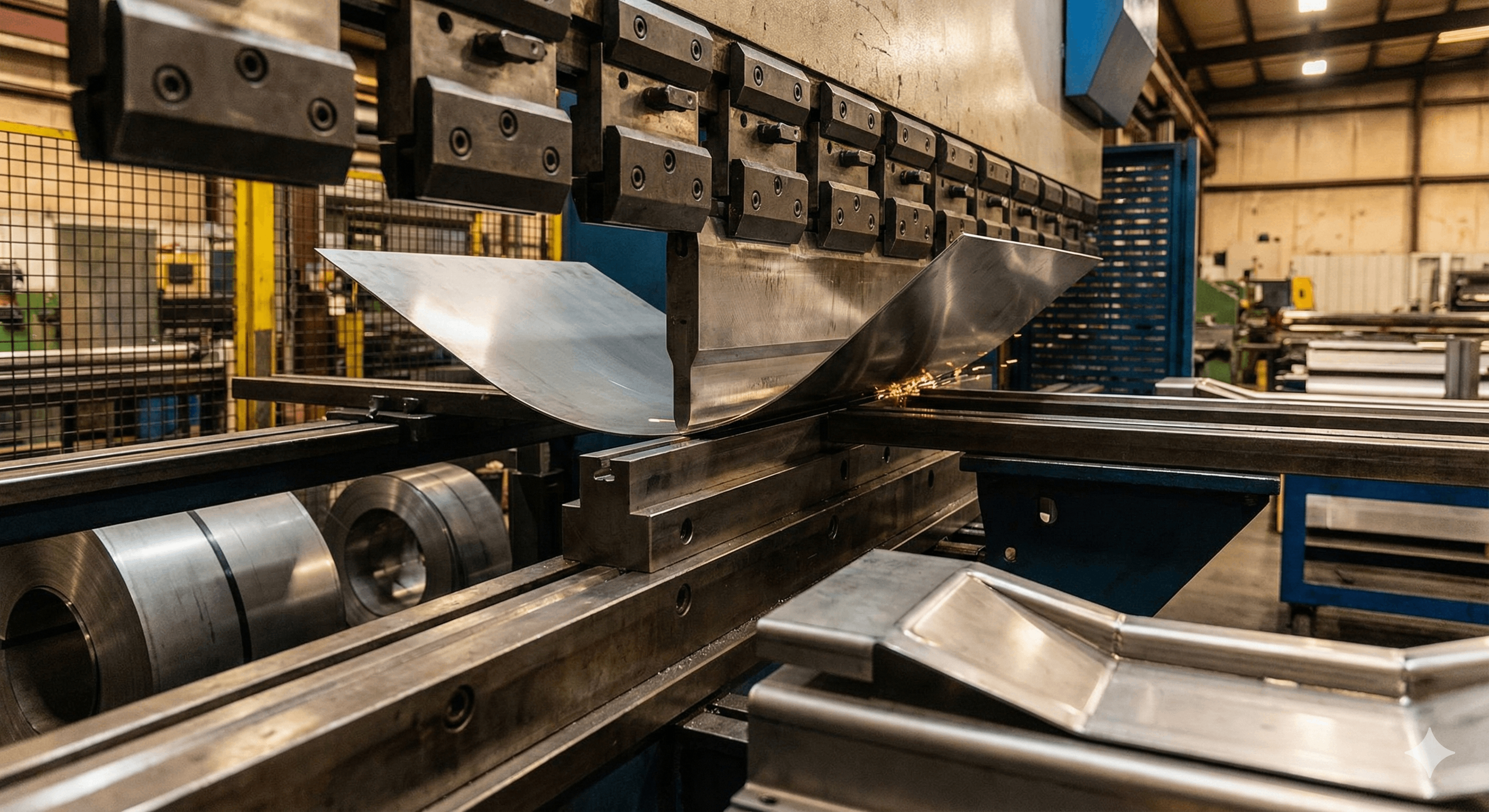
4. Press Braking: The Flexibility Champion
For lower volumes (under 5,000 units) or large enclosures, Press Braking is the industry standard.
It uses a CNC-controlled back gauge to bend sheet metal. It requires no custom hard tooling, only standard V-dies.
Why Choose It:
Zero tooling cost. You don’t pay for expensive dies. This is perfect for market testing or products with frequent design changes.
The Trade-off:
It is labor-intensive and slower. Unit costs are higher than stamping. A strategic buyer uses Press Braking for market entry.
Once volumes justify the investment, you switch to Stamping or Roll Forming. A partner like YISHANG helps manage this transition seamlessly.
5. Forging and Extrusion: The Structural Alternatives
While our focus is often on sheet metal, understanding the broader metal forming processes is vital for comprehensive sourcing.
Forging:
Used for safety-critical hardware (hooks, rods). It offers the highest strength but requires high MOQs. Best for frozen designs in heavy industry.
Extrusion:
Dominant in aluminum. Excellent for complex cross-sections (heatsinks). Low tooling cost compared to stamping, but often requires secondary machining.
Part 3: Mitigating Supply Chain Risk – The “Hidden” Variables
Scale amplifies risk. A minor inconsistency in a forming factory becomes a major liability when multiplied by 50,000 units.
Here is how to control the variables that standard quality checks might miss.
The Springback Reality
One of the most frequent complaints from end-users is that parts “don’t fit.” In formed metal, this is often due to springback.
This is the tendency of metal to return to its original shape after the bending force is removed.
If a batch of brackets arrives bent at 89 degrees instead of 90, it slows down your customer’s assembly line.
The Root Cause:
This is often a material sourcing issue. If a factory switches steel batches, the yield strength may fluctuate.
Different yield strengths mean different springback characteristics. The old tooling will no longer produce the correct angle.
The Solution:
Strategic buyers require Mill Test Certificates for every batch. They demand “First Article Inspections” (FAI) whenever a new coil is loaded.
This ensures the tooling is recalibrated for the specific batch of material before mass production begins.
Surface Finish and Tooling Marks
In forming and metalworking, the tool comes into direct contact with the cosmetic surface of the part.
Tooling marks, scratches, or galling are inherent risks, especially with soft materials like aluminum or bright stainless steel.
For aesthetic parts (e.g., appliance panels), you must specify “Film-On” processing.
This involves leaving the protective PVC film on the metal during the forming operation. It acts as a lubricant and a shield.
This increases the unit cost slightly due to the hassle of removing the film later. However, it drastically reduces the scrap rate from cosmetic defects.
Traceability and Compliance
For international wholesalers, compliance is binary: you are either compliant or you are out of business.
Whether it is RoHS for electronics or ASTM for structural steel, traceability is key.
YISHANG integrates Positive Material Identification (PMI) to ensure the forming materials match the spec.
The difference between 304 and 316 Stainless Steel is invisible to the eye but critical for corrosion resistance.
Never rely on trust alone; rely on verified documentation and third-party lab testing.
Part 4: Design for Manufacturability (DFM) – The Cost Killer
The most effective way to improve margins is not to negotiate a lower hourly rate. It is to eliminate waste through design optimization.
The Tolerancing Trap
A common mistake in forming examples we see is “over-tolerancing.” Engineers often copy tolerances from machining (+/- 0.05mm) to sheet metal.
This forces the factory to use secondary machining or 100% sorting. This drives up costs without adding value to the final product.
The Fix:
Adopt ISO 2768-m standards for formed parts. Relax tolerances on non-mating features (like air vents).
Tighten them only on critical mounting holes. This allows the press to run at maximum speed. Speed in manufacturing translates directly to lower unit costs.
Hole Placement and Deformation
Placing holes too close to a bend line is a classic error. When the metal bends, the material stretches.
A round hole near the bend will distort into an oval. This requires the factory to use a secondary punching operation after bending.
The Design Rule:
Keep hole edges at least 2.5x material thickness away from the bend line. This allows the holes to be punched in the flat stage.
Punching in the flat stage is the cheapest and fastest method. It ensures roundness without extra processing steps.
Tooling ROI Calculation
Smart procurement involves calculating the Break-even Point. This is where finance meets engineering.
If you forecast selling 5,000 units, a $10,000 progressive die might seem expensive compared to laser cutting.
However, if that die reduces the unit cost by $2.00, the investment is recovered in the first 5,000 units.
Every part produced after that yields $2.00 in pure additional margin. This is how you build long-term profitability.
Ask YISHANG for a “Scalability Roadmap.” We help you define the exact volume threshold to switch from soft tooling to hard tooling.
Part 5: Logistics and Surface Finishing – The Final Mile
Often overlooked, the post-forming stages can add 30% to your product cost. Planning this early is crucial.
Plating and Coating Allowance
If your formed parts require zinc plating or powder coating, the dimensions will change.
Zinc plating adds 8-12 microns; powder coating adds 60-100 microns.
For precision forming operation parts, the designer must account for this buildup.
If the holes are punched to the exact final size before coating, the bolt won’t fit after coating.
A capable forming factory will punch the holes slightly oversize to accommodate the coating layer.
Packaging Density for Global Shipping
As a wholesaler, you are paying for air in a shipping container. Formed parts can often be bulky.
During the design phase, consider how the parts will stack. Can a tapered angle be added to allow nesting?
Can the part be shipped flat and bent at the destination? (Though usually, it is better to bend at the factory for quality control).
Optimizing the packing density of formed parts can save thousands of dollars in ocean freight per year.
Part 6: FAQ – Common Questions in Forming Procurement
To assist in your decision-making, we have compiled answers to common questions about forming processes.
What are the different types of forming? The main types include compressive forming (Rolling, Extrusion, Forging) and tensile/shearing forming (Stamping, Deep Drawing, Press Braking). The choice depends on the geometry and the volume of production.
What are the most common forming materials? Steel forming is the most prevalent, including Carbon Steel (SPCC) and Stainless Steel (304/316). Aluminum (5052, 6061) is widely used for lightweight applications, while Copper and Brass are used for electrical components.
How does a forming operation differ from machining? Machining removes material to create shape (subtractive), resulting in waste. Forming rearranges material (plastic deformation), resulting in near-zero waste and improved structural grain flow.
Conclusion: Sourcing a Partner, Not Just a Vendor
In the world of wholesale distribution, the product is only as good as the process behind it.
Forming manufacturing is a sophisticated balance of physics, material science, and economic strategy.
It offers the potential for incredibly efficient, scalable production. But this potential can only be realized if managed with engineering rigor.
As a buyer, your goal is to inspect the process, not just the part. Does the factory monitor grain flow?
Do they understand springback compensation? Do they offer proactive DFM suggestions to lower your TCO?
A supplier who answers these questions is a strategic partner. At YISHANG, we specialize in guiding wholesalers through this landscape.
We deliver not just metal parts, but the reliability, consistency, and margin security your business demands.
If you are ready to optimize your supply chain with precision-formed components, contact our engineering team today. Let’s build your scalability roadmap together.