
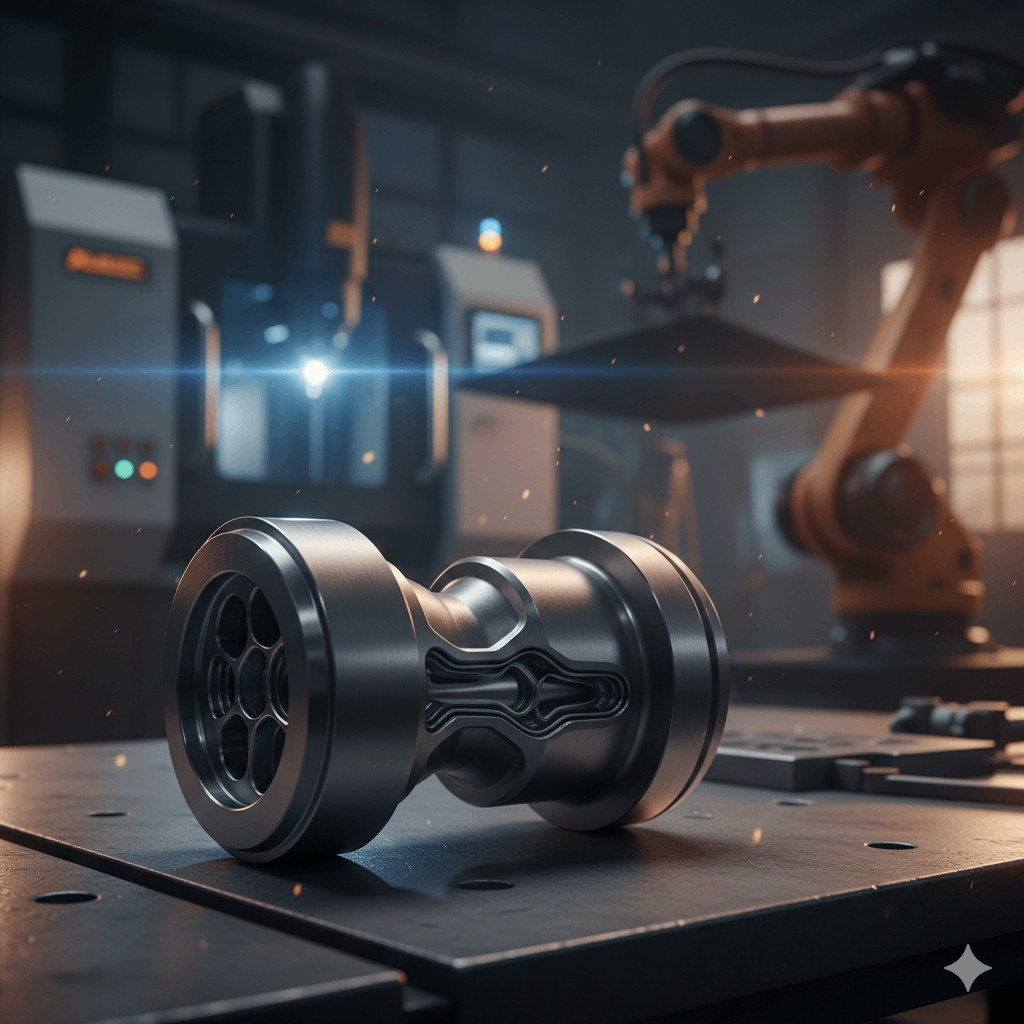
In the contemporary sphere of industrial sourcing, the role of a procurement officer has shifted. It is no longer just about buying parts. Instead, it is about building a resilient supply chain. For overseas wholesale buyers, metal printing services have become a vital tool. They offer a strategic exit from the rigid costs of traditional fabrication. YISHANG, with 26 years of heritage, recognizes this shift. We see 3d metal fabrication as the key to unlocking complex designs while maintaining structural integrity.
The modern industrial buyer is not looking for a simple service bureau. You are looking for a partner who understands the link between metallurgy and scalability. This guide provides a deep technical and economic analysis. It is tailored for professionals in the automotive, medical, and energy sectors. These industries demand high-durability, long-life components. Consequently, this article focuses on the metrics that matter most: Total Cost of Ownership (TCO), material performance, and industrial-grade validation.
At YISHANG, we view metal printing as a sophisticated evolution of fabrication. We merge the freedom of laser fusion with the rigor of traditional CNC machining. As a result, we provide a de-risked sourcing environment. Throughout this guide, we will explore how additive technology enhances your market position. We will focus on factual data and industrial logic to guide your decision-making.
1. The Financial Architecture: Reshaping Wholesale Procurement ROI
The primary barrier to adopting metal printing services is the perception of cost. However, a professional analysis reveals a different story. In fact, 3d metal fabrication is often the more economical choice. This is especially true when you factor in the elimination of “Non-Recurring Engineering” (NRE) costs. Traditional methods require expensive molds and dies. These costs can range from $15,000 to over $100,000. Additive manufacturing erases these hurdles entirely.
The Zero-Tooling Advantage
Traditional casting involves high upfront investment. If a design fails, the financial loss is significant. In contrast, metal printing requires zero physical tooling. Consequently, it allows for agile product evolution. You can modify a design without wasting a massive mold investment. For a wholesale partner, this means a much lower entry risk for new product lines.
Accelerating Time-to-Market
Speed is a quantifiable financial asset in global trade. For instance, a 12-week delay in tooling can lose you a market season. YISHANG can move from a CAD file to a production batch in 14 days. Therefore, procurement teams can remain lean. This agility allows you to respond to regional demand shifts almost instantly.
Improving Unit Economics through Complexity
In subtractive manufacturing, complexity costs more. Every internal channel or curve adds machining time. However, in metal printing services, complexity is “cost-neutral.” A complex manifold costs the same as a solid block of equal weight. As a result, you can offer superior products without a “complexity tax.” This directly improves your wholesale margins.
The Digital Inventory Revolution
Storing legacy spare parts is a massive drain on liquidity. By maintaining digital CAD files, YISHANG enables a “Print-on-Demand” strategy. For example, this can reduce warehouse overhead by up to 70%. It ensures that legacy equipment remains supported for decades. Ultimately, this fosters deep trust between the wholesaler and the end-user.
2. Metallurgical Mastery: Engineering for Fatigue Resistance
In the B2B world, durability is non-negotiable. A primary concern for buyers is structural consistency. At YISHANG, we treat metallurgy as a precise science. During the laser fusion process, rapid cooling creates unique grain structures. If left unmanaged, these can lead to premature failure. Consequently, we implement a strict “Thermal Management Protocol.”
Managing Anisotropy and Grain Growth
Direct Metal Laser Sintering (DMLS) creates parts layer by layer. This can lead to different strengths in different directions, known as anisotropy. To solve this, YISHANG optimizes build orientations. We ensure that the strongest grain alignment follows the primary load path. To illustrate, this is crucial for automotive brackets facing constant vibration.
Validated Stress-Relief Protocols
Every industrial component at YISHANG undergoes a vacuum stress-relief cycle. This process is tuned to the specific alloy’s requirements. Specifically, it rearranges the crystal lattice to relieve internal tension. It maintains the fine-grained microstructure that gives printed parts their yield strength. Without this, parts might warp or crack during service.
Eliminating Internal Porosity
For critical safety components, we offer Hot Isostatic Pressing (HIP). This process applies high pressure and heat. Consequently, it reaches near-theoretical density by closing micro-voids. This ensures the component can survive millions of cycles. For a procurement officer, this means fewer field failures and lower warranty claims.
Global Standards and Compliance
Traceability is the bedrock of our ISO 9001 and RoHS compliance. For buyers exporting to the EU, material purity is a legal requirement. YISHANG provides full Mill Test Reports (MTR) for every powder batch. We use only verified substrates. Thus, you can be certain that your parts meet all safety and environmental regulations.
3. Strategic Material Strategy for Diverse Industrial Needs
The success of 3d metal fabrication depends on the material match. For a procurement professional, this is a strategic decision. It affects both the functional life and the final bid price. At YISHANG, our alloy library meets the needs of 50+ countries. We provide verified data for every substrate we offer.
Stainless Steel 316L for Harsh Environments
Stainless Steel 316L is the workhorse of the medical and marine sectors. It offers exceptional pitting resistance in chloride environments. In addition, it is highly ductile. YISHANG ensures that our printed 316L meets all biocompatibility standards. This makes it ideal for long-life surgical instruments or marine sensors.
Aluminum AlSi10Mg for Thermal Efficiency
In the EV and energy storage sectors, heat is the enemy. Aluminum AlSi10Mg is the perfect solution. It combines light weight with high thermal conductivity. Moreover, metal printing services allow for internal cooling channels. These designs are far more efficient than traditional heat sinks. This enhances the lifespan of your electronic systems.
Inconel 718 for Extreme Temperature
Some industrial valves and turbine parts face extreme heat. Traditional steels fail in these environments. However, Inconel 718 maintains its strength at temperatures over 700°C. YISHANG optimizes the build parameters for this superalloy. As a result, we provide a reliable source for parts that operate in hostile conditions.
Titanium Ti64 for High-Strength Applications
Titanium is the gold standard for aerospace and medical implants. It has an incredible strength-to-weight ratio. Furthermore, it is fully biocompatible. While it is difficult to machine traditionally, it is perfect for 3d metal fabrication. YISHANG helps you leverage this material to create lighter, stronger industrial products.
4. DfAM: Leveraging Part Consolidation for Agility
“Design for Additive Manufacturing” (DfAM) is a powerful tool for cost reduction. In traditional manufacturing, assemblies are made of many parts. Each part needs its own SKU and quality check. This creates a logistical burden. However, YISHANG uses metal printing services to merge these into a single component.
Reducing Bill of Materials (BOM) Complexity
Part consolidation simplifies your entire supply chain. For instance, a manifold with 20 parts can become one single piece. This reduces the number of SKUs you must track. Moreover, it eliminates potential leak points at joints. Consequently, the final product is more robust and easier to manage for the procurement team.
Topology Optimization and Weight Reduction
We use mathematical algorithms to remove material from areas that do not carry loads. The result is a part that is 40% to 60% lighter. This is essential for the automotive and drone sectors. Lighter parts mean better fuel efficiency. At YISHANG, we help you meet modern sustainability goals without sacrificing rigidity.
Integrated Functional Features
We can print mounting brackets and internal sensors directly into the metal structure. This “Functionally Integrated” approach reduces labor at your assembly line. For a wholesale buyer, this means buying a complete solution. It lowers your total production cost. Specifically, it minimizes the human error risk during secondary assembly processes.
Improving Energy Absorption
Lattice structures can be printed inside solid metal parts. These geometries mimic bone or honeycomb patterns. They provide exceptional energy absorption and vibration damping. To illustrate, this is perfect for protective industrial gear or high-end medical equipment. It allows for performance levels that traditional sheet metal simply cannot reach.
5. The Hybrid Reality: Scaling Complexity at Wholesale Prices
A common mistake is trying to “print everything.” For large projects, this is not cost-effective. YISHANG advocates for the “Hybrid Manufacturing” model. We use traditional sheet metal for the bulk structure. Then, we use metal printing services for the complex internal nodes. This strategy ensures the best price-per-part for high-volume orders.
Combining Traditional Strength with Additive Detail
Imagine a medical workstation frame. The large panels are made by high-speed laser cutting. The intricate internal hinges are made by 3d metal fabrication. We kemudian assemble these into a cohesive unit. As a result, you get a high-tech product at a competitive wholesale price. This is our core strategic advantage.
CNC Post-Machining for Extreme Precision
Even the best 3D printer has limits in tolerance. To reach ±0.01mm specifications, we use in-house CNC post-machining. We print critical features with extra material and mill them to size. This ensures that mating surfaces are perfect. Consequently, your parts integrate seamlessly into complex mechanical systems without any adjustment.
Late-Stage Customization for Regional Markets
Wholesale buyers often need to adapt products for different markets. The hybrid model makes this easy. We maintain standard fabricated frames in stock. Then, we print custom interface kits for specific regional requirements. This reduces the “Product Proliferation” problem. It allows for a modular strategy that keeps your inventory lean.
Single-Source Quality Responsibility
Managing multiple vendors for printing, machining, and assembly is difficult. YISHANG manages the entire integrated process. We take full responsibility for the quality of the hybrid assembly. This reduces your communication overhead. Ultimately, it ensures that the final product meets a unified standard of excellence for your global clients.
6. Industrial Validation: The Bedrock of B2B Trust
In a global supply chain, trust is built on data. A buyer in Europe must be certain that every unit is identical. At YISHANG, our metal printing services follow a strict validation framework. This starts with a “Digital Pre-Flight” simulation. We predict thermal warping before the build begins. This ensures a high first-time success rate.
In-Situ Monitoring for Total Traceability
During the build, we track laser stability and oxygen levels in real-time. This creates a “Birth Certificate” for every industrial component. For wholesale buyers, this level of data is essential for compliance. It provides the assurance that the metal was fused under perfect conditions. Consequently, it eliminates the risk of hidden structural defects.
Advanced Inspection Protocols
We don’t just “look” at the parts. We use 3D laser scanners and Coordinate Measuring Machines (CMM). These tools verify that the dimensions meet your tolerances. In addition, we use ultrasonic testing for critical parts. This ensures there is zero internal porosity. As a result, you receive parts that are ready for immediate industrial use.
Surface Metrology and Aesthetic Standards
For medical instruments, surface finish is a functional requirement. We use 3D profilometers to verify the “Ra” values. YISHANG offers post-build treatments like electropolishing and PVD coating. This ensures that the parts are not only strong but also meet aesthetic standards. This protects your brand’s reputation for high-end quality in the market.
Batch-Level Testing with Witness Coupons
Every production run includes “Witness Coupons.” These are test bars printed alongside your parts. We perform tensile and hardness tests on these bars. This verifies that the material properties of that specific batch meet the data sheet. Consequently, quality is a verifiable fact. It is not just a marketing claim for our wholesale partners.
7. Global Logistics and Long-Term Partnership Strategy
The final stage is the “Last Mile.” Delivering precision parts to 50+ countries is a logistical challenge. YISHANG recognizes that industrial metal parts are sensitive assets. Our packaging team designs custom, VCI (Vapor Corrosion Inhibitor) solutions. This prevents oxidation during sea-freight. Thus, your parts arrive in pristine condition, ready for assembly.
MOQ Flexibility for Scaling Businesses
Traditional factories demand massive orders. In contrast, additive manufacturing allows for “Dynamic Batching.” You can order 5 units for a pilot or 500 for full distribution. This flexibility is a vital tool for managing unpredictable demand. It allows you to scale your business with confidence. Moreover, it reduces the risk of dead inventory.
Engineering Partnership as a Value-Add
We understand that procurement teams are busy. You may not be an expert in metal printing services. Therefore, YISHANG offers design support. Our DfAM experts review your drawings to find cost-saving opportunities. We look for ways to reduce weight or consolidate parts. This collaborative spirit turns a supplier relationship into a strategic alliance.
Supporting Sustainability in Procurement
As sustainability becomes a core metric, material efficiency matters. Traditional machining wastes up to 80% of raw material as scrap. However, 3d metal fabrication uses only the powder required for the part. Any excess powder is recycled. This reduced footprint is important for wholesale buyers. It helps you report on the green credentials of your supply chain.
Conclusion: Building the Future of Metal Products
The integration of metal printing into the industrial supply chain is a path to agility. By focusing on metallurgical truth and economic logic, YISHANG provides a robust platform. We invite you to experience the difference that 26 years of heritage makes. Together, we can build a more resilient future for your metal products.
Contact YISHANG today to receive a technical feasibility review and a strategic quote for your next high-durability project.
To learn more about our ISO 9001 certified processes and advanced material capabilities, please explore our full suite of technical resources on our website.