Introduction
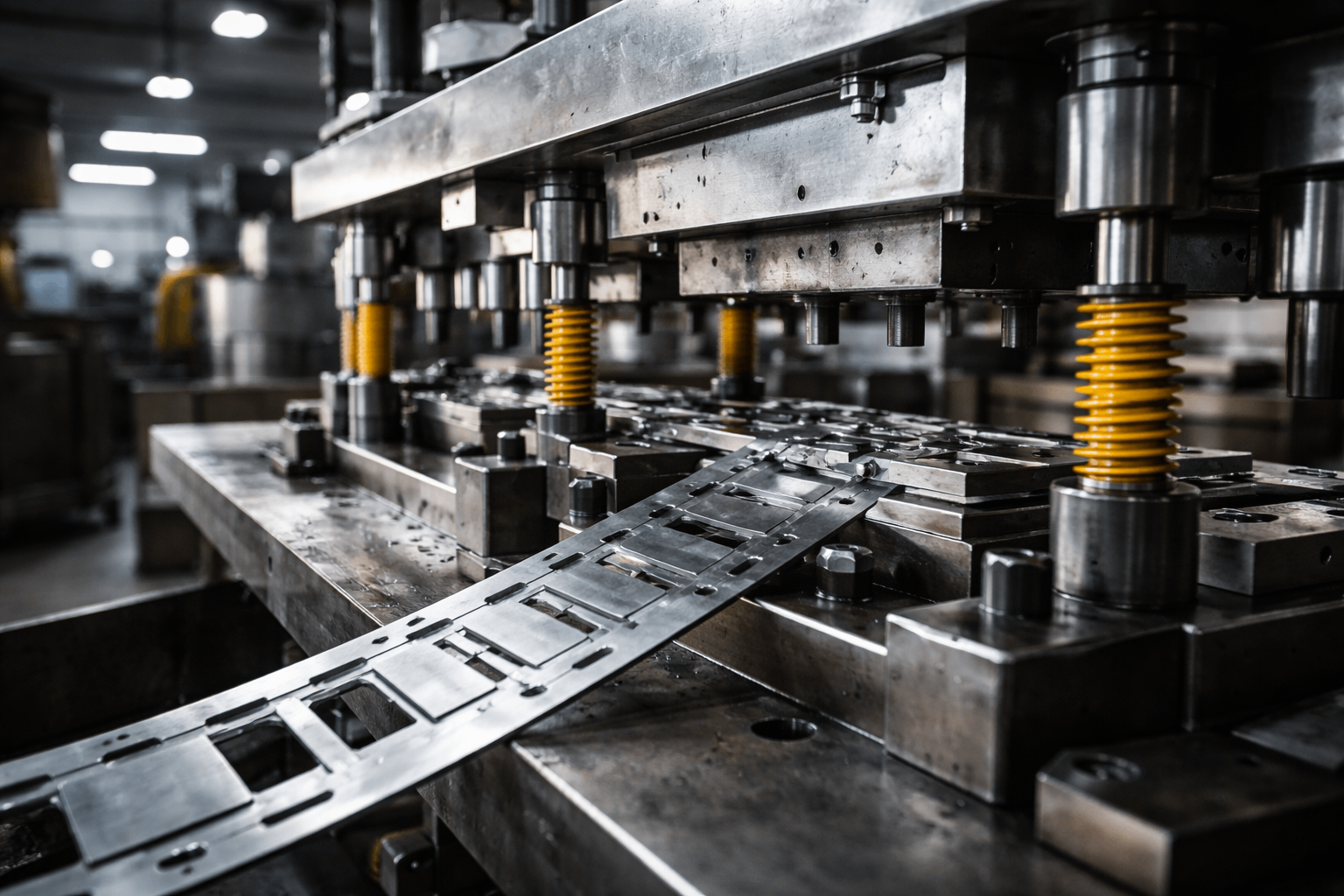
Metal stamping looks simple when you watch it from the outside. A press cycles, the die closes, and finished parts start stacking up.
What buyers learn very quickly, though, is that the process is only simple on the surface.
The real sourcing challenge is not whether a supplier can stamp a decent-looking sample. It is whether they can keep that result stable after material lots change, tooling starts wearing, production speeds rise, and the program moves from observation into routine volume manufacturing.
That is why buyers usually search for metal stamping services with a much more practical question in mind:
Can this supplier support repeatable production at scale without quietly creating cost through drift, rework, delayed shipments, or assembly problems?
This article approaches stamping from that buyer-side perspective. It focuses on the decisions that actually shape long-run results: tooling, volume logic, material behavior, tolerance realism, product risk, and supplier discipline.
Why Metal Stamping Often Fails After the First Production Run
Many stamping projects look healthy at the beginning for one simple reason: the first run is usually produced under the best possible conditions.
Material is often carefully selected, tooling is still fresh, operators pay closer attention, and production may run slower than normal. Under those conditions, even a process with weak long-term stability can produce parts that pass inspection.
The real test starts later.
Once the program moves into normal production, several things change at the same time:
press speed increases
operators rotate
coil lots change
cutting edges begin to wear
minor variation stops being corrected manually
That is when problems begin to surface—not always as dramatic failures, but as slow, expensive drift.
Typical signs include:
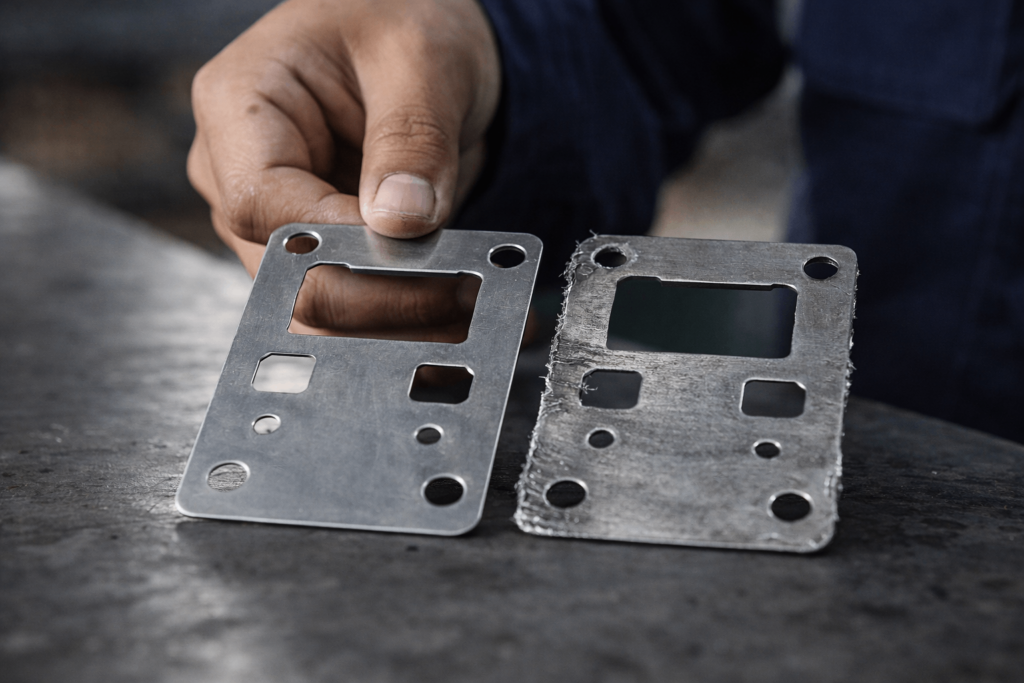
burr height increasing over time
bend angles moving out of target
hole location shifting
parts losing flatness
assemblies becoming harder to fit together downstream
For buyers, this matters because the cost rarely appears as one single reject event. It usually shows up as inspection drag, sorting, rework, late delivery, slower assembly, or customer complaints after installation.
The better sourcing question is not “Can this supplier make a sample?”
It is:
Can this supplier keep the process stable once the easy conditions are gone?
Choosing Metal Stamping Is a Manufacturing Commitment, Not Just a Process Choice
Metal stamping is often compared with CNC machining, laser cutting, or press brake forming because all of them can produce sheet-metal parts.
But stamping behaves very differently once a program is locked in.
Flexible processes like CNC or laser cutting can usually absorb design changes more easily. A dimension changes, a hole moves, or a profile is adjusted, and the program can often be updated without rebuilding the manufacturing system.
Stamping does not work that way.
Once tooling is built, the project is tied to a physical production method where repeatability depends on die geometry, strip progression, press behavior, and material consistency—not on quick software edits.
That lock-in is exactly what makes stamping efficient at scale.
It is also what makes a poor early decision expensive to unwind.
For procurement teams, three commitments matter most:
Tooling Commitment
A stamping die is not just an accessory. It is the production engine. Even minor drawing revisions can lead to tool modification, tryout cost, and schedule disruption.
Volume Commitment
Stamping becomes strongest when demand is stable enough to justify tooling investment, process refinement, and maintenance planning.
Flexibility Commitment
If the design is still moving, stamping may be the right destination later—but not always the safest starting point.
Experienced buyers treat stamping as a strategic manufacturing decision, not just a low-unit-cost process.
What Actually Determines the Outcome of a Metal Stamping Service
Before going deep into quoting or DFM discussions, experienced buyers usually want a fast reality check.
They want to know whether the supplier has the structure to support the job—or whether the conversation will eventually collapse under issues that were predictable from the start.
A 60‑Second Fit Check for Wholesale Buyers
A useful first-pass check often includes the following:
| What buyers usually confirm first | Why it matters in real production |
| Typical stamping formats supported | Shows whether tooling strategy matches part geometry and output volume |
| Common material families processed | Indicates real experience with material behavior, springback, and wear |
| Thickness range | Helps buyers assess force requirements, die load, and process fit |
| Secondary operations available | Reduces handoff risk across tapping, deburring, welding, plating, or coating |
| In-process quality controls | Shows whether the supplier builds stability into production instead of relying only on final inspection |
This early screening step is useful because many suppliers can show stamping capability, but fewer can clearly explain how they maintain output quality once the part enters long-run production.
Tooling Is Not a Cost — It Is the Product
One of the biggest sourcing mistakes in stamping is treating tooling as an upfront expense that needs to be minimized at all costs.
In reality, tooling defines the part far more than most buyers initially expect.
The die determines:
strip layout
forming sequence
burr behavior
stress distribution
repeatability across long runs
how easily the process can be maintained over time
That is why the die should be understood as the real product engine, not a side item in the quotation.
A cheaper tool may lower the first invoice and still raise the total program cost later through:
scrap
unplanned downtime
faster wear
more frequent adjustments
unstable dimensions after extended production
Buyers evaluating a custom metal stamping supplier should ask practical tooling questions early:
What are the expected wear points?
How is preventive maintenance handled?
Can inserts be replaced without rebuilding the full tool?
Which design changes can be absorbed, and which would trigger major rework?
These answers often reveal more about supplier maturity than equipment lists do.
When Metal Stamping Becomes Economical — and When It Quietly Becomes Risky
Stamping is powerful because it can lower unit cost dramatically once the process is stable and the volume is high enough to justify the tooling.
But the economic advantage is not automatic.
It changes depending on where the program sits on the volume curve.
| Production Scenario | What Drives Unit Cost Most | Common Stability Risk | Practical Sourcing Note |
| Low volume | Tooling + setup | Design changes make the tool hard to justify | Flexible processes may still be safer |
| Medium volume | Tool amortization + scrap + downtime | Wear appears before the process is fully stabilized | Process discipline matters more than quoted price |
| High volume | Cycle time + maintenance control | Wear, handling damage, and drift over time | Preventive maintenance becomes essential |
This is where buyers sometimes get caught.
A supplier may quote an attractive unit price based on stamping logic, but if the design is still changing, or if volume is too unstable to support a strong tooling strategy, the hidden cost starts to grow quietly.
The right question is not simply “Is stamping cheaper?”
It is:
At this volume, with this design maturity, is stamping economically stable?
Material Behavior Over Time and Its Impact on Stamped Parts
Materials do not behave the same way in stamping, even when the drawing stays unchanged.
This is one of the reasons long-run production can drift even when tooling is technically correct.
A few common examples make the point clear:
steel often shows growing burr issues as trim edges wear
stainless steel usually requires more force and may show stronger springback behavior
aluminum can be more sensitive to lubrication, surface condition, and handling marks
copper alloys may behave differently in forming depending on hardness and temper
For procurement teams, this means material sourcing is not just about metal grade. It is also about batch behavior.
| Material Variable | Typical Production Impact | Why Buyers Should Care |
| Thickness variation | Burr growth, dimensional drift | Increases sorting and assembly-fit risk |
| Yield strength variation | Bend-angle movement, forming inconsistency | Makes output harder to keep stable |
| Surface condition | Galling, scoring, cosmetic instability | Affects tool life and part appearance |
| Work hardening behavior | Crack risk in tight-form areas | Can shorten process window unexpectedly |
A stable stamping program does not assume material is perfectly constant. It is built to recognize and manage that variation.
Tolerances in Stamping and What They Mean for Procurement
Tolerance discussions in stamping need to be handled differently from machining discussions.
In CNC machining, dimensions are usually driven by toolpath control. In stamping, dimensions are influenced by material flow, elastic recovery, tooling wear, strip progression, and forming sequence.
That means a tolerance that looks reasonable on paper may still be expensive or unstable in real stamping conditions.
The best procurement conversations focus on:
which dimensions are truly functional
what datum strategy matters in assembly
where variation can be tolerated without harming performance
where the process needs tighter control because the downstream impact is high
| Feature Type | Practical Tolerance Concern | Buyer Takeaway |
| Hole location | Datum shift and strip progression | Ask how location is controlled in-tool |
| Bend angle | Springback and wear sensitivity | Expect a managed range, not magic stability |
| Edge condition | Sharpness of trim section and wear state | Define acceptance by function, not appearance alone |
| Flatness | Internal stress and forming history | Important for automated assembly or sealing interfaces |
The right goal is not “tightest possible tolerance.”
It is functional tolerance that the process can hold repeatedly at production speed.
How Product Risk Shapes Stamping Decisions
Experienced buyers do not choose stamping based only on industry labels. They look at product risk.
A stamped decorative bracket and a stamped alignment-critical structural part may use the same process family, but they do not deserve the same control strategy.
Questions that matter include:
Does the part feed an automated assembly?
Is it cosmetic, structural, or both?
Will small burr or angle variation create installation issues?
Is the design still evolving?
Will the customer tolerate sorting or rework at arrival?
This risk-based view is useful because it keeps procurement focused on downstream consequences instead of only process labels.
How Experienced Buyers Evaluate a Metal Stamping Supplier
A capable stamping supplier is not defined by having presses alone.
For wholesale and OEM buyers, the real test is whether the supplier can protect output quality after the project leaves the sample stage.
A practical evaluation often includes the following:
| Buyer Concern | What to Verify | Indicator of Supplier Maturity |
| Long-run stability | How drift is monitored during production | Trend-based process checks, not only final inspection |
| Tool life control | Preventive maintenance structure | Planned maintenance instead of breakdown response |
| Assembly fit | Burr, angle, and feature consistency | Clear acceptance criteria tied to use condition |
| Material variation | Coil and lot management | Stable sourcing and material traceability |
| Engineering changes | Change-control method | Clear review path for design revisions |
Suppliers who can explain these areas clearly tend to be much safer long-term partners than those who only emphasize tonnage, equipment count, or short-term pricing.
Conclusion
Metal stamping is simple to observe but difficult to control well over time.
That is why the sourcing decision matters more than the process name itself.
The suppliers that create the best long-run results are not necessarily the ones who offer the lowest first quote. They are the ones who understand:
how tooling shapes the part
when stamping is economically justified
how material behavior changes over time
which tolerances are functionally realistic
how to keep production stable after the first run stops being special
For buyers, the most useful question is not “Can this supplier stamp this part?”
It is:
Can this supplier keep the part stable as volume, wear, and variation start to build?
At YISHANG, we support buyer-side decision making for custom metal stamping programs with feasibility review, tooling strategy input, and production planning grounded in real OEM and wholesale manufacturing conditions.
If you are reviewing a new stamping RFQ or troubleshooting instability in an existing program, the next step is to look beyond sample appearance and examine the full production logic behind the part.