
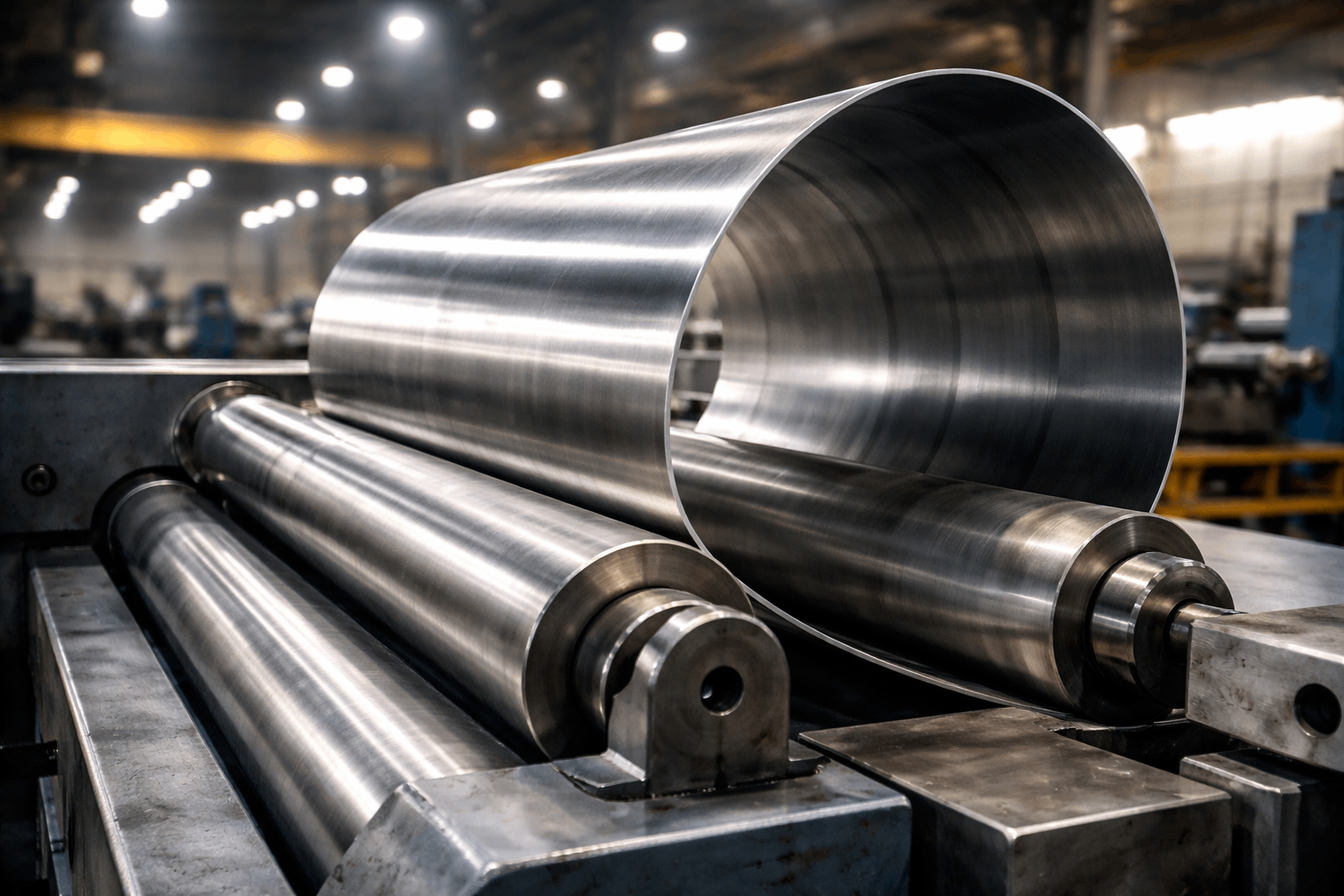
How Early Decisions Drive Batch Consistency, Fit-Up, and Total Cost
Terminology note (to avoid confusion): In this article, rolling sheet metal and sheet rolling refer to plate rolling / roll bending / slip rolling used to form curvature (cylinders, arcs, cones). This is not thickness-reduction rolling performed in steel mills. Using the correct meaning upfront helps buyers compare suppliers accurately and prevents mismatched expectations.
Rolling sheet metal is often treated as a simple forming step. In sourcing conversations, it can sound like a checkbox: Can the supplier roll this radius? For overseas wholesale buyers, however, sheet rolling is rarely neutral. It influences batch-to-batch behavior, fit-up during welding or assembly, and how much rework appears after goods have already crossed borders.
This article is written for B2B procurement teams and engineers who buy rolled components at scale—cylinders, curved panels, housings, cabinets, frames, or assemblies that will be welded, coated, or integrated downstream. Instead of catalog-style descriptions, the focus is on predictability: why samples look stable while production drifts, which constraints actually matter, and how to specify acceptance criteria that match real use.
Key takeaways for buyers (quick scan)
- Rolling sheet metal creates shape and a stress map; the latter drives downstream stability.
- Samples often hide variability; production reveals it under constraint.
- Equipment names matter less than the stable process window.
- Acceptance criteria should mirror assembled-state behavior, not free-state geometry only.
- Early alignment reduces scrap, rework, and delivery risk.
Why Rolling Sheet Metal Rarely Looks Like the Problem at First
In early RFQs, rolling sheet metal is framed as geometry. A drawing specifies a diameter or radius, and many suppliers confirm capability. First articles commonly pass dimensional checks, reinforcing the assumption that rolling is flexible and easily corrected.
The issue is timing. When sheet rolling causes problems, they often appear later—during welding, fixture assembly, coating bake, or integration at your facility. At that point, the symptom is visible (ovality, twist, misalignment), but the cause is debated as welding, fixtures, or tolerances, while the origin sits upstream.
For overseas wholesale buyers, delayed discovery is costly. Late findings mean container rework, line stoppage, or emergency sorting. Even with a cooperative supplier, resolution is slower because the batch is already moving. Treating rolling sheet metal as an early risk decision—not a shop adjustment—keeps discussions focused on prevention rather than blame.
What Rolling Sheet Metal Changes Inside the Material
Sheet rolling produces two outputs at the same time. One is the visible curve. The other is an internal stress map created by plastic deformation as the sheet passes through the rolls. The shape is easy to measure; the stress map is harder to detect but often decisive.
That internal condition governs how parts behave when heated or constrained. Residual stress is not inherently bad—it is stored imbalance. When welding adds heat, when fixtures add constraint, or when a curing oven raises temperature, the part finds a new equilibrium. If the stress map is uneven, geometry shifts unevenly.
For procurement, this explains why two parts can measure the same diameter yet behave differently on the line. Rolling sheet metal affects predictability more than appearance. Predictability is what keeps batches consistent and prevents intermittent fit-up failures that quietly inflate total cost.
Why Sheet Rolling Looks Perfect During Sampling
Sampling is a forgiving environment. Material often comes from one coil or heat, operators monitor passes closely, and adjustments happen in real time. Low quantities do not reveal drift, and inspections focus on diameter or length—metrics that can look good even when internal stress is uneven.
Production changes the conditions. Parameters are standardized, throughput increases, and operator intervention decreases. Material comes from multiple lots. Downstream processes apply real constraint. Under these conditions, the same sheet rolling setup can become sensitive.
This is why a first article inspection is necessary but not sufficient. A sample predicts production only when it represents the actual production route—same rolling approach, same material route, same downstream processes, and the same inspection characteristics. Confirming this alignment early prevents a common mismatch.
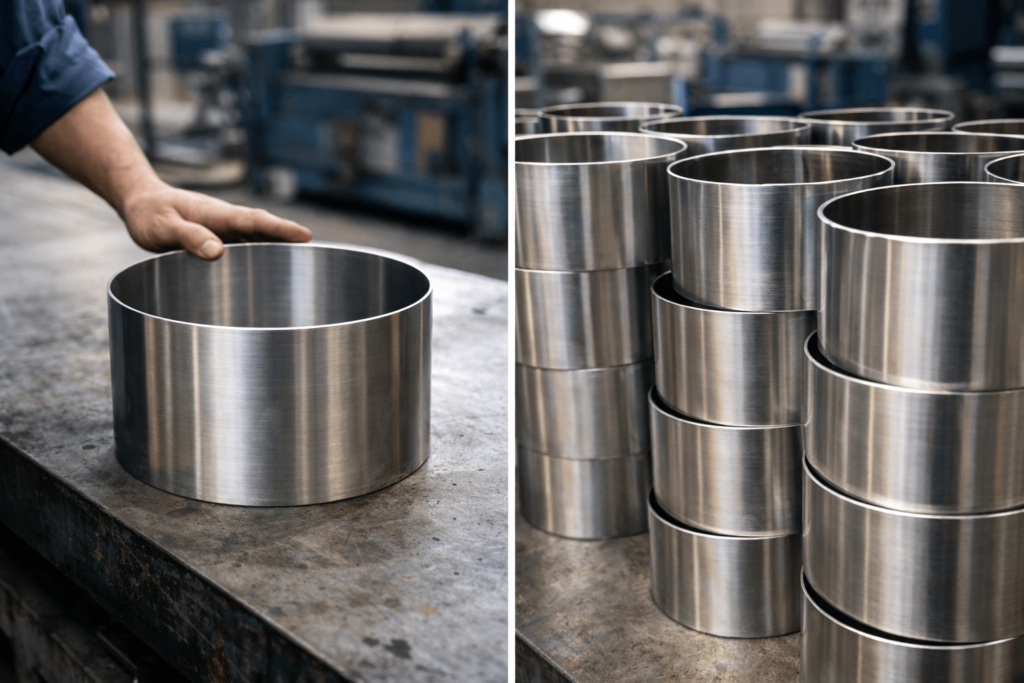
Equipment Matters, but Constraints Explain Outcomes
Search results often list manual ring rollers, power slip rollers, 3-roll plate rollers, and 4-roll plate rollers. These categories are useful, but they do not explain why results drift.
Every plate rolling setup operates within a stable window defined by thickness, width, yield strength, surface condition, and target radius. When the job stays inside that window, results look consistent. When it pushes the edge, variability increases—regardless of brand.
Manual rolling offers flexibility but depends on operator consistency. Powered slip rolling raises throughput but can be sensitive to incoming sheet variation and setup drift. Three-roll systems balance versatility and cost; tight radii and repeatability demands expose limits. Four-roll systems can improve repeatability, but only with disciplined setup and parameter control.
Buyer tip: Instead of asking “Do you have a 4-roll machine?” ask “What defines your stable window for this part?” A capable supplier will discuss thickness-to-radius limits, expected springback range, and how drift is prevented over long runs.
| Equipment (common term) | What it’s good at | Where risk increases | Buyer-relevant signal |
|---|---|---|---|
| Manual / ring rolling | Quick setup, low volume | Operator variation | How repeatability is checked shift-to-shift |
| Power slip rolling | Higher throughput | Material variation + drift | How parameters are locked and verified |
| 3-roll plate roller | Versatility | Tight radius, end flat spots | End treatment + roundness control |
| 4-roll plate roller | Better repeatability | Setup sensitivity | How setup is standardized and recorded |
Incoming Sheet Condition Often Drives Outcomes
Two sheets with the same grade and thickness can roll differently. The difference usually lies upstream—hot vs cold route, leveling, coil set, storage, or handling. These factors shape residual stress and directional behavior before rolling begins.
Sheet rolling redistributes that history; it does not erase it. If incoming material carries uneven stress or anisotropy, rolling can amplify those traits. Parts may meet nominal geometry yet behave inconsistently during welding or assembly.
For buyers, this is where grade + thickness can be an incomplete specification. Certificates confirm chemistry and tensile properties, not stress history. Programs that require high repeatability benefit from lightweight controls: lot traceability for critical parts, batch qualification when lots change, and agreement on what constitutes out-of-family behavior.
Why Issues Appear During Welding, Coating, or Assembly
A rolled component can look stable free-state, then move once heat or constraint is applied. Welding releases and redistributes residual stress. Fixtures expose instability free-state inspection cannot detect. Coating bakes add another heating event.
The practical implication for procurement is straightforward: downstream steps expose what rolling created. If acceptance is based only on free-state geometry, the inspection does not reflect real use.
| Where the symptom appears | What the buyer sees | Often blamed | Likely upstream contributor |
|---|---|---|---|
| Welding | Distortion, ovality | Welding settings | Rolling-induced residual stress |
| Assembly | Fit-up resistance | Fixture/tolerances | Springback variation |
| Coating bake | Subtle warp | Coating process | Stress release from rolling |
Quality: Thickness Is Necessary, Not Sufficient
Thickness is easy to measure and familiar, but it is a weak predictor of rolling quality. Parts can meet thickness tolerance while carrying stress or geometry that shifts later.
Buyer-relevant indicators correlate with real constraints: roundness/ovality, edge flatness near seams, springback consistency, and batch repeatability. The right indicators depend on use—welded housings differ from bolted frames—but one or two stability metrics added to thickness often prevent most surprises.
| Quality indicator | Why it matters | Typical failure pattern |
|---|---|---|
| Roundness / ovality | Predicts fit-up | Shifts after welding |
| Edge flatness (ends) | Affects gaps | End flat spots |
| Springback spread | Predicts repeatability | Batch drift |
| Batch repeatability | Predicts supply reliability | Time/lot variation |
Total Cost: Where Rolling Decisions Show Up Later
Unit price is visible; variability is expensive. When rolling introduces drift, downstream processes compensate with slower assembly, more clamps, added inspection, and rework. These costs accumulate quietly.
A small percentage of parts requiring rerolling or refitting can consume margin over long runs. The procurement takeaway is not “pay more” but evaluate control. Suppliers who can explain how they manage drift, lot changes, and inspection features usually protect total cost over time.
Buyer Questions That Reduce Risk (Without Slowing Sourcing)
Capability questions confirm can you do it. Stability questions confirm will it stay consistent.
Effective, neutral questions include how the stable window is defined, what happens when lots change, and which inspection features reflect downstream use. Clear answers signal a controlled process rather than ad-hoc correction.
Suggested RFQ note (example):
For rolled components, supplier shall confirm capability for specified radius/diameter and describe repeatability across production batches. Supplier shall identify key constraints (thickness-to-radius window, sensitivity to lot variation, expected springback range). For parts requiring welding or assembly, supplier shall recommend inspection characteristics beyond thickness (e.g., roundness/ovality, edge flatness, batch repeatability). First-article approval should represent the intended production route, and material lot changes that affect forming behavior should be communicated.
Rolling Sheet Metal as a Procurement Decision
By the time rolling issues appear, batches are often already in transit. The fastest way to reduce risk is early alignment on predictability, repeatability, and acceptance that mirrors real use.
From an SEO and E‑E‑A‑T perspective, helpful manufacturing content translates cause-and-effect into decision clarity. That is why this article emphasizes constraints, batch behavior, and downstream exposure rather than generic definitions.
If you are sourcing rolled parts for long-term programs, YISHANG can support early technical alignment on rolling conditions and acceptance criteria. Share your drawing and downstream context (welded, coated, assembled), and we can recommend a practical control plan for stable production.
Quick inquiry: Preparing an RFQ for rolled components? Send target radius/diameter, material, thickness, and downstream notes. A short alignment early can save weeks later.
FAQ (for quick answers)
What is the difference between sheet rolling and plate rolling?
In this context, they are used interchangeably to describe roll bending/plate rolling (forming curvature), not thickness-reduction rolling in mills.
Why does ovality appear after welding on rolled cylinders?
Welding releases residual stress introduced during rolling; uneven stress leads to uneven movement.
How do buyers control springback variation across batches?
By defining a stable window, monitoring lot changes, and inspecting stability metrics tied to downstream use.
What should be specified in an RFQ for rolled components?
Capability plus stability: constraints, expected springback range, and acceptance criteria that match assembled-state behavior.