
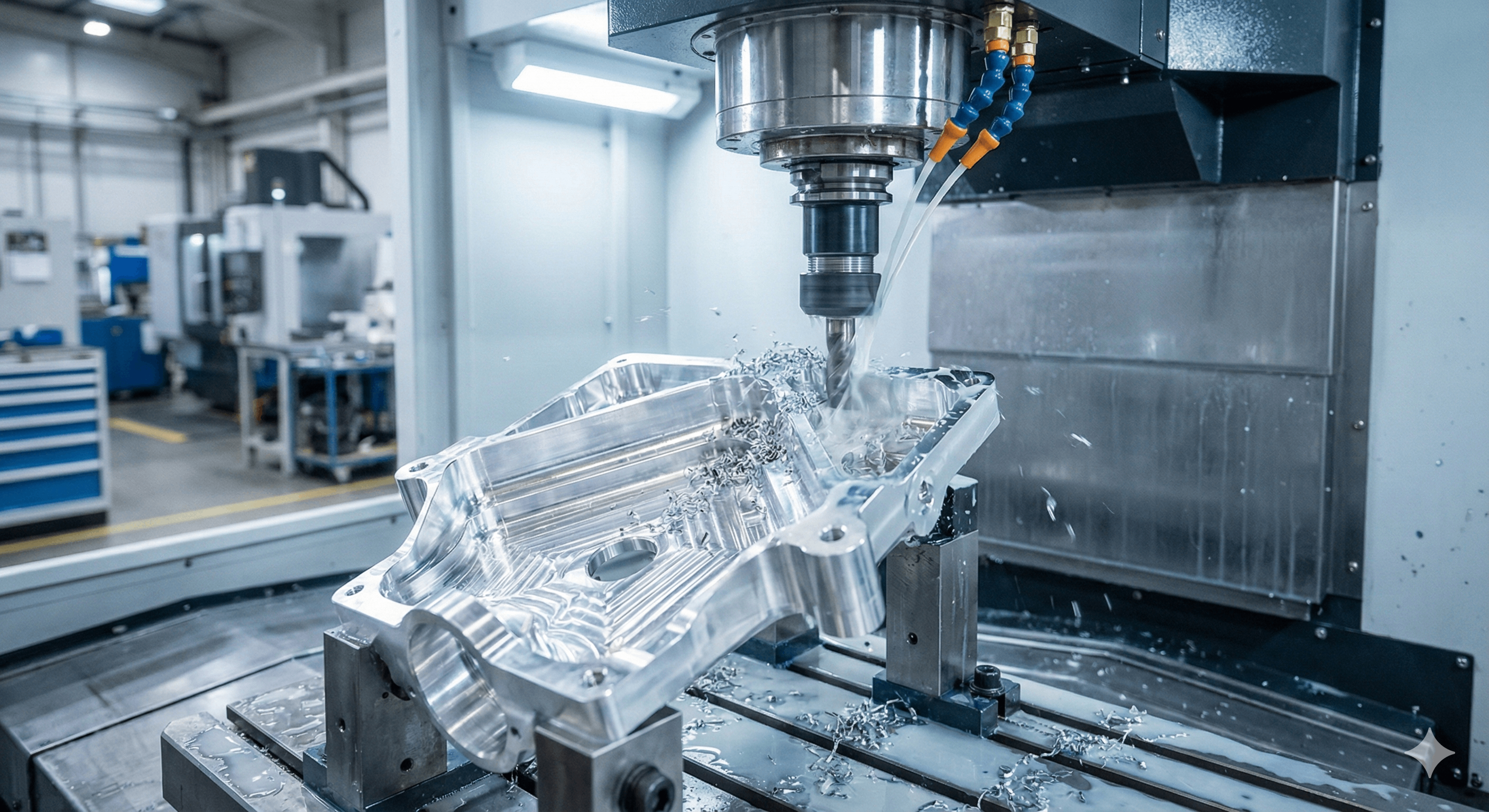
In the high-stakes arena of global manufacturing, the role of a procurement leader involves more than just reading blueprints; it requires orchestrating a complex supply chain where failure is not an option. For wholesale buyers and OEMs, aerospace CNC machining represents a critical intersection of engineering precision and commercial risk.
A delay in receiving aerospace machined parts due to quality deviations, or a batch of ground support equipment arriving corroded due to poor logistics, drives up the “Total Landed Cost” significantly. In this sector, the lowest unit price is often a mirage if it comes without process stability.
This guide moves beyond generic manufacturing concepts. It dissects the engineering realities of sourcing precision machining for the aerospace industry, exploring how to navigate material physics, 5-axis efficiency, and global logistics. We will demonstrate how YISHANG helps partners de-risk their supply chain by balancing AS9100-level quality with ISO 9001 agility.
Mastering Material Physics: The Science of Volume Consistency
The transition from prototyping to volume manufacturing is where supply chain friction most often occurs. Machining a single perfect prototype proves capability; machining 5,000 identical units proves process control. This distinction is paramount when dealing with exotic aerospace alloys.
A capable aerospace machine shop must do more than cut metal. They must manage the invisible interactions between thermal dynamics, tool wear, and residual stress.
Common Aerospace Materials & Machinability Strategy
To optimize production, it is vital to match the material grade with the correct machining strategy. Below is a breakdown of the materials we process most frequently for aerospace applications:
| Material Category | Typical Grades | Application Focus | Machining Challenge | YISHANG Strategy |
| Titanium | Ti-6Al-4V (Grade 5) | Structural brackets, Fasteners | Poor heat conductivity (Heat buildup) | 1,000 PSI High-Pressure Coolant |
| Aluminum | 7075-T6, 2024-T3 | Wing ribs, Bulkheads, Housings | Internal stress (Warping) | “Rough-Rest-Finish” Stress Relief |
| Stainless Steel | 17-4 PH, 316L | Valves, Actuators, Shafts | Work hardening | Rigid setup & aggressive feed rates |
| Superalloys | Inconel 625/718 | Hot-section engine parts | Extreme tool wear | Ceramic tooling & slow speeds |
| Plastics | PEEK, Ultem | Insulators, Interior clips | Deformation & Melting | Air cooling & sharp PCD tools |
Thermal Management in Titanium (Ti-6Al-4V)
Titanium acts as a thermal insulator. In high-volume cnc aerospace production, localized heat buildup at the cutting edge can exceed 1,000°C. If uncontrolled, this leads to Dimensional Drift (tolerances wandering) and Alpha Case Formation (brittle surface layer).
At YISHANG, we employ variable-pressure coolant systems that penetrate the vapor barrier at the cutting zone. This hydraulic wedge forces heat away from the part, ensuring that thermal conditions remain constant throughout the entire run. This is how we guarantee aerospace precision machining specifications are met for every single unit.
Stress Evolution in Structural Aluminum
When a cnc machinist aerospace expert removes 80% of the material from a solid Aluminum 7075 billet, internal stresses are unleashed, causing the part to “bow.”
We implement a mandatory protocol: Roughing (remove bulk) -> Resting (allow settling) -> Finishing (final cut). This disciplined workflow ensures that large structural parts arrive at your assembly line perfectly flat, eliminating the need for manual rework.
The Geometry of Efficiency: 5-Axis Manufacturing Strategy
Modern aerospace design is driven by aerodynamics, resulting in free-form geometries that defy traditional manufacturing. Relying on legacy 3-axis machines for complex housings is an outdated strategy that inflates costs due to multiple setups and “stack-up errors.”
Reducing Costs Through Single-Setup Technology
The economic argument for aerospace machining companies to adopt simultaneous 5-axis technology is irrefutable. It allows us to access five sides of a workpiece in a single clamping operation.
This “Done-in-One” philosophy eliminates manual repositioning errors and significantly reduces total cycle time. Whether we are producing intricate hydraulic manifolds or cnc machined parts for aerospace interiors, the relative position of every feature is locked in by the machine’s kinematics.
The Physics of Thin-Wall Machining
Weight reduction targets often dictate wall thicknesses below 1mm. The challenge here is “harmonic chatter”—vibration that degrades surface finish.
We utilize Harmonic Analysis to tune spindle speeds to cancel out vibration frequencies. Furthermore, we employ custom Vacuum Workholding. By pulling the part down across its entire surface area, we artificially increase its rigidity, allowing us to machine aircraft machining components with extreme aspect ratios while holding strict tolerances (+/- 0.005mm).
Surface Integrity: The Functional Requirement
In B2B aerospace supply, surface integrity is a functional requirement. Micro-scratches become stress risers that can propagate into fatigue cracks under flight conditions.
Predictive Dimensional Planning for Coatings
Treatments like Type III Hard Anodizing add approximately 25-50 microns to the part diameter. A common friction point in precision machining for the aerospace industry is failing to account for this growth.
Our engineering team calculates this “coating offset” before the first chip is cut. We machine the raw part undersized by the exact thickness of the coating. This predictive planning ensures that your aerospace machined parts fit your go/no-go gauges perfectly after plating.
Logistics as a Quality Process
For overseas wholesale buyers, corrosion during ocean freight is a major risk. At YISHANG, we view packaging as the final manufacturing step.
We utilize VCI (Volatile Corrosion Inhibitor) technology. These specialized bags release a molecular barrier that protects the metal surface from oxidation. Combined with custom-cut foam dunnage, our logistical protocol ensures the quality you inspected at our factory is exactly what you receive in your warehouse.
Strategic Sourcing: The ISO 9001 Opportunity
Smart procurement aligns supplier capability with component criticality. Applying AS9100 standards to every part on a Bill of Materials (BOM) is an inefficient use of capital.
The “Zone B” Sourcing Strategy
We advocate for a tiered outsourcing strategy. YISHANG operates in the strategic gap for non-flight-critical components. We utilize the same Tier-1 equipment (Mazak, DMG MORI) and DFARS-compliant material sources as AS9100 shops, but with an ISO 9001 structure that reduces overhead costs.
Ideal Applications for our “Zone B” Strategy:
Ground Support Equipment (GSE): Tow bars, engine stands, maintenance ladders.
Interior Components: Seat frames, latch mechanisms, overhead bin brackets, lighting housings.
Test Fixtures: Hydraulic test blocks, electronic sensor housings.
Prototyping: Rapid iteration of aluminum or plastic concepts before mass production.
Data-Driven Traceability
Even for support equipment, traceability is non-negotiable. We provide a complete “digital thread” including Mill Test Reports (MTRs) linking raw material to the heat number, and First Article Inspection (FAI) reports verifying 100% of dimensions.
Design for Manufacturing (DFM): Cost Reduction Checklist
Collaboration minimizes waste. By engaging in Design for Manufacturing (DFM) reviews early, engineers can strip out unnecessary costs.
Corner Radii: Use standard tool sizes (e.g., R3.0mm) instead of custom radii to reduce tooling costs.
Pocket Depth: Limit depth to 4x the tool diameter to prevent vibration and slow machining.
Tolerancing: Apply tight tolerances (+/- 0.005mm) only to mating surfaces, not clearance holes.
Wall Thickness: Keep walls above 1.0mm where possible to avoid expensive custom fixturing.
FAQ: Sourcing Aerospace Parts from YISHANG
Q: Do you hold AS9100 certification?
A: YISHANG is ISO 9001:2015 certified. We specialize in “Zone B” components—Ground Support Equipment, Interiors, and non-flight-critical hardware—offering the same precision as AS9100 shops but at a more competitive cost structure.
Q: Can you handle DFARS compliant materials?
A: Yes. We source materials from approved countries and provide full Mill Test Reports (MTRs) for every batch to ensure compliance with DFARS regulations.
Q: What is your standard lead time for volume orders?
A: For standard aerospace milling projects, our lead time is typically 3-4 weeks. Expedited services are available for urgent AOG (Aircraft on Ground) support tooling.
Q: How do you protect Intellectual Property (IP)?
A: We sign a strict Non-Disclosure Agreement (NDA) with every client. Your drawings and proprietary designs are stored on secure, offline servers and are never shared with third parties.
Conclusion: Engineering Your Supply Chain
Success in the aerospace sector requires a partner who understands that precision is a baseline, not a differentiator. The true value lies in process stability, material mastery, and logistical resilience.
Whether you are looking to optimize the cost of your maintenance tooling or seeking a reliable source for cnc machined parts for aerospace interiors, YISHANG brings over 26 years of export expertise to your project.
Ready to de-risk your production?
Send us your CAD files today for a comprehensive, no-obligation DFM review. Let’s discuss how we can engineer cost and risk out of your next aerospace project.