
In the high-pressure world of global supply chains, success creates new demands. Simply bringing a product to market is no longer sufficient; moreover, you must do so with validated manufacturability. You require cost predictability, and above all, rigorous risk mitigation.
For sourcing managers in the cross-border B2B sector, rapid prototype development represents a critical juncture. Specifically, this is where you define these key metrics. It acts as the ultimate testing ground where the abstract logic of a digital CAD file finally collides with the physical realities of manufacturing.
However, a dangerous misconception persists in the industry. Many procurement professionals view 3d rapid prototyping merely as a visual tool used only to hold a physical representation of the design. Unfortunately, this limited view fails to leverage the true potential of modern prototyping technologies.
When executed strategically, this phase serves as a comprehensive stress test for the supply chain. For instance, it acts as a firewall that identifies material incompatibilities and tolerance mismatches. Furthermore, it finds assembly bottlenecks before you invest a single dollar in expensive hard tooling.
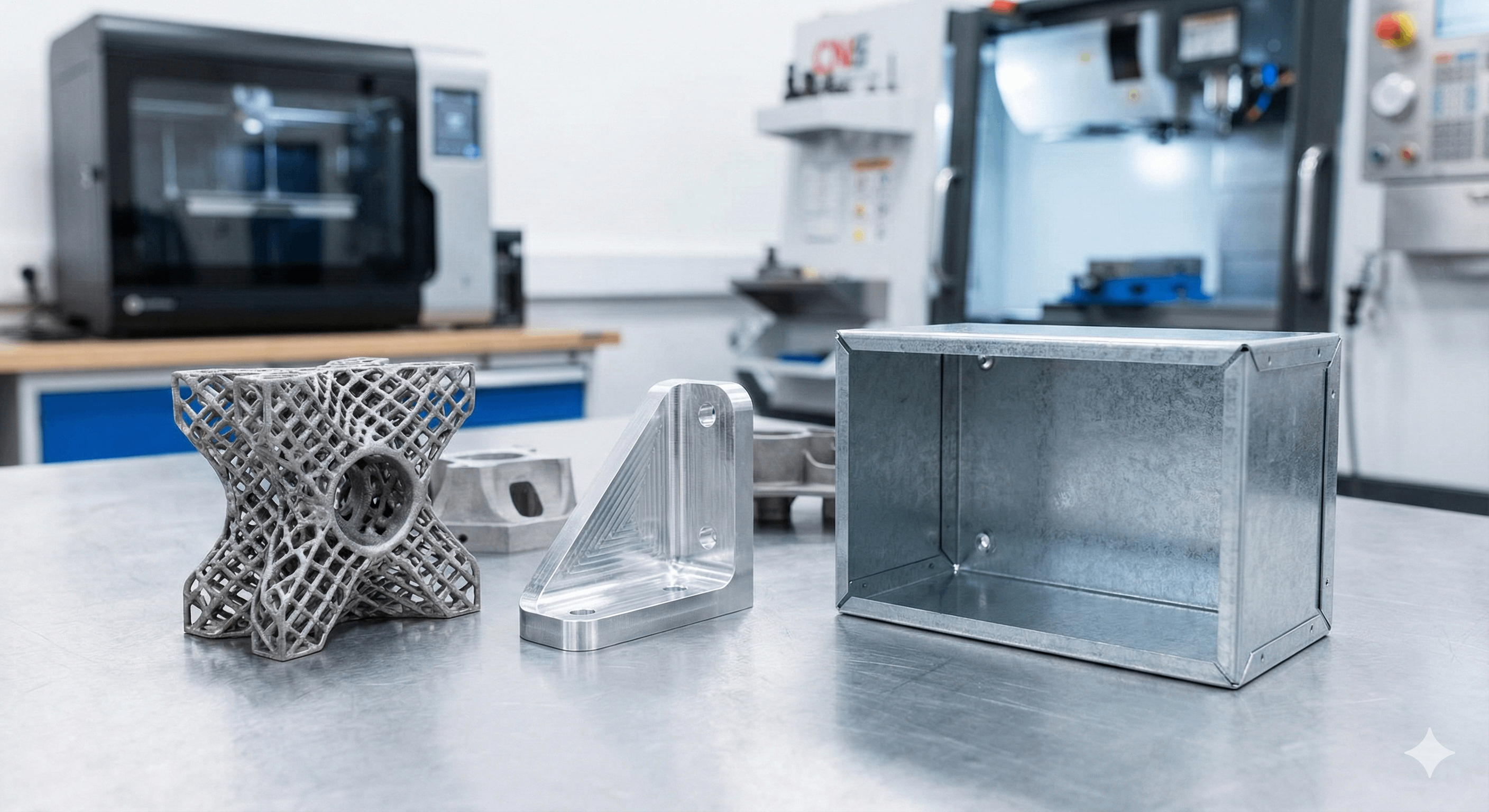
The landscape of rapid prototyping methods is vast. It ranges from the additive layering of rapid manufacturing 3d printing to the precision of CNC machining and the agility of sheet metal fabrication. Consequently, each technology serves a distinct engineering purpose.
The challenge for the wholesale buyer is significant. You must do more than simply find a prototyping firm; rather, you must understand which technology aligns with your validation goals. A mismatch here is a financial liability. For example, using a fragile plastic model to validate a metal component creates a “Validation Gap.” Ultimately, this gap can lead to catastrophic failures during mass production.
This guide targets the rigorous demands of the industrial buyer. We move beyond the elementary need to define rapid prototyping. Instead, we dissect strategic applications. First, we explore how to select the right method for material authenticity. Next, we discuss bridging the gap to volume production. Finally, we analyze the return on investment (ROI) of your prototyping budget. Master these strategies to ensure a seamless transition, so your move from prototype to container-load shipment will be profitable and devoid of surprises.
I. The Physics of Validation: Why “Simulants” Fail in Industrial Procurement
The foundational pillar of any robust sourcing strategy is material authenticity. In the initial conceptual phase, teams often prioritize speed. Therefore, design teams may engage a fast prototyping service to generate a “look-and-feel” model using Stereolithography (SLA) or Fused Deposition Modeling (FDM).
These additive technologies are exceptional for spatial verification. As a result, teams can assess ergonomics and basic fit in a matter of hours. However, B2B buyers must focus on functional performance and longevity. Relying solely on these methods introduces significant risks.
The Discrepancy in Material Science
The core issue stems from the difference between “Simulants” and “Real Materials.” Notably, photopolymers used in SLA are chemically distinct from engineering-grade thermoplastics. The same applies to basic filaments in FDM. While they mimic the appearance of the final material, they rarely inherit its performance characteristics.
For instance, a rapid prototyping machine utilizing standard resin might produce a snap-fit enclosure that functions perfectly on a desk. Yet, that same resin lacks thermal stability. Additionally, it lacks creep resistance and does not match the chemical inertness of injection-molded Polycarbonate or Nylon 6/6.
Consequently, do not base a procurement decision solely on a resin prototype. If you do, you face a high probability of failure. Mass-produced parts must withstand real-world thermal cycling and endure mechanical stress. Regrettably, simulants often fail these critical tests.
The Trap of Anisotropy in Additive Manufacturing
Furthermore, fast rapid prototyping produces parts with a different structural integrity. Because 3D printed parts are built layer by layer, they exhibit weakness in the vertical (Z) axis. This structural limitation is due to layer adhesion issues, known as anisotropy.
In contrast, mass-produced parts are typically isotropic. Whether molded or machined, they possess uniform strength in all directions.
Consider engineers designing load-bearing brackets or pressure vessels. For them, this directional weakness renders standard prototype printing data invalid. A printed prototype might fracture under a load, whereas the final part would easily withstand it. This leads to expensive design over-engineering. Conversely, a print might survive a static load test but could fail later under dynamic fatigue.
Experienced sourcing managers pivot to bridge this gap. Specifically, they seek technologies that offer higher material fidelity. Although plastic printing has its place for spatial checks, validating mechanical components demands a robust approach. This often involves a hybrid strategy where you use rapid prototyping parts made from metal to ensure the data is actionable.
II. Beyond the Printer: The Strategic Value of CNC and Metal Technologies
The public often associates industrial prototyping with 3D printers. However, the reality for industrial metal components is more nuanced. High-stakes projects involving automotive or medical machinery cannot rely on plastic because the limitations are absolute.
Consequently, this drives the imperative for real metal prototypes. You must manufacture them from the intended alloy, whether it is Aluminum 6061, Stainless Steel 304, or Brass. Here, the strategy shifts as we move from additive manufacturing to subtractive processes.
CNC Rapid Prototyping: The Gold Standard for Data
CNC rapid prototyping stands as the benchmark for reliability. While printed parts may suffer from internal porosity or rough surfaces, a CNC-machined prototype is different. Specifically, we carve it from a solid block of billet material.
For a sourcing manager, this is invaluable. For example, it validates thermal conductivity, proving that Aluminum 6061-T6 works for a heat sink. Additionally, it verifies corrosion resistance, confirming that Stainless Steel 316L suits a marine application.
We can even machine engineering plastics. In fact, machining PEEK or Delrin (POM) provides structural density and surface lubricity that printed simulants cannot match. This guarantees valid test data derived from the exact specific gravity and hardness of the final material.
Therefore, prototyping services that rely solely on printing are insufficient for this level of fidelity. The CNC process uses the final material properties, providing trustworthy data for safety certification and critical performance analysis. Although the upfront cost of CNC programming may be higher, the cost of failure due to bad data is exponentially higher.
The Role of DMLS in Complex Geometries
On the other hand, geometry sometimes becomes too complex for traditional machining. Examples include internal cooling channels or organic lattice structures. In these cases, rapid prototyping equipment utilizing Direct Metal Laser Sintering (DMLS) becomes the viable alternative.
DMLS creates geometries that machines cannot cut. Yet, buyers must understand the implications. Metal printing involves extreme thermal gradients and requires significant post-processing. Steps include stress relief heat treatment and using wire EDM cutting to remove the part from the build plate.
A savvy procurement strategy knows when to deploy which technology. Ideally, use CNC for simple structural brackets. It provides a faster fast prototyping solution than printing powder and is often more cost-effective. Moreover, CNC eliminates the rough surface finish of DMLS and delivers a part chemically identical to the final unit.
YISHANG advises clients to perform a rigorous analysis. Essentially, use DMLS only when the geometry demands it, and rely on CNC for everything else. This maximizes your ROI.
III. The Hidden Efficiency: Rapid Sheet Metal as a Bridge Production Strategy
A pervasive misconception exists in the industrial sector. Many believe sheet metal fabrication is solely for mass production and assume it requires long lead times for expensive stamping dies. Unfortunately, this belief leads engineering teams into error. They erroneously 3D print large, flat enclosures, which is cost-inefficient and structurally unsound.
A large printed chassis is prone to warping. In addition, it lacks electromagnetic interference (EMI) shielding properties and provides zero data on grounding continuity.
To address this, agile supply chains use a modern solution. They use rapid prototyping services that specialize in sheet metal without hard tooling. Manufacturers utilize high-powered fiber laser cutters combined with digital NC bending machines. This produces production-grade parts in timelines comparable to printing.
Validating the “Real” Assembly
This approach is strategic for “Bridge Production.” Significantly, it allows companies to validate their design with actual material, such as galvanized steel, aluminum, or copper, without waiting weeks for stamping tools.
For a wholesale buyer, this capability changes the game. You can produce a pilot run of 50 to 100 units quickly. Then, use them to test the market or validate the assembly line.
These rapid prototyping examples in sheet metal provide immediate feedback. You can test assembly stiffness and verify weight and paint adhesion. Unlike a plastic model that requires conductive paint to simulate grounding, a sheet metal prototype functions exactly as the final unit will.
Furthermore, this method allows for design flexibility. Perhaps a hole needs moving or a flange needs extending. With this method, we make the change instantly in the digital file, and the laser cutter adapts immediately. This agility is the essence of fast prototyping machine utilization, proving that “Rapid” does not have to mean “Plastic.”
IV. Visualizing the Rapid Prototyping Process
Transparency is key in manufacturing. Therefore, we visualize the workflow as a structured industrial sequence. The following breakdown illustrates the transformation from digital data to physical asset, which YISHANG has refined over decades of operation.
| Stage | Process Step | Key Engineering Action |
| 1. Digital Input | CAD Analysis & DfM | Reviewing .STEP files for wall thickness and interference. |
| 2. Strategy | Technology Selection | Deciding between DMLS (complexity) or CNC (precision). |
| 3. Fabrication | Layering or Subtraction | Executing the build (e.g., Sintering Nylon 12 or Machining Al7075). |
| 4. Refinement | Post-Processing | Stress relief, bead blasting (Ra 3.2), or anodizing. |
| 5. Validation | CMM Inspection | Verifying dimensions against 2D drawing tolerances (±0.05mm). |
V. Engineering Precision: Navigating Tolerances and Surface Fidelity
First, select your material and method. Then, shift focus to precision. A prototype is only as useful as its dimensional accuracy. While in CAD, every dimension is perfect; in the physical world, every manufacturing process has variance.
A common friction point in B2B procurement is the “Tolerance Mismatch.” Here, a prototype fails to assemble correctly. Often, this is due to the limitations of the manufacturing process and is rarely a flaw in the design itself.
The Tolerance Gap
Industrial 3D printing technologies generally achieve tolerances around ±0.1mm to ±0.2mm. While this suffices for visual models, it falls short for precision engineering. Interference fits require tighter control, and bearing surfaces demand higher accuracy.
Rapid prototyping companies must communicate these limitations. Failing to do so leads clients into a false sense of security. For instance, consider a 3D printed hole for a precision shaft. It will often be slightly undersized or oval due to the layering process.
High-precision requirements often necessitate a hybrid approach. Specifically, we print complex geometry near-net shape, and then we CNC machine the critical features. This achieves tight tolerances (±0.01mm) and validates the functional fit without compromising speed.
Surface Finishing Standards (Ra Values)
Surface finish is another critical aspect. A standard metal printed part (DMLS) has a rough surface (Ra 6.3 – 12.5 µm), resembling a sand casting. As a result, this is unsuitable for sealing surfaces and will fail with O-rings. In contrast, a CNC machined part achieves Ra 0.8 – 1.6 µm easily.
Post-processing is not just cosmetic; rather, it is functional. Techniques include bead blasting, anodizing, and chromate conversion coating. These are essential for verifying corrosion resistance. A robust rapid prototype service verifies these finishes. YISHANG emphasizes that defining the surface finish is vital; indeed, it is as important as the geometry itself.
VI. The Logistics of Speed: Why “Global” Can Be Faster Than “Local”
Sourcing managers often search for a 3d printing prototype service near me. Urgency drives this search because the assumption is simple: a local vendor must be faster. However, in the industrial sector, proximity does not equal velocity.
Local shops often face capacity constraints. They may lack material stock or secondary finishing capabilities like heat treating. Consequently, this forces them to outsource steps, which adds days to the lead time.
True speed in rapid prototype development comes from capacity and integrated processes. A dedicated overseas prototyping firm like YISHANG operates 24/7. Moreover, we hold vast in-house material inventory. We can often complete a project and ship it via international priority airfreight faster than a local shop can clear its backlog.
For the wholesale buyer, “Door-to-Door” time matters most. Thus, physical distance is secondary. We consolidate CNC machining, 3D printing, and finishing under one roof. By doing so, we eliminate the latency of multi-vendor supply chains. We deliver parts globally in as little as 3-5 days. This rivals domestic lead times and, importantly, comes with significantly lower costs.
VII. The Economics of Scalability: Analyzing Cost, Volume, and ROI
Every engineering decision relies on financial reality. For the B2B buyer, the “Total Cost of Ownership” matters most. It is more significant than the price of a single prototype. The economics of rapid prototyping are non-linear. Therefore, they depend highly on volume.
Understand the cost curves of different technologies. This is essential for maximizing Return on Investment (ROI).
For one to five units, rapid manufacturing 3d printing usually offers the lowest entry barrier. There are no setup costs, so you can print a design immediately. However, as volumes increase, print costs remain flat. Subtractive methods differ. CNC and Sheet Metal have high setup costs, but they see a dramatic drop in per-unit cost as volume increases.
The “Valley of Death” in Prototyping
A phenomenon known as the “Valley of Death” exists in prototyping. This typically occurs between 10 and 100 units. At this stage, printing becomes prohibitively expensive because cycle times are too slow. Yet, hard tooling is not justified by the volume.
You need a strategic partner to navigate this zone.
For these intermediate volumes, switch technologies. CNC machining or rapid sheet metal fabrication often yields a better ROI. Furthermore, consider “Rapid Tooling.” Instead of durable steel molds, use aluminum molds. They are faster and cheaper to produce. This allows for injection molding of rapid prototyping parts using the final production resin. Ultimately, this strategy bridges the gap to mass production and allows for market entry while we cut the final tools.
VIII. Frequently Asked Questions in Industrial Prototyping
We have compiled answers to common queries regarding our rapid prototype service. This assists B2B buyers in making informed decisions.
How do I define rapid prototyping in an industrial context?
General definitions focus on quick fabrication. In an industrial context, however, rapid prototyping is a risk-mitigation strategy. It encompasses more than just fast prototyping machines. It includes rapid subtractive methods like CNC and laser cutting. The goal is validation: you must confirm “Form, Fit, and Function” with production-grade materials before investing in permanent hard tooling.
What is the difference between a “Prototyping Firm” and a “Service Bureau”?
A standard service bureau typically operates a “print-what-you-send” model. They focus solely on executing the print job and rarely offer engineering input. In contrast, a strategic prototyping firm or rapid prototype design company, such as YISHANG, acts as a partner. We perform Design for Manufacturing (DfM) reviews, suggest material alternatives, and offer post-processing services. This ensures the prototype is a functional engineering asset.
Is CNC machining considered a rapid prototyping method?
Yes, absolutely. Rapid manufacturing 3d printing is the common association. Nevertheless, CNC machining is often superior for industrial prototyping. This is true when functional metal parts are required. Modern high-speed CNC centers produce complex parts in 24-48 hours. If you need to verify structural strength or check tight tolerances (±0.01mm), CNC is often the only valid method.
IX. Conclusion: Partnering for Strategic Advantage
In the modern industrial landscape, rapid prototyping is a strategic lever. It manages risk and validates supply chains. Ideally, the journey from digital file to product warehouse should be smooth, but it is often fraught with pitfalls ranging from material incompatibilities to manufacturing bottlenecks.
View the prototyping phase as part of the production roadmap. By doing so, sourcing managers can uncover these issues early, when they are cheapest to fix.
Do not drive your choice of prototyping services by machine speed alone. Instead, choose a partner who understands the path to mass production. You may need the freedom of 3d rapid prototyping, the certainty of CNC machining, or the agility of sheet metal. Regardless, the technology must serve the ultimate goal: a scalable product launch.
At YISHANG, we position ourselves as your partner. We understand you are not just buying parts; rather, you are buying certainty. By combining deep industrial prototyping knowledge with manufacturing experience, our team helps wholesale buyers navigate complexity. Furthermore, our assistance covers critical areas such as material selection, tolerance analysis, and cost scaling.
Validate your next project with industrial rigor. Let us review your design for manufacturability today.