
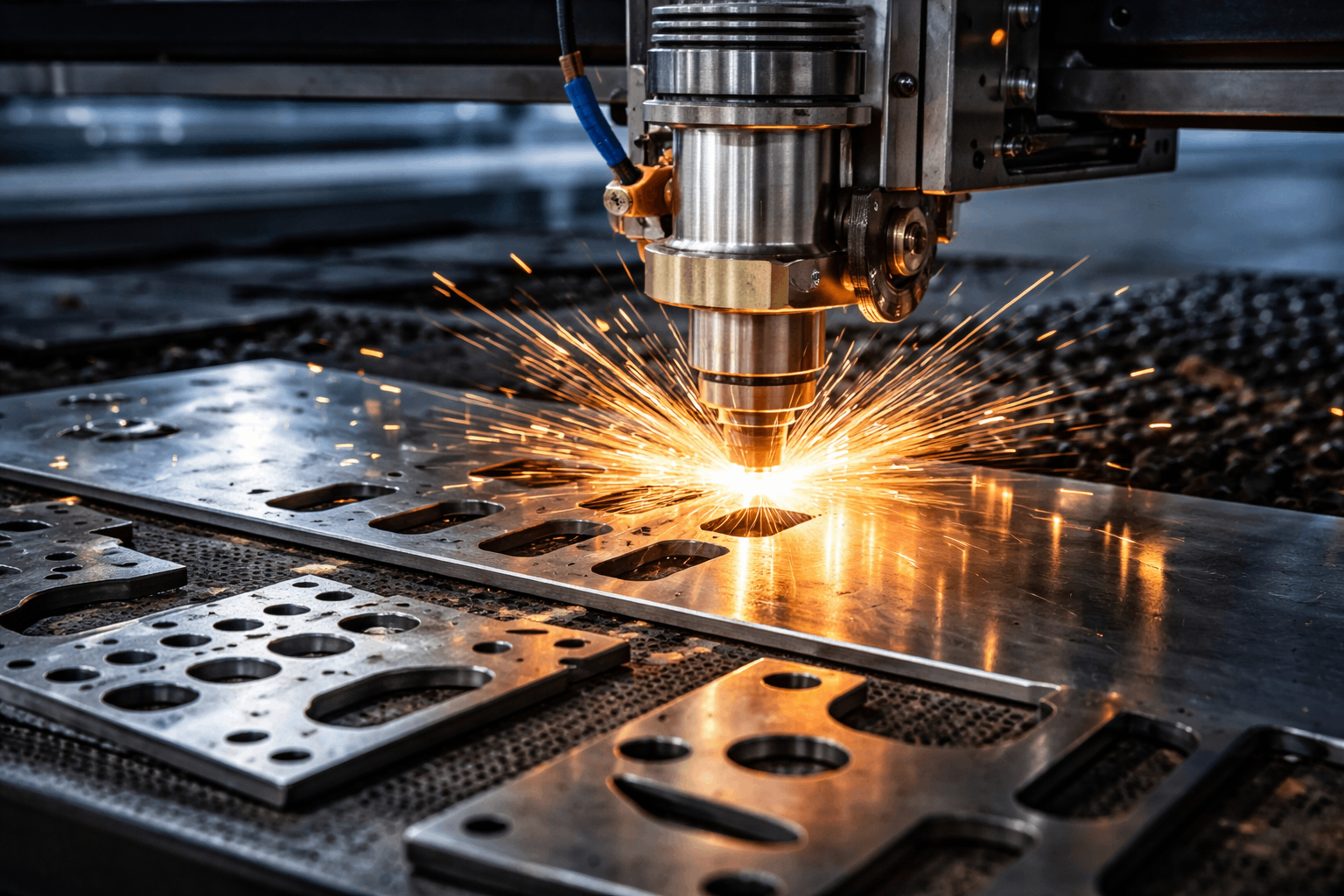
In metal fabrication, a cnc cutting machine is rarely “just equipment.” For overseas wholesale buyers and sourcing managers, it is the first place where batch consistency, delivery predictability, and downstream assembly risk start to form.
Cutting is also the first irreversible operation. Once a profile is cut, every later step—bending, welding, finishing, packaging—must work with the geometry and edge condition that cutting created.
This article is written for professional buyers who evaluate suppliers beyond samples and machine lists. It focuses on what actually drives repeatable outcomes in bulk orders, using the language buyers care about: tolerance drift, rework risk, inspection burden, and total landed cost.
You’ll see terms like edge quality, heat‑affected zone, datum strategy, and traceability, but the goal is practical: help you ask better questions, read supplier answers more accurately, and reduce surprises after the first shipment.
CNC Cutting Looks Precise — Until Parts Enter Real Production
Prototype parts often look excellent. Dimensions match drawings, the edge appears clean, and a quick inspection report can look reassuring.
That first impression is real—but incomplete. Prototypes are usually made under “best conditions”: slower speeds, extra attention, carefully selected sheets, and short runs.
When production scales, small variations become visible. Parts that were fine as single pieces may start to behave differently as a batch: hole positions drift slightly after forming, tab‑and‑slot fit becomes inconsistent, or assembly requires small adjustments that weren’t needed during sampling.
For wholesale buyers, this is where cost grows quietly. Not because the supplier made obvious scrap, but because assembly time and inspection time increase.
Why prototypes pass, but batches struggle
In batch production, variation stacks. A typical metal part might see cutting, deburring, bending, welding, and coating. Each step adds a small uncertainty.
Even if the cut profile is within tolerance, the edge condition can change how the part forms or welds. If you’re buying components meant to assemble into cabinets, frames, racks, or enclosures, the “fit” you care about is often decided later—yet the root cause begins at cutting.
A simple example makes this concrete. Suppose your drawing allows ±0.15 mm on a hole position and ±0.20 mm on a flange location.
If both features drift toward the same side across processes, your real assembly misalignment can approach 0.35 mm. That might still be “within tolerance” on paper, yet enough to cause fastener binding, uneven gaps, or a forced fit.
Buyer takeaway: evaluate cutting like a supply risk, not a sample result
When you approve a prototype, ask how the supplier keeps that result stable across lots.
Look for evidence of process control: consistent CAM strategy, consistent sheet sourcing, consistent inspection method, and change control when material or parameters shift.
This is also why you’ll sometimes see factories promote “premium” or even luxury cnc cutting machines for factories. Capability can help, but consistency comes from the system around the machine.
CNC Cutting Precision Is a Process Outcome, Not a Machine Feature
A common sourcing misconception is that precision is embedded in the machine.
A quote might list positioning accuracy, repeatability, or laser power, implying that the equipment guarantees a tight result.
In reality, those numbers describe potential under controlled conditions. Real production precision is created by the process, not the label on the cnc cutter machine.
What actually creates CNC cutting precision
In metal fabrication, precision emerges from a chain of controllable inputs:
Design intent, CAM toolpath strategy, material behavior, machine calibration, and operator discipline.
If any element changes, the cut result changes. That is true even when the machine is functioning correctly.
This is not a weakness. It is simply how manufacturing works.
For buyers, the implication is important: “better machines” do not automatically mean “better deliveries.”
A supplier can own advanced or luxury CNC cutting machines for factories and still produce unstable batches if CAM strategies vary between shifts, if material traceability is weak, or if maintenance routines are inconsistent.
Precision versus repeatability versus consistency
Buyers often use “precision” as a single concept. In production, it helps to separate three ideas:
Precision: How close a feature is to the nominal value.
Repeatability: How tightly results cluster when the same part is repeated.
Consistency: Whether results remain stable across time, lots, and material batches.
Wholesale buyers usually suffer most when consistency fails. You can manage a known offset. You cannot easily manage unpredictable drift.
Buyer takeaway: ask for process evidence, not just specs
Instead of asking “what tolerance can your cnc cutting machine hold,” ask:
How do you keep the same cutting conditions across lots, and what triggers a controlled change?
A supplier who can answer that clearly is often the supplier who ships stable batches.
Where CNC Cutting Accuracy Is Decided Before the Machine Starts
Most determinants of cutting accuracy are set before the machine moves.
This is why two suppliers can run the same DXF and deliver different real‑world results.
Design data: “correct geometry” can still be unstable
CAD files can be geometrically correct yet physically fragile.
Examples include very sharp internal corners, narrow webs, long unsupported edges, or unbalanced profiles.
When a part is cut free, residual stress releases. If the design concentrates stress in certain regions, the part can shift slightly.
That shift might be invisible in a quick check of overall length and width, yet it can affect bend lines, hole alignment, or flatness.
From a buyer perspective, this is not about blaming the designer.
It’s about understanding that the design’s manufacturability affects the supplier’s ability to deliver stable batches.
CAM strategy: toolpath choices shape stability
CAM is not just file conversion.
Entry points, lead‑ins, cutting direction, and cut sequence determine how heat and force distribute through the sheet.
Two toolpaths can create identical outlines with different internal stress outcomes.
One path might cut long outer edges first and allow the part to move before internal holes are finished.
Another path might lock stability by cutting internal features first, controlling how the sheet relaxes.
Supplier questions worth asking
When you request a quotation, it helps to ask how the supplier handles:
- cut sequencing for thin sheets with tight positional features
- deformation control for long profiles
- edge finishing requirements for coating or cosmetic surfaces
This is not a “step‑by‑step” checklist. It’s a way to see whether the supplier treats cutting as a production control point.
Identical CNC Cutting Machines, Different Results: What Really Changes
It is tempting to assume that identical machines produce identical parts.
In practice, performance diverges with calibration quality, wear condition, parameter discipline, and maintenance history.
Calibration and motion behavior matter more than brochures
Even when two machines share the same model number, small differences appear over time.
Servo tuning, backlash compensation, and axis smoothness affect dynamic cutting.
These differences rarely show up in simple acceptance tests, yet they affect contour accuracy and hole roundness when the machine accelerates and decelerates across complex profiles.
Defaults are not neutral
Control software defaults often work “well enough” for many jobs.
But defaults can produce different outcomes across materials and thicknesses.
Acceleration limits, cornering behavior, kerf compensation strategy, and pierce parameters influence real edge quality and dimensional repeatability.
A supplier who actively controls these variables usually delivers more stable batches than a supplier who relies on default parameter sets.
Buyer takeaway: equipment lists don’t predict stability
If a supplier claims “we have the newest cnc cutting machine,” that’s not the full story.
A factory with fewer but well‑maintained cnc cutter machines can outperform a factory with newer machines but weak discipline.
Ask about calibration routines, preventive maintenance, and how parameter changes are controlled.
These answers reveal far more about batch stability than a machine brand list.
Speed, Heat, and Edge Quality: The Trade‑Off Behind Every Cut
Cutting speed influences lead time, so it often appears in sales conversations.
But speed always creates trade‑offs, especially for thin stainless, coated sheet, and parts that will be bent or welded.
Edge quality is a functional requirement
For buyers, edge quality should be treated like a functional characteristic.
A cut edge that looks fine can still create problems later.
Micro‑dross, small striations, and micro‑hardening can reduce coating adhesion, increase burr‑related handling risk, or change how a flange forms.
In thermal cutting, heat input creates a heat‑affected zone (HAZ) where microstructure changes.
That zone may not affect the overall profile, yet it can influence bending behavior and weld response.
A practical tolerance example: why edge condition affects fit
Suppose your assembly relies on two tab features sliding into a slot.
If burr height varies from 0.05 to 0.20 mm across a batch, your effective clearance changes.
Some parts slide smoothly. Others bind.
That becomes a sorting problem for the buyer, or a rework problem for the supplier.
Buyer takeaway: ask for edge criteria, not just dimensional tolerances
To reduce downstream issues, align on edge requirements early.
If your parts are cosmetic, coated, or assembled with tight fit, clarify acceptable burr limits and deburring expectations.
When a supplier treats edge quality as a controlled variable, it protects your assembly efficiency and reduces inspection load.
Material Behavior During CNC Cutting: What Machines Cannot Correct
Material variability is one of the most underestimated drivers of inconsistency.
Even within the same grade, rolling direction, residual stress level, and batch history change how a sheet behaves when cut.
Residual stress release is real—and it is often invisible early
When a profile is cut free, internal stress redistributes.
Parts can move slightly during cutting or relax after cutting.
Those shifts may still pass a dimensional check, yet they influence flatness and alignment during forming.
No cnc cutting machine can “detect” internal stress release and correct it automatically.
It can only follow the programmed path.
Procurement relevance: traceability reduces surprises
Wholesale buyers benefit when suppliers can maintain material traceability.
A material test report (MTR), heat number tracking, and consistent sourcing reduce batch‑to‑batch variation.
This is especially helpful for stainless steels, galvanized materials, and thicker plates where stress behavior varies more.
Buyer takeaway: material control is part of cutting control
If you want stable batches, treat material supply as part of the cutting process.
Ask whether the supplier controls sheet source, keeps batch records, and flags changes that may affect results.
When CNC Cutting Issues Appear as Assembly Problems
Many cutting issues do not show up as scrap.
They show up as assembly friction: alignment problems, forced fits, or inconsistent gaps.
Why this hits wholesale buyers hardest
Assembly problems occur late.
By the time you discover them, value has been added: bending, welding, coating, packing.
For overseas buyers, late discovery can mean delayed deliveries, extra communication cycles, and higher landed cost.
That is why suppliers who understand downstream behavior often outperform suppliers who only optimize cutting speed.
Functional accuracy is what matters
A part that measures well on a flat table may still fail in a welded frame.
The real test is repeatable assembly across batches.
A supplier who evaluates cutting by downstream outcomes is typically better at preventing these late‑stage surprises.
Buyer takeaway: request evidence tied to fit, not only dimensions
If fit matters, ask for assembly‑relevant evidence.
This could be a simple go/no‑go gauge approach, sample assembly verification, or a first article inspection report that highlights critical-to-assembly features.
The method matters less than the mindset: the supplier is controlling what you actually care about.
CNC Cutting as a Constraint Inside a Metal Fabrication System
CNC cutting is a constraint in a larger fabrication system.
It defines the starting condition for bending, welding, and finishing.
If that starting condition is unstable, downstream controls cannot fully compensate.
Why “systems thinking” predicts supplier maturity
Some factories achieve excellent outcomes with non‑luxury equipment.
Their advantage is alignment: cutting parameters and strategies are chosen with forming limits and assembly tolerances in mind.
That alignment reduces drift and makes batches interchangeable.
A procurement-friendly way to evaluate systems thinking
When you speak with a supplier, notice whether they connect cutting to downstream steps.
Do they ask about bend lines, weld sequence, coating requirements, or final assembly interface?
If they do, they are likely controlling the system.
If they only discuss machine wattage and speed, they may be controlling a single step.
Choosing CNC Cutting Capability Without Over‑Specifying the Machine
Procurement teams often compare machine specs because they are visible.
But over‑specifying a machine without matching process control rarely improves outcomes.
What buyers actually need to define
Instead of starting with “what machine do you have,” start with:
- required batch consistency
- tolerance sensitivity in assembly
- cosmetic and coating requirements
- material stability and traceability expectations
These requirements guide whether a supplier needs a particular capability and whether their process can support it.
A simple evaluation table for RFQ conversations
| Buyer concern | What to ask | Evidence that matters |
|---|---|---|
| batch-to-batch consistency | how do you control parameter drift | controlled revision + records |
| assembly fit | which features are critical-to-fit | gauge / sample assembly check |
| edge quality | how do you manage burr and HAZ | defined edge criteria |
| material variability | do you keep MTRs and traceability | batch logs + trace tags |
| change control | what triggers process changes | documented change notice |
This kind of discussion is often more predictive than comparing machine brands.
CNC Cutting Machines Do Not Define Quality — Processes Do
CNC machines are essential tools, but they do not define quality on their own.
Quality emerges from controlled interaction between design, material, planning, execution, and verification.
For wholesale buyers, the most valuable supplier trait is not “the newest cnc cutting machine.”
It is the ability to reproduce the same cutting conditions over time and across batches.
That is the difference between a supplier who ships good samples and a supplier who ships stable production.
Manufacturers such as YISHANG emphasize this process-driven mindset because it supports reliable long-term sourcing relationships.
Closing Thoughts
If you are sourcing CNC-cut metal parts at scale, the biggest cost is rarely the first sample.
The biggest cost is inconsistency: added inspection, assembly adjustments, and late-stage rework.
If you want to reduce downstream risk, an early technical discussion about process control, edge criteria, and material traceability usually pays back quickly.
If you’d like, send your drawings and target batch quantities and we can share practical feedback on risk points and control priorities.