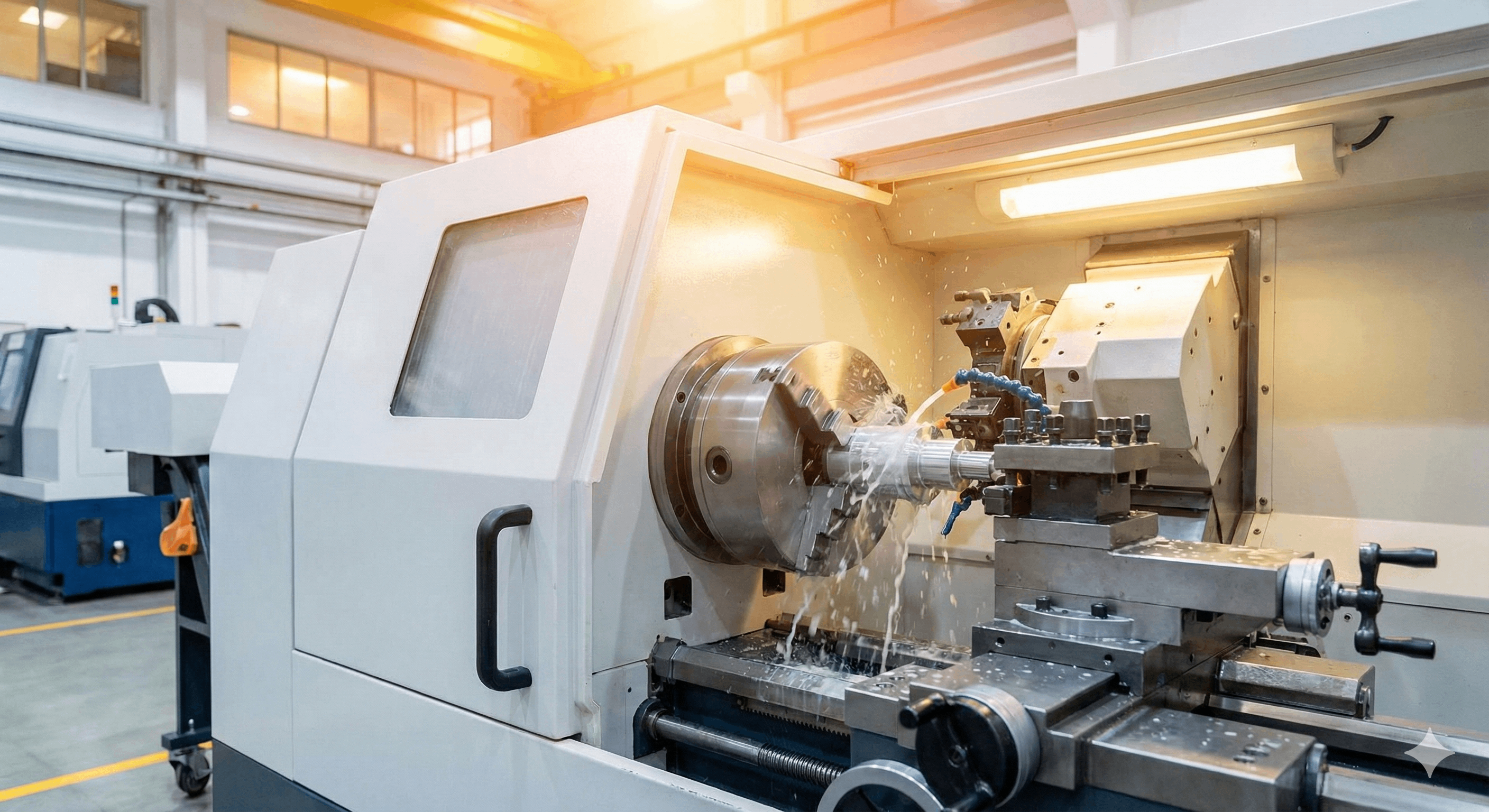
For procurement officers and supply chain managers in the automotive, electronics, and industrial sectors, sourcing metal components is rarely a simple transactional event. It is a strategic alignment of engineering requirements with commercial viability. The goal is clear: secure a supply chain that delivers consistent quality, minimizes risk, and optimizes the Total Cost of Ownership (TCO).
At the center of this equation is cnc lathe machining. However, selecting the right partner requires more than just a vendor list; it requires a deep understanding of how manufacturing nuances—from machine axis configurations to material science—directly impact your bottom line.
At YISHANG, with over 26 years of focused experience in metal fabrication and export, we view machining not just as a production process, but as a critical node in your logistics chain. This guide strips away the generalities to provide actionable insights into sourcing precision turned parts, ensuring your decisions are driven by data and industry expertise.
What is a CNC Lathe? (A Procurement Perspective)
To evaluate a supplier effectively, one must first reframe the fundamental question: what is a cnc lathe in the context of high-volume global procurement? It is not merely a tool for shaping metal; it is an instrument of risk mitigation and scalability.
The Shift from Manual to Digital
In the era of Just-In-Time (JIT) manufacturing, batch inconsistency is a supply chain killer. Traditional manual lathes rely on operator skill, introducing variables that result in dimensional drift. For a wholesale buyer importing 50,000 units, a variance of 0.05mm can mean rejecting an entire container.
Modern Computer Numerical Control (CNC) turning centers eliminate this variable. By executing pre-programmed G-code with digital rigidity, these machines ensure that the component produced at the start of a shift is identical to the one produced at the end. This repeatability is what allows YISHANG to guarantee “Dock-to-Stock” quality, reducing your overhead on incoming inspections.
Turning vs. Milling: The Distinction
While CNC milling rotates the tool against a stationary part, CNC turning rotates the workpiece against a stationary tool. This makes lathes the only viable option for creating cylindrical parts (shafts, pins, bushings) with high concentricity and speed. Understanding this distinction helps you classify your RFQs correctly and select the right subtractive manufacturing process.
Choosing the Right Machine Configuration for Your Cost Structure
A common misconception is that all CNC lathes are created equal. The specific axis configuration of your supplier’s equipment is a primary driver of unit cost. YISHANG utilizes a mix of machines to match the complexity of your part.
2-Axis Lathes: The Cost-Effective Workhorse
For simple cylindrical parts—like pins, washers, or basic shafts—a standard 2-axis lathe (X and Z axis) is the most economical choice.
- Best For: High-volume, simple geometry orders.
- Cost Impact: Lowest hourly machine rate, ideal for aggressive target pricing.
Multi-Axis Turning Centers with Live Tooling
For complex parts requiring side holes, milled flats, or off-center tapping, a standard lathe is insufficient. Traditionally, this would require moving the part to a mill (secondary setup), increasing labor costs and cumulative errors.
- The YISHANG Advantage: We utilize CNC turning centers with Live Tooling. This allows the turret to use rotating cutters while the part is still clamped.
- Cost Impact: Enables a “Done-in-One” workflow. Although the machine rate is slightly higher, the elimination of secondary setups reduces total labor by 30-50% and significantly improves precision tolerances.
Material Intelligence: Balancing Performance with Manufacturability
Raw material selection is often driven by the end-use application, but the machinability of that material dictates the production cost. A disconnect here can lead to inflated pricing.
To help you optimize your BOM (Bill of Materials), here is a comparison of common materials we process at YISHANG:
| Material Series | Machinability | Cost Efficiency | Common Challenge | YISHANG Solution |
|---|---|---|---|---|
| Aluminum (6061) | High | Excellent | Surface scratching (Built-Up Edge) | Polished diamond-like tooling for mirror finishes. |
| Brass (C360) | Very High | High | Material cost is high | High-speed recycling of chips to offset material cost. |
| Stainless (304) | Medium-Low | Moderate | Work hardening | High-pressure coolant & specialized carbide grades. |
| Stainless (303) | Medium | Good | Slightly lower corrosion resistance | Recommended alternative to 304 for non-marine parts. |
| Carbon Steel | High | Good | Rust/Corrosion | Integrated zinc plating or black oxide treatment. |
Navigating the Stainless Steel Challenge
Stainless steel is non-negotiable for medical and food-grade applications. However, grades like 304 and 316 are susceptible to work hardening. If cut improperly, the material hardens instantly, destroying tools. YISHANG employs specific protocols to maintain aggressive cycle times on stainless steel, ensuring you get corrosion resistance without paying for inefficient processing.
Design for Manufacturability (DfM): Engineering Out the Cost
The most significant cost savings are not found on the factory floor, but on the drawing board. By engaging YISHANG’s engineering team early, wholesale buyers can leverage DfM principles to strip unnecessary costs.
1. The Trap of Sharp Internal Corners
A frequent oversight is requesting 90-degree internal corners. Since every turning insert has a nose radius, achieving a sharp corner requires slow, specialized picking operations.
- Optimization: Allow for a standard corner radius (e.g., 0.4mm to 0.8mm) or design a relief undercut. This simple change significantly reduces cycle time.
2. Managing Length-to-Diameter (L:D) Ratios
Long, slender parts are prone to deflection (bending) under tool pressure, causing “chatter.”
- Optimization: If the L:D ratio exceeds 3:1, production becomes slower and requires steady rests. Increasing the shaft diameter or reducing the unsupported length makes the part more rigid and cheaper to produce.
3. Strategic Tolerancing
Applying a blanket tolerance (e.g., +/- 0.005mm) to non-critical dimensions is a costly habit.
- Optimization: Define Critical-to-Quality (CTQ) features—such as bearing seats—for tight tolerances, and default to ISO 2768-m for the rest. This tiered approach signals to the manufacturer that you are a knowledgeable buyer.
Quality Assurance: Quantifying Trust in Global Trade
In the B2B landscape, trust must be backed by data. For YISHANG, exporting to 50+ countries means our Quality Assurance (QA) protocols must meet global standards.
Advanced Metrology
Complex turned parts often feature geometric requirements that simple calipers cannot verify. We utilize Coordinate Measuring Machines (CMM) to validate parameters such as concentricity, cylindricity, and parallelism. For a motor shaft spinning at high RPM, this data is vital to prevent vibration and failure.
Compliance and Traceability
Risk mitigation extends to regulatory compliance. We provide full traceability for all materials, including Mill Test Certificates that verify chemical composition. For our partners in Europe and North America, our strict adherence to RoHS standards ensures that your products face no barriers to market entry.
The One-Stop Solution: Integrating Logistics and Post-Processing
A machined part is rarely the end of the story. It must be plated, assembled, or welded. Sourcing these processes from disparate vendors increases logistical complexity.
YISHANG offers a turnkey solution. We integrate cnc lathe machining with our in-house sheet metal fabrication, welding, and assembly capabilities. For example, a turned steel bushing can be welded into a laser-cut chassis, then zinc-plated and assembled—all under one roof.
Finally, we address the often-ignored aspect of export: packaging. Carbon steel parts are vulnerable to corrosion during ocean freight. We implement rigorous preservation protocols, utilizing VCI (Volatile Corrosion Inhibitor) packaging to ensure your parts arrive in the exact condition they left our CNC centers.
Conclusion: Aligning for Long-Term Growth
The landscape of modern manufacturing is defined by precision, speed, and efficiency. CNC lathe machining, when executed with strategic oversight, becomes more than a production method—it becomes a competitive advantage.
For the wholesale buyer, the challenge is not just finding a factory that has machines, but finding a partner who understands the business of manufacturing. It is about aligning with a team that views your technical drawings through the lens of cost optimization and supply chain stability.
At YISHANG, we combine over two decades of industry experience with a commitment to technological advancement. Whether you are launching a new product line or looking to optimize an existing supply chain, the right manufacturing collaboration is the catalyst for growth.
Ready to optimize your component sourcing? Contact YISHANG’s engineering team today to review your project and discover the value of a true manufacturing partnership.