
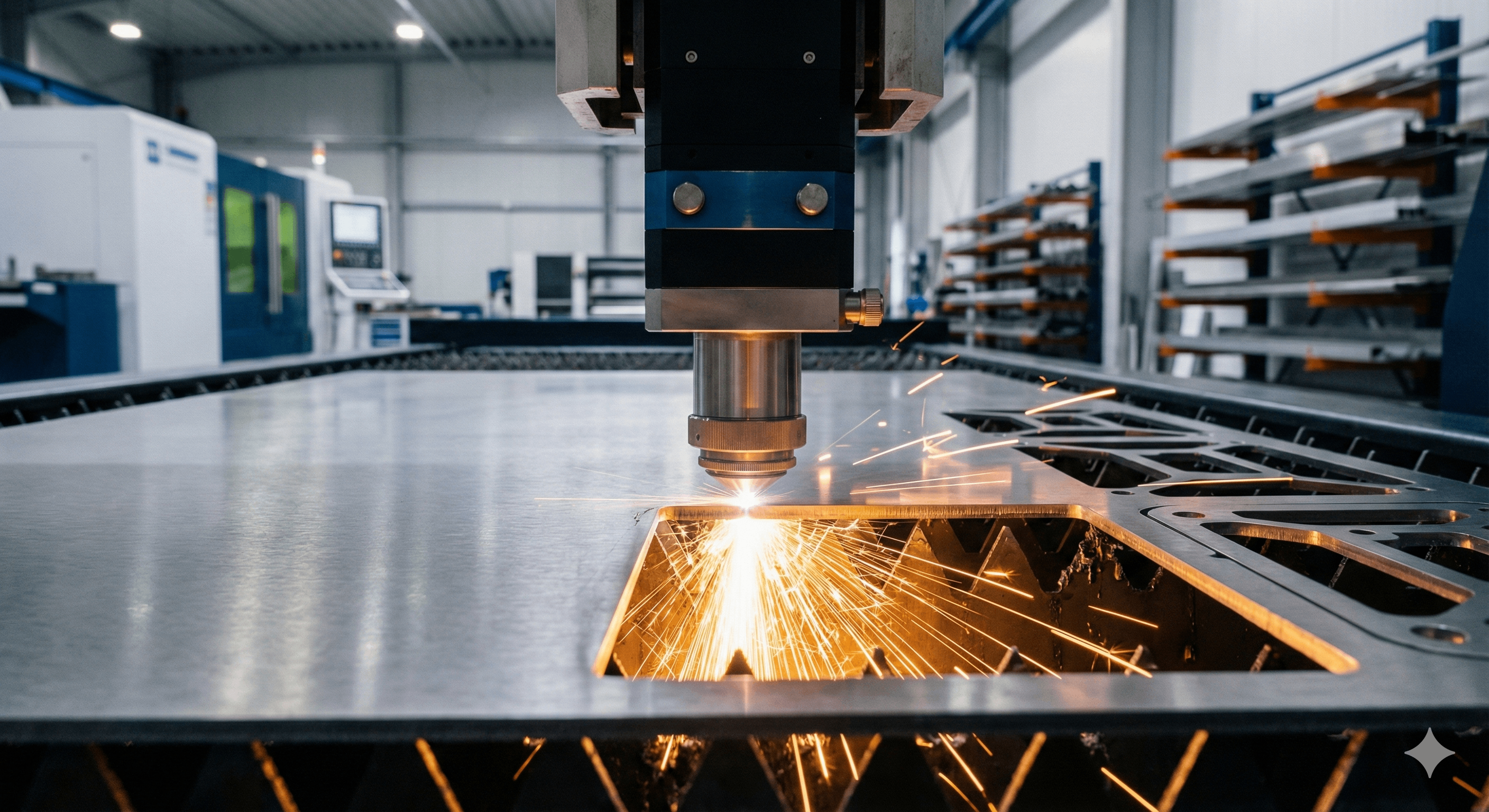
In the complex calculus of global manufacturing, the “First Cut” is often the most undervalued variable. For procurement directors and supply chain managers sourcing metal components from overseas, cnc laser cutting is frequently relegated to a line item in a spreadsheet—a commoditized service measured solely by price per meter.
This reductionist view, however, introduces a silent accumulation of risk. In high-volume manufacturing, the laser cutting process is the geometric foundation upon which all subsequent value is added.
A deviation of 0.1mm at the cutting stage does not merely create a scrap part; it propagates downstream. It causes misalignment in robotic welding fixtures, creates gaps that compromise structural integrity, and generates surface defects that lead to catastrophic coating failures.
At YISHANG, with over two decades of export manufacturing data, we observe a clear correlation: buyers who treat laser cutting as a strategic engineering process consistently achieve lower defect rates and higher yield.
Sourcing effective metal cutting laser cnc services is not about finding a machine; it is about finding a partner who understands the physics of consistency.
This guide is not a glossary of terms. It is a strategic analysis of how specific engineering decisions—from beam modulation to assist gas chemistry—directly impact the Total Landed Cost, scalability, and risk profile of your wholesale orders.
The Physics of Scalability: Why Beam Quality Defines Batch Consistency
Beyond Speed: The Stability of Fiber Optics
The industry-wide transition from CO2 to fiber laser technology is often marketed on speed. While it is true that fiber lasers (operating at a 1.064-micrometer wavelength) cut thin gauge metals up to 300% faster, speed is a vanity metric for the wholesale buyer.
The true value of fiber technology lies in process stability. In a production run of 10,000 units, the primary risk is not slowness, but variance.
Fiber lasers utilize solid-state diodes with no moving mirrors, providing an inherently stable energy source. Unlike CO2 systems, where beam path alignment can drift due to vibration or thermal changes, fiber optics deliver identical energy density from the first part of the shift to the last.
For the buyer, this means that the dimensional tolerances verified in the First Article Inspection (FAI) remain valid for the entire batch, eliminating the “tolerance drift” that often plagues legacy manufacturing methods.
The Beam Parameter Product (BPP) and Kerf Width
The technical metric that defines this consistency is the Beam Parameter Product (BPP). A low BPP indicates a beam that can be focused into a tighter, more intense spot. This results in a narrower kerf width—the slit of material removed during cutting.
Why does kerf width matter to a supply chain manager?
- Material Savings: A narrower kerf consumes less raw material, improving nesting efficiency on the sheet.
- Thermal Control: Less vaporized metal means significantly lower thermal input into the sheet.
Excess heat is the enemy of precision; it causes the metal sheet to expand and warp during processing. By minimizing thermal expansion, high-quality laser cnc systems prevent positional errors.
This is critical for parts with complex hole patterns, such as electronics chassis, where holes must align perfectly with PCB standoffs. A controlled BPP ensures that hole locations do not shift relative to the datum edge, guaranteeing seamless assembly at your destination facility.
Scalability in High-Volume Orders
When scaling from a prototype to a full container load, the machine’s duty cycle becomes a factor. High-end fiber lasers maintain peak power stability even under 24/7 operation.
This reliability allows manufacturers to quote accurate lead times. It removes the “buffer time” that less capable factories add to account for machine downtime or realignment.
For the procurement manager, this translates to a leaner supply chain with predictable “Just-in-Time” delivery capabilities.
Metallurgy in Action: Specific Challenges of Industrial Alloys
The Viscosity Challenge of Stainless Steel 316
Procurement specifications often interchange Stainless Steel 304 and 316, but their behavior under the laser is distinct. Grade 316 contains molybdenum, an alloying element added for corrosion resistance in marine and chemical environments.
This element, however, increases the viscosity of the molten metal pool. When cutting 316, the molten material is sluggish and resistant to ejection.
If standard 304 parameters are applied, the result is “hard dross”—resolidified metal clinging to the bottom edge. Unlike soft aluminum burrs, this dross is fused to the base metal and requires aggressive grinding to remove.
An engineered approach involves adjusting the focal point to a negative position (inside the material thickness) and increasing the gas pressure to force the viscous melt out.
For the buyer, ensuring your supplier understands this nuance is the difference between receiving ready-to-use parts and paying for hours of secondary manual rework.
Managing Zinc Vapor in Galvanized Steel
Galvanized steel is the standard for outdoor enclosures and HVAC components, but it presents a unique chemical hazard during cutting.
The protective zinc coating has a boiling point (907°C) that is significantly lower than the melting point of the underlying steel (~1370°C). As the laser hits the surface, the zinc vaporizes instantly.
This creates a high-pressure cloud of plasma and dust. This vapor can destabilize the cutting gas flow and cloud the laser’s protective lens, leading to a deterioration of cut quality mid-batch.
To mitigate this, capable manufacturers employ “gap-cutting” techniques or specialized air-flow strategies to evacuate zinc vapor before it interferes with the beam.
This attention to detail prevents edge roughness and ensures the corrosion-resistant properties of the material are maintained right up to the cut edge.
The Reflectivity Solution for Aluminum and Copper
Historically, sourcing laser-cut copper busbars or aluminum heat sinks was fraught with risk due to reflectivity. These metals could reflect the laser beam back into the source, damaging the machine.
Modern metal cutting laser cnc systems at YISHANG utilize active back-reflection isolation sensors. This allows us to process highly reflective alloys like Aluminum 6061 and Oxygen-Free Copper with the same reliability as mild steel.
Crucially, because aluminum conducts heat away from the cut zone rapidly, we utilize high-frequency pulse modulation. This delivers energy in nanosecond bursts to vaporize the material before the heat can spread.
This strategy ensures sharp edges and prevents the material from welding itself back together, which is a common failure mode in lower-quality aluminum fabrication.
The Economics of Gas: Nitrogen vs. Oxygen Strategies
The “Total Landed Cost” of Oxidation
The choice of assist gas—Nitrogen (N2) or Oxygen (O2)—is often dismissed as a factory-floor detail, yet it has a massive impact on the financial bottom line of a project.
Oxygen cutting is an exothermic chemical reaction. The oxygen fuels the burn, allowing for rapid processing of thick carbon steel. However, the byproduct is a chemical layer of iron oxide (scale) on the cut edge.
This scale is brittle and loosely attached. For a buyer, this oxide layer represents a hidden liability.
If the parts are destined for painting or powder coating, the oxide must be removed via shot blasting or acid pickling. If painted over, the oxide will eventually detach from the steel, taking the paint with it and leading to field failure.
Comparative Analysis: Gas Selection Strategy
To help procurement managers visualize the cost-benefit analysis, we compare the three primary gas modes below.
| Feature | Oxygen (O2) | Nitrogen (N2) | Compressed Air |
|---|---|---|---|
| Primary Mechanism | Exothermic (Heat Generating) | Endothermic (Shielding) | Hybrid |
| Edge Condition | Oxidized (Dark Scale) | Oxide-Free (Bright Silver) | Slightly Oxidized |
| Paint Adhesion | Poor (Requires Descaling) | Excellent (Ready to Paint) | Good |
| Weldability | Requires Cleaning | Ready to Weld | Requires Minor Cleaning |
| Cost Implication | Low Gas Cost, High Labor Cost | High Gas Cost, Zero Cleaning Cost | Lowest Operational Cost |
| Best Application | Thick Carbon Steel (>6mm) | Stainless, Aluminum, Thin Steel | Internal Brackets (Non-visual) |
Nitrogen: The Insurance Policy
Nitrogen cutting is an inert shielding process. It prevents the chemical reaction, resulting in a clean, silver, oxide-free edge.
While nitrogen gas is more expensive than oxygen, it eliminates the need for secondary mechanical cleaning.
When calculating the Total Landed Cost, the premium paid for nitrogen is almost always lower than the labor cost of grinding or shot blasting—and certainly lower than the cost of a warranty claim for peeling paint.
For stainless steel and aluminum, Nitrogen is the industry standard. For carbon steel intended for welding, it is increasingly the preferred choice.
DFM: Engineering Value Into the Design
Optimizing the Hole-to-Thickness Ratio
Design for Manufacturability (DFM) is the lever that procurement managers can pull to reduce unit costs. A common inefficiency in received CAD files is the specification of holes that are smaller than the material thickness.
The physics of cnc laser cutting dictate that piercing a hole requires a stationary dwell time. If the hole is too small (e.g., a 2mm hole in 4mm plate), the heat cannot dissipate.
This leads to a “blown out” crater rather than a precise circle. The surrounding material becomes hardened and brittle.
At YISHANG, we advise a minimum ratio of 1:1. If smaller holes are strictly necessary, we implement specific “soft-pierce” routines or suggest hybrid processing (laser marking center points for secondary drilling).
This proactive DFM feedback prevents scrap and ensures hole cylindricity, which is vital for fastener alignment.
The Micro-Joint Strategy for Logistics
How parts are handled after cutting is as important as the cut itself. Small parts tend to tip up and fall through the machine slats, or they get sucked into the scrap collector, leading to lost inventory.
To prevent this, we use “micro-joints” or tabs—tiny bridges of material (0.3mm to 0.5mm) that keep the part attached to the skeleton sheet.
However, the strategy goes beyond machine safety. For wholesale shipping, keeping parts tabbed into the sheet (known as “shaker parts”) can act as a natural packaging solution.
It prevents parts from rattling against each other during ocean freight, protecting critical surface finishes. The buyer simply snaps them out upon arrival, ensuring pristine condition.
Common Line Cutting: Risk vs. Reward
For high-volume orders, material yield is the primary cost driver. “Common Line Cutting” involves arranging rectangular parts so they share a single cut line.
This reduces the laser path length by up to 40% and drastically cuts gas consumption. However, this technique carries technical risk.
As the laser cuts, heat accumulates, and without the gap of a traditional web, the parts can expand into each other. This can cause the final edge to be slightly convex.
Successful execution requires sophisticated CAM software that analyzes thermal flow. We strategically place cooling points and cut sequences to manage this expansion.
When done correctly, this yields significant unit cost reductions for the buyer without compromising dimensional accuracy.
Quality Assurance: Beyond Standard Tolerances
The Geometry of the Cut Edge: Taper
In the realm of precision sourcing, “tolerance” is often simplified to X and Y dimensions. However, the Z-axis geometry—the profile of the cut edge itself—is equally critical.
Laser beams are not perfectly cylindrical; they focus to an hourglass shape. On plates thicker than 10mm, this results in a slight taper, where the cut is wider at the top and bottom than in the middle (or vice versa depending on focus).
For parts requiring a tight “interference fit” or precise stacking, this taper must be accounted for.
Experienced engineering teams will control this by using longer focal length lenses to elongate the hourglass waist, minimizing the taper angle to ensure perpendicularity standards are met.
Reference: Laser Cutting Tolerances (ISO 9013)
Providing clear tolerance expectations is key to aligning buyer and supplier. Below is the general tolerance standard maintained at YISHANG for fiber laser production.
| Material Thickness (mm) | Dimensional Tolerance (mm) | Perpendicularity/Taper (mm) |
|---|---|---|
| 0.5 – 3.0 mm | ± 0.10 | < 0.15 |
| 3.1 – 6.0 mm | ± 0.15 | < 0.25 |
| 6.1 – 12.0 mm | ± 0.20 | < 0.40 |
| 12.1 – 20.0 mm | ± 0.30 | < 0.60 |
Note: These are general standards. Tighter tolerances can be achieved through specific process control and slower cutting speeds.
The Heat Affected Zone (HAZ) and Machinability
The Heat Affected Zone (HAZ) is the area of metal adjacent to the cut that has not melted but has undergone microstructural changes due to thermal intensity.
In high-carbon steels, this zone becomes locally hardened—essentially heat-treated. This presents a major challenge for secondary operations.
If your production plan involves receiving laser-cut blanks and then tapping threads into them at your facility, a hardened HAZ is a production killer. It will snap taps and destroy drill bits.
A strategic manufacturing partner anticipates this. We can program the laser to cut a smaller pilot hole, allowing your drill to remove the hardened HAZ material before the tap engages the soft base metal.
The Supply Chain Impact: Why Precision Matters Downstream
The Ripple Effect on Robotic Welding
The modern assembly line is increasingly automated. Robotic welding cells rely on precise fixture fit-up. If a laser-cut component is twisted due to thermal stress or has variable edge dimensions, it will not seat correctly in the jig.
This forces the welding robot to weld air gaps or miss the seam entirely. The result is not just a bad part, but line downtime and manual intervention.
By prioritizing beam stability and stress-relief cutting patterns, we deliver components that enable your automation to run at peak efficiency.
This predictability allows you to reduce safety stock levels, trusting that the incoming parts will flow through your production line without friction.
Traceability and Certification
For industries like automotive and medical, material traceability is non-negotiable.
We integrate the laser cutting process into a broader ERP system. Every batch of parts is linked to the specific mill certificate of the raw material coil.
Laser marking technology allows us to etch QR codes or lot numbers onto each part during the cutting process. This provides full lifecycle traceability without adding a secondary printing step.
Frequently Asked Questions (FAQ) for Sourcing Managers
Q: Does YISHANG accept CAD files directly for laser cnc quotes? A: Yes. We accept DXF, DWG, STEP, and IGES files. Our engineering team reviews all files for DFM optimization before quoting to ensure the best yield and lowest cost.
Q: What is the maximum thickness you can cut with your fiber lasers? A: Our high-power fiber lasers can process Carbon Steel up to 25mm, Stainless Steel up to 20mm, and Aluminum up to 16mm with production-grade edge quality.
Q: Can you handle the “skeleton” scrap recycling? A: Absolutely. As a sustainable manufacturer, we handle all scrap recycling. The cost savings from scrap recovery are often factored into our competitive wholesale pricing structure.
Q: How do you prevent scratches on mirror-finish stainless steel? A: We use a “Vinyl-on” cutting strategy. The laser cuts through the protective plastic film (PVC) without melting it onto the edge, ensuring the cosmetic surface remains pristine during fabrication and shipping.
Conclusion: The ROI of Engineering Partnership
In the final analysis, the cost of cnc laser cutting is not defined by the invoice price of the batch.
It is defined by the efficiency of your assembly line, the durability of your product’s coating, and the reliability of your delivery schedule.
Sourcing from a partner who treats fabrication as a science rather than a commodity is the most effective way to mitigate supply chain risk.
At YISHANG, our twenty-six years of experience are not just a measure of time, but a measure of data. We have optimized parameters for thousands of alloys and geometries, turning that data into a predictable, scalable manufacturing process for our clients.
We invite procurement leaders to look deeper. Engage with our engineering team to review your drawings, discuss your assembly constraints, and optimize your next production run for true value.
Secure your supply chain with engineering precision. Contact YISHANG today to discuss your manufacturing requirements.