
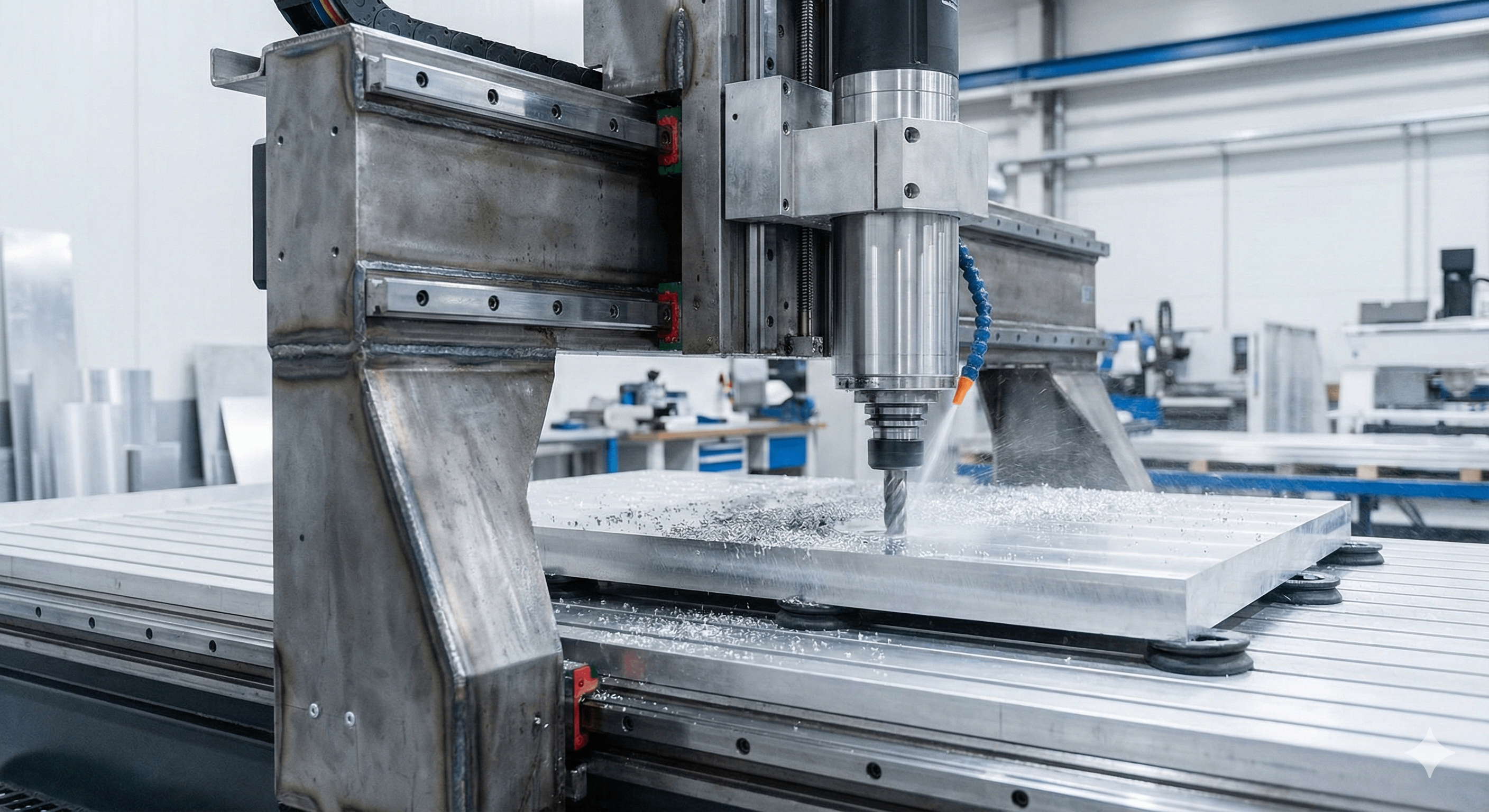
In the global supply chain ecosystem, equipment terminology is often dangerously vague. The term “CNC Router” is a prime example. To a hobbyist, it might refer to a desktop cnc wood router used in a home shop cnc setup; to a procurement manager in the aerospace sector, it must refer to a heavy-duty production asset capable of holding tight tolerances on aluminum alloys 24/7.
For wholesale buyers and OEMs, this distinction is financial. Sourcing the wrong equipment—or partnering with a supplier who relies on basic cnc machines woodworking grade assets—introduces a “Hidden Tax” on every unit produced.
This tax manifests in three specific ways:
- Inconsistent Batch Quality: Variations between part #1 and part #5,000.
- Supply Chain Bottlenecks: Delayed shipments due to unplanned machine downtime.
- Secondary Process Failures: Surface finishes that reveal chatter marks only after expensive anodizing.
This analysis is not a basic introduction. It is a technical deconstruction of Industrial CNC Router Equipment designed for B2B professionals. We will examine the physics of rigidity, the logic of closed-loop kinematics, and the machinability of non-ferrous metals to help you make data-driven sourcing decisions.
I. Structural Mechanics: The Physics of Static Rigidity
Before a single line of G-code is executed, the potential accuracy of any machining operation is predetermined by the machine’s static structure. In the realm of industrial-grade assets, rigidity is the governing constraint.
1. Frame Dynamics: Industrial vs. Hobbyist Architecture
The marketplace is flooded with small cnc routers built from aluminum extrusions. While these desktop cnc router machine models offer modularity for light prototyping, they inherently lack the mass required for effective vibration dampening during metal fabrication.
The Vibration Scenario: When a carbide tool engages with Aluminum 6061 or Brass at 18,000 RPM, it generates high-frequency harmonic vibrations.
- The Risk: On a lightweight frame, these vibrations are amplified, creating “chatter marks.”
- The Consequence: For a wholesale buyer, chatter is a disaster. It ruins the aesthetic of the part and creates microscopic fissures that cause coating failures.
The Industrial Standard: A high-quality large cnc router must utilize a heavy-duty, annealed welded steel frame. Unlike a c and c machine for wood which tolerates flex, an industrial metal router must be immovable. This structural stability is the only way to guarantee that the 5,000th part in a production run is identical to the first.
2. The Gantry Leverage Problem
A common misconception in equipment selection is prioritizing excessive Z-axis clearance. Buyers often ask for a 400mm clearance “just in case.” However, from a physics standpoint, increasing the gantry height drastically reduces lateral rigidity.
- Comparison: CNC wood router manufacturers often prioritize clearance for thick lumber. Industrial metal routers prioritize stiffness.
- Engineering Reality: In precision manufacturing, a tall gantry acts as a lever, amplifying flexibility.
Engineering Best Practice: For sheet metal processing, a lower gantry height yields significantly higher dynamic stiffness. This structural discipline ensures that tolerances are held tightly (within +/- 0.05mm) even when the machine is pushing high feed rates.
3. Table Flatness and Vacuum Integrity
The machine bed serves as the absolute reference plane. In non-ferrous metal fabrication, table flatness is critical. A variance of even 0.1mm across the table can lead to parts that fail to fold correctly.
- The Difference: A standard table cnc machine might rely on a simple MDF board. An industrial unit uses a phenolic grid with localized vacuum zoning.
- ROI Impact: This allows the machine to hold down small parts firmly without mechanical clamps, reducing setup time and material waste.
II. Kinematics & Drive Systems: The Engine of Throughput
Once structural stability is established, the focus shifts to kinematics—how the machine moves mass accurately at speed.
1. Transmission Logic: Helical Rack vs. Ball Screw
In heavy-duty machinery design, the choice of transmission impacts long-term reliability.
- X/Y Axis: For the long axes, a helical rack and pinion system is the industrial standard. Unlike straight-tooth racks found on a wood cutter cnc machine, helical gears have angled teeth that provide smoother motion and minimize backlash.
- Z Axis: For the Z-axis, a ball screw drive is superior, preventing the spindle from dropping during power loss.
This hybrid approach optimizes the cnc router machine for the diverse demands of metal fabrication: high speed for profiling, high torque for drilling.
2. Closed-Loop Control: The Safety Net for Scalability
For B2B buyers, the distinction between stepper and servo motors is critical.
- Stepper Motors (Open-Loop): Common in cnc for woodworkers. They blindly execute commands. If the tool hits a hard spot, the motor “misses a step.”
- AC Servo Motors (Closed-Loop): Used in industrial cnc router equipment. They feature optical encoders that report position back to the controller.
The Scalability Factor: If a servo detects a deviation, it instantly increases torque to correct the position. This “Closed-Loop” architecture allows the machine to run unattended, protecting the buyer from the risk of receiving a batch of drifted parts.
III. The Metal Factor: Machinability Strategies for Non-Ferrous Alloys
While wood routing is forgiving, machining non-ferrous metals (Aluminum, Copper, Brass) requires a distinct synergy of spindle physics and thermal management. This is where general-purpose commercial cnc machine suppliers often fail.
1. Spindle Physics: Runout and Surface Quality
Machining aluminum requires high RPM (18,000+) to achieve the correct surface speed (SFM). However, speed without precision is destructive. Spindle Runout (TIR) becomes a defining factor.
- The Standard: Industrial spindles use ceramic bearings to minimize thermal expansion. For buyers, this ensures that cut edges are smooth and free of burrs, significantly reducing the need for manual deburring.
2. Thermal Management: Preventing “Chip Weld”
The most common failure mode in aluminum routing is “chip welding” (galling). Aluminum is sticky; as it gets hot, it melts and fuses to the cutter flutes.
To combat this, Minimum Quantity Lubrication (MQL) or “Mist” systems are mandatory. From a procurement perspective, if a supplier is using a basic cnc router without an MQL system for aluminum, they are risking your delivery timeline.
3. Tooling Strategy: Geometry Matters
The choice of cutting tool is often the difference between profit and loss. Unlike cnc wood routing which uses standard double-flute bits, metal fabrication demands specialized geometries like Single-Flute (O-Flute) cutters and ZrN coatings to prevent sticking.
IV. The Economic Reality: TCO and Supply Chain Strategy
Ultimately, the technical specifications of a cnc router machine for sale translate directly into economic reality. For a wholesale buyer, the “Total Cost of Ownership” (TCO) is mirrored in the unit price, quality stability, and supply risk.
1. The Real CNC Router Cost: CapEx vs. OpEx
When analyzing the price of cnc router machine assets, one must look beyond the sticker price.
- Entry-Level: A small cnc routers setup might cost under $5,000 but lacks rigidity.
- Industrial-Grade: A high-end cnc router price often exceeds $80,000 to $150,000.
For a manufacturing brand, purchasing a cheap machine leads to high OpEx (Operational Expenditure) in the form of scrap parts and downtime. Conversely, the high capital outlay for industrial equipment is a barrier to entry.
2. The Operational Energy Equation
Industrial efficiency also impacts sustainability. High-end industrial routers consume less energy per part produced due to regenerative braking drives. Furthermore, rigid machines consume fewer cutting tools, offering operational savings that allow for competitive per-unit pricing.
3. The Strategic Value of Outsourcing: Buy vs. Make
Understanding the complexity of cnc router equipment—from the stress-relieved frames to the closed-loop servo systems—often leads companies to a strategic “buy vs. make” decision.
Owning and maintaining such high-capital assets requires a skilled workforce. The cnc router cost is just the tip of the iceberg.
The Solution: For many businesses, the most efficient path to scalability is partnering with a dedicated OEM metal fabrication service. A partner like YISHANG has already amortized the cost of industrial-grade machinery and mastered the nuances of non-ferrous machining.
By outsourcing to a factory that understands the physics of rigidity, buyers gain access to “Aerospace-grade” precision without the capital risk of asset ownership.
V. Frequently Asked Questions (FAQ)
Q: What is the difference between a “c and c router” and a milling machine? A: “C and C” is a common phonetic spelling for CNC (Computer Numerical Control). While a c and c router typically has a large bed for sheet materials (wood, aluminum panels) and higher RPM, a milling machine is designed for smaller, thicker blocks of metal with higher torque.
Q: Can a CNC wood router cut aluminum? A: Technically yes, but poorly. CNC machines woodworking grade frames lack the rigidity to prevent vibration. This results in poor edge quality and drastically reduced tool life compared to an industrial metal router.
Q: What is the typical CNC router price for industrial applications? A: While a desktop cnc wood router can be found for under $3,000, a robust commercial cnc machine capable of holding tight tolerances on metal typically starts at $50,000 and can exceed $150,000 depending on the cnc router computer (controller) and drive system.
Q: Is a home shop CNC suitable for small batch production? A: For prototyping, a home shop cnc is sufficient. However, for batches exceeding 50 units, the lack of closed-loop servo motors means you risk “lost steps” and inconsistent quality, making outsourcing to a professional factory more cost-effective.
Conclusion:
In the search for the perfect manufacturing solution, do not overlook the price of failure. A robust supply chain relies on robust machinery. Ensure your manufacturing partner is equipped with the industrial-grade technology required to deliver excellence, batch after batch.
Ready to scale your production? Contact YISHANG today for precision metal fabrication services backed by industrial engineering expertise.