
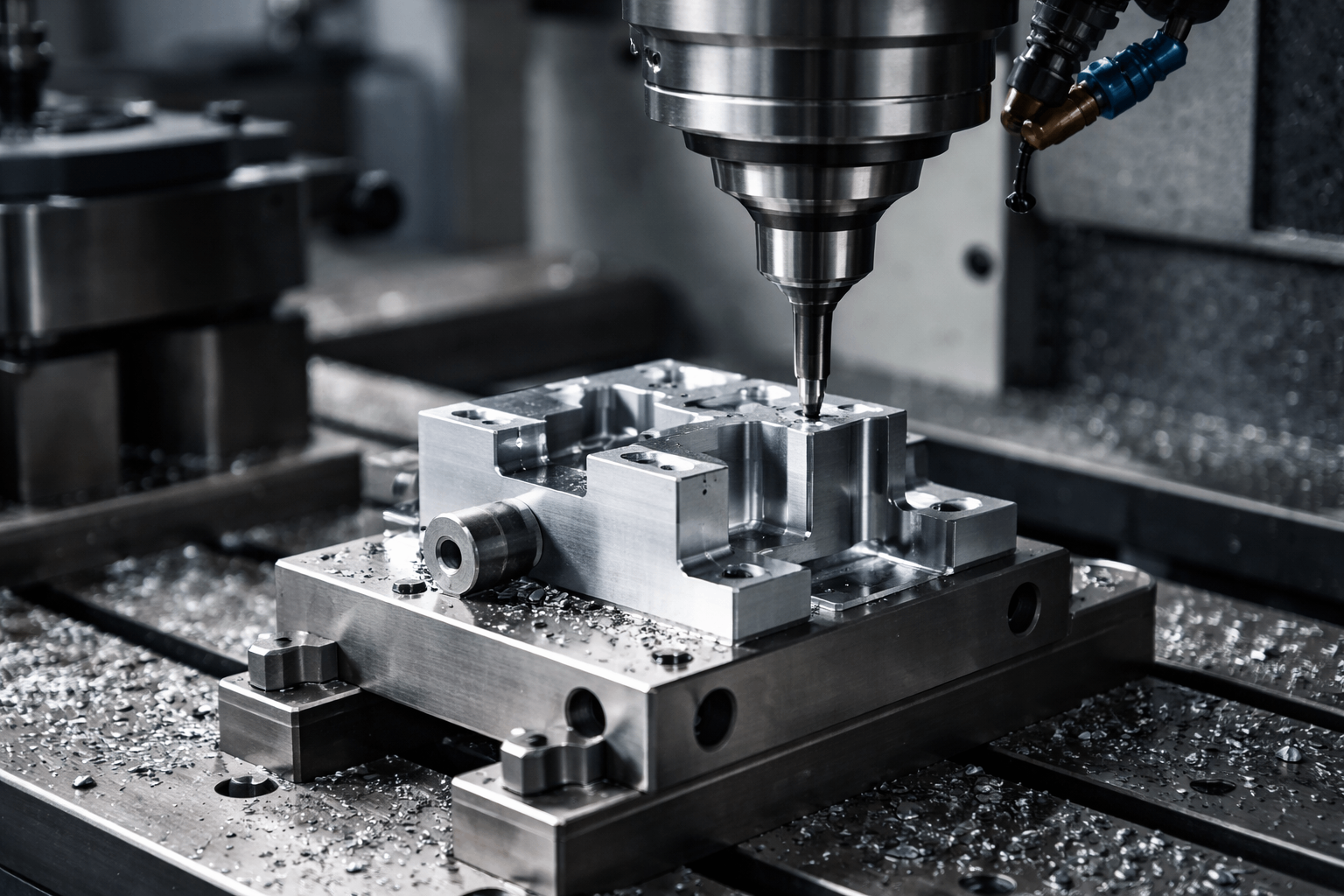
Overseas wholesale buyers rarely read CNC content to understand how machines work. They read to reduce risk in RFQs and repeat orders, especially when a product moves from first articles to recurring shipments. The practical concern is not whether a part can be made once, but whether it will remain consistent over time.
That consistency depends on the machining route, and the machining route is shaped early by design for machining decisions. In search results, you may also see the phrase cnc machine design. In procurement contexts, this usually refers to CNC part design choices that align with machine capability, tooling availability, and setup strategy. This article uses that buyer‑centric meaning.
A design that looks correct in CAD can still create unstable behavior in production. The warning signs are familiar to purchasing teams: quotes filled with assumptions, lead times that change after sampling, or incoming quality that shifts as quantities increase. Instead of repeating generic CNC rules, this article explains the cause‑and‑effect relationships buyers actually care about.
We will move from design assumptions to geometry and tolerances, then to setups, special features, RFQ inputs, and prototype‑to‑production risk. The goal is to help you write clearer RFQs, compare quotes more intelligently, and build more predictable supply.
CNC Machining Behavior Is Driven by Design Assumptions
CNC machining is often described as precise, automated, and repeatable. In practice, it is a constraint‑driven system in which every feature on a drawing carries assumptions about tool access, stiffness, heat generation, and workholding. When those assumptions align with the real setup, machining repeatability is achievable; when they do not, the process adapts in ways that introduce variation.
That adaptation is not operator error. It is physics expressing itself inside your tolerances. A common buyer‑side example is a thin flange located next to a deep pocket. On the drawing, both features look ordinary, but on the machine the deep pocket often forces a long‑reach tool. Long reach increases tool deflection and vibration, making the nearby thin flange more sensitive to instability.
You can still receive an acceptable sample under these conditions, but stability over volume becomes harder to maintain. This explains why two suppliers can quote the same print very differently. One may see a part that can be produced routinely, while another sees a part that can be produced only with higher drift risk and a heavier inspection plan.
These differences are not subjective opinions. They are forecasts of machining behavior across tool life, batches, and setups. For overseas wholesale sourcing, you do not need to become a machinist, but you do need a practical lens for evaluating supplier feedback. When a supplier asks about datums, critical‑to‑quality dimensions, surface finish intent, or allowable corner radii, it usually means they are validating assumptions before those assumptions become schedule or quality risk.
A useful way to think about design for machining is this: CNC machining does not merely make the part. It reveals whether the design cooperates with cutting forces, tool stiffness, and fixturing constraints. Once this is clear, the next question follows naturally: which design choices control stability most strongly?
Geometry Controls Machining Stability More Than Material Choice
Why Geometry Dominates CNC Part Outcomes
Material selection matters, but geometry usually determines whether the machining process remains stable. Two parts made from the same aluminum alloy can behave very differently in production: one may machine smoothly with consistent surface finish, while the other chatters, heats up, and drifts. In most cases, the difference is geometry rather than material.
Geometry governs how cutting forces enter the workpiece and how well the part can be supported during machining. When geometry forces small tools, long reach, or weak support, the system becomes sensitive. That sensitivity is what procurement teams experience as variation, wider quote spreads, and longer lead times.
If a design pushes tool stiffness limits, one supplier may plan conservative feeds, another may add finishing passes, and a third may introduce extra setups. All three responses are reactions to geometry‑driven risk. This is why buyers should treat geometry as a sourcing variable, not just an engineering detail.
Internal Corners, Radii, and Tool Reality
Most milling cutters are cylindrical, which means internal corners will always have a radius. Forcing a very small internal corner radius often triggers a cascade of manufacturing consequences. Smaller tools reduce rigidity, increase chatter, and make surface finish harder to control, especially in harder alloys.
A practical CNC part design approach treats internal radius as a manufacturing interface. When the radius is large enough to allow a robust tool diameter, stability improves. If a sharp corner is truly function‑critical, relief features are often a better solution, as they acknowledge machining physics while protecting functional intent.
For buyers, this matters because corner radii influence tooling choices, which affect cycle time and landed cost. Corner geometry also affects inspection, since small radii are harder to verify consistently without controlled measurement methods.
Feature Ratios That Predict Production Risk
Many production problems are not caused by absolute size but by ratios. Ratios predict tool reach, chip evacuation difficulty, and part stiffness, and they also indicate how quickly behavior will change as tools wear. Three ratios appear frequently in RFQs for machined metal parts: pocket depth relative to pocket width, wall height relative to wall thickness, and hole depth relative to hole diameter.
When these ratios become extreme, suppliers compensate by slowing down, adding finishing, increasing inspection, or adding setups. These compensations raise unit cost and lead time and reduce the number of suppliers capable of delivering stable batches. The table below summarizes stability‑focused guidelines commonly used across CNC production.
| Feature | Stability‑focused guideline | Why it matters in sourcing |
|---|---|---|
| Pocket depth | ≤ 4× pocket width | Long‑reach tools raise vibration and chip evacuation risk |
| Thin walls (metal) | ≥ 0.8 mm preferred | Thin walls flex, increasing scrap and rework |
| Hole depth | ≤ 4× diameter recommended | Deep drilling increases drift and inspection burden |
| Internal corner radius | ≥ tool radius where possible | Small radii force fragile tooling |
If you are comparing quotes, these ratios help explain why pricing can diverge. A supplier quoting aggressively may still be capable, but ratio‑sensitive designs leave less margin. Reduced margin is what later becomes late deliveries and quality disputes as volumes rise.
Holes, Threads, and Standard Tooling: The Fastest Way to Reduce RFQ Friction
In competitive sourcing, holes and threads are where easy CAD can become slow machining. Holes are often numerous, interact directly with assembly, and are frequently specified with tight size or position requirements. When hole design aligns with standard tooling, suppliers can quote faster and run more repeatably.
If a hole diameter matches standard drill sizes, the process is usually faster and more stable. When it does not, the shop may mill the hole instead, which increases cycle time and introduces more variation. Tight‑tolerance holes also benefit from a clear manufacturing intent, such as specifying a reamed fit rather than only a tight diameter.
Threads behave similarly. When thread engagement is much longer than functional need, tapping time increases and breakage risk rises. For many assemblies, moderate engagement provides sufficient strength. When engagement is truly critical, identifying it as CTQ allows suppliers to plan appropriate inspection and process controls.
This topic also aligns with long‑tail search intent. Buyers frequently search phrases related to hole sizing, standard tooling, and thread engagement. Answering those questions in procurement language improves both ranking and conversion.
Tolerances Are Manufacturing Commitments, Not Just Numbers
Tight tolerances are often read as a sign of high quality. In machining, a tight tolerance is better understood as a commitment imposed on the production system. You are asking the system to hold a limit repeatedly across tool wear, batches, fixtures, and operators.
Tolerances shape cost and risk because they determine tool strategy, finishing passes, inspection methods, and sometimes the number of setups required. A tolerance is not just a drawing detail; it is a production decision.
Functional Tolerances vs. Comfort Tolerances
Many procurement issues stem from tolerances that are not functionally necessary. They exist because they feel safer, were inherited from legacy drawings, or seem professional. These comfort tolerances reduce supplier options and increase inspection load without improving performance.
Functional tolerances protect fit, sealing, alignment, or load transfer. They map directly to assembly requirements and can be defended. Identifying CTQ dimensions helps suppliers focus control and measurement where it matters most, improving repeatability and cost stability.
How Tight Tolerances Change CNC Production Behavior
Tight tolerances often push processes toward slower cuts, additional finishing, or special tooling. They may require in‑process measurement using probing, fixtures, or CMMs. None of this indicates weak capability; it reflects the reality of holding a commitment.
In high‑volume production, these effects compound. Tool wear becomes more critical, offset adjustments more frequent, and inspection a larger share of cycle time. This explains a common sourcing pattern: samples pass, then quotes or lead times change for production.
Tolerance Stack‑Up and Datum Strategy
Even reasonable tolerances can cause problems when they stack up. Parts may meet individual dimensions yet assemble inconsistently because variation accumulates. The solution is not tighter tolerances but a coherent datum strategy and clearer definition of functional requirements.
GD&T enables functional control through datums rather than arbitrary dimensions. Referencing standards such as ISO 2768 or ISO 1101 where they clarify intent reduces RFQ friction and inspection disputes.
Machine Setup Is Where Cost and Risk Multiply
Machine setup is the bridge between drawing intent and production reality. Each setup defines how a part is located, clamped, and referenced, and it establishes the coordinate system for tool paths. Every re‑orientation introduces small alignment differences that accumulate as variation.
This is why setup count is a hidden cost driver. More setups mean more fixtures, more handling, and more opportunities for inconsistency. For overseas wholesale buyers, setup count directly influences quote stability, lead time stability, and batch‑to‑batch repeatability.
Setup Count and Procurement Outcomes
A part requiring multiple setups is not automatically a bad design, but it is more sensitive to execution quality. It depends heavily on fixture accuracy and operator discipline. Over time, this sensitivity appears as variation between batches or stretched delivery schedules.
Suppliers who suggest modifying feature orientation are often trying to remove a setup, not redesign your product. Reducing setup count improves repeatability and simplifies production scheduling, which is critical for recurring orders.
Datum Alignment Across Machining and Inspection
Setup stability depends on datums. A strong datum strategy aligns how the part is clamped, how it is measured, and how it functions in assembly. When datums are unclear, suppliers improvise, leading to inconsistent results even when parts pass inspection.
A practical buyer question is which surfaces are used as datums for machining and inspection, and whether they match functional datums. Clear answers usually indicate a stable process mindset.
3‑Axis vs 4‑Axis vs 5‑Axis: A Buyer’s Access‑and‑Risk Framing
Five‑axis CNC machining expands tool access and can reduce setup count, making it valuable for complex surfaces and distributed features. In some cases, multi‑axis machining improves repeatability by avoiding re‑clamping.
However, additional axes do not eliminate cutting physics. Tool stiffness, heat, and part deflection still matter. Programming and verification effort increases, and the process becomes more sensitive to calibration and operator skill.
For wholesale sourcing, axis choice is a risk trade. Added axes can reduce setup‑related variation, but they can also narrow the supplier pool, increase quote spread, and introduce capacity‑related lead time risk. Five‑axis should be specified when access is the limiting factor, not as a default substitute for clean feature layout.
Undercuts and Deep Features: Where Machinable Becomes Unstable
Undercuts are often described as design limitations, but in practice they are stability limitations. Many undercuts are machinable using special cutters, yet those tools are typically less rigid and more sensitive to wear.
As quantities increase, that sensitivity becomes process variation. The risk for buyers is not whether the undercut can be made once, but whether it controls yield and delivery. If a single feature drives scrap or relies on long‑lead tooling, schedules become fragile.
Deep internal features introduce similar challenges. Chip evacuation becomes inefficient, heat accumulates, and re‑cutting chips damages surface finish. These issues rarely appear in short prototype runs but often emerge during continuous production.
RFQ Inputs That Prevent Cost and Lead‑Time Surprises
Many top‑ranking competitors include RFQ guidance because it matches buyer search intent. Buyers are not only asking what is machinable; they are asking how to get stable quotes and predictable supply.
Small RFQ improvements can remove weeks of back‑and‑forth and reduce quote spread. Clarifying CTQs, datum intent, material condition, surface finish function, expected volumes, and inspection expectations allows suppliers to price risk consistently.
Removing hidden assumptions increases supplier confidence. Confident suppliers tend to quote more accurately and deliver more reliably.
Why CNC Prototypes Rarely Predict Production Stability
A prototype is a snapshot, while production is a trend. Prototypes are often made under favorable conditions: new tools, short runs, and close operator attention. These conditions mask the gradual effects that dominate production.
Over time, tool wear changes cutting edges, thermal patterns shift, fixtures fatigue, and material batches vary. A part may remain within tolerance while surface finish degrades or assembly fit becomes inconsistent. These effects are rarely visible in single‑piece samples.
Production‑oriented validation focuses on reducing future surprises. Clarifying CTQs, aligning datums with inspection, and defining change control practices help ensure that prototype performance translates into stable supply.
Design for Machining Is Design for Predictable Supply
For overseas wholesale buyers, sourcing success is judged by outcomes: stable quality, stable lead time, and stable cost. Design decisions influence all three. Designs that cooperate with CNC machining behavior are easier to quote, schedule, inspect, and reproduce across batches.
This is what terms like production‑ready CNC design and machining repeatability really mean in practice. They describe designs with margin, not designs pushed to theoretical limits. Removing fragile decisions early makes second sourcing more realistic and long‑term supply more resilient.
Conclusion: Predictable Machining Behavior Protects Long‑Term Sourcing
Design for machining is not about pushing CNC capability to its limits. It is about aligning CNC part decisions and cnc machine design constraints with real production behavior. Geometry, tolerances, setup logic, and access interact to determine whether a part remains stable beyond prototypes.
When design decisions respect machining realities, production becomes predictable. Costs stabilize, quality holds, and supply becomes easier to manage. That is the outcome overseas wholesale buyers ultimately care about.
If you are reviewing CNC‑machined metal part designs and want feedback focused on production stability rather than one‑off feasibility, YISHANG can support early‑stage design review and RFQ clarification. A short discussion early often prevents long‑term sourcing issues later.