
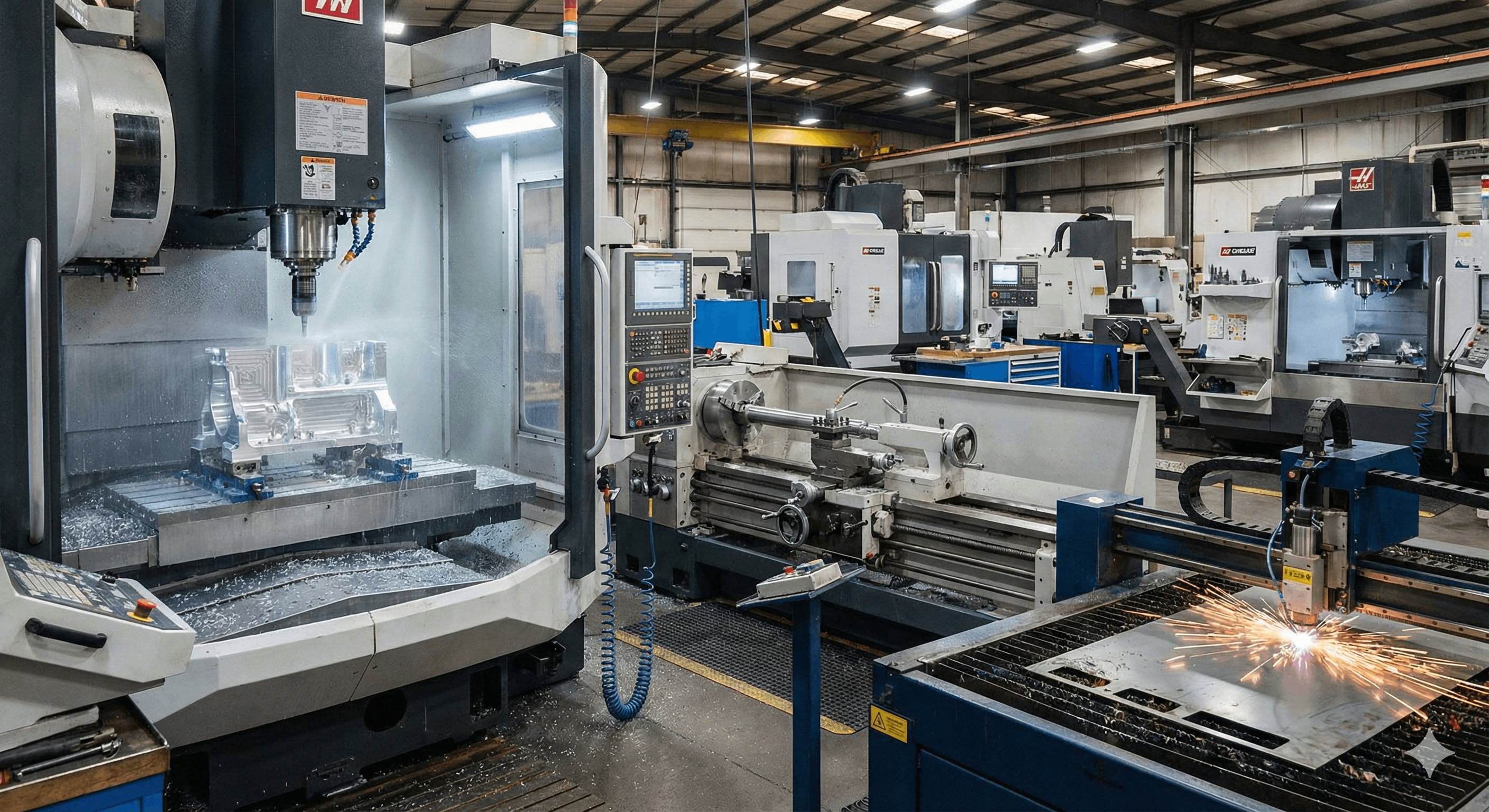
In the competitive landscape of global procurement, selecting a manufacturing partner is arguably the most critical decision a project manager makes. It is not merely about finding a factory with capacity; it is about finding a facility equipped with the specific types of computer numerical control systems that align with your product’s lifecycle.
For wholesale buyers and OEM engineers, the “black box” approach—sending a CAD file and hoping for the best—is a financial risk. The specific machine used to cut your metal dictates your unit cost, your tolerance consistency, and your ability to scale from 500 to 50,000 units.
At YISHANG, with over 26 years of experience exporting to 50+ countries, we have observed a pattern: educated buyers secure better pricing. By understanding the nuances of different types cnc machines, you can design for manufacturability (DFM) and select the most efficient process. This guide moves beyond textbook definitions. It provides strategic cnc machine examples and operational insights to help you engineer a resilient, cost-effective supply chain.
Quick Decision Matrix: Matching Machine to Need
Before diving into the engineering details, use this snapshot to orient your sourcing strategy.
| Machine Type | Best For (Application) | Volume Sweet Spot | Key Benefit |
|---|---|---|---|
| Fiber Laser Cutter | Sheet metal enclosures, brackets, panels | Low to Mid (1-5,000) | Zero tooling cost; high speed. |
| CNC Turret Punch | Perforated panels (e.g., server racks) | Mid to High (5,000+) | Lowest cost for holes; forming capability. |
| Vertical Mill (VMC) | Flat, prismatic parts (plates, heatsinks) | Low to Mid | Flexible setup; lower hourly rate. |
| Horizontal Mill (HMC) | Complex housings (gearboxes, blocks) | High Volume | Gravity chip removal; palette changers. |
| Swiss Lathe | Long, thin pins (Medical/Electronics) | High Volume | Micron precision; zero deflection. |
| 5-Axis Mill | Complex geometry (Aerospace/Implants) | Any Volume | “Done-in-One” setup; reduced risk. |
Part 1: CNC Milling Strategies – Solving the Geometry Equation
Milling is the default process for creating non-symmetrical, prismatic parts. However, the strategic choice for a buyer lies in distinguishing between vertical flexibility and horizontal throughput.
Vertical Machining Centers (VMC): The Flexible Standard
The VMC is the workhorse of the industry. The spindle is oriented vertically, plunging down into the workpiece.
- Procurement Context: Ideal for high-mix, low-volume orders (e.g., 50 sets of custom aluminum housings).
- Pros: Lower setup costs; excellent operator visibility.
- Limitations: Chip evacuation in deep pockets is difficult as gravity works against the process, potentially limiting speed.
Horizontal Machining Centers (HMC): The Volume Engine
For orders exceeding 1,000 units, the HMC becomes a strategic asset. The spindle is parallel to the floor.
- The Gravity Advantage: Chips fall naturally away from the part. This prevents “chip re-cutting” (which damages surface finish) and allows for aggressive feed rates.
- Pallet Pools: Most HMCs at YISHANG feature automatic pallet changers. We load “Part B” while “Part A” is cutting. This continuous throughput reduces your amortized machine cost per unit by 20-30%.
5-Axis CNC Machining: Risk Mitigation at Scale
There is a myth that 5-axis CNC machines are only for expensive aerospace parts. For the wholesale buyer, 5-axis is actually a tool for quality assurance.
- The “Tolerance Stacking” Problem: Machining a complex manifold on a 3-axis machine might require six manual flips. Each flip introduces a margin of error.
- The 5-Axis Solution: By accessing five sides of the part in a single setup (“Done-in-One”), we eliminate human handling errors. This ensures that the 5,000th part matches the 1st part perfectly, drastically reducing rejection rates at your assembly line.
Part 2: Revolutionizing Rotation – Advanced Turning Capabilities
Turning creates cylindrical parts. However, the gap between a standard lathe and a modern turning center defines the scalability of your project.
CNC Turning Centers with Live Tooling
To illustrate efficiency, let’s look at specific cnc machine examples. Consider a hydraulic fitting that needs a turned body, a milled flat spot, and a drilled cross-hole.
- Old Way: Turn on Lathe -> Move to Mill -> Move to Drill Press. Result: High labor cost, high WIP inventory.
- The YISHANG Way: We use Turning Centers with “Live Tooling.” The turret holds rotating drills and mills. We perform all three operations in one chucking.
- Benefit: Superior concentricity (perfect alignment) and significantly faster lead times.
Swiss-Style Machining: The Micro-Precision Standard
For clients in the electronics and medical sectors, standard turning often fails when parts become long and slender (like bone screws). Tool pressure causes the part to bend.
- The Guide Bushing Difference: Swiss machines support the stock material right next to the cutting tool. There is zero deflection.
- Application: If you are sourcing 50,000 contact pins with tolerances of ±0.005mm, Swiss machining is the only viable option. It is designed for “lights-out” 24/7 manufacturing, offering the lowest cost per part for high-precision micro-components.
Part 3: Sheet Metal Architecture – The Scalability of Enclosures
For industries requiring cabinets, chassis, and brackets (Telecom, Vending, Energy Storage), the technology shifts from chip removal to thermal and mechanical cutting.
Fiber Laser Cutting: Agility for Market Entry
Fiber lasers use solid-state diodes to generate a beam that cuts through metal with incredible speed.
- Material Versatility: Unlike older CO2 lasers, fiber lasers can efficiently process reflective metals like copper and aluminum—crucial for EV battery components.
- Strategic Value: “Zero Tooling.” We can cut your prototype chassis directly from the CAD file. If you need to move a hole 2mm, we simply update the code. This makes it the ideal process for New Product Introduction (NPI).
CNC Turret Punching: The High-Volume Economics
When volumes stabilize, the CNC Turret Punch Press offers unbeatable economics for perforation.
- Scenario: A server rack door requiring 5,000 ventilation holes.
- Comparison: A laser must trace every hole. A punch press uses a “cluster tool” to create 20 holes in a single hit.
- Forming: Punch presses can also create 3D features like louvers (vents) and card guides in the same cycle. At YISHANG, we often employ a hybrid strategy: Laser for the outer contour, Punch for the internal holes.
Automated Bending: Precision in the Third Dimension
Cutting is only step one. The CNC Press Brake transforms flat sheets into 3D structures.
- Solving Springback: Metal tries to return to its original shape after bending. Our advanced CNC brakes measure angle in real-time and compensate for material variations.
- Why it Matters: For wholesale orders, consistency is key. Automated back-gauging ensures that every bracket stacks perfectly and fits into your final assembly without forcing.
Part 4: The Invisible Value – EDM, Grinding, and Finishing
In lists of types of cnc, finishing processes are often overlooked. Yet, they determine the reliability of the supplier.
Wire EDM: Supply Chain Security
Wire Electrical Discharge Machining cuts metal using electrical sparks.
- Internal Tooling Maintenance: We use Wire EDM to manufacture and repair our own stamping dies in-house. This means if a tool breaks during your production run, we fix it onsite. We are not dependent on third-party tool shops, securing your lead times.
- Hardened Parts: EDM cuts hardened tool steel as easily as aluminum, essential for wear-resistant industrial components.
CNC Grinding: The Surface Finish Mandate
For dynamic components like motor shafts, “smooth” isn’t good enough.
- The Spec: CNC Cylindrical Grinders achieve surface finishes of Ra 0.4 µm or better.
- The Result: Specifying a ground finish ensures seal integrity in pumps and reduces noise in mechanical assemblies.
Part 5: B2B Sourcing Strategy – Material & Volume Matrix
To act on this knowledge, you must align the types of cnc with your specific project constraints.
1. Material-Specific Considerations
- Aluminum (6061/7075): Ideal for high-speed machining (HSM). Gumminess can be an issue; requires specific coolant strategies.
- Stainless Steel (304/316): Prone to work-hardening. Requires rigid machines (like HMCs) and high-torque spindles to prevent vibration.
- Titanium: Holds heat in the tool. Requires specialized high-pressure coolant systems to prevent tool failure.
2. The Volume-Cost Trajectory
- Prototype (1-500): Prioritize flexibility. Use Fiber Lasers and 5-Axis Mills (Zero Tooling).
- Scale-Up (1k-10k): Prioritize cycle time. Use Turning Centers with Live Tooling and HMCs with Pallet Pools.
- Mass Production (50k+): Prioritize automation. Use Swiss Machining and dedicated Stamping Dies.
Part 6: Quality Control – The Data Behind the Metal
The best machines are useless without verification. YISHANG integrates QC directly into the CNC workflow.
- In-Process Probing: Machines equipped with Renishaw probes measure the part during the cycle. If a tool wears down by 0.01mm, the machine auto-corrects.
- CMM Verification: Final validation is done on Coordinate Measuring Machines, ensuring complex geometries match your CAD model.
- Traceability: For wholesale orders, we provide full material certifications and inspection reports, essential for ISO 9001 compliance.
FAQ: Common Questions on CNC Sourcing
Q: What are the most common types of CNC machines for general metal parts? A: For prismatic parts, the Vertical Machining Center (VMC) is most common. For cylindrical parts, the 2-axis Lathe is standard. However, for efficient wholesale production, YISHANG recommends HMCs and Turning Centers with Live Tooling.
Q: Which CNC type is best for reducing unit costs on high-volume orders? A: For sheet metal, the CNC Turret Punch Press is generally cheaper than laser cutting for high volumes of holes. For machined parts, Horizontal Machining Centers (HMC) offer the best economy due to pallet changers and speed.
Q: Can YISHANG handle both Sheet Metal and Machining? A: Yes. We are an integrated facility. We use different types cnc machines under one roof, allowing us to build complex assemblies (e.g., a laser-cut chassis with milled heat sinks and turned standoffs) without outsourcing.
Q: How do I choose between 3-axis and 5-axis machining? A: If your part requires machining on multiple faces, 5-axis is often cheaper in total because it eliminates manual re-fixturing time and improves accuracy, despite the higher hourly machine rate.
Conclusion: Engineering a Resilient Supply Chain
Navigating the diverse landscape of types of cnc is not just an academic exercise; it is the foundation of a profitable supply chain. A factory that relies solely on one type of technology will inevitably force your products into inefficient workflows, compromising either cost or quality.
For the global wholesale buyer, the goal is to find a partner that acts as a technology-agnostic ecosystem. At YISHANG, our fleet ranges from the brute force of plasma cutters to the microscopic precision of Swiss lathes. We do not push a process because it is what we have; we select the process that aligns with your volume, material, and budget.
Your brand’s reputation is built on the durability and precision of your products. Ensure your manufacturing partner has the depth of capability to support that promise.
Ready to optimize your next project? Contact the YISHANG engineering team today for a manufacturing audit and quote.