
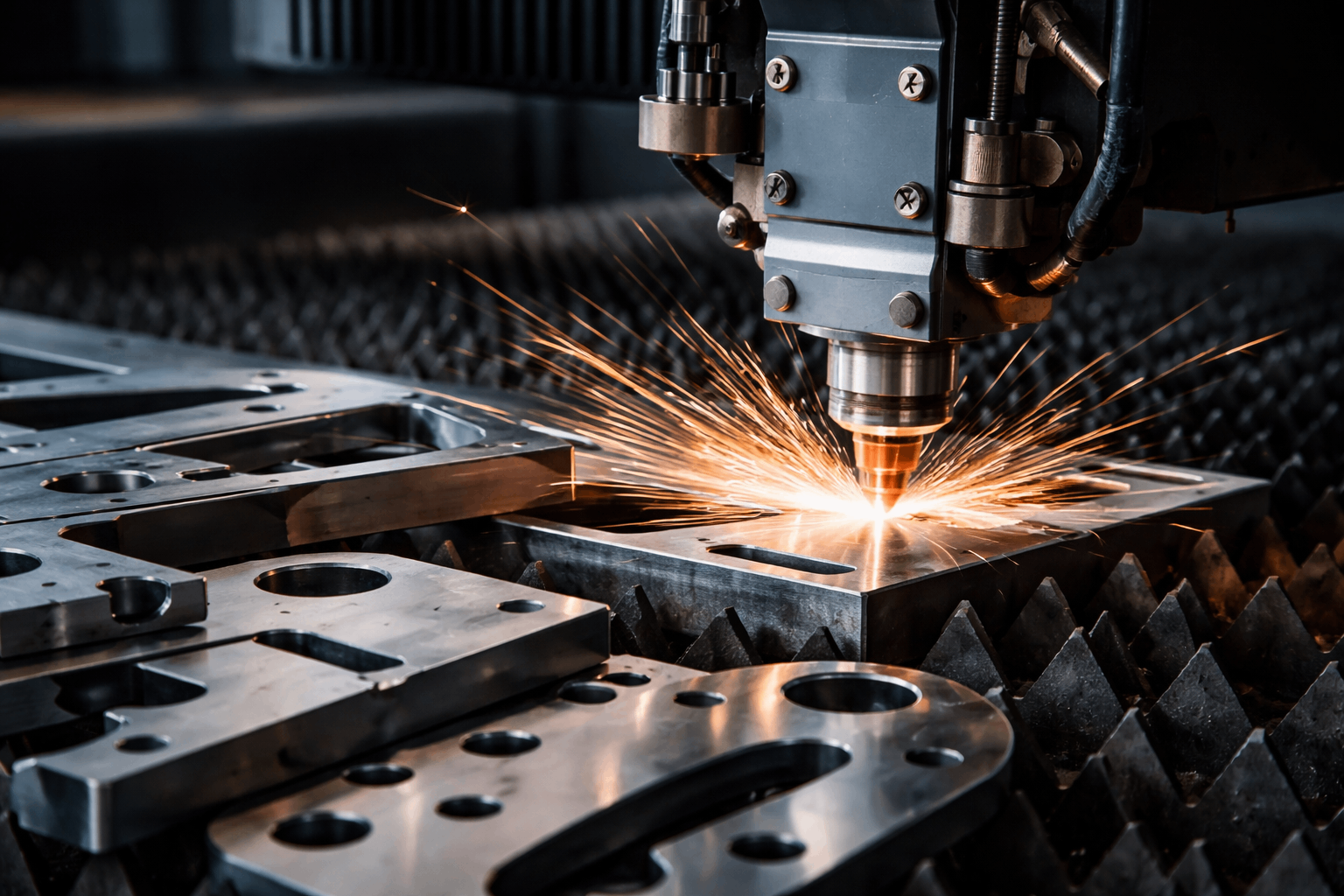
For overseas wholesale buyers, a supplier’s blog is rarely read for general knowledge. It is used as a risk-screening tool. Buyers skim technical content to judge whether a manufacturer understands what happens after the first successful sample—when volumes increase, delivery schedules tighten, and parts must perform consistently across batches.
Most procurement teams already know that stainless steel can be laser cut. What they are trying to determine is whether stainless laser cutting will remain stable over time: whether edge quality drifts, flatness changes after shipping, or secondary operations suddenly become inconsistent.
That is why many buyers search with phrases such as custom cut stainless steel for bending, laser cutting SS burr issues, or stainless steel laser cutting consistency. These searches are not about operating a machine. They are about avoiding downstream cost, delays, and quality disputes.
This article is written for that reality. It explains why stainless steel laser cutting often looks reliable during sampling yet becomes unstable in production, and how buyers can evaluate suppliers in ways that support long-term, repeatable supply rather than one-time success.
1. Why Early Samples Create Confidence but Not Proof
In most sourcing projects, stainless laser cutting is first evaluated through samples. These samples are usually produced under ideal conditions: the machine is cold, the sheet is not densely nested, and there is little pressure to maximize throughput. Under these circumstances, laser cutting SS delivers clean edges and accurate dimensions with minimal effort.
From a buyer’s perspective, it is reasonable to assume that if the sample meets the drawing, the process is ready for volume. The problem is that sampling conditions are static, while production conditions are dynamic. Once volume increases, cycle time shortens, nesting density rises, and heat begins to accumulate across the sheet and cutting bed.
This is why a process can “work once” without being stable over time. The risk for wholesale buyers is not whether the supplier can hit tolerance on a single part. The risk is whether the same result can be repeated across hundreds or thousands of parts without gradual drift.
A useful procurement mindset is this: a sample proves capability, but only sustained production proves process discipline. Buyers who separate these two ideas early tend to experience fewer surprises after repeat orders begin.
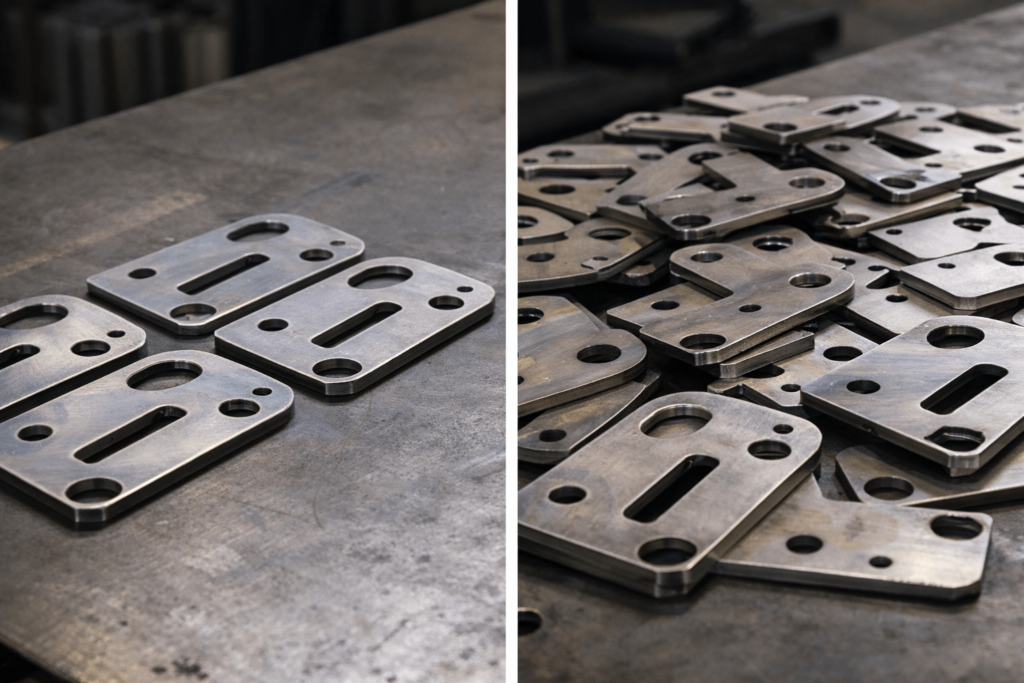
2. How Stainless Steel Responds to Repeated Thermal Exposure
Stainless steel is chosen for corrosion resistance and mechanical stability, which often leads buyers to assume that material behavior is predictable. During stainless steel laser cutting, however, material behavior is strongly influenced by thermal history rather than chemistry alone.
Laser cutting is inherently a thermal process. The beam melts material locally while assist gas ejects the molten pool. Even when the visible heat-affected zone appears narrow, residual stresses extend beyond the cut edge. In isolated cuts, these stresses usually dissipate. In dense nests or continuous runs, they accumulate and interact.
This accumulation explains a common procurement complaint: parts measure correctly at incoming inspection but change shape after cooling, stacking, transport vibration, or a later bending operation. For buyers sourcing custom cut stainless steel parts for forming or assembly, this delayed behavior can turn into scrap, rework, or line stoppages.
Understanding how stainless steel reacts to repeated thermal exposure helps explain why first impressions are often misleading. Stability depends not just on material grade, but on how consistently thermal input is managed over time.
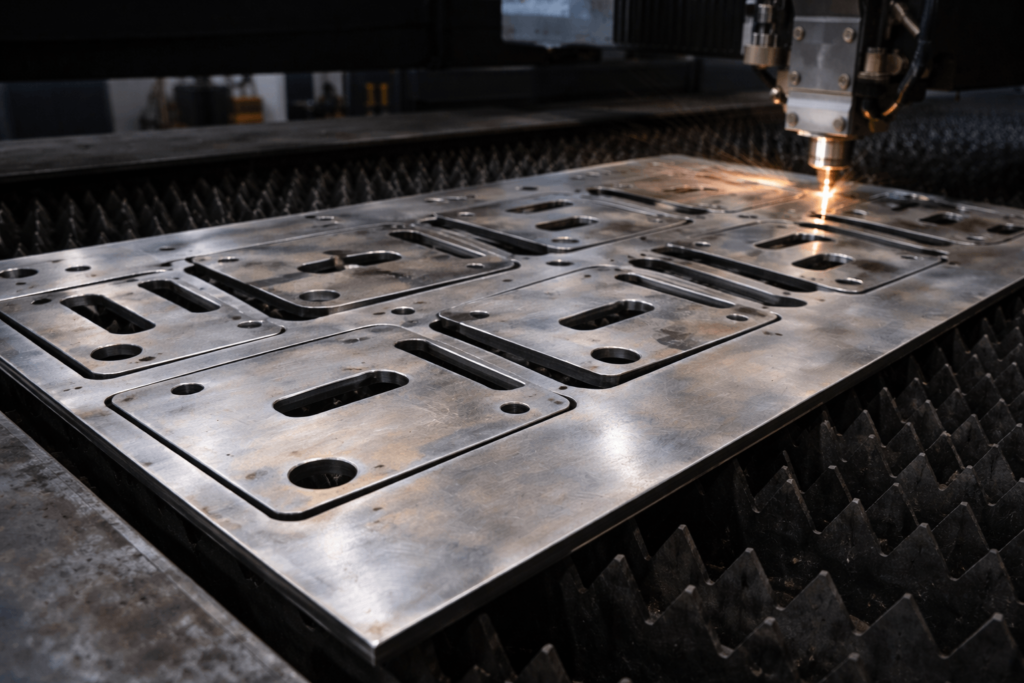
3. Why Parameters Define Possibility, Not Stability
Many articles about stainless steel laser cutting emphasize parameters such as power, cutting speed, focus position, and assist gas. These variables are important, but they are often misunderstood as guarantees rather than operating boundaries.
In practice, parameters define a window in which cutting is possible. Stability over time depends on how sensitive that window is to changes in heat load, optics condition, gas flow, and machine wear. A parameter set that performs well on a short run can become fragile during continuous production.
For example, increasing power may improve penetration but also increases thermal input. Nitrogen assist gas is commonly used to keep edges clean and oxide-free, especially for appearance-sensitive parts, but its effectiveness depends on nozzle condition and gas purity. Oxygen can increase cutting speed, yet introduces additional heat and oxide formation that may affect edge consistency and downstream welding.
From a buyer’s standpoint, the key question is not “what settings do you use,” but “how do those settings behave as volume and time increase.” Suppliers who discuss process windows and drift control provide more useful insight than those who focus only on machine specifications.
4. Edge Quality as an Early Signal, Not a Cosmetic Detail
In laser cutting SS, edge quality is often treated as a finishing concern. For experienced buyers, edge behavior is a practical indicator of process stability.
Changes in burr height, dross, discoloration, or edge micro-hardening often appear before dimensional accuracy drifts. These changes usually signal an imbalance between thermal input and material ejection, or a shift in shielding effectiveness.
For buyers sourcing laser cut stainless steel parts that will be bent, welded, or assembled, consistent edge behavior is directly tied to downstream yield. Slight increases in burrs can add deburring cost. Variations in discoloration can affect appearance or corrosion performance. Edge hardness changes can alter bend angles or weld penetration.
Monitoring edge trends across batches—not just inspecting a single sample—provides an early warning that helps buyers address issues before they escalate.
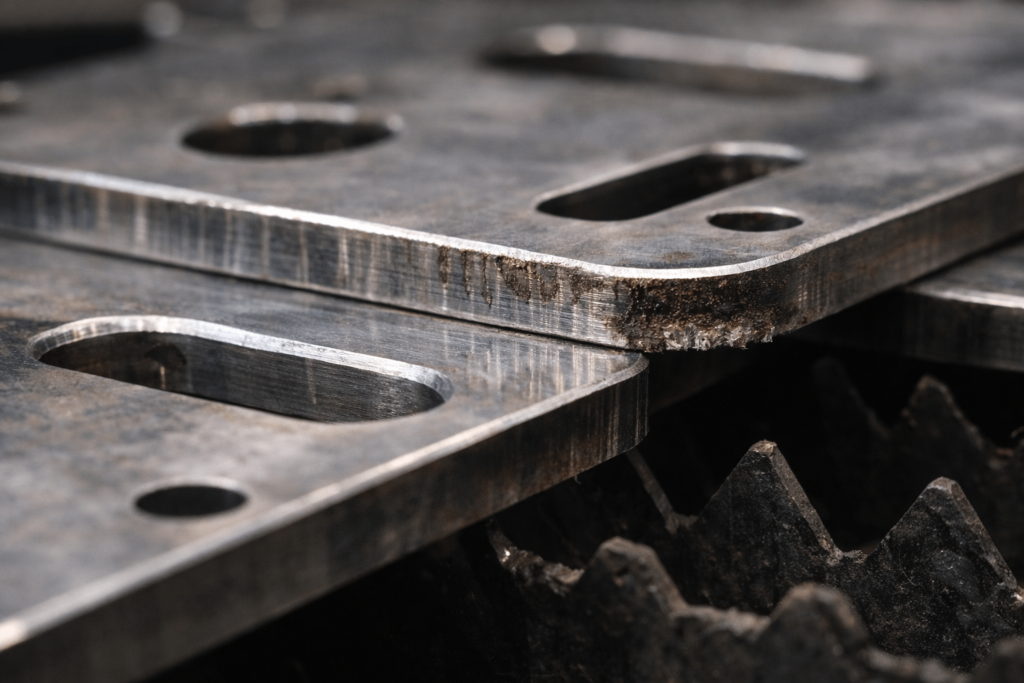
5. Why One Sheet Behaves as a Single Thermal System
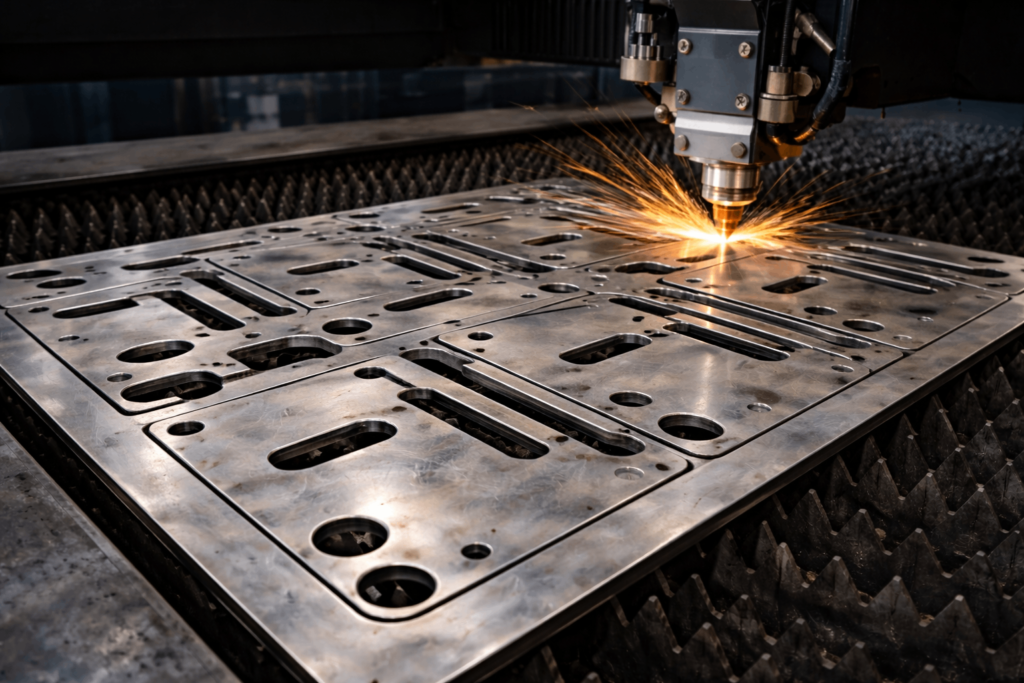
In production, stainless steel laser cutting rarely involves isolated parts. Multiple components are cut from the same sheet, sharing a common thermal environment.
As cutting progresses, the sheet develops uneven temperature zones depending on nesting density and cut sequence. Areas cut early may cool while adjacent regions continue heating. These thermal gradients influence how stresses build and release.
This is why identical parts cut from different positions on the same sheet can behave differently in flatness or edge condition. It is also why the same part can behave differently across different nests.
For procurement teams, this explains why aggressive material-utilization targets can sometimes compromise consistency. A slightly lower yield may reduce rework and improve batch-to-batch stability if it allows better thermal balance.
6. Time as a Hidden Variable in Stainless Laser Cutting
Most quality evaluations focus on what comes off the laser table today. Over weeks and months, however, the cutting system changes.
Optics gradually accumulate fine contamination that affects beam efficiency. Nozzles wear and alter gas flow patterns. Slats and supports collect debris and change how parts are supported during cutting. Each change is small, but the combined effect is process drift.
This explains why quality often degrades gradually rather than failing suddenly. Buyers managing repeat orders often see a pattern: early batches match samples, later batches require more deburring or show subtle edge variation.
Suppliers who recognize time as a variable—and actively manage maintenance and monitoring—are better positioned to support long-term wholesale supply.
7. Why Prototypes Rarely Reveal Volume Risk
Prototypes are usually produced under forgiving conditions: low cutting density, generous spacing, and minimal cycle pressure. These conditions suppress thermal accumulation and system interaction.
Production environments are different. Higher throughput, tighter nests, and continuous operation amplify every variable discussed earlier. That is why prototypes often look better than later runs even when drawings and materials remain unchanged.
For buyers, this does not mean prototypes are useless. It means supplier qualification should reflect production reality. Evaluating stainless laser cutting under production-like conditions provides a more accurate picture of long-term capability.
8. What Buyers Should Include in an RFQ for Custom Cut Stainless Steel
Many sourcing problems begin with incomplete alignment rather than poor execution. When requesting quotes for custom cut stainless steel parts, buyers can reduce risk by clarifying a few production-critical points.
Beyond drawings and material grades, it is helpful to identify which dimensions are function-critical, how edge quality will be evaluated, and at what stage flatness is measured—immediately after cutting, after cooling, or after secondary processing.
Packaging and stacking expectations also matter. Residual stress can express itself differently depending on how parts are handled after cutting. Aligning on these details early reduces ambiguity and corrective actions later.
Clear RFQ inputs do not eliminate process variation, but they make stability measurable rather than assumed.
9. A Buyer-Focused Evaluation Framework Beyond Dimensional Accuracy
Dimensional accuracy is essential, but wholesale supply requires broader indicators that predict stability over time.
| Buyer observation | What it may indicate in stainless laser cutting | Procurement impact | What to clarify early |
|---|---|---|---|
| Burr trend increases across batches | Thermal balance shift, nozzle wear, focus drift | Extra deburring, delayed assembly | Edge requirement, deburr allowance, drift control |
| Edge discoloration varies lot-to-lot | Shielding change, higher heat load | Appearance issues, weld variation | Gas strategy, cosmetic edge expectation |
| Flatness changes after shipping | Residual stress accumulation | Fit-up issues, scrap | Flatness check timing, packaging method |
| Secondary ops vary (bend angle, weld gap) | Edge hardness or micro-distortion | Line disruption | Downstream process needs |
| Same part differs by sheet position | Nest density, thermal gradients | Mixed quality in one delivery | Nest strategy for critical parts |
Shared standards also help reduce ambiguity. General tolerances are often referenced by ISO 2768. Stainless sheet material is commonly specified to ASTM A240 or EN 10088. Thermal cut edge quality may be discussed using ISO 9013 classifications.
Using a common vocabulary does not replace engineering discussion, but it reduces misunderstanding and aligns expectations early.
Conclusion: Consistency Is the Capability Wholesale Buyers Rely On
Stainless laser cutting is a proven manufacturing process. For wholesale buyers, the differentiator is not whether a supplier can produce an accurate sample, but whether results remain consistent across repeat orders.
Heat accumulation, time-dependent drift, and sheet-level interaction explain why production behavior can differ from early trials. Buyers who evaluate these factors early reduce downstream risk and improve long-term yield.
For buyers evaluating suppliers such as YISHANG, the most valuable conversations often focus on stability rather than equipment lists. If you are sourcing laser cut stainless steel parts for repeat orders and want to reduce production uncertainty, we welcome early technical discussions focused on consistency, not just first-sample results.