
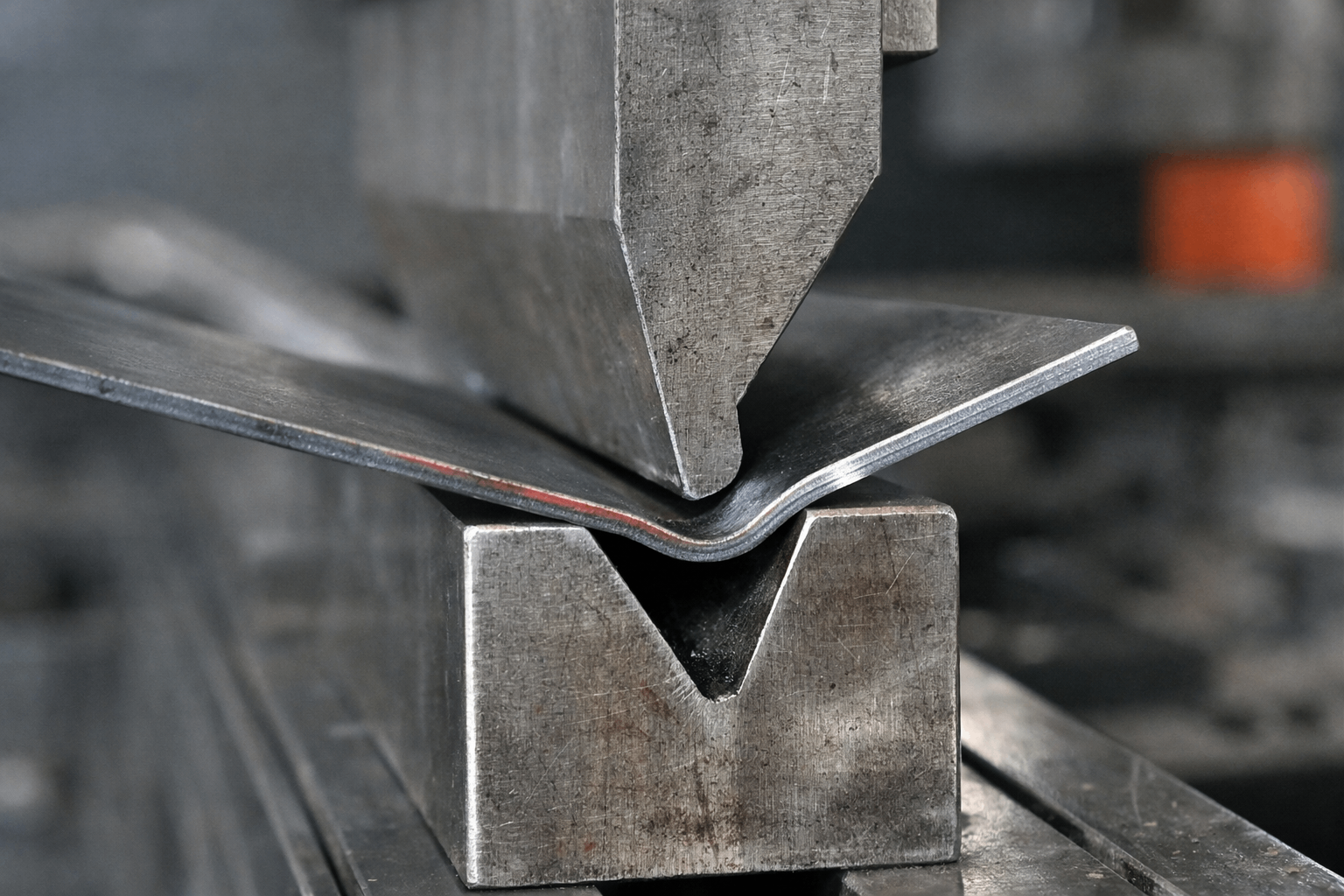
Steel sheet bending often appears straightforward when observed during a factory visit.
Quick Summary: What Makes Steel Sheet Bending Stable?
In batch production, steel sheet bending is stable when material response is predictable, constraints are consistent, and the process window is repeatable. Instability appears when yield strength variation, tooling wear, friction changes, or support differences are allowed to accumulate across time. For overseas wholesale buyers, stability is verified not by a perfect first sample, but by evidence of lot control, tooling management, and in-process checks that prevent drift before parts reach assembly.
A press brake can run smoothly, angles can be checked, and the first bent sheet can meet the drawing. For overseas wholesale buyers, that early confidence is often where risk begins.
In real batch production, the question shifts from accuracy to stability. The issue is not whether one bent sheet metal part can pass inspection. The issue is whether the next 500 pieces will assemble the same way in a different country, on a different line, under a different schedule.
Most costly bending failures are not dramatic. They show up as slow drift: a flange that slowly walks out, a bend angle that changes enough to create gap variation, or a part that “measures fine” but will not seat in the assembly fixture. These are expensive because they are discovered late—after shipping, after coating, or after sub-assemblies have already been built.
This article is written for B2B wholesale procurement teams and engineers sourcing bent sheet metal for repeat orders. Instead of generic bending guidelines, it explains how stability is built, why drift appears after sampling, and how to evaluate suppliers with buyer-verifiable evidence. YISHANG uses the same logic internally when planning cnc sheet metal bending programs for export customers.
Why Steel Sheet Bending Problems Are Almost Never Detected at the Bend Itself
Procurement conversations about sheet metal bending usually start with drawings and tolerances. A bend angle, flange length, and a few critical features look measurable and clear. Sampling often confirms that the geometry is achievable.
That first success can hide the real question. Many bending defects are not created by an “incorrect” press brake stroke. They are created by a process that allows internal stress, support conditions, and friction to vary in small ways that compound over time.
In a press brake cycle, the sheet is forced into an elastic‑plastic state. When the tooling retracts, the constraints change instantly. The part begins to recover elastically, and it also becomes sensitive to what happens next.
This is why buyers often see a pattern: the first articles are clean, and later cartons contain parts that require hand tuning. The bend itself might still measure close to target, but downstream operations reveal the instability.
One common sourcing scenario illustrates this clearly. A buyer approves samples for a bracket with a long flange. The bracket is later powder coated, then assembled with a rivnut and a mating panel. The assembly team reports inconsistent gaps.
In many cases, the “root cause” is not coating or assembly. It is that a small angular change at the bend becomes a larger positional error at the end of a long flange. The bend passed inspection, but the system behavior did not.
For overseas wholesale buyers, this distinction matters: capability is making a correct bend once. Control is delivering repeatable sheet bending behavior across lots, shifts, and time.
What Changes Inside Steel the Moment Bending Begins
Neutral Axis, K-Factor, and Why Flat Patterns Disagree
Stress Distribution and Neutral Axis Shift
To evaluate stability, it helps to reframe bending. Sheet metal bending is not only a geometric operation. It is a controlled redistribution of stress.
When the punch drives the sheet into the die, the outer fibers stretch while the inner fibers compress. Between them, elastic and plastic deformation coexist through the thickness. This creates a stress gradient that remains in the part after unloading.
That stored stress is known as residual stress. Residual stress itself is not a defect. Every bent sheet carries some of it. Problems begin when residual stress is uneven, amplified by geometry, or allowed to vary from part to part. Variation is the enemy of assembly.
A related mechanism is the neutral axis shift. The neutral axis is the layer with near-zero strain during bending. In higher strength steels and in bending stainless steel sheet metal, the neutral axis shifts depending on thickness, material strength, and tooling geometry. This shift directly influences elastic recovery and bend behavior.
K-Factor and Flat Pattern Consistency
In practical terms, neutral axis behavior explains why different suppliers can generate different flat patterns from the same drawing. Bend allowance and bend deduction calculations depend on where the neutral axis is assumed to be, often expressed through a K-factor.
The K-factor is not a fixed material constant. It changes with material grade, thickness, punch radius, die opening, and bending method. When these variables are not aligned, flat patterns may differ even when CAD geometry is identical.
For procurement teams, this is a common source of friction. Hole locations appear correct in CAD, yet shift after bending. Stable programs avoid this by agreeing early on who controls the flat pattern and how the K-factor is validated, often using a simple bend test coupon during sampling.
Why This Matters for Repeat Orders
This step helps prevent batch-level misalignment later. It also reduces sensitivity to small changes in die opening, punch radius, and friction as production progresses.
For buyers, the key implication is straightforward. Suppliers who only discuss final angles are describing results. Suppliers who can explain stress behavior, neutral axis assumptions, and K-factor validation are describing control.
This difference becomes critical in repeat orders. Two suppliers may deliver identical first samples. The one with a stress-aware approach is more likely to maintain consistent output months later.
Why Springback Is Not the Real Problem in Steel Sheet Bending
Springback is one of the most searched topics in steel sheet bending, and many articles treat it as a defect to eliminate. In production, springback is better understood as a normal behavior that must be kept predictable.
Springback is elastic recovery after unloading. If every part springs back by the same amount, compensation is straightforward.
The production problem is springback variation. Variation forces operators to “chase” angles, and it creates mismatch at the assembly stage.
Springback varies because the system varies. Material strength can shift within allowed ranges. Surface condition changes with oil, film, or sheet finish. Tool radii slowly change as punches and dies wear. Support conditions differ if parts are handled, stacked, or oriented differently.
This is why “dialing in” a single compensation number is rarely a long-term solution. It works during sampling, and it fails later.
For overseas buyers, a better way to evaluate a supplier is to shift the question. Instead of asking whether they can reduce springback, ask how they keep springback behavior stable during cnc sheet metal bending across different lots.
That question is not confrontational. It simply invites the supplier to explain their control strategy. A clear answer usually signals process maturity.
The Hidden Conditions That Decide Whether Springback Becomes Unstable
Springback becomes unstable when recovery is allowed to change from cycle to cycle. Three conditions dominate in practice: thickness distribution, geometry amplification, and rolling direction.
Thickness and Geometry Effects
Even when a mill meets thickness tolerance, the distribution of thickness across a batch can matter. In high-volume sheet bending, mixed thickness across coils or sheets changes force requirements and stress profiles.
Geometry then multiplies the impact. Long flanges, asymmetric profiles, and features close to the bend line act like levers.
A small angular difference at the bend can become a much larger positional difference at the end of a long flange. That is why buyers sometimes report “the angle is okay, but the part doesn’t fit.”
Inside bend radius and die opening also contribute. A tighter inside radius increases strain and can increase sensitivity to material variation. A wider die opening reduces forming force but can increase springback.
This does not mean tight designs should be avoided. It is a reason to recognize where stability needs to be engineered.
Rolling Direction and Grain Orientation
Steel sheet is directionally processed. Rolling creates anisotropy that influences how material deforms. Bending parallel to rolling direction can behave differently than bending perpendicular.
When orientation is not controlled or documented, springback variation can look random. For global sourcing, that is a problem because it is hard to debug across borders.
Stable suppliers treat grain direction as an input. If orientation is critical, they document it and maintain it across batches.
For buyers, asking whether a supplier tracks rolling direction is not “overly technical.” It is a practical way to reduce unexplained drift.
Why Press Brakes Solve Repetition, Not Stability
CNC Sheet Metal Bending: What It Controls—and What It Does Not
Press brakes—especially CNC systems—are excellent at repeating motion. They can repeat ram position, backgauge location, and bend sequences with high precision.
Repetition is not the same as stability. Stability means the material responds the same way over time.
Most press brakes are effectively open-loop with respect to material behavior. They do not directly sense yield strength shifts, residual stress state, or friction variation at the tool interface.
So the machine can run the same program while results drift. This is why an equipment list alone is rarely enough to predict batch consistency.
It also explains a common buyer surprise. Two suppliers may both claim CNC capability. One produces stable output; the other requires frequent operator tuning.
The difference is rarely the machine brand. It is whether the supplier controls the variables that the press brake cannot “see.”
This is also where bending method matters.
In CNC sheet metal bending, stability improves when machine repeatability is paired with process feedback. Angle sensing, recorded compensation values, and mid-run verification help detect drift early. These measures do not eliminate variation, but they limit how far it can move before correction is required.
For buyers, the practical takeaway is simple: CNC capability is a baseline. Process feedback and documented adjustment rules are what turn that capability into predictable output.
Bending method matters here. Air bending provides flexibility but is more sensitive to variation. Bottoming and coining can reduce angle variation but increase tonnage and tool wear.
The right approach depends on geometry, thickness, and finish requirements. What buyers should look for is a supplier who can explain why a method was chosen, not one who defaults to a single practice.
Where Steel Sheet Bending Actually Becomes Controllable
Stability in steel sheet bending is built through constraints. Control is created before the angle is measured.
Three levers matter most: tooling geometry, support and follow-up, and a repeatable process window.
Tooling geometry defines stress distribution and sensitivity. Punch radius, die opening, and tool alignment influence inside radius, bend allowance, and how strongly springback expresses itself.
Support and follow-up limit unwanted movement during forming and immediately after unloading. When a long flange is unsupported, small differences in contact and friction can change the recovery path.
A repeatable process window defines what “normal” looks like. It reduces dependence on operator intuition and makes output stable across shifts.
For buyers, the key idea is the difference between bending accuracy and bending stability. Accuracy is hitting the target today. Stability is hitting it after thousands of cycles, after a material lot change, and after normal tool wear.
Buyer-Focused View of Stability Drivers
Procurement teams often need to evaluate suppliers quickly. A useful approach is to translate shop-floor variables into buyer-verifiable evidence.
| Stability factor | Typical source of drift | Buyer-verifiable evidence | Why it matters for overseas assembly |
|---|---|---|---|
| Material property range | Yield strength spread | Material reports, lot separation | Fit changes across batches |
| Tooling condition | Punch and die wear | Inspection intervals, wear criteria | Gradual angle/radius change |
| Support method | Inconsistent constraint | Photos/process notes, fixture use | Warping after transport or welding |
| Process window | Sensitivity to friction | Defined setup limits, first-article plan | Operator-dependent output |
| Time effects | Heat and wear accumulation | Extended trial data, mid-run checks | Late-stage drift surprises |
This approach focuses on preventing issues that appear only at production scale. It is a way to prevent “it worked in sampling” from becoming “it failed in volume.”
Why Perfect Samples Often Predict Future Instability
Sampling is essential, but sampling is not a stress test. A perfect sample proves that a bend can be achieved under ideal conditions.
It does not prove that the same result will hold after time and volume introduce normal variation.
Tool surfaces change as runs continue. Material lots change across shipments. Handling stress accumulates through stacking and transport.
These are not rare events. They are normal production conditions.
This is why some overseas buyers experience a frustrating sequence. They approve a sample, place a bulk order, and receive cartons that assemble inconsistently.
A more reliable evaluation includes a small “time-exposed” run. It does not need to be large.
It simply needs to include realistic elements: a pause, a re-load, and (if feasible) a material lot transition. The goal is to learn whether the process resists drift.
Buyers can frame this as risk reduction rather than mistrust. A supplier who is confident in their control usually welcomes a stability-focused trial because it reduces future disputes.
Why Measurement Confirms Errors Instead of Preventing Them
Inspection is indispensable for any supplier. But inspection happens after bending has already occurred.
That timing is important. Measurements confirm whether a part meets requirements, yet they do not prevent variation at the source.
Even 100 percent inspection cannot stabilize an unstable process. It can only sort output after drift has happened.
More mature operations treat inspection as verification. They monitor the conditions that predict drift: tool condition, material orientation, and support consistency.
For overseas buyers, this approach reduces the chance of discovering problems only after shipment.
A shared tolerance language helps as well. Standards such as ISO 2768 are commonly used for non-critical features.
The goal is not to “tighten everything.” The goal is to define what variation is acceptable so control efforts focus on what matters in assembly.
If angle measurement method matters, align it early. Different gauges and different measurement locations can produce different readings on the same part.
Aligning the measurement method early reduces disputes later.
The Design Decisions That Quietly Decide Bending Outcomes
Many bending issues are designed in. Drawings often describe geometry without describing behavior.
In sheet metal bending, behavior is shaped by stress, constraints, and time. If the drawing leaves no room for that behavior, the supplier must chase perfection in a process that naturally varies.
Three design patterns commonly increase risk. Tight inside radii increase strain and sensitivity. Features close to bend lines distort under residual stress. Overly tight tolerances on non-functional features increase scrap without improving function.
Design for manufacturability does not mean lowering standards. It means focusing control where it protects function.
For procurement teams, it helps if drawings clearly mark critical-to-function dimensions. It also helps if the intended measurement method is noted for bends.
If you are sourcing bent sheet parts for repeat assembly, a short design review before ordering can save weeks of downstream negotiation.
Suppliers who offer a practical design review are usually the ones who have lived through batch drift and built systems to prevent it.
Steel Sheet Bending as a Production Risk, Not a Fabrication Step
For overseas wholesale buyers, the practical question is not “Can the supplier bend the sheet?”
The practical question is “Will the process stay stable when volume, time, and normal variation enter the system?”
When bending is unstable, the consequences are familiar. Rework grows. Assembly slows. Shipments get delayed. Teams argue about whose measurement is correct.
These costs rarely appear in initial quotes, but they strongly influence total landed cost.
Thinking in production-risk terms also changes RFQ behavior. Buyers get better outcomes when they specify what matters to stability: material traceability expectations, acceptable variation windows, and critical-to-function features.
Suppliers also benefit because they can plan control points early instead of improvising later.
This is where a good supplier relationship becomes measurable. Not through slogans, but through reduced disruption.
Frequently Asked Questions Buyers Ask About Steel Sheet Bending
Why do bent sheet metal parts fit during sampling but fail later in assembly?
Because sampling is performed under ideal conditions. Tooling is fresh, material comes from a single lot, and time-dependent effects are minimal. In production, normal variation accumulates. Without controls, small differences in angle or flange position grow into assembly problems.
How can springback variation be controlled in batch production?
Springback itself cannot be removed, but variation can be limited by controlling material lots, tooling condition, support methods, and process windows. Stable programs treat springback as a monitored behavior, not a one-time compensation.
What should be specified in an RFQ for CNC sheet metal bending?
Beyond geometry, RFQs benefit from notes on material traceability, acceptable variation windows for non-critical bends, and expectations for first-article and mid-run verification. These signals reduce ambiguity before production starts.
Air bending, bottoming, or coining—which is more stable for repeat orders?
Each method has trade-offs. Air bending offers flexibility but is more sensitive to variation. Bottoming and coining reduce angle spread but increase force and tool wear. Stability depends on matching the method to geometry, volume, and tolerance requirements.
Rethinking Steel Sheet Bending as a Controlled System
The most stable programs treat steel sheet bending as a controlled system. Variation is limited at its source, control conditions are documented, and stability is verified over time.
This approach is not about over-complicating bending. It is about making output predictable across batches.
For global buyers, predictability is what protects schedules and reduces total cost. It also makes repeat orders easier because the process is not re-invented each time.
If you are sourcing bent sheet metal parts for repeat production, YISHANG can support your team with stability-focused process planning and export-ready documentation. This article reflects the same internal evaluation logic we use when preparing programs for overseas wholesale customers. If you want to review a current drawing or compare process assumptions before placing a bulk order, you are welcome to send an inquiry.