
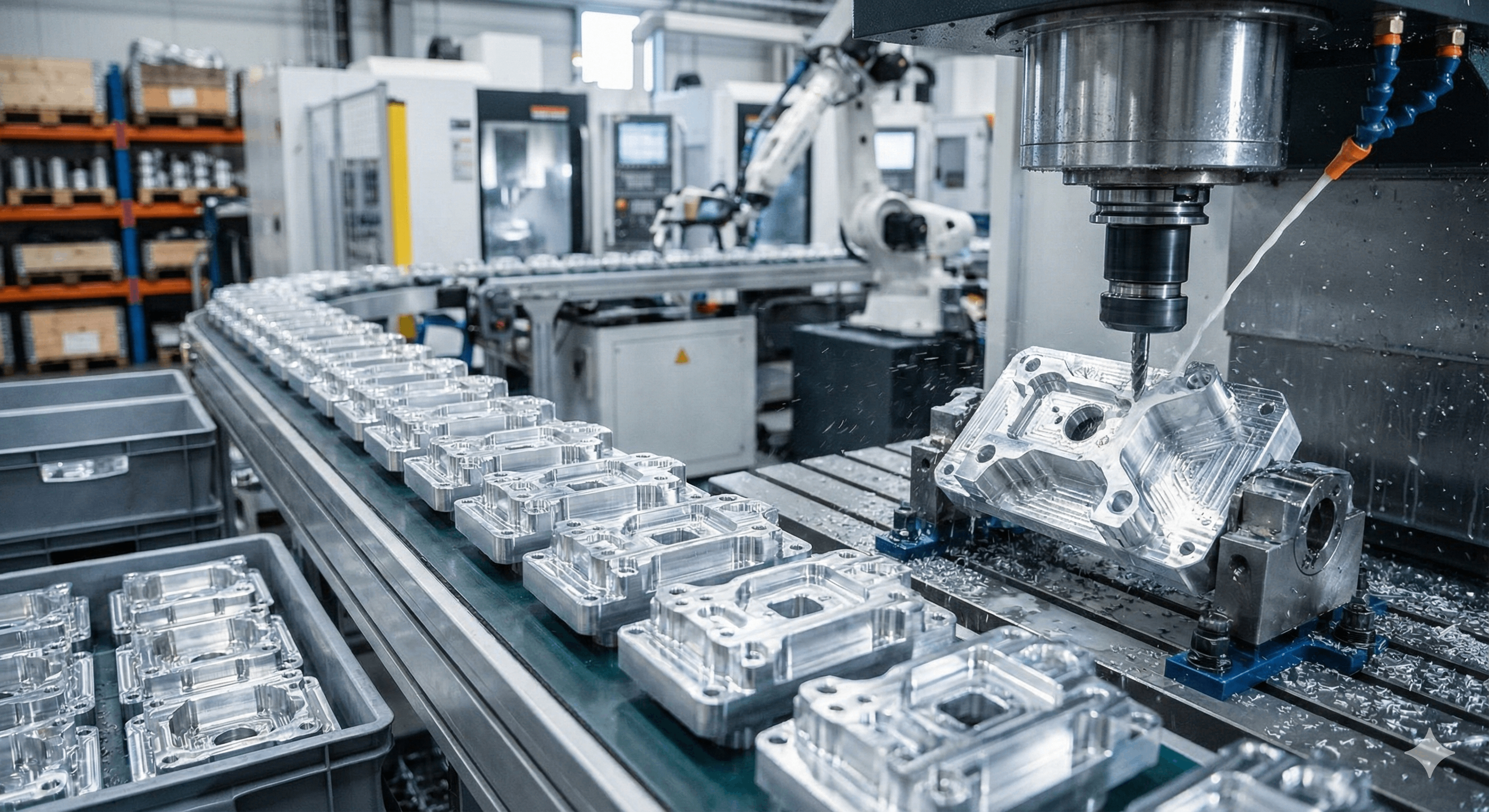
For senior procurement directors and product engineers, the transition from a validated prototype to a full-scale high volume CNC machining run is the ultimate stress test of a global supply chain. It is a critical pivot point where the primary focus must shift from “design feasibility” to “supply chain resilience,” “process stability,” and Total Landed Cost.
A component design that functions perfectly in a lab can easily become a financial liability if the manufacturing strategy does not account for the rigorous demands of mass production—from cycle time economics to the risks of oceanic corrosion. Navigating manufacturing runs ranging from 1,000 to over 100,000 units requires a mindset fundamentally different from sourcing prototypes. It is not merely about finding a high volume machine shop with excess capacity; it is about identifying a partner who acts as an operational extension of your business.
This guide serves as a technical blueprint for B2B buyers scaling production. It dissects the engineering levers that drive cost-down initiatives, the quality protocols that ensure batch-to-batch consistency, and the logistics strategies that protect margins. At YISHANG, we implement these strategies daily to transform procurement from a cost center into a competitive advantage.
The Economics of Scale: Deconstructing Total Landed Cost
For OEM procurement managers, the “Unit Price” listed on a quote is a deceptive metric. The true measure of success in mass production is the Total Landed Cost—the final cost of the part validated, packaged, delivered, and ready for assembly. Without a deep dive into the cost structure, hidden expenses such as freight inefficiencies, “Quality Fade” (gradual quality degradation), and assembly line disruptions can erode margins significantly.
The Cycle Time Multiplier: Winning the “Seconds Game”
In prototyping, setup costs and NRE dominate the invoice. In high volume CNC machining, Cycle Time is the absolute king. Cycle time is the total duration required to machine a single part, including cutting, tool changes, and rapid movements.
The mathematics of scale are unforgiving: in a production run of 50,000 units, reducing cycle time by just 30 seconds per part saves approximately 416 hours of machine capacity. At a standard machine burden rate, this single optimization translates to tens of thousands of dollars in direct savings.
Experienced CNC turning services providers play the “Seconds Game” by optimizing tool paths to maximize Material Removal Rates (MRR). For the buyer, this means understanding that rigid adherence to non-critical cosmetic standards can unnecessarily inflate costs. By collaborating with YISHANG engineers to relax tolerances on non-mating surfaces, we can increase feed rates significantly, directly lowering the machine-hour cost component without compromising functionality.
Amortizing NRE: Strategic Upfront Investment
Volume production often necessitates an upfront investment in Non-Recurring Engineering (NRE)—custom hydraulic fixtures, dedicated form tools, or multi-part “tombstones.” While a $5,000 fixture seems expensive compared to a standard vise used for prototyping, it is a strategic lever for unit price reduction.
If a dedicated fixture allows for high-density loading (machining 16 parts simultaneously), it drastically reduces operator intervention and increases spindle uptime. When amortized over 100,000 parts, the NRE adds mere cents to the unit cost, while the efficiency gains reduce the price by dollars. Smart procurement involves embracing these capital expenses to secure a stable, lower long-term unit price, rather than minimizing upfront spend at the expense of production efficiency.
Machine Selection Strategy: Matching Tech to Volume
A common oversight in CNC sourcing is failing to match the part geometry to the correct machine architecture. Using a standard 3-axis mill for a complex, high-volume part is a recipe for inefficiency. Below is a comparative guide to selecting the right technology for your volume run:
| Feature Requirement | Recommended Machine Type | Why It Wins in High Volume |
|---|---|---|
| Complex Cylindrical Parts (<32mm) | Swiss CNC Lathe | Simultaneous turning/milling in one cycle; zero deflection. |
| Prismatic Parts (Multi-Sided) | Horizontal Machining Center (HMC) | “Tombstone” fixtures hold 20+ parts; automated pallet changers reduce downtime. |
| Large Housings (5-Sided) | 5-Axis Indexing (3+2) | Completes part in “One Hit”; eliminates manual flipping and tolerance stack-up. |
| Simple Flanges/Plate Work | Vertical Mill with Robot Loading | Low hourly rate; robotic arms enable lights-out manufacturing over weekends. |
Swiss Machining for Precision Small Parts
For small, complex cylindrical parts (under 32mm diameter) required in volumes of 5,000+, standard lathe processing is often too slow. Swiss CNC Machining is the game-changer here. Unlike conventional lathes, Swiss machines slide the stock through a guide bushing, cutting close to the support point. This eliminates deflection and allows for extreme precision.
More importantly, Swiss machines can perform milling, drilling, and turning simultaneously. A part that might require three separate setups on traditional machines can be dropped complete in one cycle on a Swiss lathe. If your BOM includes pins, shafts, or connectors, asking your high volume machine shop about their Swiss capabilities is a mandatory vetting question.
5-Axis Indexing vs. Continuous Machining
For larger, prismatic parts, the debate is often between 3-axis and 5-axis. In high volume, we rarely use “continuous” 5-axis machining (which is slow and for complex contours). Instead, we use 3+2 Axis Indexing.
This allows the tool to approach the part from five sides in a single setup. The primary benefit is not just geometry, but Accuracy and Speed. By eliminating the need to manually flip the part (which introduces human error), we guarantee position tolerance. For a run of 10,000 housings, this “One-Hit” strategy prevents the tolerance stack-up that typically causes rejection rates to spike in multi-setup workflows.
Engineering for Manufacturing (DFM): Technical Cost Reduction
The most effective cost reduction happens before the metal is cut. In precision CNC manufacturing, the design phase dictates up to 70% of the final production cost. Proactive Design for Manufacturability (DFM) audits are essential to align part geometry with production realities.
Geometry Optimization: Trochoidal Milling Strategy
A frequent inefficiency in design transfer is the specification of tight, square internal corners. Since CNC tools are cylindrical, cutting a square corner requires the tool to stop and pivot, causing chatter (vibration) and heat buildup. This forces the machine to run slowly to avoid tool breakage.
In a high volume scenario, YISHANG engineers recommend increasing internal corner radii slightly beyond the standard tool diameter (e.g., a 6.3mm radius for a 6mm tool). This enables Trochoidal Milling (dynamic milling), where the tool maintains constant circular motion and high speed. This invisible geometric adjustment can reduce cycle time by 20% and extend tool life, ensuring your production schedule isn’t plagued by downtime for tool changes.
Threading Efficiency: The Shift to Form Taps
Threaded holes are major cost drivers. For volume production, we advocate switching from traditional “Cut Taps” to “Form Taps” (Roll Taps) wherever ductile materials (like aluminum or mild steel) allow.
Cut taps create chips, which can clog automated feeders or damage threads during retraction. Form taps, conversely, displace metal to create threads through plastic deformation. They produce zero chips, create stronger threads, and run at higher speeds. Designing pilot holes to accommodate form taps eliminates the risk of conductive chips causing shorts in electronic assemblies—a critical detail for electronics OEMs.
Project Spotlight: Automotive Cost Reduction
Challenge: An EV charging client needed 20,000 aluminum heatsinks. The original design required 3 machine setups and had a 12% scrap rate due to flatness issues. YISHANG Solution: We transitioned the raw material from block stock to a custom Near Net Shape Extrusion. We then implemented a custom vacuum fixture for single-setup machining. Result: Material waste reduced by 65%. Cycle time dropped from 14 minutes to 6 minutes. Total Unit Cost reduced by 42%.
Advanced Material Strategy: Balancing Cost and Machinability
In high-volume manufacturing, material selection must balance mechanical requirements with “Machinability Ratings.” A material that is difficult to cut increases cycle time and tool wear, directly inflating the unit price.
Aluminum 6061 vs. 7075: A Cost-Benefit Analysis
Engineers often default to Aluminum 7075 for its high strength. However, 7075 is harder, more expensive, and wears tools faster than the standard 6061-T6. If structural analysis permits, switching to 6061 can reduce raw material costs by 20-30% and improve machining speeds by another 15%. For heat sinks or cosmetic parts, Aluminum 6063 (often used in extrusions) offers superior thermal conductivity and anodizing quality at a lower cost.
Brass and Copper: The Speed Champions
For electrical components, Brass C360 is the gold standard for high volume. It has a machinability rating of 100% (the benchmark). It cuts incredibly fast with minimal tool wear. While the raw material cost of brass is higher than steel, the massive reduction in cycle time often makes the finished part cheaper in volumes over 10,000 units. Sourcing managers should evaluate the total part cost, not just the raw material price per kilogram.
Surface Finishing at Scale: Managing Tolerance Stack-up
A critical, often overlooked aspect of OEM metal fabrication is how surface finishing affects final dimensions. In high volume, “Tolerance Stack-up” from anodizing or plating can ruin a precision fit.
Anodizing and Plating Considerations
Anodizing adds thickness to the part (typically 0.005mm to 0.02mm depending on the type). In a prototype, this might be negligible. In a high-volume run with a tight H7 bore tolerance, this growth can cause assembly failure.
We work with clients to define “Pre-Plate Dimensions.” We machine the part slightly undersized so that after plating, it hits the target tolerance perfectly. Furthermore, identifying “racking points” (where the part is held during plating) is crucial. These points will have no coating. Defining these non-cosmetic areas on the print prevents rejected lots due to visible rack marks.
Supply Chain Strategy: Inventory and Form Factors
Stability is as important as quality. High volume CNC machining unlocks strategic sourcing options that low-volume purchasing cannot access, specifically regarding raw material form factors and inventory modeling.
Near Net Shape Sourcing: Reducing “Buy-to-Fly” Ratios
In prototyping, parts are machined from solid blocks, often wasting 70% of the material as chips. In volume production, this waste is unacceptable. YISHANG employs “Near Net Shape” sourcing.
For aluminum parts with constant cross-sections, we commission custom Extrusions. The raw material arrives shaped like the part profile, requiring only finish machining. For steel, Cold Rolled or precision-ground stock eliminates turning operations. While these custom materials have Minimum Order Quantities (MOQs), they drastically reduce the “Buy-to-Fly” ratio (the ratio of raw material weight to finished part weight), yielding significant savings.
Blanket Orders and Kanban: Cash Flow Optimization
Transactional purchasing (ordering batch-by-batch) exposes buyers to price fluctuations and lead time instability. We encourage Blanket Orders—a single purchase order for 50,000 units with a scheduled 12-month release.
This allows us to purchase raw material in bulk, hedging against inflation. In return, we hold finished inventory in our warehouse and release it via a Kanban system. This maximizes your working capital (you only pay upon shipment) and provides a “Safety Stock” buffer against demand spikes or shipping delays.
Quality Assurance: Risk Management via Process Control
In B2B sourcing, quality is not just about “good parts”; it is about Risk Management. A 1% defect rate in a 100-piece run is one bad part. In a 50,000-piece run, it is 500 defective units that can jam assembly lines and damage reputation.
Statistical Process Control (SPC) vs. 100% Inspection
Inspecting 50,000 parts manually is impossible and prone to fatigue error. We rely on Statistical Process Control (SPC). By measuring a statistically significant sample at regular intervals and plotting data on control charts, we monitor Process Capability (Cpk).
If a dimension drifts due to tool wear, the trend is identified and corrected before a part goes out of tolerance. This shifts the focus from “detecting defects” (inspection) to “preventing defects” (control), ensuring the 50,000th part is identical to the first.
Traceability and Documentation
For automotive and medical clients, data is as critical as metal. We maintain full traceability from the raw material heat number to the specific machine shift. We provide comprehensive documentation packages including First Article Inspection (FAI), Material Certifications (Mill Certs), and Finishing Reports. This data trail allows for surgical containment in the event of a field issue, limiting liability and protecting your brand.
Logistics: The Final Mile of Quality
Shipping 50 tons of precision metal parts requires a strategy distinct from shipping prototypes. A weak logistics plan can result in a container of rusted or damaged goods, negating all manufacturing value.
VCI Corrosion Prevention
Ocean freight exposes metal to high humidity and salinity. Standard oiling is often insufficient and requires costly cleaning upon arrival. We utilize Volatile Corrosion Inhibitor (VCI) packaging. VCI papers release a vapor that forms a molecular protective layer on the metal, preventing oxidation without greasy residue. Parts arrive ready for assembly.
High-Density Custom Packaging
Shipping “air” is expensive. We engineer custom vacuum-formed trays or honeycomb dividers to maximize container density. This prevents part-to-part contact (shipping rash) and optimizes the number of units per pallet. By reducing the physical volume of the shipment, we effectively lower the freight cost per unit, directly improving your Total Landed Cost.
Frequently Asked Questions (FAQ)
What is considered “High Volume” in CNC machining? Generally, high volume refers to orders exceeding 1,000 units per run, or annual quantities over 10,000. However, the definition depends on complexity; for complex 5-axis aerospace parts, 500 units might be considered high volume.
At what quantity should I switch from CNC to Die Casting? For aluminum parts, the tipping point is usually between 5,000 and 10,000 units. If your design is frozen (no changes expected) and volumes exceed this, investing in a die-casting mold often yields a lower unit price despite the high upfront tooling cost.
How does YISHANG handle price fluctuations in raw materials? For Blanket Orders, we can purchase raw material in bulk upfront to lock in pricing for the duration of the contract, insulating you from market volatility.
Conclusion: Partnering for Strategic Growth
Scaling from prototype to production is a supply chain transformation. It requires a departure from the transactional “job shop” mentality and an embrace of strategic partnerships focused on long-term stability.
The lowest quote on a spreadsheet is rarely the winner once the hidden costs of quality rejections, delayed shipments, and rusted inventory are tallied. The most successful procurement leaders engage with manufacturers who act as technical consultants—partners who challenge designs for efficiency, manage inventory to smooth cash flow, and engineer robust logistics.
When you are ready to move from “feasible” to “scalable,” look for a partner who understands the complete lifecycle of high-volume manufacturing. From DFM audits to VCI packaging, YISHANG ensures your growth is built on a foundation of precision, data, and trust.
Ready to optimize your high-volume production? Contact our engineering team today for a Manufacturing Feasibility Review and discover how we can drive value for your supply chain.