
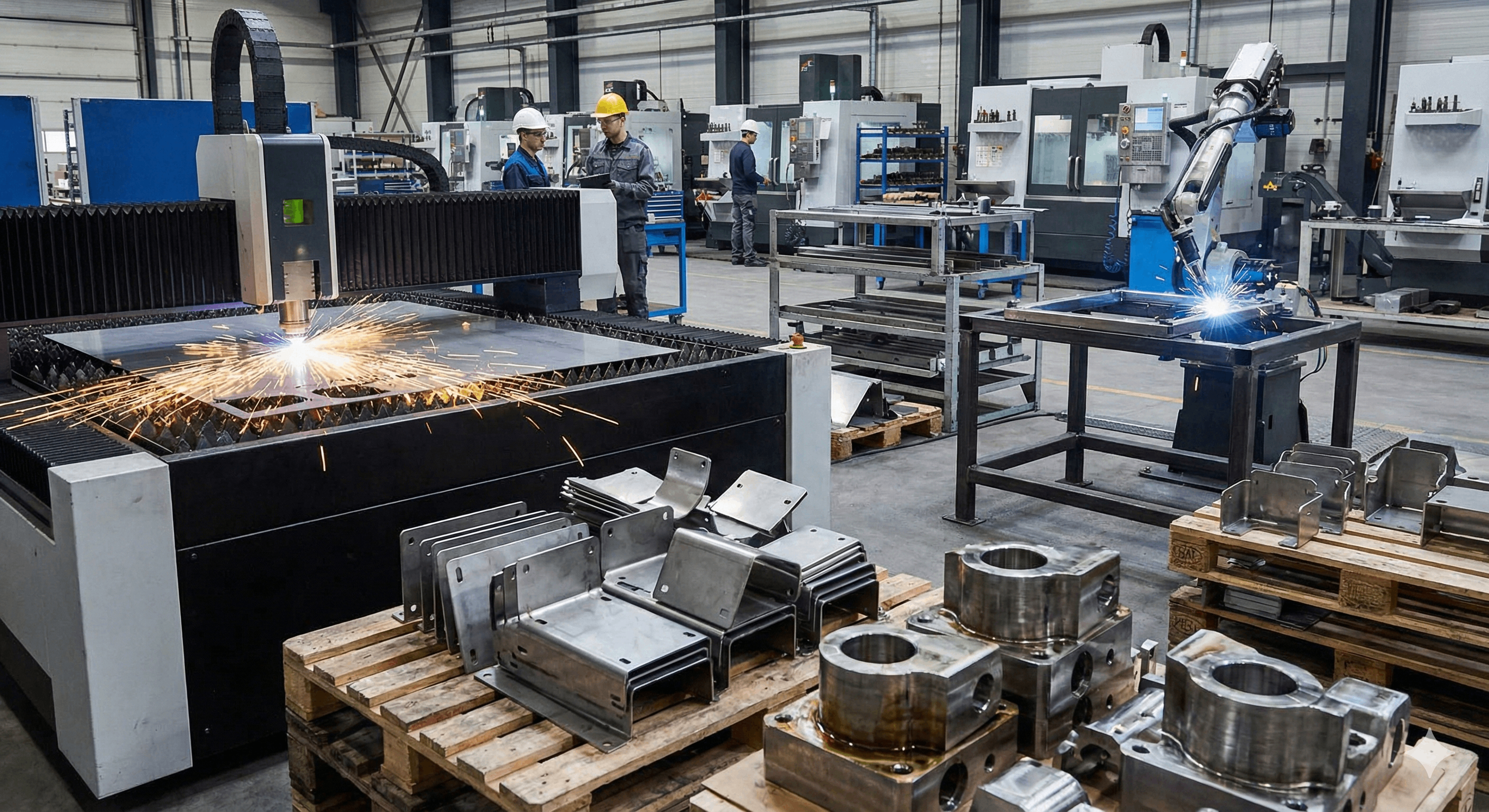
The Strategic Imperative in Modern Metal Sourcing
In the high-stakes environment of global trade, the distinction between a thriving wholesale business and one struggling with margins often lies deep within the supply chain. For procurement directors, sourcing agents, and category managers, the manufacturing of metal parts has evolved far beyond a simple transactional exchange of drawings for hardware.
It is no longer just about finding a supplier; it is about engineering a supply chain that is resilient, scalable, and financially optimized. The current market is saturated with digital platforms and generalist workshops. However, for a B2B buyer, the challenge is identifying a manufacturing partner capable of delivering consistent quality across ten thousand units while simultaneously reducing the Total Landed Cost (TLC).
A prototype is easy; mass production with zero defects is a discipline. This guide serves as a strategic roadmap for international wholesalers and OEMs. We move beyond the rudimentary definitions of metal manufacturing processes to explore the operational realities that drive value. We will examine how to balance precision with economy, the distinct advantages of factory-direct sourcing, and how to leverage advanced fabrication capabilities to safeguard your market reputation.
1. The Economics of Process Selection: A Decision Matrix
The most impactful financial decision in part manufacturing is matching the production method to your specific order volume. A frequent inefficiency we observe involves buyers adhering to a specific manufacturing process simply because “that is how it was done previously.”
To aid in your decision-making, we have compiled a strategic matrix comparing the most common processes based on volume, cost, and lead time.
Manufacturing Process Selection Matrix
| Process Type | Ideal Volume (Units) | Upfront Tooling Cost | Unit Cost at Volume | Key Benefit for Wholesalers |
|---|---|---|---|---|
| Laser Cutting & Bending | 1 – 1,000 | Low / None | High | Zero tooling cost; immediate design changes possible. |
| CNC Machining | 1 – 5,000 | Low | High | Extreme precision (±0.01mm) for complex 3D geometries. |
| Metal Stamping | 5,000 – 100,000+ | High | Very Low | Lowest possible unit cost; unmatched repeatability. |
| Robotic Welding | 1,000+ | Medium (Fixtures) | Low | Structural consistency; eliminates human error. |
The Cost-Volume Pivot Point
For initial market testing, precision sheet metal fabrication (Laser + Bending) is the logical financial choice. It allows for agility. However, as market demand stabilizes, a mature manufacturing partner will analyze your annual usage.
If your volume hits the “Pivot Point” (typically around 2,000-5,000 units depending on geometry), transitioning to metal stamping or progressive die forming becomes imperative. While this incurs an initial NRE (Non-Recurring Engineering) cost for molds, it can slash unit costs by 40% to 60%. At YISHANG, we actively model these ROI scenarios for our clients, ensuring you never pay for an inefficient process.
2. Factory-Direct vs. Digital Platforms: Securing Accountability
A growing trend in metal manufacturing is the rise of digital brokerage platforms. While convenient for prototyping, relying on an algorithm-based middleman for high-volume wholesale orders introduces significant risk.
The Communication Gap
Platforms often anonymize the factory. When a technical issue arises—such as a specific bend radius causing material cracking—the information must pass through the broker’s support team before reaching the engineer on the floor. This “telephone game” delays resolution and increases the risk of misinterpretation.
The Direct Advantage
Partnering directly with a factory like YISHANG eliminates this layer. You have direct access to the DFM engineers who are analyzing your CAD files.
- Accountability: If a quality issue occurs, there is no finger-pointing between the platform and the vendor. The factory owns the process and the result.
- Cost Transparency: You are not paying the platform’s 20-30% markup fee, which directly impacts your wholesale margins.
- Agility: Design changes can be implemented instantly on the shop floor without waiting for a platform’s central system to update.
3. Material Sourcing Strategy: Mitigating Supply Chain Risk
Material selection is often viewed solely through the lens of mechanical performance. For a wholesaler, however, it is equally a matter of supply chain security and global compliance.
Standardization vs. Availability
Specifying niche or proprietary alloys can lead to disastrous lead-time disruptions. A robust sourcing strategy prioritizes industry-standard grades (e.g., Al 5052, SS 304) that offer global availability. This ensures your production line is never held hostage by raw material scarcity in a specific region.
The Liability of Corrosion: 304 vs. 316
Consider the nuance between Stainless Steel 304 and 316. While 304 is the industry workhorse for indoor cabinets, it creates a potential liability for products destined for coastal regions.
Advising a client to upgrade to 316—which contains Molybdenum for chloride resistance—is brand insurance against warranty claims. This proactive metallurgy advice prevents product failures that could occur years after the sale.
Regulatory Compliance (RoHS & REACH)
For manufacturing of metal parts destined for the EU or North America, RoHS compliance is mandatory. Your manufacturing partner must provide Mill Test Certificates (MTC) for every batch, verifying that the chemical composition matches the specification and contains no banned hazardous substances.
4. Engineering for Profit: The DFM Advantage
Cost savings generated during negotiation are finite; savings generated through Design for Manufacturing (DFM) are scalable. Wholesalers often inherit functional drawings that are not optimized for mass production efficiency.
Tolerance Stack-Up Analysis
Designers frequently apply tight tolerances (e.g., ±0.05mm) globally. In reality, a chassis may only require such precision at mounting points. Relaxing non-critical tolerances allows for faster machining speeds and lower scrap rates, savings that are passed directly to you.
Nesting Efficiency and Material Yield
Material cost often constitutes 60% of the total part price. DFM engineers analyze part geometry to maximize “nesting”—the layout of parts on a raw sheet. A minor adjustment to a flange length can often allow 20% more parts to fit on a single sheet, instantly reducing your Bill of Materials (BOM) cost.
Assembly Simplification (The Flat-Pack Strategy)
For industrial equipment or display racks, shipping air is expensive. Redesigning welded assemblies into modular, bolt-together constructions significantly increases container density. YISHANG engineers often convert bulky welded frames into smart tab-and-slot constructions, reducing ocean freight costs per unit.
5. Advanced Fabrication Techniques: Precision as a Standard
Modern part manufacturing involves a suite of advanced technologies that ensure the final product is both aesthetically pleasing and structurally sound.
The Fiber Laser Advantage
Fiber Laser Cutting utilizes nitrogen assist gas to produce an oxide-free cut edge on stainless steel. Older methods leave an oxidation layer that prevents paint adhesion. By eliminating this, we ensure that subsequent powder coating bonds directly to the substrate, preventing peeling issues in the field.
Robotic Welding Consistency
For structural components, reliance on manual labor introduces variability. Shifting high-volume welding to robotic cells ensures that every weld bead has identical heat penetration. This eliminates “Monday morning” quality variance, ensuring every unit meets the same rigorous standard.
6. Sustainability and Ethical Manufacturing
As global markets shift towards ESG (Environmental, Social, and Governance) criteria, your supply chain’s sustainability profile is becoming a competitive differentiator.
Green Manufacturing Practices
Leading manufacturers are adopting cleaner technologies to meet global standards. This includes:
- Scrap Recycling: 100% recycling of steel and aluminum offcuts ensures circular economy compliance.
- Eco-Friendly Coatings: Utilizing powder coating lines that reclaim overspray and are free from Volatile Organic Compounds (VOCs), unlike traditional wet paint.
- Energy Efficiency: Transitioning to fiber lasers, which consume significantly less energy than CO2 lasers.
Aligning with a manufacturer like YISHANG, who prioritizes these practices, strengthens your brand’s position when selling to eco-conscious retailers or government entities.
7. Quality Assurance: Risk Management Protocols
For a B2B buyer, Quality Assurance (QA) is risk management. A container of defective parts represents wasted freight, import duties, and reputational damage.
The First Article Authority (FAI)
The First Article Inspection (FAI) is the contract between buyer and factory. Before mass production, a “Golden Sample” is verified against every dimension. Mass production does not trigger until this report is signed, preventing batch-level errors.
Traceability and ISO Standards
For critical industries, traceability is essential. A robust system maintains records linking finished batches to specific raw material coils and machine operators. Backed by ISO 9001, this data allows for precise root-cause analysis in the rare event of a field issue.
8. Logistics: The Final Cost Determinant
The manufacturing of metal parts does not end at the factory gate. For export orders, logistics are intrinsic to the final cost.
Corrosion Prevention in Transit
Ocean freight exposes metal to high humidity. A professional exporter utilizes VCI (Volatile Corrosion Inhibitor) films and desiccants to create a protective micro-climate, preventing “white rust” on galvanized parts during the voyage.
Container Optimization
Freight costs are calculated by volume. Designing custom pallets that maximize the use of a 20ft container is a logistical engineering task. Increasing packing density by 10% directly reduces the shipping cost per unit.
Value-Added Kitting
Many wholesalers leverage the factory for “last-mile” preparation. This includes kitting with fasteners, labeling, and retail packaging. This allows you to ship directly from port to customer, bypassing expensive warehousing labor.
Conclusion: Securing a Competitive Edge Through Partnership
Ultimately, the successful procurement of custom metal parts is about creating a predictable, scalable, and profitable supply chain. It requires looking beyond the “price per piece” to understand the total value equation, including reliability, engineering support, and logistics.
In an industry often commoditized, the difference lies in the caliber of your partner. You need a team that acts as an extension of your own engineering department.
At YISHANG, we adopt this partnership mindset. With over 26 years of experience navigating the complexities of international manufacturing, we are uniquely positioned to help you optimize your procurement strategy. By engaging with an engineering-focused manufacturer early, you ensure your products are built to a standard that drives your business growth.
Ready to optimize your supply chain? Contact YISHANG today for a comprehensive DFM review of your next project.*